" We don't sell the wine without touching the vine "
| Country: | Germany |
| Region: | Mosel |
| Winery: | St. Nikolaus-Hospital |
| Grape Type: | Riesling |
| Vintage: | 2015 |
| Bottle Size: | 750 ml |

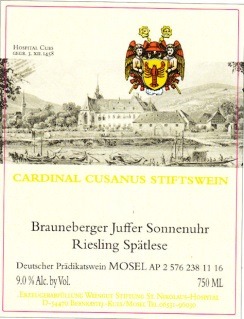
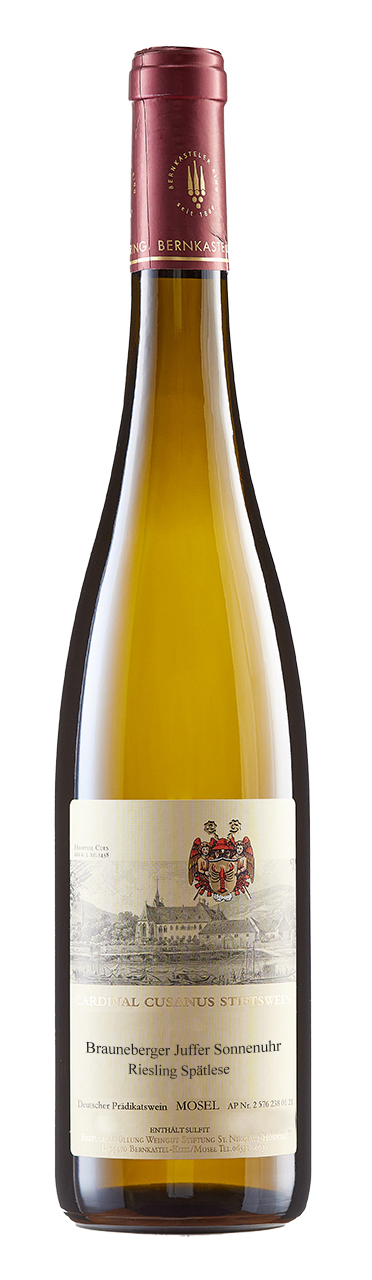
St. Nikolaus Brauneberger Juffer-Sonnenuhr Riesling Spatlese is made from 100 percent Riesling.
"Sonnenuhr" means sundial. The vineyard is facing the small town of Brauneberg formerly Dusemond. It's a steep slate slope on the Mosel, with a south-southeast exposure.
Full-bodied Riesling with typical Devonian slate qualities. Luscious fruit; nice minerality, length and acidity.

St. Nikolaus Graacher Himmelreich Riesling Kabinett is a delicious wine with good alcohol, acidity and sweetness.
RS: 55 grams/liter
Acidity: 7.8 grams/liter
ABV: 7.5%
Goes well with Asian cuisine with some spiciness.

Bastgen Berncastel-Cueser Weisenstein Riesling Spatlese Trocken is made from 100 percent Riesling.
Bright, clean, fresh and zesty. Grapefruit like flavors. Fruity aromas and a nice minerality, typical of the Riesling grape grown on blue slate soil. Round, rich and a very long finish. The grapes for this wine are vigorously selected. Botrytis is not tolerated. At harvest the grapes are fully ripened, have a golden color, and a soft tartness. After a long spontaneous fermentation in a traditional 1000L barrel, the wine just reaches the dry stage. This gives the wine a creamy structure that interplays with ripe yellow and exotic fruit aromas.
They meticulously tend 4.5 ha (11.11 acres) of which 80% is Riesling. The soil is made of slate. Their vineyards are located in Kesten and Brauneberg, on a steep terrace, and planted to 50-year old vines. Fortunately for Bastgen, they own part of the famous Brauneberger Juffer Sonnenuhr. The vines produce very small, ripe berries that are very tasty.
Review:
"This dry Mosel riesling is GG in all but name! Complex nose of white peach and red-fleshed vineyard peach with herb garden notes. Very elegant and polished this glides over your palate, the precision of flavor on the medium-bodied palate is very impressive. Then comes the wet stone and red berry finish that doesn’t want to stop. From organically grown grapes. Drink or hold."
- James Suckling (November 2023), 95 pts
Bastgen Berncastel-Cueser Weisenstein Riesling Spatlese Trocken is made from 100 percent Riesling.
Bright, clean, fresh and zesty. Grapefruit like flavors. Fruity aromas and a nice minerality, typical of the Riesling grape grown on blue slate soil. Round, rich and a very long finish. The grapes for this wine are vigorously selected. Botrytis is not tolerated. At harvest the grapes are fully ripened, have a golden color, and a soft tartness. After a long spontaneous fermentation in a traditional 1000L barrel, the wine just reaches the dry stage. This gives the wine a creamy structure that interplays with ripe yellow and exotic fruit aromas.
They meticulously tend 4.5 ha (11.11 acres) of which 80% is Riesling. The soil is made of slate. Their vineyards are located in Kesten and Brauneberg, on a steep terrace, and planted to 50-year old vines. Fortunately for Bastgen, they own part of the famous Brauneberger Juffer Sonnenuhr. The vines produce very small, ripe berries that are very tasty.
Delicate fruit with hints of peach and mineral. Complex and juicy.
Gessinger Zeltinger Sonnenuhr Riesling Spatlese St. Josef is made from 100 percent Riesling.
The Zeltinger Sonnenuhr Riesling Spätlese St. Josef - formerly know as Josefsberg- was produced from fruit harvested from 120-year-old vines in a prime Rothlay part of the vineyard known locally as Josefsberg, next to the cross of St. Josef - the patron of vineyard growers. Here grow old, ungrafted Riesling vines whose particular small and loose grapes develop a lot of aroma.
It was made from fruit picked at the end of the harvest and was fermented down to sweet levels of residual sugar. It offers a backward nose made of white peach, melon, smoke, herbs, and minerals. On the pleasant racy palate and the wine leaves a beautiful feel of ripe fruits packed into zesty minerals in the finish. The featherlight side of this Spätlese paired with its flavor intensity are simply a thing of beauty. However, during the years this wine will reveal all its facets.
Perfect match to Asian cuisine as well as spicy food.
SALE!
"Sonnenuhr" means sundial. The vineyard is facing the small town of Brauneberg formerly Dusemond. It's a steep slate slope on the Mosel, with a south-southeast exposure.
Full-bodied Riesling with typical Devonian slate qualities. Luscious fruit; nice minerality, length and acidity.
St Nikolaus-Hospital Cusanusstift is the oldest estate in the Middle Mosel region, founded in 1458 by philosopher Nikolaus von Kues, the best known ancestor of the town of Bernkastel-Kues. He became Bishop and Cardinal then founded the St Nikolaus Hospital, a social service institution that has been functioning since 1465. Over the years, this award-winning producer has received numerous medals for his wines, and is a member of the "Bernkasteler Ring". The equipment at the winery is state of the art and the winemakers are among the finest ones in Germany. The estate also operates the Vinothek, one of Europe's most beautiful tasting facilities which gathers 140 of Germany's top producers and represents a major tourist destination.
The vineyard is located along the Mosel River and measures 15 hectares (37.05 acres) total, including the following sites: Wehlener Sonnenuhr, Graacher Himmelreich, Graacher Domprobst, Bernkastler Badstube, Bernkastler Graben, Brauneberger Juffer and Braunberger Juffer-Sonnenuhr. The 40 year-old vines are planted on steep, slate soil.

Walt Bob's Ranch Pinot Noir is made from 100 percent Pinot Noir.
Bob’s Ranch Estate Vineyard
Characterized by its proximity to the Pacific Ocean; Coastal breezes along with low rolling hills and morning fog define this cool climate site
Sonoma Coast Appellation
Heavy fog and strong winds tempered by bright afternoon sunshine
Petaluma Wind Gap
Creates a unique micro-climate within the appellation, producing distinctive Pinot Noir
Sandy, Well-draining Soils
Stresses vines into producing grapes of full varietal intensity
43 Vineyard Blocks on 72 Acres
With an array of clones and field selections, this ranch produces complex and delicious wines
Review:
"The stunning 2021 WALT ‘Bob’s Ranch’ Pinot Noir is a masterclass by this winemaking team. This Sonoma Coast AVA property has a wide range of Pinot Noir selections and is in close proximity to the Pacific Ocean. Stored in roughly 30% new French oak, this shows off dense blackberry and black cherry notes on the nose with shades of cola. Very seamless on the mouth, this effortlessly glides throughout the drinking experience. The salty and savory aspects, as well as the length, all add to the enjoyment."
Owen Bargreen 95 Points

Thorn Clarke Varietal Collection Pinot Gris is made from 100 percent Pinot Gris.
We believe that exceptional wines are created in the vineyard and that we are custodians, rather than creators of quality. Six generations of rich viticultural and geological family history has gone into creating these wines, which truly showcase the best of the Barossa & Eden Valley.
Pale straw in color with quartz green hues at the edge. A classic Pinot Gris style with lifted nashi pear, apples and nougat aromas. The palate is a textural, medium weight style with juicy pome fruits and zesty lime and grapefruit. A refreshing style with a subtle texture and long, fruit driven finish.