" We don't sell the wine without touching the vine "
| Country: | Germany |
| Region: | Mosel |
| Winery: | St. Nikolaus-Hospital |
| Grape Type: | Riesling |
| Vintage: | 2021 |
| Bottle Size: | 750 ml |

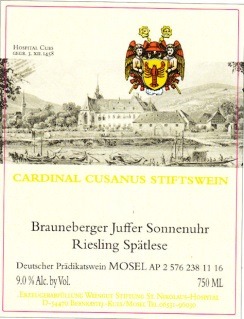
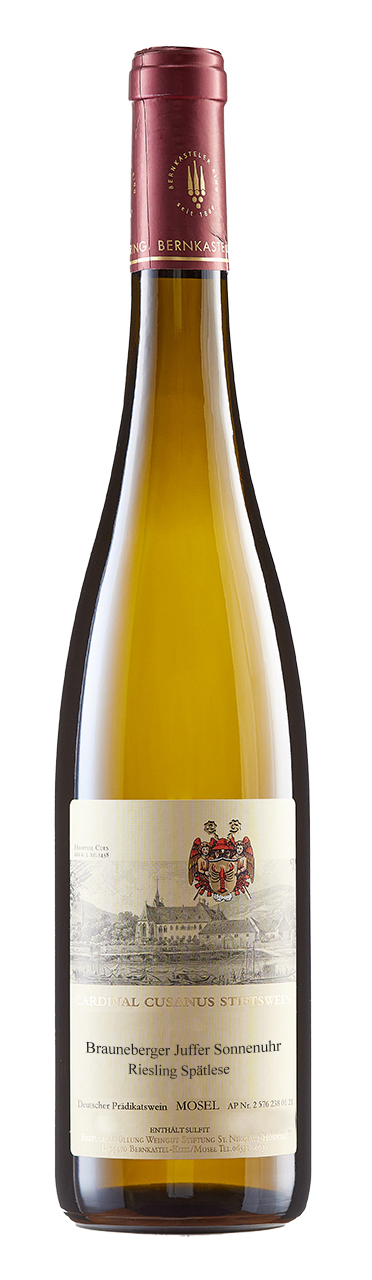
St. Nikolaus Brauneberger Juffer-Sonnenuhr Riesling Spatlese is made from 100 percent Riesling.
"Sonnenuhr" means sundial. The vineyard is facing the small town of Brauneberg formerly Dusemond. It's a steep slate slope on the Mosel, with a south-southeast exposure.
Full-bodied Riesling with typical Devonian slate qualities. Luscious fruit; nice minerality, length and acidity.

St. Nikolaus Graacher Himmelreich Riesling Kabinett is a delicious wine with good alcohol, acidity and sweetness.
RS: 55 grams/liter
Acidity: 7.8 grams/liter
ABV: 7.5%
Goes well with Asian cuisine with some spiciness.

Bastgen Berncastel-Cueser Weisenstein Riesling Spatlese Trocken is made from 100 percent Riesling.
Bright, clean, fresh and zesty. Grapefruit like flavors. Fruity aromas and a nice minerality, typical of the Riesling grape grown on blue slate soil. Round, rich and a very long finish. The grapes for this wine are vigorously selected. Botrytis is not tolerated. At harvest the grapes are fully ripened, have a golden color, and a soft tartness. After a long spontaneous fermentation in a traditional 1000L barrel, the wine just reaches the dry stage. This gives the wine a creamy structure that interplays with ripe yellow and exotic fruit aromas.
They meticulously tend 4.5 ha (11.11 acres) of which 80% is Riesling. The soil is made of slate. Their vineyards are located in Kesten and Brauneberg, on a steep terrace, and planted to 50-year old vines. Fortunately for Bastgen, they own part of the famous Brauneberger Juffer Sonnenuhr. The vines produce very small, ripe berries that are very tasty.
Review:
"This dry Mosel riesling is GG in all but name! Complex nose of white peach and red-fleshed vineyard peach with herb garden notes. Very elegant and polished this glides over your palate, the precision of flavor on the medium-bodied palate is very impressive. Then comes the wet stone and red berry finish that doesn’t want to stop. From organically grown grapes. Drink or hold."
- James Suckling (November 2023), 95 pts
Bastgen Berncastel-Cueser Weisenstein Riesling Spatlese Trocken is made from 100 percent Riesling.
Bright, clean, fresh and zesty. Grapefruit like flavors. Fruity aromas and a nice minerality, typical of the Riesling grape grown on blue slate soil. Round, rich and a very long finish. The grapes for this wine are vigorously selected. Botrytis is not tolerated. At harvest the grapes are fully ripened, have a golden color, and a soft tartness. After a long spontaneous fermentation in a traditional 1000L barrel, the wine just reaches the dry stage. This gives the wine a creamy structure that interplays with ripe yellow and exotic fruit aromas.
They meticulously tend 4.5 ha (11.11 acres) of which 80% is Riesling. The soil is made of slate. Their vineyards are located in Kesten and Brauneberg, on a steep terrace, and planted to 50-year old vines. Fortunately for Bastgen, they own part of the famous Brauneberger Juffer Sonnenuhr. The vines produce very small, ripe berries that are very tasty.
Delicate fruit with hints of peach and mineral. Complex and juicy.

Bastgen Blauschiefer Riesling is 100 percent Riesling.
Bright, clean, fresh and zesty. Grapefruit like flavors. Fruity aromas and a nice minerality, typical of the Riesling grape grown on blue slate soil. Round, rich and a very long finish.
They meticulously tend 4.5 ha (11.11 acres) of which 80% is Riesling. The soil is made of slate. Their vineyards are located in Kesten and Brauneberg, on a steep terrace, and planted to 50-year old vines. Fortunately for Bastgen, they own part of the famous Brauneberger Juffer Sonnenuhr. The vines produce very small, ripe berries that are very tasty.
St. Nikolaus Brauneberger Juffer-Sonnenuhr Riesling Spatlese is made from 100 percent Riesling.
"Sonnenuhr" means sundial. The vineyard is facing the small town of Brauneberg formerly Dusemond. It's a steep slate slope on the Mosel, with a south-southeast exposure.
Full-bodied Riesling with typical Devonian slate qualities. Luscious fruit; nice minerality, length and acidity.
St Nikolaus-Hospital Cusanusstift is the oldest estate in the Middle Mosel region, founded in 1458 by philosopher Nikolaus von Kues, the best known ancestor of the town of Bernkastel-Kues. He became Bishop and Cardinal then founded the St Nikolaus Hospital, a social service institution that has been functioning since 1465. Over the years, this award-winning producer has received numerous medals for his wines, and is a member of the "Bernkasteler Ring". The equipment at the winery is state of the art and the winemakers are among the finest ones in Germany. The estate also operates the Vinothek, one of Europe's most beautiful tasting facilities which gathers 140 of Germany's top producers and represents a major tourist destination.
The vineyard is located along the Mosel River and measures 15 hectares (37.05 acres) total, including the following sites: Wehlener Sonnenuhr, Graacher Himmelreich, Graacher Domprobst, Bernkastler Badstube, Bernkastler Graben, Brauneberger Juffer and Braunberger Juffer-Sonnenuhr. The 40 year-old vines are planted on steep, slate soil.

Gold, 92 points, LA Invitational
Gold, 91 points, Critics Challenge International Wine & Spirits Competition
Gold, Virginia Governor's Cup
Gold, Monticello Cup Wine Competition
Tasting notes:
Our 2017 Blanc de Blanc is made with 100% estate-grown Chardonnay. Aged for a minimum of 36 months on lees. Bright green apple and fresh citrus notes with layers of brioche and yeast complexity. An excellent balance of acidity, creamy mousse, and textures that persist with a long and elegant finish.
Pair with any special occasion. Make a Tuesday dinner special. Enjoy with mild cheeses, scallops, or serve as an aperitif.

Lydian GSM is made from 40% Grenache, 33% Mourvèdre, 27% Syrah.
Lydian was established in 2019 as a new way to experience Washington wine. The team behind Avennia brings you another delicious wine that serves as an introduction to a lifetime of wine appreciation and a fresh take on Washington terroir.
In music, Lydian refers to a mode, or scale that is used as a building block for some of the world’s oldest and newest masterpieces. This happy sounding mode brings joy on its own, yet when molded and crafted by talented musicians can become a work of timeless art.
We believe Washington vineyards produce some of the finest building blocks in the world. With these grapes, and the collective talent behind those growing and working with them, Lydian wines can be as complex, nuanced, and profound as any jazz classic.
Lydian: a fun, fresh take on Washington wine.
Lydian GSM is fresh and lively on the palate, with strawberry, red cherry, and hints of savory earth, fresh mint, and lavender. A delicious wine!