
" We don't sell the wine without touching the vine "
| BUY MORE! SAVE MORE! | ||||||||||||||||||||
|
| Country: | Australia |
| Region: | Barossa Valley |
| Winery: | Torbreck |
| Grape Type: | Shiraz |
| Organic: | Yes |
| Vintage: | 2021 |
| Bottle Size: | 750 ml |
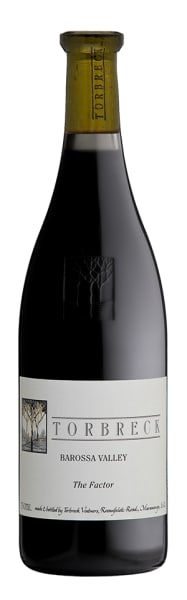
The Factor is predominantly from the Gomersal and Marananga sub-regions of the Barossa, providing dense texture and richness to the palate with subtle notes of olive tapenade, saddle leather and minerals. Ripe aromas of plum and wild blackberries, olive, pepper and spice are all supported by a dark core of espresso roast, ripe blackberries and saltbush. Brooding and densely packed, this lavish wine has ample generosity to cellar for many years, where it will slowly unravel.
Review:
Offers a dense, powerful mix of violet, bittersweet chocolate and sandalwood-infused morello cherries in syrup. Blueberry, blackberry and date-nut bread flavors are plump on a frame of polished and toothsome tannins. Clove and Saigon cinnamon notes linger, with a powerful crescendo on the finish. Shiraz.
Wine Spectator 96 Points
Robert Parker's Wine Advocate 96+ Points
Torbreck is on a quest to become one of the world’s great wine marques.
A critical part of this journey is remaining unwaveringly true to our core vision and not being diverted by trends and fashions.
SINCE 1994 TORBRECK HAS BEEN COMMITTED TO CREATING EXCEPTIONAL RHONE STYLE RED AND WHITE WINES REFLECTING THE VERY BEST VINEYARDS IN AUSTRALIA’S FAMOUS BAROSSA.
Provenance is everything to us. We believe the Barossa is the most exciting place to make wine in the world, with its gentle Mediterranean climate and 175 years of Silesian and English commitment to winemaking and grape-growing.
There is a European sense of tradition here that means vines planted in the 1840s – many of them Rhone varieties such as Shiraz, Grenache, Mourvédre – still thrive and bear fruit of unique concentration and flavour.
Torbreck pays tribute to these vineyards with minimal intervention, creating wines of richness, structure and length that age gracefully.
The multi-generational growers, whose descendants arrived here nearly two centuries ago, are the backbone of Torbreck’s winemaking aspirations. Without their knowledge of the seasons and the soil, we would not have such a precious resource of fruit to work with.
Torbreck has also been fortunate to have the opportunity to invest in the protection of some of the Barossa’s most precious vineyards, after accepting fruit from them over many years. The historic Hillside Vineyard at Lyndoch, The Laird Vineyard in the sub-region of Marananga and the Greenock Keller Vineyard owned by the Schultz family, are all now under the custodianship of Torbreck.
In 2008 this long-term commitment to the Barossa was cemented when we completed our winery and bottling line, enabling us to achieve maximum quality control through 100% estate vinification, maturation and packaging.
Our latest development was the 2017 expansion of our original settler’s cottage cellar door to become an international guest centre, where we are proud to welcome our many friends and collectors from the USA, Asia, Europe and Australia.
Torbreck has achieved a lot in less than three decades, but the journey is a long way from complete. In fact we remind ourselves every day that the best Barossa grapes are yet to be picked and the finest Torbreck wines are yet to be made.
We invite you to join us on this road to perfection.
-Pete Kight, Proprietor

Busi Chianti Rufina Riserva is made from 100% Sangiovese
Vineyards: Travignoli, a name which literally means “Tra Vignoli” (between the vineyards) is located in the middle of Frescobaldi’s Nipozzano vineyard in the heart of the Rufina zone. There is documented evidence that wine was first produced there in the 5th C BC by the Etruscans who called it “Nectar of the Gods”. The Church acquired the land and constructed the cellars in 1100.
Count Busi and his family acquired the estate in the 1800’s. Overall, 91
hectares belong to the estate. The 60 hectares of vineyards are excellently
position on the slopes with a southerly exposure at an elevation between 270 to 370 meters. Clay, marl and calcareous soil with a large percentage of rocks and stones for good drainage. Vines are an average of 10–25 years old.
Harvest: October– by hand.
Yield per hectare: 40 Quintals per hectare
Vinification: Fermentation in stainless steel at controlled temperatures for 7 to 8 days with an additional 7 to 8 days on the skins. The wine is then racked and goes through malolactic. It is then racked again and stays another 3 months in stainless steel.
Aging: 25 to 30 hectoliter barrels of Slavonian oak for 18 months and 3 months in Allier barriques. There is a period of refinement of 4 to 5 months in the bottle.
Alcohol: 13% by vol.
Color: Ruby red with garnet reflections.
Bouquet: Intense, ethereal bouquet with hints of leather, tar and ripe cherry fruit.
Taste: The flavor is full of mature fruit with nuances of leather and liquorice. The taste is complex and round and rich with character. The finish is persistent and satisfying.
Foods: Grilled, braised or roasted meats, dishes flavored with mushrooms, or rosemary. Excellent with polenta dishes.
Total Production: 3,300 cases
Enologist: Mauro Orsoni

Every now and then, in life and in wine, we are presented with unique opportunities to express ourselves and create something truly remarkable.
When rare opportunities arise, we need to capture, nurture and develop them so that their potential is fulfilled. So when Torbreck was given the opportunity to work with one of the most famous vineyards in the Barossa Valley, it became almost inevitable that the resulting wine would be truly remarkable.
In 2003, Torbreck growers and fourth generation descendants of the Seppelt family, Malcolm and Joylene Seppelt, asked our winemakers to create for them a small batch of Shiraz from their old Gnadenfrei vineyard in the sub-region of Marananga.
Planted in 1958, the five acre vineyard is traditionally dry grown and comes from an original Barossa clonal source. South facing, on the eastern side of a ridge separating the Seppeltsfield and Marananga appellations, these aged vines have been meticulously hand tended, traditionally farmed and pruned by a grower with a lifetime’s experience on Western Barossa soils of very dark, heavy clay loam over red friable clay. The resulting low yields of small, concentrated Shiraz berries make the vineyard the envy of all winemakers in the Barossa.
We looked longingly at the wine when it was returned to the Seppelts, knowing that it was the best we had ever made. In 2005 we convinced the Seppelts to sell Torbreck the fruit and The Laird was born. In 2013 Torbreck purchased the Gnadenfrei vineyard, securing The Laird’s reputation as one of the world’s great single vineyard Shiraz wines.
Torbreck is the name of a forest near Inverness, Scotland and you’ll find more than a passing nod to the Celts in our wine naming conventions. The Laird of the Estate in Scotland is the Lord of the Manor and master of all he surveys.
Review:
I poured the 2017 The Laird, set it aside and got about doing other jobs for 45 minutes or so, to give it some room to breathe. And it does breathe. It has its own pulse and beat and life, and it flexes and moves in the mouth. This is incredibly enveloping, with aromas reminiscent of campfire coals, charred eucalyptus, lamb fat, roasted beetroot, black tea and a prowling sort of countenance. In the mouth, the wine is bonded and cohesive and seamless, there are no gaps between anything, no space between fruit, oak and tannin; it all comes as one. While this is a singular wine, it is so big and concentrated that it needs no accompaniment other than some fresh air and a good mate. It's denser than osmium and is impenetrable at this stage.
-Erin Larkin (Robert Parker) 97 Points

Bright and glossy ruby red in color. On the nose it reveals aromas of small fresh berries and a trace of sour cherry, melded with hints of blackberries and black cherries, followed by a hint of vanilla. A fragrant wine with satisfying intensity. On the palate it is warm, smooth and a medium-bodied with finely-balanced tannins. Dry and sinewy yet fresh with a persistent, aromatic finish.
It naturally accompanies dishes that are typical of Tuscan cuisine with its bold, authentic flavors, such as pasta and risottos made with mushrooms or truffles, pork, grilled meats and medium-matured cheeses.
Review:
-James Suckling 91 Points

Thorn Clarke Shotfire Shiraz is made from 100% Shiraz.
Striking deep red-purple in color. A rich, voluptuous wine with aromas of blackcurrant and mulberries accompanied by notes of smokey oak and hints of cloves. The palate is filled with dark fruits and chocolate backed up by taut tannins and lingering oak.
Story:
When the Clarke forebearers discovered gold in 1870 at the Lady Alice mine in the Barossa goldfields, so began a family dynasty intrigued by geology. A fine legacy that is reflected today in the terroir of our vineyards. The Shotfire range immortalizes the Shotfirer's hazardous job of setting and lighting the charges in the mines.
Fran shares his story on how he discovered Thorn-Clarke:
"It was October 2001 and I was searching for and sourcing for Australian wines, as it was clear that Australia was going to become the "next big thing." After tasting about 100 assorted wines, I decided I liked the style of Barossa, Shiraz best - chocolate, cherries, mint and eucalyptus - so I started focusing on Barossa growers (years later, Barossa Shiraz would develop its reputation as the Icon Shiraz for Australia).
Late on a Thursday afternoon, the carrier delivered a beat-up box of 12 bottles from Australia, 10 of which were leaking. The box was from a guy named Steve Machin, who had just left Hardy's and was beginning work with the Clarke family on setting up a possible new brand. The samples were sticky and messy, but I popped the corks anyway ..... and I was glad that I did. The wine inside tasted like Christmas - mint, eucalyptus, camphor, and evergreen aromas. Great acidity, color, flavor and length of finish - very tasty. These samples were so good and so exciting, especially compared to what I had tasted prior, that I immediately called the number on the card. I didn't realize that it was a Perth number (Western Australia) and it was actually 3:00 in the morning. It turned out I was calling the residence of David and Cheryl Clarke, where a sleepy Cheryl answered the phone. I told her, you don't know who I am, but we are going to be doing business together very soon, and lots of it! After a few months of talking, faxing (yes, faxing) and sorting out the details, I began importing their wines.
That super-star wine from the busted box of samples is the wine we know today as Shotfire Shiraz. It was originally called Stone Jar, but fortunately we came up with a better name. Many years and vintages later, I'm still glad to be importing Shotfire Shiraz and other Thorn-Clarke selections .... and I'm still glad that Cheryl Clarke woke up for that phone call."
Review:
-James Suckling 92 Points
-Angus Hughson (Vinous) 91 Points

Chateau La Nerthe Chateauneuf-du-Pape Rouge is made from Grenache 39%, Mourvédre 33%, Syrah 25%, Cinsault 2%, Others 1%.
Château La Nerthe is one of the oldest estates in Châteauneuf-du-Pape and dates from 1560. Château La Nerthe has 227 acres of vineyards that surround the château and top the renowned La Crau plateau. The terroir is typical of the region. Vineyards run along a slope and grow in sandy-clay soils. The ground is covered by a layer of ‘galets’ – large, round, well-worn stones that were carried down from the Alps by glaciers during the last ice age. All the 13 permitted primary varietals are planted here. Grenache dominates 62% of the vineyards and the average vine age is over 40 years old. The grapes are hand harvested and sorted on tables. The grapes are then put into vats for almost 4 weeks with regular pump overs and punch downs. The must is tasted every day during fermentation to ensure the best extraction of the berry compounds. At the end, the wines are racked into oak vats for malolactic fermentation. The cuvée is then aged in large French oak casks and barrels for 12 months before blending. Bottling takes place 6 months later.
The dark, deep, inky color of the wine shows immediately, stemming from the concentration of the vintage. Nose of blackcurrants, black tea and dried flowers stands out. The mouth is rich, fruity and velvety with an incredibly layered tannic structure. The wine is balanced and pure with strong intense and incredibly long aging potential.
Review:
-Wine Enthusiast 93 Points
-Jeb Dunnuck 97 Points

Matthews Cabernet Sauvignon Columbia Valley is made from 76% Cabernet Sauvignon, 15%Merlot, 6% Cabernet Franc, 2% Petit Verdot, 1% Malbec.
The 2021 Columbia Valley Cabernet Sauvignon is deep ruby in the glass with purple hues. The rich bouquet of spiced black plum and cocoa nib are balanced with aromas of fresh earth and crushed flint. Intense and opulent flavors of ripe blackberry, cedar, mocha, and black currant coat the broad and balanced palate and the ripe tannin creates a perfect frame for the lush fruit expression. Cherry cordial and cola linger on the long, quenching finish.
Review:
-Decanter 94 Points
-Owen Bargreen 94 Points
-Wine Spectator 93 Points
-Vinous 93 Points
-Jeb Dunnuck 93 Points

Matthews Winery Columbia Valley Cuvee is made from 65% Merlot, 27% Cabernet Franc, 8% Malbec.
The 2021 Columbia Valley Cuvée sparkles with purple and deep garnet in the glass. Meadow flowers, fresh red berry, black plum, and cocoa powder aromas exhilarate leading to flavors of morello cherry liqueur, cardamom, mountain blackberry, and licorice snaps. This merlot-dominant blend is plush and weighty on the palate with powdery tannins. Dark stone fruits and dusty minerality coat the palate for a long, seamless finish.
Reviews:
A handsome blend, structured and polished, with expressive black cherry flavors accented by tarragon, mocha espresso and toasty spices that sail toward refined tannins. Merlot, Cabernet Franc and Malbec. Drink now through 2031.
-Wine Spectator 93 Points
This Merlot-based blend is a part of the Matthews tradition. Wildly fruity aromatics with whole berries, destemmed aromas driven by red berries, mountain blueberries, and a touch of green peppercorn and mocha dust. A streak of graphite underlines red berries, early season blackberries and a savoury herbal character that mingles complexity with fresh ripe fruits.
-Decanter 93 Points
"The 2021 Matthews ‘Red Mountain Cuvee’ Red Wine is mostly composed of Merlot and Cabernet Franc that comes from largely the Red Mountain Vineyard. The wine is absolutely singing in its full-throttle youth. Very deep and brooding with good concentration, the palate delivers tar and anise flavors with scorched earth and heady blackberry and black currant flavors. This is very true to the region and vintage."
-Owen Bargreen 95 Points

All older vintage wines have been purchased from a single collectors cellar. Pictures can be requested before shipment.

Duorum was founded in the Douro Superior by two of Portugal's most celebrated winemakers — João Portugal Ramos and José Maria Soares Franco, the long-time hand behind Barca Velha. Their Vintage Port is a field blend from old, often centenarian vines and is declared only in the finest years. Powerful and built for the long haul, it is a classic expression of the Douro's greatest sites.
Review:
The 2017 Vintage Port, the first declared vintage here since the 2011, is a field blend from centenarian vines. It is equal parts Touriga Nacional and Touriga Franca with 20% Tinta Roriz. This is round and luscious on opening. With some air, it becomes a very different wine, showing its class and its muscle. It shows far more power and pop as it airs out, becoming very persistent. It's always most notable, though, for the rich fruit and velvety texture. It should steadily improve for the next ten to 15 years and age effortlessly for some time after that.
Wine Advocate (Mark Squires) 95 Points



