
" We don't sell the wine without touching the vine "
| Country: | United States |
| Region: | California |
| Winery: | Trione |
| Grape Types: | Cabernet Franc Cabernet Sauvignon Malbec Merlot Petit Verdot |
| Vintage: | 2009 |
| Bottle Size: | 750 ml |

Trione Henrys Blend Alexander Valley 2022 is made from a blend of Cabernet Sauvignon, Merlot, Petit Verdot, Cabernet Franc and Malbec.
A Bordeaux-style claret grown entirely on the family's estate Geyserville Ranch in Alexander Valley, fermented in open-top tanks with extended maceration and aged eighteen months in French oak. Deep and savory, it layers dark fruit, coffee and olive with a rich, structured palate built to age.
Winery Info: Trione Vineyards & Winery is a three-generation Sonoma County farming family whose winery was established in 2005. Their Geyserville Ranch was certified sustainable in 2017, and Henry's Blend is named in honor of the family's patriarch.
A tribute to the family patriarch, Henry Trione, this deep red wine is an artful blend of the five classic Bordeaux varieties: 35% Cabernet Sauvignon, 34% Merlot, 13% Petit Verdot, 13% Cabernet Franc and 5% Malbec. Cabernet Sauvignon forms the base structure and Merlot contributes fruit flavors and velvety texture; the Malbec, Cabernet Franc and Petit Verdot add depth, color and spice. We harvested the fully ripe grapes from select blocks on three Trione ranches in Alexander Valley, just ahead of early rains.
Winemaker Notes:
Aromas of black currants, blackberry pie and warm spices are the wine’s first impressions. On the palate Henry’s Blend is soft and supple, a seamless integration of ripe fruit, French oak and fine-grained tannins. Delicious now, the solid structure and abundant fruit suggest this wine will age well for 6–7 years with proper cellaring.
Review:
-The Tasting Panel - The Somm Journal 94 Points

Dominus Napa Valley Red Blend is made from 88% Cabernet Sauvignon, 7% Cabernet Franc, 5% Petit Verdot.
The historic Napanook Vineyard, a 124-acre site west of Yountville, was planted in 1838. This vineyard was the source of fruit for some of the finest Napa Valley wines. Estate-bottled in the spirit of the Bordeaux châteaux, Dominus Estate is dry-farmed to allow natural stress and good concentration of fruit. Grape clusters are crop-thinned to allow sun and air to pass in between, helping to achieve full maturation and soften the tannins. Only 20% to 40% new French oak barrels are used in order to limit the extraction of oak notes. To express the unique terroir, the classic Bordeaux grape varietals of Cabernet Sauvignon, Merlot, Cabernet Franc and Petit Verdot are planted with different root stocks best suited for the varying soil composition of gravel, heavy clay and loam.
Reviews:
One of the legendary Dominus, the 2021 Cabernet Sauvignon is unquestionably in the same league as the 2018, 2016, 2015, 2013, 2010, and 1991, and to my mind, wine simply doesn't get any better. Sporting a dense purple hue as well as an incredible perfume of blackcurrants, crushed stone, cedar pencil, smoke tobacco, and baking spices, it s rich, full-bodied, and voluptuously textured, with ripe yet building tannins. It reminds me slightly of the 2010 (maybe the 2013), and I suspect it will have a similar evolution. Hide bottles for 7-8 years, and it will evolve gracefully for 30+ years. Hats off to the team of Christian Moueix and director Tod Mostero.
Jeb Dunnuck 100 Points
Dominus Napa Valley Christian Moueix Red Blend is made from 87% Cabernet Sauvignon, 9% Cabernet Franc, 4% Petit Verdot.
Dominus Estate is the Napa Valley property of Bordeaux producer Christian Moueix. The wine is bottled from the historic Napanook Vineyard. Located at the foothills of the Mayacamas, the vineyard was planted in 1838 and continues to evolve under the stewardship of Christian Moueix. The estate's Bordeaux varietals benefit from the Yountville microclimate where temperatures are moderated by cool breezes from the San Pablo Bay. The resulting wine is a uniquely refined expression of this special terroir. The 2023 vintage is seductive and deep with notes of cedar, oriental spices, wild berry, and cocoa, followed by a finely etched finish.
Reviews:
Black currant, pencil shaving, subtle sandalwood, wet earth, forest floor and violet aromas follow through to a medium- to full-bodied palate with ultra-fine tannins that integrate perfectly at the end. A polished and caressing texture that goes on for minutes. The balance and drinkability of this Dominus is terrific, and it will age beautifully. A blend of 87% cabernet sauvignon, 9% cabernet franc and 4% petit verdot. From organically grown grapes. Very drinkable now, but will age beautifully.
James Suckling 99 Points
"The aromatics are a little more contained than the Napanook, knitted down with savoury incense and charred sandalwood, and a texture that even visually is rich and supple. Through the palate, things move slowly and deliberately, tobacco, musk, ocean spray, iris, with layers of sweet red liquorice, olive tapenade, latte, crushed rocks, broth, cranberry, just a beautifully crafted wine that is so enticing you could drink it now, but that promises to reward long ageing. 40% new oak, Tod Mostero winemaker, Christian Moueix owner. A late harvest from October 7-18. Drink 2026-2045."
-Jane Anson 100 Points

Mascot is a small-production label founded by Will Harlan in Napa Valley. The wines under this label are made from the younger vines of Harlan Estate, BOND, and Promontory, but The Mascot bottles share an exclusive preview at the development of their estates. Founded as an initial experiment to see what the young vines were capable of producing, the wines were initially only shared with close friends and family. By 2008, Will officially released the first vintage to the public since production had increased significantly. They create just one wine made from Cabernet Sauvignon, and the bottle is aged for five years before release. Assembled into a single, youthful expression, this wine shares a glimpse into the evolution and pedigree of its parent estates.
Tasting Notes:
Following a vintage full of changing conditions and demanding decision points, the steady and pleasant progress of the 2018 vintage left our team, at times, in limbo. Contradictory as it may seem, the dramas that sometimes punctuate the definitive months for the growing season help to frame the winegrowing team’s course of action; yet the tranquil succession of weeks that emerged between spring and fall in 2018 left almost entirely open the question of when to harvest. Healthy rainfall in March and April preceded a benevolent summer, whose mildness was interrupted only briefly by a few warming periods. The fruit of the young vines maintained a measured balance that gave the team little indication that harvest was imminent. Fog and temperate days followed in September, when—relying more on instinct than empirical cues—we began to pick. This judgment—as well as the gentle nature of the season—is confirmed in the subtle, ethereal power of the vintage, which reveals itself first in the deep, brooding aromas of dark fruit, black tea, and herbal notes. The texture expands around a lifted structure, as powdery tannins gently resolve. This diffused, enigmatic softness is anchored on the mid-palate by a gratifying density, which prepares the senses for a flourish of hidden energy and vivid detail that illuminates the finish.
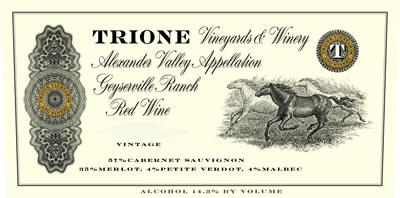
Trione Geyserville Red Blend Alexander Valley 2009 is made with 53% Cabernet Sauvignon, 22% Merlot, 11% Petit Verdot, 10% Cabernet Franc and 4% Malbec.
Winemaking:
We fermented each variety separately in small, open top vessels. To extract maximum color and flavor, we used a gentle irrigation device that circulated free-run juice over the cap during the peak of fermentation. The wine aged in French oak barrels (50% new) for eighteen months from coopers Taransaud, Vicard and TW Boswell.
Technical Analysis:
Alc: 14.9%
TA g/L ---
pH ---
ML g/L ---
VA g/L ---
RS g/L ---
Winemaker Notes:
Aromas of black currants, plums, and sage foretell the rich flavors of this wine. On the palate the wine is deep and layered, the fruit flavors supported by integrated oak and fine tannins. The solid structure and abundant fruit suggest this wine will age well for many years.
The Trione Winery Estate
For 35 harvests, for 35 Septembers, our family has carefully farmed and managed some of the finest grapes in Sonoma County. With painstaking devotion to the land, three generations – Henry Trione, sons Mark and Vic, and Mark’s daughter Denise – have developed a reputation for producing premium grapes. Our wines are characteristic of the appellations in which they are grown: the cool, slow-ripening flavors of the Russian River Valley and the rich, dark-berry essence of the Alexander Valley.
Over these many harvest seasons, we have owned and managed more than 700 acres of the best grapes and soils in these highly respected Sonoma County appellations. We have learned to balance and blend the gifts of nature with state-of-the-art winemaking. Our grapes have been the foundation of many award-winning wines. Now we bring our grapes to you in wines bottled under our own label, Trione Vineyards & Winery.
We are passionate about family and tradition, especially traditions that include good food and good wine. Our vineyards, our wines – and our winery – have been a labor of love, the culmination of our family’s long tradition of dedication to Sonoma County. Please share a bottle of wine from the Trione Vineyards and Winery with your family and friends, and taste our commitment to excellence. Salute!
The Trione Winery Vineyard
River Road Ranch is our jewel in the Russian River Valley Appellation. It is 115 acres total in the rolling hills of the valley at a location where the river makes a westerly turn towards the Pacific Ocean. The soils are alluvial deposits of the Russian River described as sandy clay loam over sandy loam subsoil’s. They are well-drained soils that are perfect for growing world class Chardonnay, Sauvignon Blanc, Pinot Noir and Syrah.
Our Cloverdale Ranch is situated along the western flank of the Mayacamas Mountains that run to the eastern bank of the Russian River. It is located in the upper end of the Alexander Valley Appellation, and is 180 acres in size. Our grapes for Trione Cabernet Sauvignon come from one block planted in 2001 that we call Block 21. It is a single selection of the Bordeaux clone 339. The soils at this site are described as clay loam over sand clay loam subsoil’s, with a high percentage of rounded gravel from alluvial sediments. The combination of soil and exposure are perfect for growing concentrated Cabernet Sauvignon with intense flavor and color.

2013 Henriot Cuvee Hemera Brut is made from 50% Chardonnay, 50% Pinot Noir.
The year 2013 offered a substance rich in freshness, tension and acidity. These elements have given Cuvée Hemera 2013 a profile of precision, detail and lace. On the nose, fresh and candied citrus fruits, lemony notes, a frank minerality, and an almost heady smokiness come through. On opening, subtle notes of toast and dried fruit accompany the nose. On the palate, it is a continuity, with a salivating tension, a frank and straightforward structure, accompanied by a finish sprinkled with tannins that give it a fine length.
Review:
A wonderfully expressive nose of sourdough, acacia, citrus peel, apricots and honeycomb. Some pineapple and grapefruit. It’s explosive on the palate, with mouthwatering acidity and so much tension. Tight bubbles. Drives forward with energy. Chardonnay and pinot noir from the six founding crus of the house: Avize, Chouilly, Le Mesnil-sur-Oger, Mailly-Champagne, Verzenay and Verzy. 3.5g/L dosage. Disgorged June 2023. Drink or hold.
James Suckling 96 Points

Setriolo Chianti Classico 2024 is made predominantly from Sangiovese, with a touch of Merlot. Setriolo is a tiny family estate at Castellina in Chianti, where the Soderi family have grown grapes since the early nineteenth century; after decades of selling their fruit, they bottled their first estate wine in 2005 and today farm just over three and a half hectares organically.
Hand-harvested and fermented in stainless steel with a two-week maceration, a portion aged a year in French oak, this is a classic, honest Chianti Classico: ruby red with aromas of fresh cherry and raspberry lifted by a note of licorice, with good tannic structure, softness and a savory Tuscan finish.



