
" We don't sell the wine without touching the vine "
| Country: | Germany |
| Region: | Mosel |
| Winery: | Weingut Matheus |
| Grape Type: | Riesling |
| Vintage: | 2016 |
| Bottle Size: | 750 ml |
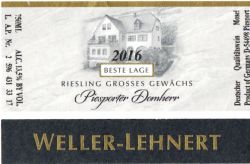
Weller-Lehnert Piesporter Domherr Grosses Gewachs Riesling is made from 100 percent Riesling.
Made in accordance with the stringent production criteria of the classification of the Bernkasteler Ring, wines with the designation “Grosses Gewächs Bernkasteler Ring” represent the premium line of the association’s dry wines. These Grand Crus can only come from the best sites of the steep slopes and are distinguished by their exceptional aging potential. To be awarded the status of “Grosses Gewächs”, selective hand-harvesting, a restriction of yields to 50 hl/ha and the passing of a stringent sensory examination by a highly qualified professional panel are required.
Piesporter Domherr is the ancient and original Piesporter Goldtröpfchen. It lies in the heart of Piesporter Goldtröpfchen right by the Mosel River. It consists of 4 hectares that are south-southeast facing.
The locatio on the river creates a mirror effect, offering optimum conditions for the production of outstanding mineral wine with fine, fruity elegance. Because of its prolonged vegetation period, Riesling (frequently referred to as the “queen of white varieties”) is often capable of expressing the characteristics of its terroir like no other.
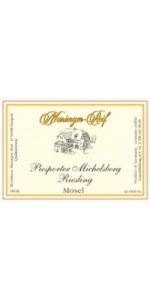
Maringer-Reif Piesporter Michelsberg (liter) is 100 percent Riesling.
This Mosel-Riesling is fruity and semi-sweet. It is easy to drink on the evening of a hot summer day. It's got a hint of lemon flavor and a very good minerality.
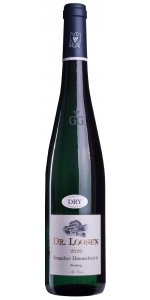
A heavenly, full-bodied dry Riesling with forceful minerality from 100-year-old vines grown in the blue slate soil of Graach.
Graach is a small village in the Mosel valley. It’s steep slate slopes produce wines that combine elegance with rustic strength. Grosses Gewächs (GG) is the designation for an estate’s best dry wine from a Grosse Lage (grand cru) vineyard. This limited-production wine was fermented with indigenous yeasts and kept in the barrel, on the full lees, for a year before bottling. The extended maturation time allows the wine to develop greater texture and a deeper natural harmony. This is a fully ripe wine, with vibrant aromatics and a pronounced acidity that gives it a brilliant structural precision.
Review:
Convincing proof that 2020 is an excellent vintage for dry GG on the Mosel! Cool and stony with delicate white-peach and white-currant aromas. Really takes off at the intensely slatey and racy finish.
-James Suckling 95-96 Points
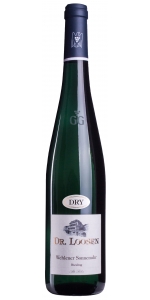
Dr. Loosen Wehlener Sonnenuhr Alte Reben Riesling Grosses Gewachs is made from 100 percent Riesling.
This is one of the greatest vineyards in the Middle Mosel. This precipitously steep, rocky vineyard consistently yields some of the most elegant and sophisticated white wines in the world. Citrus and white peach flavors predominate when the wines are young, turning to a pure expression of the mineral soil as they age.
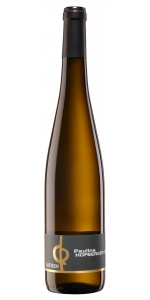
Scents and flavors of peach and yellow plum, citrus and mineral notes. Extremely long, white peach finish.
This wine is a 100 case Cuvee produced from the steepest part of the Paulinschofberger vineyard, 65 % slope. Vine age is 105 years old. "Grosses Gewachs" Großes Gewächs: (great growth = Grand cru), a designation used by VDP members in all regions except Mosel and Rheingau to designate top-level dry wines from selected sites (the highest level of quality). Dry means dry on the palate. The maximum yield is 50 hl/ha, from a classified vineyard. The natural minimum density of must is around 90° Oechsle. The wines are produced using exclusively traditional production methods. The wines are tested and approved by a test body before and after bottling. Hand Harvest (no machine harvest). The wine must not be released before September the year after it was made.
Review:
"In spite of the abundant yellow fruit aromas (think Mirabelle plums more than peaches), this is a very cool and sleek style of Mosel GG with great herbal freshness. Although this has excellent concentration, it definitely needs time to give its best due to the bone-dry style. Quite a steely, tightly wound finish, but very long. Drinkable now, but best from 2026. - Stuart PIGOTT (Senior Editor)" - James Suckling (August 30th 2024), 95 pts
Scents and flavors of peach and yellow plum, citrus and mineral notes. Extremely long, white peach finish.
This wine is a 100 case Cuvee produced from the steepest part of the Paulinschofberger vineyard, 65 % slope. Vine age is 105 years old. "Grosses Gewachs" Großes Gewächs: (great growth = Grand cru), a designation used by VDP members in all regions except Mosel and Rheingau to designate top-level dry wines from selected sites (the highest level of quality). Dry means dry on the palate. The maximum yield is 50 hl/ha, from a classified vineyard. The natural minimum density of must is around 90° Oechsle. The wines are produced using exclusively traditional production methods. The wines are tested and approved by a test body before and after bottling. Hand Harvest (no machine harvest). The wine must not be released before September the year after it was made.
Review:
"Very smoky nose of sealing wax and candied citrus. This medium-bodied dry riesling is strikingly original and has good balance on the impressively structured palate, but it does lack a bit of charm. Long, firm finish. May well show better after further bottle age. From organically grown grapes. Drink or hold. - Stuart PIGOTT (Senior Editor)" - James Suckling (November 9th 2023), 91 pts
Made in accordance with the stringent production criteria of the classification of the Bernkasteler Ring, wines with the designation “Grosses Gewächs Bernkasteler Ring” represent the premium line of the association’s dry wines. These Grand Crus can only come from the best sites of the steep slopes and are distinguished by their exceptional aging potential. To be awarded the status of “Grosses Gewächs”, selective hand-harvesting, a restriction of yields to 50 hl/ha and the passing of a stringent sensory examination by a highly qualified professional panel are required.
The Weingut Matheus Estate
Weingut Matheus is located in Piesport on the Mosel and has a 400 year tradition of winemaking (8 generations). Since 1992, the estate has been managed by Petra Hain-Matheus and Jorg Matheus, a graduate of the school in Geisenheim. Total estate production is 35,000 bottles or 2,916 cases annually, but they could produce more (50,000 bottles).
The Weingut Matheus Vineyard
Currently, they make wine from 13.6 acres of vineyards located in such sites as:
- Piesporter Goldtröpfchen (4.5 acres)
- Piesporter Treppchen
- Dhroner Hofberger
- Wintricher Ohligsberg
The Tempest was one of the first wines, and the first Proprietary Blend, we produced. At the time, it seemed almost uncanny that we were able to access three grape varietals at the same time from the same vineyard; it was blind luck or perhaps the proverbial “perfect storm.” The resulting wine reflected a fierce determination to brave the storm as well as a new desire to realize the possibilities of Merlot. The Tempest is still made with outstanding grapes, from vineyards such as Blair in Calistoga and cooler sites like Farella and Orchard. Predominantly Merlot with lesser amounts of Cabernet Sauvignon depending on vintage, The Tempest is a roiling cauldron of fresh red and blue fruit and silky tannins – a wine that shows what Merlot can be in the right hands, from the right vineyards.
Red fruit; silky tannins; more approachable in its youth
Review:
The 2022 The Tempest is a blend of 67% Merlot, 10% Cabernet Franc, and 23% Cabernet Sauvignon. Deep garnet-purple colored, it comes skipping out of the glass with bright, cheery notes of black raspberries, mulberries, and kirsch, leading to hints of lavender, wild sage, and aniseed. The medium to full-bodied palate delivers bright, crunchy fruit with firm, fine-grained tannins and great tension, finishing on a lingering peppery note. This was bottled in March 2024.
Henriot Brut Souverain is made from 50% Pinot Noir, 40% Chardonnay, 10% Pinot Meunier.
The Brut Souverain is the most historical cuvée in the region, as it was the first cuvée Apolline Henriot produced in 1808. Apolline aspired to put the light on her vineyards through the expression of a champagne. According to her, one year was not enough to tell the story of the terroirs, so she decided to put wines in reserve each year to incorporate them into a future blend. Therefore, she founded the House by creating a Champagne that would have blending as its fundamental principle. The House respects this philosophy today and uses every terroir in this multi-cru, multi-vintage cuvée. It was named Brut Souverain by Ernest Henriot, Apolline's grandson, when the House was appointed the official champagne supplier to the Courts of the King of Holland and of the Emperor of Austria-Hungary.
Review:
A superprecise, reductive style due to bright lime-peel aromas enhanced by chalky minerality with linden tree and yellow plums. Light-bodied, it has zesty acidity with pinprick bubbles, a tight-knit structure and a chewy yet very polished finish.
-James Suckling 95 Points



