" We don't sell the wine without touching the vine "
| Country: | Germany |
| Region: | Mosel |
| Winery: | Weingut Matheus |
| Grape Type: | Riesling |
| Vintage: | 2019 |
| Bottle Size: | 750 ml |
Weller-Lehnert Piesporter Domherr Grosses Gewachs Riesling is made from 100 percent Riesling.
Made in accordance with the stringent production criteria of the classification of the Bernkasteler Ring, wines with the designation “Grosses Gewächs Bernkasteler Ring” represent the premium line of the association’s dry wines. These Grand Crus can only come from the best sites of the steep slopes and are distinguished by their exceptional aging potential. To be awarded the status of “Grosses Gewächs”, selective hand-harvesting, a restriction of yields to 50 hl/ha and the passing of a stringent sensory examination by a highly qualified professional panel are required.
Piesporter Domherr is the ancient and original Piesporter Goldtröpfchen. It lies in the heart of Piesporter Goldtröpfchen right by the Mosel River. It consists of 4 hectares that are south-southeast facing.
The locatio on the river creates a mirror effect, offering optimum conditions for the production of outstanding mineral wine with fine, fruity elegance. Because of its prolonged vegetation period, Riesling (frequently referred to as the “queen of white varieties”) is often capable of expressing the characteristics of its terroir like no other.
Maringer-Reif Piesporter Michelsberg (liter) is 100 percent Riesling.
This Mosel-Riesling is fruity and semi-sweet. It is easy to drink on the evening of a hot summer day. It's got a hint of lemon flavor and a very good minerality.
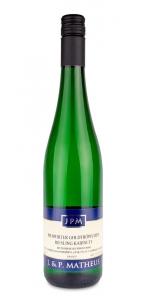
Matheus Piesporter Goldtropfchen Riesling Kabinett is made from 100 percent Riesling.
This Goldtröpfchen ranks as an unofficial "Grand Cru" delivering light floral and fresh Kabinett style wines.
Their later harvest wines, Spatlese and Auslese, tend toward apricot flavors, honeyed notes and superb intensity. All grapes are grown on Devonian slate.
Enjoy with slightly spiced sushi or moderately spicy Indian cuisine such as chicken Vindaloo.
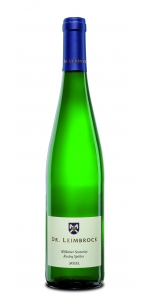
Dr. Leimbrock Mulheimer Sonnenlay Riesling Spatlese is made from 100 percent Riesling.
A classic in the residual sweet range that impresses with filigree fruit and mineral spiciness.
The circulating mountain "Mülheimer Sonnenlay" represents a geographical feature of the Moselle. Due to the strong meandering of the Moselle, the mountain was surrounded by the course of the river in geological development in such a way that a so-called circulating mountain arose from it. Located in the northeast-southwest direction, vines are cultivated on both sides of the mountain. The site name "Sonne" and "Lay" (Mosel Franconian for slate) combines the most important prerequisites for the cultivation of Riesling vines. Soils are skeletal-rich, weathered clay-ish shale enriched with sand, stones, and clay. At the beginning of the 1930s, the Mülheim winegrowers proudly pointed out that the local wine was served in the elegant restaurant of the airship "Graf Zeppelin" on its world trips and was obviously very popular.
Pair with spicy dishes, soft cheese, cakes.
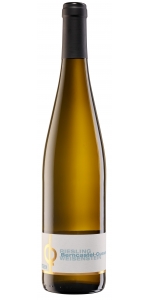
Bastgen Berncastel-Cueser Weisenstein Riesling Spatlese Trocken is made from 100 percent Riesling.
Bright, clean, fresh and zesty. Grapefruit like flavors. Fruity aromas and a nice minerality, typical of the Riesling grape grown on blue slate soil. Round, rich and a very long finish. The grapes for this wine are vigorously selected. Botrytis is not tolerated. At harvest the grapes are fully ripened, have a golden color, and a soft tartness. After a long spontaneous fermentation in a traditional 1000L barrel, the wine just reaches the dry stage. This gives the wine a creamy structure that interplays with ripe yellow and exotic fruit aromas.
They meticulously tend 4.5 ha (11.11 acres) of which 80% is Riesling. The soil is made of slate. Their vineyards are located in Kesten and Brauneberg, on a steep terrace, and planted to 50-year old vines. Fortunately for Bastgen, they own part of the famous Brauneberger Juffer Sonnenuhr. The vines produce very small, ripe berries that are very tasty.
Bastgen Berncastel-Cueser Weisenstein Riesling Spatlese Trocken is made from 100 percent Riesling.
Bright, clean, fresh and zesty. Grapefruit like flavors. Fruity aromas and a nice minerality, typical of the Riesling grape grown on blue slate soil. Round, rich and a very long finish. The grapes for this wine are vigorously selected. Botrytis is not tolerated. At harvest the grapes are fully ripened, have a golden color, and a soft tartness. After a long spontaneous fermentation in a traditional 1000L barrel, the wine just reaches the dry stage. This gives the wine a creamy structure that interplays with ripe yellow and exotic fruit aromas.
They meticulously tend 4.5 ha (11.11 acres) of which 80% is Riesling. The soil is made of slate. Their vineyards are located in Kesten and Brauneberg, on a steep terrace, and planted to 50-year old vines. Fortunately for Bastgen, they own part of the famous Brauneberger Juffer Sonnenuhr. The vines produce very small, ripe berries that are very tasty.
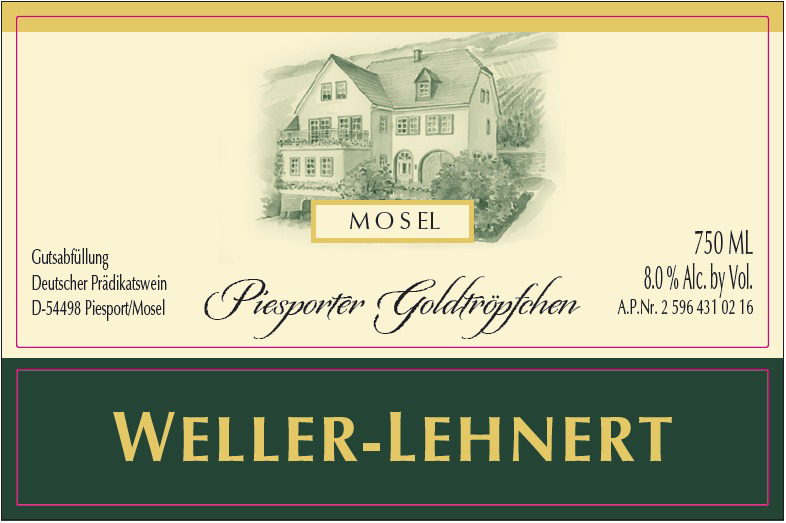
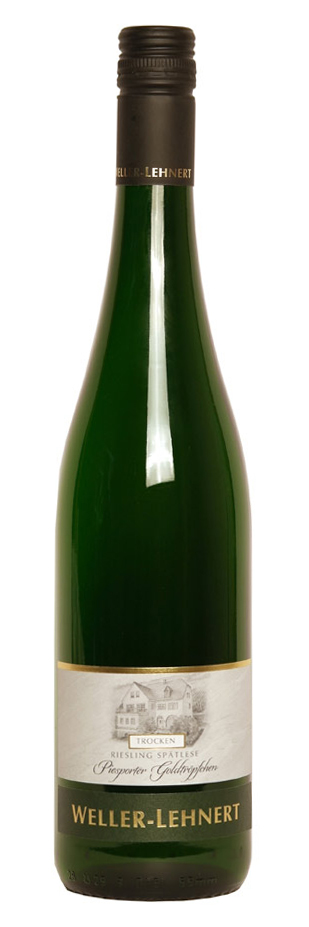
Weller-Lehnert Piesporter Goldtropfchen Riesling Spatlese is made from 100 percent Riesling.
Weller-Lehnert Piesporter Goldtropfchen Riesling Spatlese is made from Estate grown grapes planted on south-facing steep slopes. It is fresh and mineral with inviting yellow fruit aromas. Elegant, full-bodied and intensely concentrated with bright fruit flavors and fine acidity lingering on the finish.
Review:
- Wine Enthusiast (April 2021), 93 pts
The Weingut Matheus Estate
Weingut Matheus is located in Piesport on the Mosel and has a 400 year tradition of winemaking (8 generations). Since 1992, the estate has been managed by Petra Hain-Matheus and Jorg Matheus, a graduate of the school in Geisenheim. Total estate production is 35,000 bottles or 2,916 cases annually, but they could produce more (50,000 bottles).
The Weingut Matheus Vineyard
Currently, they make wine from 13.6 acres of vineyards located in such sites as:
- Piesporter Goldtröpfchen (4.5 acres)
- Piesporter Treppchen
- Dhroner Hofberger
- Wintricher Ohligsberg
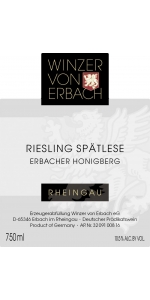
Honeyed style, rich minerality and luscious creaminess. Flavors of baked pineapple and pear. Fresh and juicy on the finish.
From the famous Erbacher Honigberg vineyard. Average of the vines is 20 years old.
Cool fermentation, matured on the lees for 2 months before bottling, with a slight filtration.
Riesling Rheingau Erbacher Honigberg Spatlese goes well with Indian Curry and blue Cheese
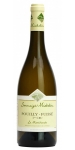
Saumaize Michelin Pouilly Fusse Premier Cru La Marechaude is made from 100 percent Chardonnay.
A beautiful Pouilly-Fuisse from "La Marechaude" parcel that Saumaize-Michelin acquired in 2013. Planted on clay and limestone slopes and hand harvested, this Chardonnay offers fresh and elegant notes of white flowers, crisp, citrus and exotic fruits. Powerful and mineral on the palate with a fantastic balance, finesse and freshness. The exceptional terroir brings minerality and juicy flavors of stone fruits, peach and melon supported by subtle toasty notes.
It is now a Premier Cru.
Jasper Morris - Inside Burgundy 94 Points

Dog Bone is a serious wine with a fun label!
We wanted to make a great wine at a fair price and help dogs across the country. 10% of all profits will go to Humane Societies in places we sell Dog Bone. Sales of this wine are also helping North Coast Grape farmers by finding a home for their excess grapes.
The 2024 growing season delivered ripe, clean fruit with great flavors. The nose has notes of Cherry blossom and Rose hips. On the palate the wine shows ripe Black Cherry and Cola notes and has beautiful balance.
pH: 3.75g/L
TA: 5
ABV: 13.5%