" We don't sell the wine without touching the vine "
| BUY MORE! SAVE MORE! | ||||||||||||||||||||
|
| Country: | France |
| Region: | Rhone |
| Winery: | Alain Jaume |
| Grape Type: | Grenache |
| Vintage: | 2023 |
| Bottle Size: | 750 ml |
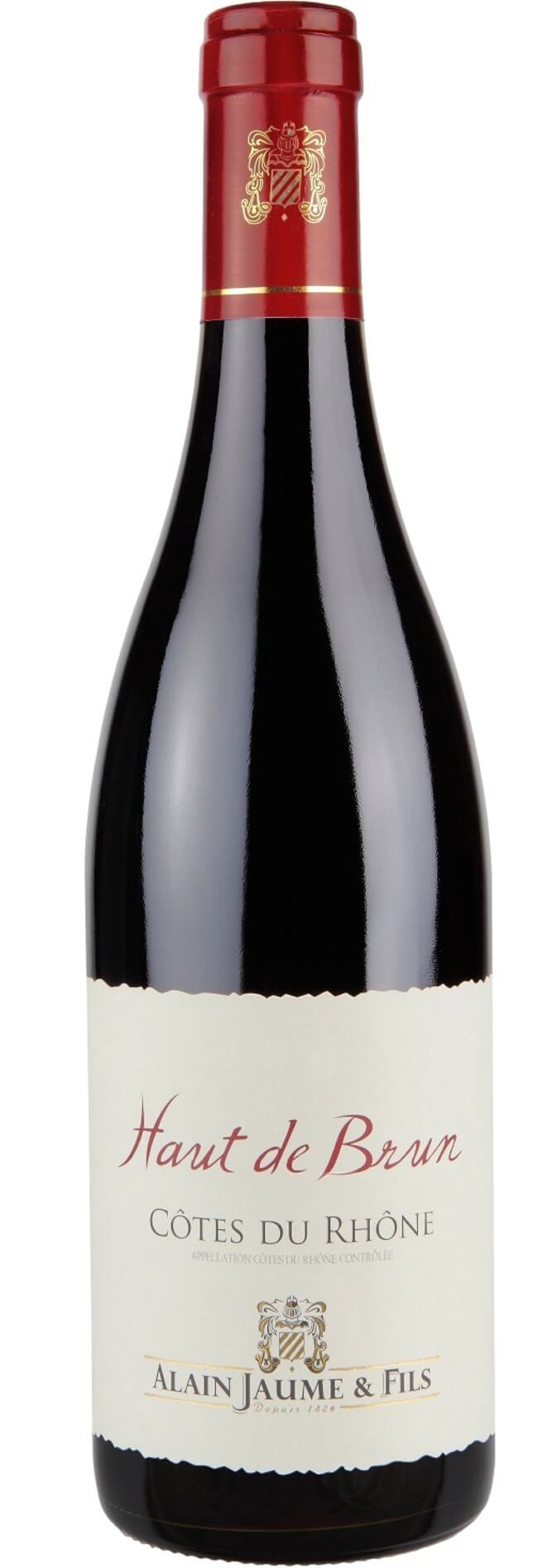
Alain Jaume Cotes Du Rhone Rouge Haut de Brun is made from 60% Grenache, 30% Syrah, 10% Cinsault
The colour is purple-tinged garnet.The aromatic range of the nose goes from fresh berries (wild raspberry, blackcurrant, blackberry) to spices.The palate is big and full-flavoured, with silky-smooth tannins and aromas of the fruit already mentioned. The finish introduces touches of liquorice and pepper. A Côtes du Rhône with great complexity for an every day drinking.
A classic Rhône to drink between 1 and 4 years. Best poured at 17°C.
Traditional wine making and ageing is performed in vats only. Bottling after 10-12 months.
Ideal throughout the meal, but particularly with poultry and other white meats, as well as mild cheeses.
The Alain Jaume Winery
Established in 1826 in the Northern part of Chateauneuf du Pape, the Alain Jaume Winery boasts both the exceptional terroir of the Southern Rhone Valley and a long line of dedicated winemakers. Alain Jaume works in accordance with certified organic agricultural practices for both the Grand Veneur and Clos de Sixte vineyards. They strive to let the true terrior be expressed in their wines.
The principal winemaker is Alain Jaume. His sons Sebastien and Christophe are both heavily involved with the winery in sales and marketing and winemaking respectively. The Alain Jaume winery consists of 40 acres in Chateauneuf du Pape, 50 acres in Lirac, and 75 acres of Cotes du Rhone vines. The family produces wines under two labels: Domaine Grand Veneur and Alain Jaume.
In 1320 Pope Jean XXII planted the first vines of Chateauneuf-du-Pape, but it was only in 1360 that the wines of the region first gained fame. Oddly, the wine that gave Chateauneuf-du-Pape its original reputation was the White and not the Red. The white wine was a favorite of Pope Innocent VI. The Domaine dates back to 1826, having been founded at that time by Mathieu Jaume. Since 1979, Alain Jaume has run the Domaine and now has the help of his two sons: Sebastien and Christophe.
"Popes throughout history have liked their juice, and when the papal see moved to Avignon in the 13th century, that juice was Chateauneuf-du-Pape ("the pope's new castle") made from grapes grown nearby in the Southern Rhône. The castle is a ruin now, the papal court long gone back to Rome, but the wines that bear the pope's coat of arms emblazoned on the bottle are still produced more or less according to the long-standing recipe. Not every winemaker uses all 13 of the grapes in the proscribed blend, though. At Domaine Grand Veneur, an estate that dates to 1826, Alain Jaume and his sons Sebastien and Christophe emphasize Grenache blended with Syrah and Mourvèdre."
- Los Angeles Times
"Improved Chateauneuf with very accomplished, stylish reds since the late 1990s; also very good Vacqueyras and Cotes-du-Rhône Villages." - Anthony Dias Blue's pocket guide to wine 2006
"Grand Veneur is one of the most brilliant estates in Chateauneuf du Pape as well as the force behind the negociant wines sold under the Alain Jaume label. Virtually everything they produce has merit. Some of this estate’s 2009 red wines are just hitting the market as they are bottled early to preserve their fruit and freshness. I can’t say enough about the job Alain Jaume’s two sons, Sebastian and Christophe, have done with this estate. The impeccable attention to detail in the vineyards, the meticulous vinification, and the careful bottling benefit every consumer." - Wine Advocate (#190, August 2010)
"Great bargains continue to emerge from Domaine Grand Veneur as well as from their negociant arm of the business, labeled Alain Jaume" - Wine Advocate (#195, June 2011)
"One of the best-run and highest quality estates of the Southern Rhone is Domaine Grand Veneur, now run by the younger generation of the Jaume family, Sebastien and Christophe. The brothers have done a fabulous job taking over for their quality-oriented father, Alain. These are their less expensive wines, but I will follow up later this year with my reviews of their 2010 Chateauneuf du Papes as well as the 2011s, which I have not yet tasted. They have certainly gotten a good start on their 2011 less expensive Cotes du Rhone selections. The Jaumes are some of the finest practitioners of white winemaking in the Southern Rhone and showcase that with their least expensive offerings, which are creative blends that over-deliver." - Wine Advocate (Issue #201, June 2012)
Some wines by Alain Jaume Winery:
Any Alain Jaume wines we have in stock are listed below, if you don’t see the wine you are looking for please don’t hesitate to ask for it.

Alain Jaume Cotes Du Rhone Rouge Haut de Brun is made from 60% Grenache, 30% Syrah, 10% Cinsault
The colour is purple-tinged garnet.The aromatic range of the nose goes from fresh berries (wild raspberry, blackcurrant, blackberry) to spices.The palate is big and full-flavoured, with silky-smooth tannins and aromas of the fruit already mentioned. The finish introduces touches of liquorice and pepper. A Côtes du Rhône with great complexity for an every day drinking.
A classic Rhône to drink between 1 and 4 years. Best poured at 17°C.
Traditional wine making and ageing is performed in vats only. Bottling after 10-12 months.
Ideal throughout the meal, but particularly with poultry and other white meats, as well as mild cheeses.

Alain Jaume Bellissime Cotes du Rhone Rose is made from 50% Grenache Noir, 25% Cinsault, 20% Syrah and 5% Mourvedre
Salmon-pink color, clear and brilliant. The nose is fruity and spicy, reminiscent of wild strawberry and fine Provencal spices. The palate is full, well-balanced and fruity, with a long, fresh finish. A beautiful and delicate rosé.
A part is drawn off the skins with short maceration and the other part is from direct press. Fermentation in stainless steel at cool temperature. Bottling 5 months after harvest.

Alain Jaume Chateauneuf Du Pape Rouge Vieux Terron is made from 85% Grenache, 10% Syrah, 5% Mourvèdre
An intense purple color is followed by ripe red fruit aromas, such as sweet black cherry.
The palate reveals clearly the aromatic complexity: spices and black fruit are boasted with soft tannins. The finish is long with aromatic hints of liquorice and pepper. Red raspberries, star anise and hints of cinnamon.
It will accompany game, red meat or meat in sauce and strong cheeses.
Soil types
Châteauneuf du Pape vineyards are mostly located on plateaux. Stony-clay soil covered with large rolled stones. Some plots are more sandy.
Winemaking and aging
Harvest is destemmed and crushed. Fermentation temperature is controlled at 30°C. Vatting period of 18 to 21 days. Matured in vats (80%) and oak casks (20%).

Alain Jaume Domaine du Clos de Sixte Lirac is made from 50% Grenache, 35% Syrah, 15% Mourvedre
An intense red garnet color. On the nose, aromas of red and black ripe fruit (kirsch and wild blackberry). The mouth is full, with aromas of blackcurrant liqueur and spice. Tannins are both harmonious and elegant thanks to the fleshiness of the wine. Hints of licorice and vanilla on the finish, which gives the wine length and complexity.
Soil type LIRAC vineyard is facing Chateauneuf du Pape, opposite side of the Rhône river. As showed by the picture and following geologist George Truc, soils are almost similar in both side. They are marked by the violence wrought by the Rhone river. It consists of a layer of marine molasses of the Miocene period covered by alpine alluvium. The presence of a great number of rounded stones known as "galets" in the earth is evidence of the time when the Rhone, then a torrent, tore fragments of rock from the Alps and deposited them on the plain. LIRAC is one of the up-coming best area from the southern Rhône valley, as it delivers outstanding wines. Winemaking & ageing Traditional wine-making in stainless still vats. Hand sorted bunches, crushed and destemmed grapes. Fermentation temperature : 30°C. 18 days of vatting with pigeages.
Alain Jaume Domaine du Clos de Sixte Lirac is made from 50% Grenache, 35% Syrah, 15% Mourvedre
An intense red garnet color. On the nose, aromas of red and black ripe fruit (kirsch and wild blackberry). The mouth is full, with aromas of blackcurrant liqueur and spice. Tannins are both harmonious and elegant thanks to the fleshiness of the wine. Hints of licorice and vanilla on the finish, which gives the wine length and complexity.
Soil type LIRAC vineyard is facing Chateauneuf du Pape, opposite side of the Rhône river. As showed by the picture and following geologist George Truc, soils are almost similar in both side. They are marked by the violence wrought by the Rhone river. It consists of a layer of marine molasses of the Miocene period covered by alpine alluvium. The presence of a great number of rounded stones known as "galets" in the earth is evidence of the time when the Rhone, then a torrent, tore fragments of rock from the Alps and deposited them on the plain. LIRAC is one of the up-coming best area from the southern Rhône valley, as it delivers outstanding wines. Winemaking & ageing Traditional wine-making in stainless still vats. Hand sorted bunches, crushed and destemmed grapes. Fermentation temperature : 30°C. 18 days of vatting with pigeages.
Alain Jaume Domaine du Clos de Sixte Lirac is made from 50% Grenache, 35% Syrah, 15% Mourvedre
An intense red garnet color. On the nose, aromas of red and black ripe fruit (kirsch and wild blackberry). The mouth is full, with aromas of blackcurrant liqueur and spice. Tannins are both harmonious and elegant thanks to the fleshiness of the wine. Hints of licorice and vanilla on the finish, which gives the wine length and complexity.
Soil type LIRAC vineyard is facing Chateauneuf du Pape, opposite side of the Rhône river. As showed by the picture and following geologist George Truc, soils are almost similar in both side. They are marked by the violence wrought by the Rhone river. It consists of a layer of marine molasses of the Miocene period covered by alpine alluvium. The presence of a great number of rounded stones known as "galets" in the earth is evidence of the time when the Rhone, then a torrent, tore fragments of rock from the Alps and deposited them on the plain. LIRAC is one of the up-coming best area from the southern Rhône valley, as it delivers outstanding wines. Winemaking & ageing Traditional wine-making in stainless still vats. Hand sorted bunches, crushed and destemmed grapes. Fermentation temperature : 30°C. 18 days of vatting with pigeages.
Review:
"I love the dark and meaty aromas of this Lirac, which also has an herbal freshness and just a hint of bitter chocolate. Medium- to full-bodied with licorice and restrained forest berry fruit on the velvety palate. Extremely well-balanced finish. From organically grown grapes. Drink or hold."
- James Suckling (April 2024), 92 pts

M. Chapoutier Hermitage Monier de la Sizeranne is made from 100 percent Shiraz.
In Hermitage, Syrah achieves its noblest expression and La Sizeranne has become a benchmark wine for the region. M. Chapoutier's roots in the Rhône date back to 1808, when the family first settled in Tain l'Hermitage. The family purchased a winery owned by Comte Monier de la Sizeranne and over time, acquired a number of excellent vineyards, including some of the oldest in France. M. Chapoutier was the first winery to put Braille on a wine label in 1996. Maurice Monier de la Sizeranne was the owner of the plot of the Hermitage, la Sizeranne until he was blinded in a hunting accident and unable to take care of the land, choosing instead to sell to the Chapoutier family. Following his accident, Maurice became the inventor of the first version of abbreviated Braille, and Chapoutier included Braille on the wine labels as a tribute to his work.
he grapes ferment in open wooden vats after total destemming. Two daily treadings ensure a good extraction of the tannins. Maturation takes place in oak casks, of which one third is new. Several rackings permit a slow and natural clarification process. The wine is unfiltered and unfined.
Review:
I was blown away by the 2019 Hermitage Monier De La Sizeranne, and if there’s a best buy out there in 2019 Hermitage, this might be it. Blackberries, black raspberries, spice box, new leather, and bouquet garni all dominate the bouquet, and it’s full-bodied, with a round, layered mouthfeel, beautiful tannins, and a rare mix of richness and elegance. It’s a stunning wine that’s guaranteed to put a smile on your face over the coming 2+ decades. Hats off to the team at Chapoutier!
-Jeb Dunnuck 97 Points

Shirley & David Maudry Sancerre Blanc Cuvee Signature is made from 100% Sauvignon Blanc.
Our Sancerre has citrus aroma and its inimitable "gun flint" notes. Fruity, minerality and freshness in the mouth to leave the taste full of emotions.
RS: less than 1g/L
TA: 4.5g/L
Pairing: Aperitif, fish, seafood, oysters, white meats, spicy dishes and Asian cuisine.