
" We don't sell the wine without touching the vine "
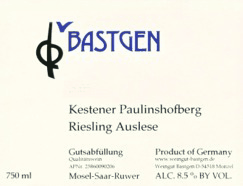
| Country: | Germany |
| Region: | Mosel |
| Winery: | Weingut Bastgen |
| Grape Type: | Riesling |
| Vintage: | 2009 |
| Bottle Size: | 750 ml |

Bastgen Kestener Paulinshofberg Riesling Kabinett is 100 percent Riesling.
Kesten is a small village right by the Mosel surrounded by steep vineyards called Paulinsberg (=hills of Saint Paul). The vines grow on bridle clay slate near the river - a classic terroir that has been cultivated with vines ever since Roman times. Riesling is the most typical grape of the Mosel region that produced a fruity Kabinett with beautiful peach aromas on the nose, rich and ripe fruits on the mouth with honeyed notes and a refreshing acidity. This is a very pleasing wine.
They meticulously tend 4.5 ha (11.11 acres) of which 80% is Riesling. The soil is made of slate. Their vineyards are located in Kesten and Brauneberg, on a steep terrace, and planted to 50-year old vines. Fortunately for Bastgen, they own part of the famous Brauneberger Juffer Sonnenuhr. The vines produce very small, ripe berries that are very tasty.
The grapes are strongly selected, only minimal amounts of botrytis are tolerated. At time of the harvest the grapes are fully ripened with a golden color and tart acidity. After a natural sedimentation process the fermentation occurs in stainless steel tanks under cool conditions. The wine remains on the lees until April, then is gently filtered once, and bottled.
Review:
"This prototypical Mosel Kabinett has depth and vibrancy all packed into a light-bodied frame. Not super-sleek, but enormously refreshing with super-expressive white peach, yellow apple and honeysuckle aromas. Super-crisp finish. Delicious now, but excellent aging potential too! From organically grown grapes. Drink or hold. Screw cap."
- James Suckling (November 2023), 94 pts

Scents and flavors of peach and yellow plum, citrus and mineral notes. Extremely long, white peach finish.
This wine is a 100 case Cuvee produced from the steepest part of the Paulinschofberger vineyard, 65 % slope. Vine age is 105 years old. "Grosses Gewachs" Großes Gewächs: (great growth = Grand cru), a designation used by VDP members in all regions except Mosel and Rheingau to designate top-level dry wines from selected sites (the highest level of quality). Dry means dry on the palate. The maximum yield is 50 hl/ha, from a classified vineyard. The natural minimum density of must is around 90° Oechsle. The wines are produced using exclusively traditional production methods. The wines are tested and approved by a test body before and after bottling. Hand Harvest (no machine harvest). The wine must not be released before September the year after it was made.
Review:
"In spite of the abundant yellow fruit aromas (think Mirabelle plums more than peaches), this is a very cool and sleek style of Mosel GG with great herbal freshness. Although this has excellent concentration, it definitely needs time to give its best due to the bone-dry style. Quite a steely, tightly wound finish, but very long. Drinkable now, but best from 2026. - Stuart PIGOTT (Senior Editor)" - James Suckling (August 30th 2024), 95 pts

Bastgen Berncastel-Cueser Weisenstein Riesling Spatlese Trocken is made from 100 percent Riesling.
Bright, clean, fresh and zesty. Grapefruit like flavors. Fruity aromas and a nice minerality, typical of the Riesling grape grown on blue slate soil. Round, rich and a very long finish. The grapes for this wine are vigorously selected. Botrytis is not tolerated. At harvest the grapes are fully ripened, have a golden color, and a soft tartness. After a long spontaneous fermentation in a traditional 1000L barrel, the wine just reaches the dry stage. This gives the wine a creamy structure that interplays with ripe yellow and exotic fruit aromas.
They meticulously tend 4.5 ha (11.11 acres) of which 80% is Riesling. The soil is made of slate. Their vineyards are located in Kesten and Brauneberg, on a steep terrace, and planted to 50-year old vines. Fortunately for Bastgen, they own part of the famous Brauneberger Juffer Sonnenuhr. The vines produce very small, ripe berries that are very tasty.
Review:
"This dry Mosel riesling is GG in all but name! Complex nose of white peach and red-fleshed vineyard peach with herb garden notes. Very elegant and polished this glides over your palate, the precision of flavor on the medium-bodied palate is very impressive. Then comes the wet stone and red berry finish that doesn’t want to stop. From organically grown grapes. Drink or hold."
- James Suckling (November 2023), 95 pts
Bastgen Berncastel-Cueser Weisenstein Riesling Spatlese Trocken is made from 100 percent Riesling.
Bright, clean, fresh and zesty. Grapefruit like flavors. Fruity aromas and a nice minerality, typical of the Riesling grape grown on blue slate soil. Round, rich and a very long finish. The grapes for this wine are vigorously selected. Botrytis is not tolerated. At harvest the grapes are fully ripened, have a golden color, and a soft tartness. After a long spontaneous fermentation in a traditional 1000L barrel, the wine just reaches the dry stage. This gives the wine a creamy structure that interplays with ripe yellow and exotic fruit aromas.
They meticulously tend 4.5 ha (11.11 acres) of which 80% is Riesling. The soil is made of slate. Their vineyards are located in Kesten and Brauneberg, on a steep terrace, and planted to 50-year old vines. Fortunately for Bastgen, they own part of the famous Brauneberger Juffer Sonnenuhr. The vines produce very small, ripe berries that are very tasty.

Bastgen Blauschiefer Riesling is 100 percent Riesling.
Bright, clean, fresh and zesty. Grapefruit like flavors. Fruity aromas and a nice minerality, typical of the Riesling grape grown on blue slate soil. Round, rich and a very long finish.
They meticulously tend 4.5 ha (11.11 acres) of which 80% is Riesling. The soil is made of slate. Their vineyards are located in Kesten and Brauneberg, on a steep terrace, and planted to 50-year old vines. Fortunately for Bastgen, they own part of the famous Brauneberger Juffer Sonnenuhr. The vines produce very small, ripe berries that are very tasty.
Bastgen Blauschiefer Riesling is 100 percent Riesling.
Bright, clean, fresh and zesty. Grapefruit like flavors. Fruity aromas and a nice minerality, typical of the Riesling grape grown on blue slate soil. Round, rich and a very long finish.
They meticulously tend 4.5 ha (11.11 acres) of which 80% is Riesling. The soil is made of slate. Their vineyards are located in Kesten and Brauneberg, on a steep terrace, and planted to 50-year old vines. Fortunately for Bastgen, they own part of the famous Brauneberger Juffer Sonnenuhr. The vines produce very small, ripe berries that are very tasty.
Review:
"Very enticing nose of ripe pear with some white peach and floral aromas! All the elegance and delicacy we expect from high-quality Mosel riesling, but this light-bodied and dry beauty is only an entry-level wine! Long, refreshing and delicate finish. This will be a bargain in all the markets it reaches. From organically grown grapes. Drink now. Screw cap. "
- James Sucking (November 2023), 92 pts
Bastgen Kestener Paulinshofberger Riesling Kabinett 2009 is a yellow color with green highlights. Beautiful peach aromas on the nose, rich and ripe fruits on the mouth with a refreshing acidity and honey notes. A very pleasing wine.
The Weingut Bastgen Estate
The property was founded in 1850 and is located in the tiny hamlet of Monzel, along the middle Mosel. The current owners are Armin Vogel (husband) and Mona Bastgen (wife) who began working in the winery in 1993. The average total production is 3,300 cases. They export mainly to Germany, Switzerland, U.K and the U.S. Their wines are bottled in screwcaps.
The Weingut Bastgen Vineyard
They meticulously tend 4.5 ha (11.11 acres) of which 80% is Riesling. The soil is made of slate. Their vineyards are located in Kesten and Brauneberg, on a steep terrace, and planted to 50-year old vines. Fortunately for Bastgen, they own part of the famous Brauneberger Juffer Sonnenuhr. The vines produce very small, ripe berries that are very tasty.

Rinaldi Red Dream is made from 100% Malvasia
this wine is obtained with a cold maceration (13° C) for 48 hours. We work in this way just to extract the color and the wine scent from the peels.
Then we soft press the grapes and we separate the solid part from the liquid part and we have the juice.
Then we keep the wine at 0 degree Celcius (32 degrees Fahrenheit) temperature and we have a natural cleaning of the must.
When we decide to bottle it the temperature increased at about 17 degrees Celcius, and when we reach 5.5% Alcohol by Volume and the desired atmospheric pressure is obtained, about 2 atmospheres, we block the fermentation with the cold and we filter it again and
finally, we put it in bottle.
The wine is ruby red but not too deep, fruity and pleasant. It's a dessert wine, it is possible to appreciate it at his best if you serve it chilled.
This frothy and fruity red wine delivers flavors of honeysuckle and black pepper. Light, fun and exciting; it’s great for parties and light fare. 100 % Malvasia Nera.
"The non-vintage Rinaldi Red Dream, which comes from 100% Malvasia Nera, has about 7% alcohol, so it is slightly more potent than its two siblings. Gorgeously fresh and frothy, with loads of cherry, honeysuckle, spice box and spring flowers, this is an exciting party wine that is brilliantly packaged, and I doubt a person can be found who would dislike it. However, these wines are meant to be drunk in their exuberant youth, so this one as well as the following two efforts should be consumed over the next 6-12 months."
- Wine Advocate (Issue 201, June 2012), 90 pts
"This Wine is a bit heavier than a bracchetto, but it shares the sweetness, effervescence and low alcohol that make it a delicious dessert wine. The added weight suggests pairing it with desserts that include ice cream."
- Washington Post (February 8th 2012), **

All older vintage wines have been purchased from a single collectors cellar. Pictures can be requested before shipment.
Vintage Unknown

For many wine lovers or consumers, wine tasting is the preserve of professionals or real connoisseurs. People still have this image of it being a complex, technical, precise and highly-formalised process. In fact, wine tasting isn’t and shouldn’t be just that. No, it should be straightforward, convivial, interesting and fun. Tasting a wine should provoke curiosity, excitement, pleasure and dreams…
When you taste a Château du Retout wine, you use all five of your senses: the sense of touch when you pick up the bottle to gauge its temperature, the sense of hearing which allows you to enjoy the sound of he popping of the cork and the wine being poured into the glass, and then, of course, you use your senses of sight, smell and taste when you drink the wine:
The Médoc grape varieties and soils give us wines with superb, dense, dark hues, ranging from deep garnet to ruby-crimson, taking on brick red shades with orange tints with age.
Very intense and expressive aromas with powerful notes of black fruit such as blackcurrants and blackberries. In older wines, the nose develops a spicy bouquet of liquorice, leather and marshmallow mingled with the vanilla scents created by well-integrated oak.
Harmonious, elegant and velvety, with smooth, round tannins, that can be appreciated from the wine's entry to the palate through to the finish. These are delightfully full-bodied wines with great aromatic persistence.
Review:
"Shows the ripeness of the vintage, with dark currant and blackberry framed by singed cedar and vanilla. Ends with a tug of warm earth, a light twang of iron and a steady grip. Cabernet Sauvignon, Merlot and Petit Verdot. Drink now through 2034."
- Wine Spectator (TOP 100 wines of 2024), 92 pts and #45 on Top100



