
" We don't sell the wine without touching the vine "
| Country: | France |
| Region: | Burgundy |
| Winery: | Capitain Gagnerot |
| Grape Type: | Chardonnay |
| Vintage: | 2014 |
| Bottle Size: | 750 ml |

Roland Champion Champagne Blanc de Blanc Grand Cru 100% chardonnay.
Champagne with rich and structured aromas. Very pleasant and generous roundness, nice length in mouth. Golden color with buttery and fruity aromas. All the expression of a magnificent terroir for your most pleasurable moments.
Manual harvest; then pressing immediately to avoid oxidation & preserve quality. Free run juice only. Aged six years sur lattes.
It matches magnificently with foie gras!
Very complex nose. Elegance and finesse. A surprising aromatic complexity. A bouquet of aromas dominated by honey, brioche and notes of dried fruits, hazelnuts and sweets. Perfectly matured.
Juice exclusively 100% Grand Cru from Chouilly, chalky soil and subsoil.
It matches magnificently with foie gras!

This is a 9 liter imperial also called a Salmanazar .
Roland Champion Champagne Blanc de Blanc Grand Cru 2014 is made from 100% Grand Cru Chardonnay from the chalky soils of Chouilly.
This Champagne is full of elegance and finesse. Very complex nose, with a bouquet of aromas dominated by honey, brioche and notes of dried fruits, hazelnuts and sweets. Perfectly matured.
Manual harvest; then pressing immediately to avoid oxidation & preserve quality. Free run juice only. Aged six years on the lees.
It matches magnificently with foie gras!
Review:
"Based in Chouilly on the Côte des Blancs, it is obvious this producer will have a Blanc de Blancs Champagne. And very good it is, with some age after six years on lees while still having freshness, crisp acidity and a tight, steely edge. The bottling will benefit from further aging, and it will be at its best from 2022. - ROGER VOSS"
- Wine Enthusiast (December 2020), 92 pt

Chateau Batailley Grand Cru is made from 78% Cabernet Sauvignon, 19% Merlot, 2% Petit Verdot & 1% Cabernet Franc.
Château Batailley is a winery in the Pauillac appellation of the Bordeaux region of France. The wine produced at the estate was classified as one of eighteen Cinquièmes Crus (Fifth Growths) in the Bordeaux Wine Official Classification of 1855.
Garnet-purple colour. Rich and expressive nose, fruity with notes of spices, smoke and vanilla. On the palate, this wine is supple, round, well balanced, with good acidity, a nice fruitiness and nice notes of leather and cedar. Long elegant finish.
Review:
The 2010 Batailley repeated its magnificent showing when poured at the chateau. It has a detailed bouquet of blackberry and cedar, quite backward and seemingly having advanced lite since | tasted in in April 2016. The palate remains full of tension and brimming with energy, delivering classic cedar and tobacco notes toward the persistent finish. Batailley can produce wines that live many decades, and this is clearly one of them. Tasted at the property. Drink 2020-2050
- Neal Martin Vinous 95 Points

Chateau Talbot Saint-Julien Grand Cru Classe is made from 69 % Cabernet Sauvignon, 26 % Merlot, 5 % Petit Verdot.
The wine presents a delicate and captivating nose of black fruits, fresh tobacco, peppermint and floral nuances. Ripe and juicy fruit flavors of black currants on the palate with well integrated velvety tannins and a beautiful refreshing acidity to the long finish.
For the 2018 vintage, a special packaging with a unique silkscreen printing bottle was created to mark the 100th anniversary of the Cordier Family's acquisition of Chateau Talbot
Pair with red meat, roast pork, game meat, poultry, hard cheeses, poached pear.
"Rich aromas of blackcurrant, blackberry, chocolate, tobacco and licorice. Oyster shell, too. It’s full-bodied with firm, well integrated tannins. Polished, silky layers with a long finish. Gorgeous ripe and bright fruit in the center palate. Best in a long time. Try from 2025."

Chateau Talbot Saint-Julien Grand Cru Classe is made from 69 % Cabernet Sauvignon, 26 % Merlot, 5 % Petit Verdot.
The wine presents a delicate and captivating nose of black fruits, fresh tobacco, peppermint and floral nuances. Ripe and juicy fruit flavors of black currants on the palate with well integrated velvety tannins and a beautiful refreshing acidity to the long finish.
For the 2018 vintage, a special packaging with a unique silkscreen printing bottle was created to mark the 100th anniversary of the Cordier Family's acquisition of Chateau Talbot
Pair with red meat, roast pork, game meat, poultry, hard cheeses, poached pear.
"Well-built and rather refined for the vintage, with a deep well of red and black currant paste and plum reduction flavors supported by a deeply inlaid iron note, all of which run the length of the wine. Offers subtle savory, tobacco and singed cedar notes that add range, with a savory echo that leaves a mouthwatering feel in the end. Built to cellar. Cabernet Sauvignon, Merlot and Petit Verdot. Best from 2025 through 2040. - James Molesworth"
- Wine Spectator (March 2022), 95 pts
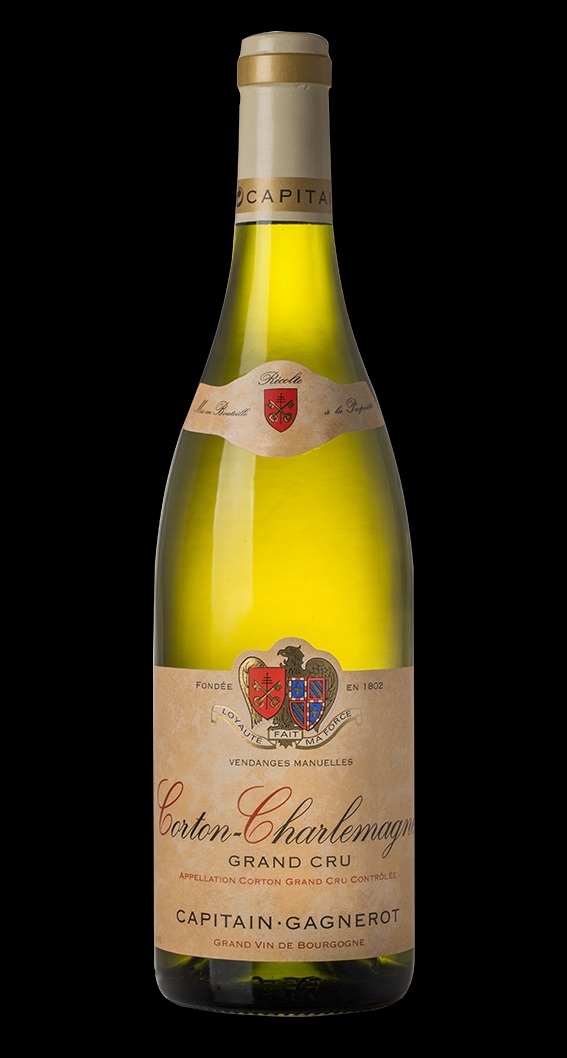
Capitain Gagnerot Corton-Charlemagne Grand Cru is made from 100 percent Chardonnay
SOILS
Soil from the Later Bathonian era, white marl and limestone.
VINIFICATION / MATURING
Harvested by hand, sorted and destemed.
After a light press of around 4 hours, alcoholic fermentation in oak barrels at around 20°C.
Maturation in oak barrels (10% new barrels) for 6 to 8 months.
ALCOHOL
13,5°
TASTING NOTES
Colour : Gold with pale green reflects.
Nose : White flowers notes, sightly honneyed. Smoky, spicy (cinnamon) and fruity (apricot, pinapple) notes, supported by a fine minerality.
Mouth : Large and complex.
FOOD ACCORDANCE
Foie gras, lobster.
The Domaine Gagnerot was established in 1802. In 1864 Marie, Jean-Baptiste’s unique daughter, marries François Capitain, wine trader, native of Champlitte. Together, Jean-Baptiste and François establish the Domaine Capitain-Gagnerot.
After the phylloxera crisis wich ravaged the Burgundian vineyard from the 1870s the the 1880s, Marie then widowed, decides to keep the domaine and to replant it vines. The succession is since made from father to son.
After the Second World War, Roger Capitain inherits 3 hectares of vineyards and a wine trade. His two sons, Patrice and Michel, take over the domaine upon his retirement.
Today, the domaine comprise 16 hectares of vineyards in full ownership, and it is Pierre-François and Delphine, Patrice’s children, who now oversee its destiny, supported by their spouses.
Terroir
The particularity of Burgundy is to produce on diversified terroirs wines elaborated with a single grape variety, which emphasize the specificity of every appellation : Pinot Noir for red wines, Chardonnay for white wines.
Our terroir refers to the specific characteristics of grounds, subsoil, weather conditions and vines, but it is also the result of man’s work and knowhow, refined over a long history.
Located at the junction of Côte de Beaune and Côte de Nuits, the highly defined vineyard of Ladoix is ideally situated on the Coteau de Corton, the only hillside in Burgundy to produce both white Grand Crus and red Grand Crus.
This famed hillside has a geologic profile which comprises two types of soils:
• Marl limestone convenient for great white wines;
• Clay and limestone, yielding red wines of great finesse.
Winemaking
Our wines are produced in accordance with reasoned culture principles, applying at the same time the principles of integrated farming and as often as the weather conditions allow it, those of biodynamic farming. We work in harmony with the vineyard and its ecosystem, by favoring natural treatment products and by limiting our interventions to the minimum, in order to obtain a healthy harvest.
Vineyards are regularly earthed up and ploughed to ensure that the vines draw in depth the typicality and the expression of their terroir. Plowing also avoids rapid erosion of the soil, therefore ensuring optimal growing conditions for the vines.
A rigorous selection of plants, a thorough pruning and an early thinning out of leaves allow the control of quality and yield. To always obtain the best of each plot, there only remains to select the most favorable harvest date for an optimal maturity and quality. We believe that great wines are born in the vineyard.
Completely hand-harvested, grapes are sorted out and destemmed before being placed in tanks to be vinified.
The fermentation of Pinot Noir is naturally made, in open tank, without yeast addition, during 12 to 15 days following the harvest, in a temperature not exceeding 30 degrees Celsius. The wine is punched-down twice a day at the beginning of wine-making.
Wines are exclusively matured in oak barrels during 12 to 18 months. After the malolactic fermentation and a light filtration, they are bottled.
After racking of the must, our Chardonnay ends its alcoholic fermentation in barrels at a temperature between 20 and 22 degrees Celsius to ensure that it retains all its aromatic freshness.
After a minimum 10 month maturing in cask, wines are racked, filtered and bottled.
To protect the character of our wine and its terroir, we do not use more than 10% of new wood.
We believe that wood is solely a support in making good wine, and a slight touch of it is enough to achieve that goal.
Our viticulture and wine-making reflect our will to make genuinely fresh wines, which are the expression of our rich terroir, and of the elegance of the great grape varieties of Burgundy.
The fermentation of Pinot Noir is naturally made, in open tank, without yeast addition, during 12 to 15 days following the harvest, in a temperature not exceeding 30 degrees Celsius. The wine is punched-down twice a day at the beginning of wine-making.
Wines are exclusively matured in oak barrels during 12 to 18 months. After the malolactic fermentation and a light filtration, they are bottled.
After racking of the must, our Chardonnay ends its alcoholic fermentation in barrels at a temperature between 20 and 22 degrees Celsius to ensure that it retains all its aromatic freshness.
After a minimum 10 month maturing in cask, wines are racked, filtered and bottled.
To protect the character of our wine and its terroir, we do not use more than 10% of new wood.
We believe that wood is solely a support in making good wine, and a slight touch of it is enough to achieve that goal.
Our viticulture and wine-making reflect our will to make genuinely fresh wines, which are the expression of our rich terroir, and of the elegance of the great grape varieties of Burgundy.

La Jota Howell Mountain Cabernet Franc is made from 100% Cabernet Franc.
The 2019 Cabernet Franc opens with aromas of cassis and graphite when poured in the glass. The firm tannins set the stage on the palate melded with rich flavors of boysenberry and pain de grille with a silky mouthfeel and lingering finish.
Review:
Savory in black pepper, smoked meat and cigar box, this wine is high-toned aromatically, with lovely hints of violet and dried herb, sage and bay leaf. Mountain-sturdy tannins give it structure, power and room to age, with lasting acidity to keep it fresh. Enjoy best from 2029–2039
.-Wine Enthusiast 95 Points

In the far northwest corner of the Sonoma Coast appellation, near the town of Annapolis, the vineyard sits just five miles from the Pacific Ocean, and provides a poignant setting for producing pinot noir with elegance, great precision, and intensity.
Review:
The 2021 Pinot Noir Goldrock Estate is deep, rich and explosive. Dark red cherry, pomegranate, blood orange, menthol, spice and rose petals are all amplified in this dramatic Sonoma Coast Pinot. The complexity and intensity here are simply unreal. Give this time, there's a lot of wine in the glass.
-Vinous 96 Points



