" We don't sell the wine without touching the vine "
| Country: | France |
| Regions: | Rhone Gigondas |
| Winery: | Clos des Cazaux |
| Grape Type: | Grenache |
| Vintage: | 2020 |
| Bottle Size: | 750 ml |
Cazaux Gigondas Tour Sarrasine is made from 75% Grenache, 15% Syrah, 10% Mourvèdre. 45 year old vines on average.
Intense, persistent red and dark fruit aromas. Raspberry, pepper and spice flavors. Silky tannins.
Enjoy with game meat or strong cheeses.
Review:
"Bright violet color. The fragrant and incisive nose displays vibrant red fruit, floral and spice qualities. Shows very good energy and detail on the palate, offering nervy bitter cherry and redcurrant flavors and a hint of garrigue. Closes long and spicy, with resonating fruit and floral notes. - Josh Raynolds - Josh Raynolds"
- Antonio Galloni's Vinous (January 2023), 92-94 pts
Cazaux Gigondas Tour Sarrasine is made from 75% Grenache, 15% Syrah, 10% Mourvèdre. 45 year old vines on average.
This strong, warm wine comes from a selection of grapes planted on exceptional soils. The vineyards in Gigondas are situated on the arid hills of the Dentelles de Montmirail. The Mistral blows regularly on these slopes which limits the amount of treatment needed to the vines. The vines grow on stony soils and produce wine that can be kept easily for 10 yrs.
Intense, persistent red and dark fruit aromas. Raspberry, pepper and spice flavors. Silky tannins.
Cazaux Gigondas Cuvee Prestige is made from 50% Grenache, 30% Syrah, and 20% Mourvèdre.
A blend of Grenache, Syrah and Mourvedre produced from the oldest vines of the estate and only in the years of highest grape quality. Aromas of prune, chocolate, spices, fruit brandy and plum. Rounded tannins and a long finish.
Red meats aged, venison
Review:
"I was also able to taste the late-release 2020 Gigondas Cuvée Prestige, which is 50% Grenache, 30% Syrah, and 20% Mourvèdre that was brought up in barrel. It has a rocking nose of Provençal spices, saddle leather, dried flowers, and assorted strawberry and raspberry fruit. It's medium to full-bodied, has fine tannins, beautiful overall balance, and a great finish. Count me in as a fan. Enjoy bottles any time over the coming 7-8 years."
- Jeb Dunnuck (October 30th 2023), 94 pts
Cazaux Gigondas Cuvee Prestige is made from 50% Grenache, 30% Syrah, and 20% Mourvèdre.
A blend of Grenache, Syrah and Mourvedre produced from the oldest vines of the estate and only in the years of highest grape quality. Aromas of prune, chocolate, spices, fruit brandy and plum. Rounded tannins and a long finish.
Red meats aged, venison
Review:
"Not yet bottled, the 2019 Gigondas Cuvée Prestige checks in as 50% Grenache, 30% Syrah, and 20% Mourvèdre, all from the older vines of the estate and vinified and aged in barrel. There are a tiny 700 cases produced. A terrific nose of red and black fruits, Provençal garrigue, and subtle spicy oak is followed by remarkable purity of fruit, silky tannins, and a great finish. it has a touch of modern character which is going to integrate with 2-3 years of bottle age, and it will have 10-15 years or more of prime drinking.."
- Jeb Dunnuck (January 2022), 91-93+ pts
Cazaux Gigondas Cuvee Prestige is made from 50% Grenache, 30% Syrah, and 20% Mourvèdre.
A blend of Grenache, Syrah and Mourvedre produced from the oldest vines of the estate and only in the years of highest grape quality. Aromas of prune, chocolate, spices, fruit brandy and plum. Rounded tannins and a long finish.
Red meats aged, venison
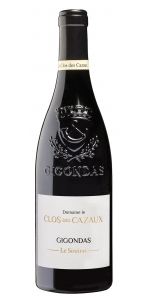
Clos des Cazaux Gigondas Le Souiras is 100% Grenache.
“Le Souiras” is the terroir located at the very South end of the Gigondas appellation. Here, in the midst of the Dentelles de Montmirail, an extraordinary calcareous massif, we planted grapevines on slopes surrounded by Mediterranean vegetation.
We are situated at an altitude of 250 meters, where the nights are cooler. The terroir is stony with a layer of grey and blue clay under the topsoil. The slopes face West and are protected from the strong summer sun by the Montmirail hill. Due to this ideal microclimate, our old Grenache grapevines contain all the complexity and balance of this sunny terroir.
Color : Dark intense ruby color.
Bouquet : Notes of little red fruits, white pepper, caramel and juniper.
Palate : The first impression is arresting and generally qualified as round, complex and dense.
The aromas of black cherry, mocha and white pepper are very intense. The palate is powerful, elegant and velvety.
The finish is long, with very silky tannins and a very slight bitterness that gives this exceptional Grenache an impression of freshness.
Review:
"A brilliant wine that has so much to love, the 2022 Gigondas Le Souiras is all Grenache that was brought up in barrels. It exhibits a vivid ruby hue as well as classic kirsch and blackberry fruit intermixed with peppery garrigue, spice, and ample Provençal nuances. This medium-bodied, fresh, focused 2022 has a beautiful sense of elegance, fine tannins, and the balance to evolve gracefully over the coming 10-12 years."
- Jeb Dunnuck (December 5th 2024), 94 pts
Cazaux Gigondas Tour Sarrasine is made from 75% Grenache, 15% Syrah, 10% Mourvèdre. 45 year old vines on average.
Intense, persistent red and dark fruit aromas. Raspberry, pepper and spice flavors. Silky tannins.
Enjoy with game meat or strong cheeses.
Review:
"The 2020 Gigondas La Tour Sarrasine follows suit and is also loaded with charm and character. Lots of up-front red and black fruits, classic, spicy aromatics, moderate acidity, and medium to full-bodied richness all characterize this 2020 barrel sample. A blend of 70% Grenache and 15% Each of Syrah and Mourvèdre, it has all the right components, and my money is on it being an outstanding bottle of wine."
- Jeb Dunnuck (January 2022), 91-93 pts
The Domaine Le Clos des Cazaux Estate
The Domaine was founded in 1905 by Gabriel Archimbaud and is now run by Maurice Vache and his two sons Jean-Michel and Frederic. The Archimbaud and Vache families are among the oldest ones in Vacqueyras. The oldest part of the property dates back to the 12th century and belonged to "Les Chevaliers de l'Ordre des Templiers" (the Templar Knights). An ancient Moorish Tower sits on the property, the Tower of Sarrasine in ruins.
The Domaine Le Clos des Cazaux Vineyard
The estate spreads over 40 hectares (98.8 acres) of vineyard land:
- 25 ha in Gigondas. The quality of the soil is outstanding and the sun exposure is optimal due to the special location of the vineyard, surrounded by the rocky massif of the "Dentelles de Montmirail", upon which is built the Sarrasine tower.
- 15 ha in Vacqueyras, on sandy-clayey and sunny slopes.
The vineyards are planted to 60% Grenache, 30% Syrah and 10% Mourvedre. The vines are 40-50 year old. The annual production is 8,800 to 10,000 cases. The average yield is 28 hl/ha.
The vines are cultivated with utmost respect to the environment. Only Bordeaux mixture (antifungal agent consisting of a solution of copper sulfate and quicklime) and sulfur is used in the phytosanitary (pertaining to the health of plant) and vineyard treatment. At all times, the vineyards are manually tended, including manual harvest. To ensure optimal quality, only the best grapes are selected during a green harvest in Summer which eliminates at least 20% of the production.
Each grape variety is picked at its optimum maturity and vinified separately. Syrah is usually harvested first, followed by Grenache and then Mourvèdre. The whole clusters are placed into specially equipped bins having a screw in the bottom that allow the grapes to fall into the tanks without any crushing. This near carbonic fermentation period depends on the grape varieties and the conditions. When the fermentation is complete, the varietal wines are blended together (typically in November).
The maturation takes place first in stainless steel tanks for the juice to settle, then in concrete or enamel tanks. The wines mature in the cellars for at least 2 years before bottling. There is no fining, and only a light filtration to limit the natural deposit on the bottle.
Patricia Raquin Nuits St. Georges les Vaucrains is made from 100 percent Pinot Noir.
"Vaucrains" comes from old French word meaning place with very little fertility (which is very good terroir for grape production)
Nuits-Saint-Georges AOC: AOC wines since 1936, 757 acres of grapes, 97 % red wine, 3 % white wine. Nuits refers to “walnuts in the area, not night”….41 Premier Cru vineyards
Tasting Notes: Powerfull aromas with lots red wild fruits, full bodied wine with great aging potential.
VINEYARD: Gravel and Silt
HARVEST: Harvest by hand.
VINIFICATION: Harvest by hand. Traditional vinification in thermoregulated stainless steel. Pre-fermentation – temperature controlled cold maceration during 10 days. Long fermentation during which pigeages and pumping over are performed. Post-fermentation - maceration at 30°C for 5 days.
AGEING: Aged in new French oak barrels for 16 months.
Roast lamb - Rib steaks - duck

Dog Bone is a serious wine with a fun label!
We wanted to make a great wine at a fair price and help dogs across the country. 10% of all profits will go to Humane Societies in places we sell Dog Bone. Sales of this wine are also helping North Coast Grape farmers by finding a home for their excess grapes.
The 2024 growing season delivered ripe, clean fruit with great flavors. The nose has notes of Cherry blossom and Rose hips. On the palate the wine shows ripe Black Cherry and Cola notes and has beautiful balance.
pH: 3.75g/L
TA: 5
ABV: 13.5%