
" We don't sell the wine without touching the vine "
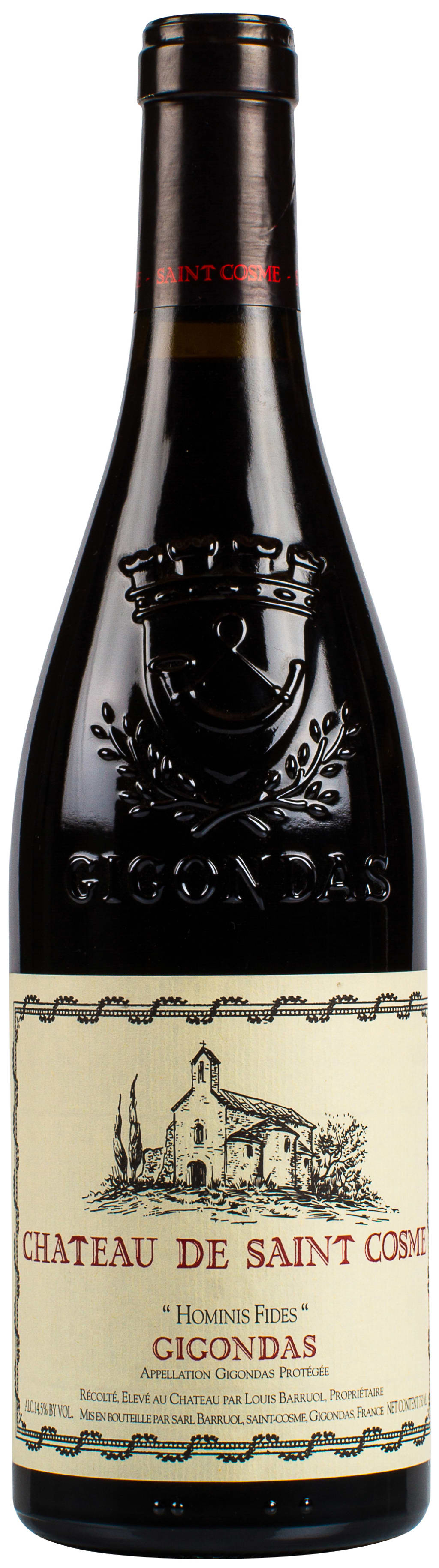
| Country: | France |
| Regions: | Rhone Gigondas |
| Winery: | Saint Cosme |
| Grape Type: | Grenache |
| Organic: | Yes |
| Vintage: | 2020 |
| Bottle Size: | 750 ml |
Hominis Fides is typically the most elegant of Château de Saint Cosme’s three single-vineyard Gigondas. “Grenache grown in the sandy soil produces marvelously textured wines as well as extremely refined tannins; a very special and stylish wine,” says Louis Barruol. The wine features aromas and flavors of pepper, truffle, graphite, and smoke.
Grenache is the pale-colored, red-fruited, and potpourri-scented red grape variety of the southern Rhône and can be paired with both rustic and sophisticated dishes. Full-bodied Grenache-based wines are ideal with stews, braises, and grilled meats, while lighter versions can work well with dark fish and tomato-based dishes such as ratatouille.
Review:
Deep, vivid ruby-red. Intensely perfumed, mineral-tinged scents of medicinal cherry, redcurrant and cassis are complemented by suggestions of star anise, white pepper and pungent flowers. It offers densely packed bitter cherry, red berry liqueur, lavender and licorice flavors that open up very slowly with air. Extremely primary but highly promising, with a long, spice- and mineral-tinged finish shaped by youthfully firming tannins. Made with 100% whole clusters; raised in barriques, one-third of them new.
-Vinous 95-97 Points
Chateau de Saint Cosme Gigondas is made from 70% Grenache, 15% Mourvèdre, 14% Syrah, 1% Cinsaut.
The wine shows intense blackberry and fig fruit with licorice, violets, and charcoal on the finish. It is remarkably fresh and finessed given the sun and warmth of the southern Rhône. The unique micro-climate combined with 60-year-old vines and traditional winemaking make Château de Saint Cosme Gigondas the benchmark wine of the appellation.
Review:
Leading off the Gigondas, the base 2020 Gigondas has lots of black raspberry, ground pepper, and violets notes as well as a round, supple, silky style on the palate. It should be approachable on release, yet it has plenty of mid-palate depth as well as tannins, and I have no doubt it will evolve for 20 years if properly stored.
-Jeb Dunnuck 91-93 Points
Chateau de Saint Cosme Gigondas Le Claux is made from 95% Grenache, 5% Syrah.
Château de Saint Cosme is the leading estate of Gigondas and produces the benchmark wines of the appellation. The property has been in the hands of the Barruol family since 1490. Louis Barruol took over from his father in 1992 making a dramatic shift to quality and converting to biodynamics in 2010.
Château de Saint Cosme Gigondas Le Claux is the estate’s oldest vineyard and sits near the entrance to the winery. “It was first planted in 1870 following phylloxera. My uncles thought it wasn’t producing enough fruit and planned to uproot it in 1914,” says Louis Barruol, but “World War I interrupted that plan.”
The 1.8-hectare Le Claux—meaning “Clos” in old French—is a field blend of predominately Grenache. Louis Barruol believes 10% of the vineyard is from the original 1870 planting. Vines are replaced by massal selection and the average vine age is 60-years. The wine is made with whole cluster fermentation from indigenous yeasts, is aged in 20% new 228-liter barrels, and bottled without fining or filtration.
Tasting Notes
Brilliant violet color. Displays pungent, mineral- and spice-accented cherry, black raspberry, potpourri and licorice aromas, along with hints of savory herbs, vanillo and incense. Chewy and tightly focused on the palate, offering bitter cherry, dark berry and Moroccan spice flavors that unfurl slowly through the back half. It closes with firm tension, chewy tannins and excellent tenacity, leaving resonating cherry and floral notes behind. All barriques, a third of them new.
-Vinous 95-97 Points
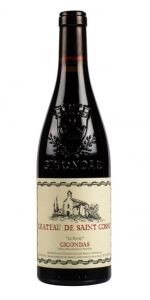
Le Poste’s cool microclimate and limestone soil make it one of Saint Cosme’s most structured, aromatic, and mineral intense wines of the estate. This wine always walks a knife's edge of power and finesse thanks to its deep fruit and precise structure. The wine features aromas and flavors of iodine, violet, pepper, and ash.
Grenache is the pale-colored, red-fruited, and potpourri-scented red grape variety of the southern Rhône and can be paired with both rustic and sophisticated dishes. Full-bodied Grenache-based wines are ideal with stews, braises, and grilled meats, while lighter versions can work well with dark fish and tomato-based dishes such as ratatouille.
Review:
Deep magenta. Expansive, spice- and mineral-tinged black raspberry, kirsch and boysenberry aromas are complicated by suggestions of incense, lavender and smoky minerals. Alluringly sweet and focused in the mouth, offering densely packed red and blue fruit preserve, floral pastille and exotic spice flavors that smoothly balance weight and finesse. This wine shows superb finishing clarity and mineral lift on the penetrating and impressively long finish, which features polished tannins and resonating fruit, floral and mineral notes.
-Vinous 95-97 Points
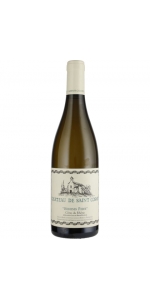
At Saint Cosme, their white wine traditions are as important and time-honored as the reds. The Clairette grape variety has found the ideal place to express itself in the cool, limestone valley of Saint Cosme. Produced by massal selection from the Le Poste vinevard, the Clairette for Hominis Fides thrives in Miocene limestone sand. Its aromas of fennel and grapefruit usher in its finely textured palate, imparting it with substantial agability.
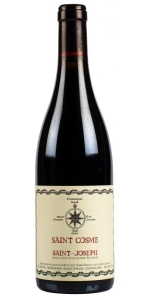
Louis Barruol describes the microclimate of the vineyard Malleval as “very cold” which allows the grapes to retain acidity and showcase the floral aromas of the local Sérine variety. Aromas and flavors of blackberries and wild strawberries are accented by notes of peppercorns, tobacco, peonies, and violets.
Syrah, with its deep flavors and firm tannins, is a natural match for grilled or smoked meat and dishes featuring herbs, roasted mushrooms, and onions. Seared venison or beef with black pepper and thyme or a Moroccan tagine of pigeon or chicken are complimented by the spicy characteristic of Syrah.
Review:
This rich and impeccably balanced Gigondas has everything we look for in the wines of this appellation. What a wide spectrum of aromas with everything from raspberry to candied orange, plus a slew of delicate spicy notes and fresh Mediterranean herbs. I love the interplay of richness, fine tannins and lively acidity on the generous, but not expansive palate. Very long, refined finish. From organically grown grapes. Drink or hold.
-James Suckling 94 Points
Powerful, with steeped plum and cherry coulis merging with potpourri and charred garrigue on a ripe, lush palate. Packs a wall of iron that provides a ballast for the ripe fruit, while refined tannins build in intensity. Long and complex, with a gorgeous expression of place. Grenache, Mourve`dre, Syrah and Cinsault.
Wine Spectator 94 Points
Hominis Fides is typically the most elegant of Château de Saint Cosme’s three single-vineyard Gigondas. “Grenache grown in the sandy soil produces marvelously textured wines as well as extremely refined tannins; a very special and stylish wine,” says Louis Barruol. The wine features aromas and flavors of pepper, truffle, graphite, and smoke.
Review:
At the moment, the 2020 Gigondas Hominis Fides looks to be the standout of the three single vineyards, although all three are beautiful wines in the making. It certainly offers the most power and concentration, with lots of ground pepper, Provençal garrigue, violets, and loamy soils notes, as well as a darker cassis and berry-driven core of fruit. It builds beautifully on the palate, with ample structure, incredible balance, and a great, great finish.
-Jeb Dunnuk 97-100 Points
Château de Saint Cosme is the leading estate of Gigondas and produces the appellation’s benchmark wines. Wine has been produced on the site of Saint Cosme since Roman times, evident by the ancient Gallo-Roman vats carved into the limestone below the château. The property has been in the hands of Louis Barruol’s family since 1490. Henri and Claude Barruol took over in 1957 and gradually moved Saint Cosme away from the bulk wine business. Henri was one of the first in the region to work organically beginning in the 1970s. Louis Barruol took over from his father in 1992, making a dramatic shift to quality, adding a négociant arm to the business in 1997, and converting to biodynamics in 2010.
The estate is in the heart of Gigondas where 15 hectares of vineyard grow in the shade of the Dentelles de Montmirail. The limestone that distinguishes Gigondas from other southern Rhône appellations is visible on the jagged cliffs of the Dentelles. In addition to Gigondas and the old-vine selection Gigondas Valbelle, three single-vineyard Gigondas are produced: Hominis Fides, Le Claux, and Le Poste. Louis Barruol owns an additional 10 hectares of vineyard in Violès outside of Gigondas to produce Les Deux Albions Blanc IGP. Côtes-du-Rhône Les Deux Albions Rouge and Le Poste Côtes-du-Rhône Blanc round out the estate offerings and are labeled as “Château de Saint Cosme.” Little James’ Basket Press, Châteauneuf-du-Pape, and northern Rhône appellations are from contracted growers and are labeled “Saint Cosme.”
Louis Barruol’s style combines the region’s typical ripeness with freshness, an elusive quality in the warm climate of the southern Rhône. One of the keys to freshness is the use of stems for their red wines. The stems absorb alcohol during fermentation and help retain acidity and tannin. Red wines are made by spontaneous fermentation. Louis prefers cement tanks or mostly used 228-liter Burgundian pièce for élevage with just a few traditional demi-muid for his whites. The négociant wines are transported to Gigondas in casks to avoid racking and unnecessary exposure to oxygen. Reds are bottled unfined and unfiltered. “I want to make wines which express their terroir with purity and personality. I want balanced wines with a great ability to age,” says Louis Barruol.
Chateau de Saint Cosme Gigondas is made from 70% Grenache, 15% Mourvèdre, 14% Syrah, 1% Cinsaut.
The wine shows intense blackberry and fig fruit with licorice, violets, and charcoal on the finish. It is remarkably fresh and finessed given the sun and warmth of the southern Rhône. The unique micro-climate combined with 60-year-old vines and traditional winemaking make Château de Saint Cosme Gigondas the benchmark wine of the appellation.
Review:
Leading off the Gigondas, the base 2020 Gigondas has lots of black raspberry, ground pepper, and violets notes as well as a round, supple, silky style on the palate. It should be approachable on release, yet it has plenty of mid-palate depth as well as tannins, and I have no doubt it will evolve for 20 years if properly stored.
-Jeb Dunnuck 91-93 Points
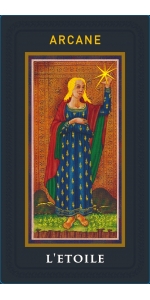
Xavier Vignon Arcane Etoile Beaumes de Venise Rouge is made from 70% Grenache, 20% Syrah and 10% Mourvèdre.
All the wines from the Arcane range are limited edition. They are the reflection of something extraordinary that happened in the vineyard. The Arcane Etoile is a multi vintage blend from 2015-2016-2017 that reveals the complexity and remarkable freshness of these high altitude Beaumes de Venise terroirs. Maceration with viognier skins.
The Beaumes de Venise terroir neighbours Gigondas and Vacqueyras. These Triassic soils (sand, limestone, clay) at the foothills of the Dentelles Sarrasines and the Grand Montmirail were specifically chosen for their high altitude (up to 600 metres above sea level) in order to impart freshness and elegance to the wine. The objective here was freshness and counterbalancing the impact of global warming.
It has something profound in its texture and balance. Notes of black raspberries, currants, dried flowers, lavender, and pepper are followed by a beautiful, full-bodied, elegant wine.
Pairs with porcini mushrooms in red wine - Foie gras - Piglet and prune stew - Honey glazed duck breast - Grilled swordfish - Dauphinois potatoes - Creamy garlic lentil and kale bake - Brie with walnuts
Review:
"Coming from the higher elevation sites, the NV Beaumes de Venise Arcane Etoile is another elegant, finesse-oriented wine from Xavier that has both richness and freshness. A blend of Grenache, Syrah, and Mourvèdre as well as a small amount of Viognier from 2015, 2016, and 2017, it has something profound in its texture and balance. Notes of black raspberries, currants, dried flowers, lavender, and pepper are followed by a beautiful, full-bodied, elegant wine that might just be one of the greatest red wines to come from Beaumes de Venise.” - Jeb Dunnuck (August 16th 2019), 95 pts
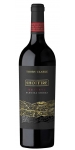
Inky purple-red in color with intense depth to the rim. Aromas of sweet rich fruit and lifted cedar oak fill the glass. Abundant blackberry, violets and cigar box roll through the profile adding complexity and interest. The palate is round and silky with dark plum, liquorice, briar and blackberry primary fruits. The rich, toasty oak, and fleshy rounded tannins complete the palate of this dense, flowing wine. This poised and powerful wine is drinking amazingly well but with it's density and presence will cellar impeccably well.
Selected parcels of estate fruit were de-stemmed into our open fermenters and seeded with yeast. The ferments were pumped over twice daily to maximise color, tannin and flavor extraction. The temperature controlled fermenters allowed the ferments remain in the 22-25 °C range giving amazing fruit expression in the wine. Each parcel was pressed after a minimum of seven days fermenting on skins. The wine completed both primary and ML fermentation in tank before being filled to American oak hogsheads (300Ltrs) to mature. The wine was aged in a combination of new, 2nd and 3rd use barrels for up to 2 years. Prior to bottling the parcels were emptied from oak and
Rare roast beef or BBQ lamb cutlets
Review:
"Growers in Barossa for six generations, the Thorn-Clarke family farms close to 600 acres of vines, providing the fruit for this sleek, black-fruited shiraz. It’s silky- smooth, with the concentration and density of flavor that takes the tannins toward blood, iron and sage. A deep, dark wine with pleasure to spare, this begins to show floral scents of roses, then detailed flavors of plums and strawberries after a day open to air. - Joshua GREENE
- Wine & Spirits (December 2023), 93 pts
"Opaque dusty garnet color. Aromas and flavors of milk chocolate and coconut, blackberry syrup, eucalyptus, and pepper bbq sauce with a round, dry-yet-fruity full body and a hot, interesting, medium-long finish that exhibits notes of black berry bbq sauce, mint and eucalyptus, and chocolate sauce and vanilla with chewy, drying, coating tannins and light oak flavor. Knows that it is Barossa Shiraz and wears that moniker proudly tattooed as a sleeve; 10 out of 10 typicity here."
- Beverage Testing Institute (June 2023), 93 pts - GOLD MEDAL - Exceptional
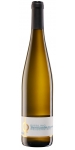
Bastgen Berncastel-Cueser Weisenstein Riesling Spatlese Trocken is made from 100 percent Riesling.
Bright, clean, fresh and zesty. Grapefruit like flavors. Fruity aromas and a nice minerality, typical of the Riesling grape grown on blue slate soil. Round, rich and a very long finish. The grapes for this wine are vigorously selected. Botrytis is not tolerated. At harvest the grapes are fully ripened, have a golden color, and a soft tartness. After a long spontaneous fermentation in a traditional 1000L barrel, the wine just reaches the dry stage. This gives the wine a creamy structure that interplays with ripe yellow and exotic fruit aromas.
They meticulously tend 4.5 ha (11.11 acres) of which 80% is Riesling. The soil is made of slate. Their vineyards are located in Kesten and Brauneberg, on a steep terrace, and planted to 50-year old vines. Fortunately for Bastgen, they own part of the famous Brauneberger Juffer Sonnenuhr. The vines produce very small, ripe berries that are very tasty.



