
" We don't sell the wine without touching the vine "
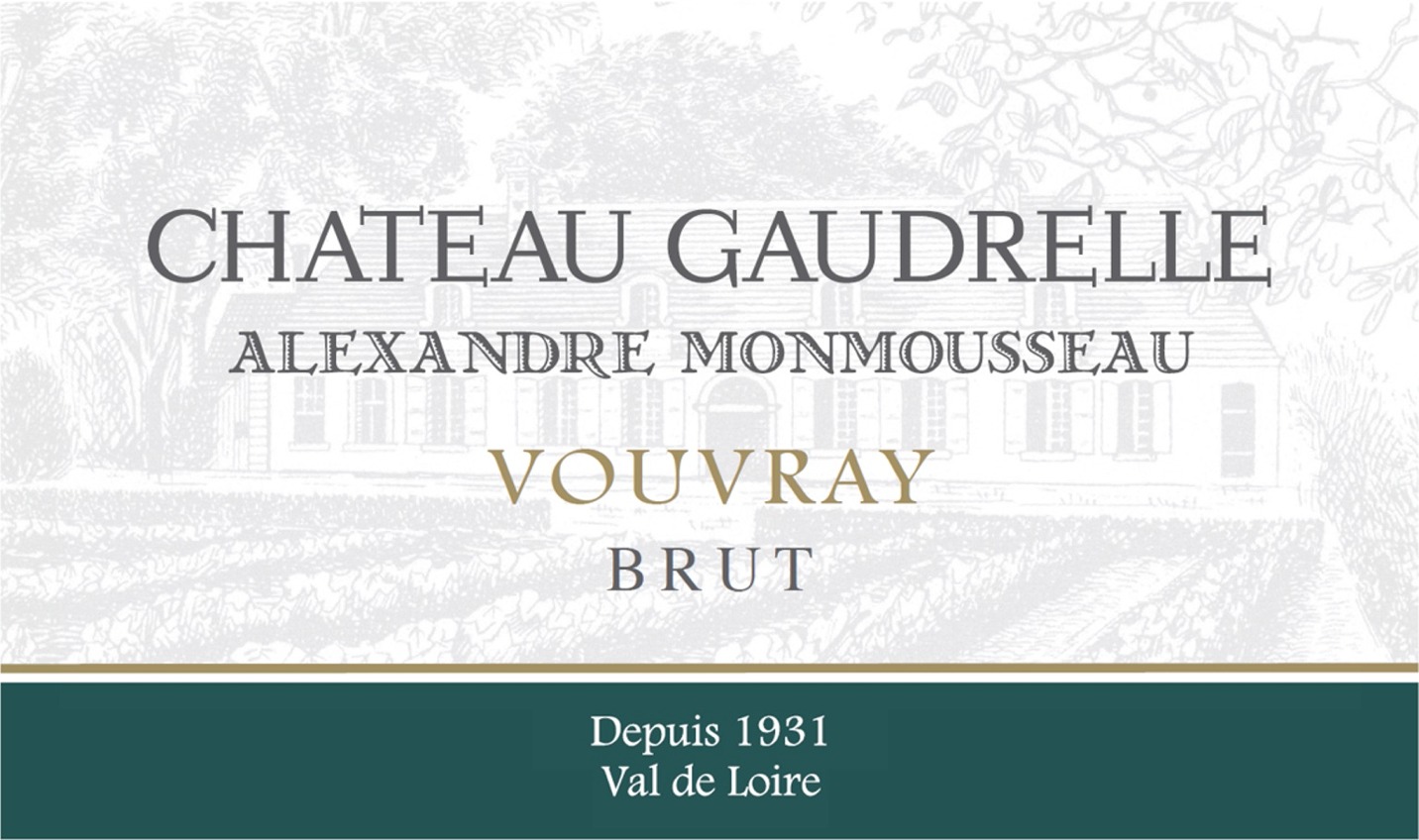
| BUY MORE! SAVE MORE! | ||||||||||||||||||||
|
| Country: | France |
| Region: | Loire |
| Winery: | Monmousseau (Alexandre) |
| Grape Type: | Chenin Blanc |
| Organic: | Yes |
| Vintage: | NV |
| Bottle Size: | 750 ml |
Produced from 100% Chenin Blanc planted on clay and flint stones based soils.
Vinification: aged in stainless steel tanks with temperature controlled fermentation. Aged on the lees for 4 months.
Kieselguhr filtration.
This sparking wine is fresh and fruity. Rich and easy to drink, which makes it a wonderful aperitif. For the aficionados this is an excellent food friendly wine. Its quality makes it a great alternative to Champagne.
"The two sparkling wines should not be missed. They’re both terrific examples of how good sparkling Vouvray can be. Both are 100% Chenin Blanc cuvees, with the non-vintage Chateau Gaudrelle Vouvray Brut showing lots of effervescence and plenty of flowery brioche, buttered citrus, melon and dried apricot notes. It is crisp, fresh, and ideal for drinking over the next several years."
-Wine Advocate 90 pts
"Just off-dry, this almond- and apple-flavored wine achieves a fine balance of crispness and richness. There is just a touch of honey, intertwined with delicious citrusy acidity."
- Wine Enthusiast , 90 pts
The Alexandre Monmousseau Estate
Chateau Gaudrelle is owned by fifth generation winemaker Alexandre Monmousseau. Alexandre's father, Armand Monmousseau, is the former head of his family's sparkling wine firm in Montrichard. Alexandre, intense and confident, received his schooling in Beaune and is one of the leaders of the Sec-Tendre (soft-dry) movement that includes producers like Huet and Champalou..
Monmousseau also produces Kysela's famous Vouvray, Clos le Vigneau.
The AOC of Vouvray covers 9 villages:
• Vouvray
• Vernou sur Brenne
• Noizay
• Chançay
• Reugny
• Parçay
• Meslay
• Rochecorbon
• Tours-Sainte Radegonde, which is the birth place of the vineyard (end of the 4th century).
"It is amazing how good a value Vouvray has remained despite the fact that it is such a popular wine from Loire. The appellation was founded in 1936 and covers nine villages in the region. You can find sparkling wines at this estate – sec (dry) or demi-sec (basically off-dry, although for most consumers these would be considered dry) – as well as their sweet wines, which vary considerably in their degrees of sweetness and are referred to as moelleux. All four of the following cuvees performed brilliantly in my tasting." - Robert Parker's Wine Advocate (June 2012)
The Alexandre Monmousseau Vineyard
Today the Monmousseau family farms 14 hectares (34.6 acres) of land: 6 hectares for Clos le Vigneau, 8 hectares for Château Gaudrelle. Clos Le Vigneau is a single vineyard from an area known as “les Gues d'Amant” or “Lover’s Gap”. Most of the vines were planted in 1929. The soil is a mixture of argilo-calcaire, silex and gravel. Alexandre Monmousseau believes in low yields for concentration and flavor. The grapes are hand harvested. Pressing is long and slow, fermentation is in stainless steel with two rackings and a light filtration before bottling.

description: This is a Pét-Nat Prosecco.
Pét-Nat is short for Pétillant Naturel (French for Naturally Sparkling).
It is the same vinification method as "Methode Ancestrale" used in Bugey Cerdon.
The wine is bottled before the end of the first alcoholic fermentation. Unlike Champagne method (in which the base wine completes his first fermentation in tank and only the secondary fermentation takes place in the bottle adding sugar and yeast also known as liqueur de tirage, which will requires the wine to be disgorged), Pét-Nat method doesn't imply the wine will be filtered or disgorged upon fermentation.
This gives Pét-Nat its light and fizzy mouthfeel, generally with a little sweetness and low alcohol. Most of the times, bottles are slightly cloudy from the presence of lees.
The wine is vibrant with complex lemon citrus, pear and verbena. It finishes dry with delicate yeasty notes.
Alcohol 11,0% vol.
Acidity 5,1 g/l.
Residual sugar 0 g/l
PH 3.3
Pressure 2.4 atm
Area of origin: Vittorio Veneto
Soil: calcareous
Varietal: 95% Glera (known as Prosecco)
Harvest: Manual, with selection of the grapes.
Vinification: Soft pressing with bladder membrane press, settling of must, fermentation at controlled temperature
Fermentation: Processed according to the traditional method of fermentation in yeast bottles. Is normal his natural “bottom” deposit in the bottle, which is why it is brilliant or velvety straw yellow if shaken; the bubble development is brilliant.
Extremely digestible wine, suitable for casual moments or tasting the typical sausages of the local tradition such as the sopressa. Great with pizza daisy.
Review:
"Showing orchard fruit aromas, this wine offers exuberant fruit with light lemon and herbal notes. It offers bright acidity and finishes complete dry. One of the best Pet-Nats we’ve had this year. Made of 95% Glera, this is a sparkling wine made the ancestrale method where the wine is bottled before the end of fermentation, resulting in dissolved carbon dioxide that lends a light sparkling quality to the wine."
- International Wine Review (Champagnes & Sparkling Wines for the Holidays: The Best of 2018), 90 pts

The Jeio line is inspired by the influential Desiderio Bisol, whose wife lovingly referred to him as Jeio. The father of the current generation of Bisol, Desiderio was dedicated to product quality, acquiring only the steepest plots. While considerably more difficult to work, these plots are ideal for vine cultivation. As a result of his vision, the Glera cultivated in these vineyards is especially rich in malic acid, making the final wine more dynamic and evolved. Glera sourced for the Prosecco Brut comes from vineyards in the DOC area just outside Valdobbiadene, taking advantage of the altitude and unique character.
Review:
A fresh and lively Prosecco with lots of lemon and lime character, as well as spiced pears. Medium body, lovely fruit and a fresh finish. Bottled in 2018. Drink now.
-James Suckling 91 Points

Beliere Bugey-Cerdon is made from 95% Gamay, 5% Poulsard (a local grape from Jura).
Spontaneous fermentation. An altogether preferable scenario to spontaneous combustion, and A LOT more fun to drink. This pink, semi-dry bubbly was made by spontaneous fermentation, otherwise known as methode ancestrale. Grapes are picked by hand (not just any grapes, these are the local Poulsard and Gamay grown on mountainous slopes in the shadow of the Alps), and fermented in chilled vats just reaching 5 or 6 degrees alcohol. The young and light wine is then bottled, along with its active yeast and considerable unfermented sugars. Under pressure of the cork, the wine continues to ferment, gaining a few degrees of alcohol but retaining a nice amount of sweetness. The bubbles, of course, are another result of fermentation under pressure. This one is so delicious and fun to drink, with a distinctly, well, grapy aroma and a fruitiness that calls out for celebration and jubilation.
This is also wonderful served with chocolate cake!
8% ABV.
Produced from the "Ancestral method" (also used to produce Clairette de Die): Low temperature fermentation starting in the tank, light filtration that leaves active yeast in the wine, bottling of the wine with fermentation continuing in the bottle ("spontaneous fermentation in the bottle"), retaining some sugar (40 gr/liter at the end). Made from 95% Gamay, 5% Poulsard (a local grape from Jura).
Review:
"Amber color. Aromas and flavors of cranberry juice, rose petal, cherry and kiwi, and red apple with a round, bright, effervescent, fruity medium-to-full body and a delightful, medium-long finish that shows nuances of cherry, cranberry, beeswax, and rose water. Concentrated fruit flavors, creamy bubbles, and well balanced acidity will make this a splendid pairing with charcuterie." - Beverage Testing -Institute (November 2022), 92 pts - Gold Medal

Enemigo El Enemigo Gran Enemigo is made from 100% Cabernet Franc.
In the spectrum of people who pay attention to detail, winemakers are often incredibly detail-oriented. This can sometimes spill over to become an internal battled, and, as Alejandro Vigil and Adrianna Catena state, "We are our own worst enemy." El Enemigo pays homage to this internal struggle.
The nose presents sweet aromas of black ripen fruits with hints of vanilla and chocolate, which appear after the oak ageing. The mouthfeel is sweet with structured, persistent tannins due to the natural acidity of this wine, leading into an excellent long finish.
Review:
The nose of the 2018 Gran Enemigo El Cepillo Single Vineyard, from a low-yielding and drier year, is full of curry, a note that was a constant across the three vintages I tasted together, but it tends to be stronger in low-yielding and dry years like this. It's also floral and comes through as aromatic and a little exotic, in a good way, with elegance, persistence and very pure flavors. It has fine-grained tannins, great acidity and balance. 7,200 bottles. All these single-vineyard bottlings mature in ancient 4,000-liter oak foudres for some 15 months.
-Wine Advocate 97 Points"Pretty and inviting on the nose with gorgeous aromas of floral violet, cassis and completed with a lifted, delicate liquorice note. The palate is graced with deep herb, pepper, crunchy red fruit and graceful, silky tannins."
-Decanter 97 Points

Aalto P.S. Pagos Seleccionados Tinto is made from 100 percent Tempranillo.
Climatic conditions
The farming year began with a mild autumn and little precipitation. A very dry winter started with -9ºC reaching at the end higher temperatures than normal for that time of the year. Spring and summer characterized by little rain, only some rain showers in July and late August avoided the hydric stress of the vines. The vegetative cycle of the vine developed with big variations of temperatures, alternating warm and atypical low temperatures of 4ºC for mid-June. The ripening of the grapes happened under very good conditions and the harvest started on 24th September 2019.
100% Tinto Fino (Tempranillo) primarily from very old vines – 60 to 90 years old – from selected plots in La Horra and La Aguilera. The harvest was done by hand, in small boxes of 15 kilos that are thoroughly inspected, bunch by bunch, on the selection table.
Tasting notes
Review:
Color: dark cherry, Aroma: toasty, spicy, fine cocoa, black fruit, Mouth: tasty, toasty, fine bitterness, ripe tannins
Guia Penin 94 Points

Arzuaga Ribera del Duero Crianza 95% Tempranillo and 5% Cabernet Sauvignon.
Dark cherry color with purple highlights. Powerful nose and high aromatic diversity of ripe red and black fruits, spicy and balsamic notes, and a roasted finish. Soft and mellow in the mouth with a great fruitiness and length.
Review:
This is a big wine with alluring aromas of cedary oak and black fruit. Ripe palate of black berries, some dark chocolate and integrated, polished oak. Long spicy finish. Classy Ribera. -Decanter 95 Points

Chateau Gaudrelle Vouvray Reserve Personelle 2009 is 100 percent Chenin Blanc
Fine Chenin Blanc typicity, with aromas of ripe apples and honeyed notes. Rich, smooth, rounded palate with great structure and weight. Has the acidity to support ageing for 10 years.
-150x300.jpg "Alexandre M Vouvray Brut Methode Traditionnelle NV")
Alexandre M Vouvray Brut Methode Traditionnelle is made from 100% Chenin Blanc.
Tasting: Nose lime tree flower and brioche.
Mouth: complex and very expressive, so fresh and balanced with a smooth touch in mouth, bubbles so small who just tease the tang, light and good length.
ZERO DOSAGE !
Aperitif, seafood, oysters, light hard sheeses, and just for fun

Made from 50% chenin blanc and 50% chardonnay
It is an interesting experience as a sparkling wine for people who want to have a fine and elegant wine comparable to Champagne for a very good price.
This methode traditionnelle sparkling wine is aged for minimum 18-24 months in cave before disgorging. The dosage is 12 g/l residual sugar and the wine is aged for minimum 3 months after disgorging .
Review:
"The two sparkling wines should not be missed. They're both terrific examples of how good sparkling Vouvray can be. Both are 100% Chenin Blanc cuvees. Even better is the slightly richer, more honey and lemon-scented and flavored non-vintage Cremant de Loire. A blend of equal parts Chenin Blanc and Chardonnay aged for a minimum of 18 to 24 months in their cellars before disgorgement, this is a real beauty and a superb wine. Unfortunately, just under 100 cases are imported to the United States." -Wine Advocate 92 pts

Pierre Olivier Brut Vin Mousseux NV is made from 100% Airen.
A value sparkling brut, made with Airen grapes from around the French/Spanish border (next to the Pyrenees). This is a new Kysela Project.
The bubbles are obtained using the Charmat method, named after Eugene Charmat, where the second fermentation takes places in a large, closed pressurized tank. It is different from the Methode Champanoise as the secondary fermentation doesn't take place in the bottle.

Gaudrelle Monmousseau Clos le Vigneau Vouvray is made from 100% Chenin Blanc
Clos Le Vigneau is a single vineyard from an area known as "les Gués d'Amant" or "Lover's Gap". Most of the vines were planted in 1929.
Off dry in style with honey, earth and apricot notes. Wines from the town of Vouvray have been known to age well for 40 years. This particular bottling should hold for at least 5-7 years.

Alma de Vida Sparkling is 100% Macabeo.
Pale greenish yellow color, clean and bright. Persistent over time.
The nose shows natural aromas of fresh grapes, intense, fine and elegant with hints of freshfruit.
The palate is balanced. Ideal for appetizers, seafood and desserts.

All older vintage wines have been purchased from a single collectors cellar. Pictures can be requested before shipment.

Named after Joe Donelan’s mother, the Nancie Chardonnay is our take on cool-climate, timeless Chardonnay. We love the way Nancie captures the classic qualities of Chardonnay while also exhibiting the unique traits of the unusual sites we source from. This Chardonnay is an emphasis on Old Vines, dry farming, and California heritage clones and selections. Every vintage embodies elegance and class, but no vintage is the same. The assemblage changes every year, so Nancie does not have a recipe. This wine lets us sit shotgun while the cool climate and the terroir do all the navigating, and they never steer us wrong. It is truly an inimitable wine made from a blend of incredible fruit we farm throughout Sonoma County, from the Coast to the Sonoma/Napa border.
On the nose, the Nancie Chardonnay opens with nutmeg, ginger snap, and chai spice leading to high-tone fruit like red apple skin, orange blossom, orchard fruit, and green pineapple. Judicious acidity makes this a great candidate for pairing with food. It’s very fresh on the palate, engaging, and invigorating, and it has quite a finish for Chardonnay. This is a stand-out wine among its peers, with one foot in California, and one foot in the old world.
Nutmeg, ginger snap, chai spice, orange blossom, and red apple skin on the nose. Salinity, minerality, and wonderful acidity on the palate.
Review:
"Named after proprietor Joe Donelan’s mother, the Nancie Chardonnay is crafted from a blend of exceptional vineyard sites across Sonoma. Key sources include Farina Vineyard on Sonoma Mountain, the 45-year-old vines at Lazy W Ranch in the Russian River Valley, along with fruit from Allen Family Ranch and Dehlinger–Garbro Ranch. Winemaker David Milner notes that sites offering mineral tension and naturally high acidity are essential to shaping the blend. The wine is aged for 10 months in 24% new oak. In 2023, the aromatics are superb, with a freshness factor that feels almost unparalleled. Citrus notes and hints of underripe pineapple mingle with ginger spice, flinty minerality and a distinct sea-salt character. Medium-bodied and beautifully precise, the palate is driven by crystalline acidity and candied citrus peel fruit dusted with saline nuance. Citrus, orchard and stone fruit notes build toward an incredibly long, lingering finish, touched by subtle toffee spice. Distinctly saline, complex and expressive, this is a Chardonnay of clarity, energy and sheer deliciousness. - Jonathan CRISTALDI"
Decanter, 96 points



