" We don't sell the wine without touching the vine "
| Country: | France |
| Region: | Bordeaux |
| Winery: | Chateau Hourbanon |
| Grape Type: | Cabernet Sauvignon |
| Organic: | Yes |
| Vintage: | 2010 |
| Bottle Size: | 750 ml |

All older vintage wines have been purchased from a single collectors cellar. Pictures can be requested before shipment.
All older vintage wines have been purchased from a single collectors cellar. Pictures can be requested before shipment.

Chateau de Saint Cosme Gigondas Le Claux is made from 95% Grenache, 5% Syrah.
Château de Saint Cosme is the leading estate of Gigondas and produces the benchmark wines of the appellation. The property has been in the hands of the Barruol family since 1490. Louis Barruol took over from his father in 1992 making a dramatic shift to quality and converting to biodynamics in 2010.
Château de Saint Cosme Gigondas Le Claux is the estate’s oldest vineyard and sits near the entrance to the winery. “It was first planted in 1870 following phylloxera. My uncles thought it wasn’t producing enough fruit and planned to uproot it in 1914,” says Louis Barruol, but “World War I interrupted that plan.”
The 1.8-hectare Le Claux—meaning “Clos” in old French—is a field blend of predominately Grenache. Louis Barruol believes 10% of the vineyard is from the original 1870 planting. Vines are replaced by massal selection and the average vine age is 60-years. The wine is made with whole cluster fermentation from indigenous yeasts, is aged in 20% new 228-liter barrels, and bottled without fining or filtration.
Tasting Notes
Brilliant violet color. Displays pungent, mineral- and spice-accented cherry, black raspberry, potpourri and licorice aromas, along with hints of savory herbs, vanillo and incense. Chewy and tightly focused on the palate, offering bitter cherry, dark berry and Moroccan spice flavors that unfurl slowly through the back half. It closes with firm tension, chewy tannins and excellent tenacity, leaving resonating cherry and floral notes behind. All barriques, a third of them new.
-Vinous 95-97 Points
All older vintage wines have been purchased from a single collectors cellar. Pictures can be requested before shipment.

Chateau Castegens Cotes de Bordeaux Castillon is made from 80% Merlot, 18% Cabernet Franc and 2% Cabernet Sauvignon.
The wine boasts an intense, deep and lively red color. The nose offers black fruit, blackberry, cigar box, licorice, some delicate and integrated oak flavors as well. The mouth is full of fruit flavors, spice and fine toasty flavors. The structure is rich, but the tannins are well integrated already. The finish is long and a slight mintiness give the wine a great length and some purity.
Pairs great with meat and vegetables on the grill.

Chateau Pitray Castillon Cotes de Bordeaux Le Grand Vin is made from 90% Merlot and 10% Cabernet Franc.
Notes of candied fruit, dried figs, currants marked by their delicacy despite the sensation of great maturity. On the palate, we find this aromatic range with present but very velvety tannins.
Ageing: partially in new oak barrels, partially 1 and 2 years old barrels and stainless steel tanks.Vinification: thermo-regulated concrete tank.
2 other grape selection including one handed, before filling the tanks.
Harvest: last generation harvesting machine with on-board grape selection.
Appellation: Medoc
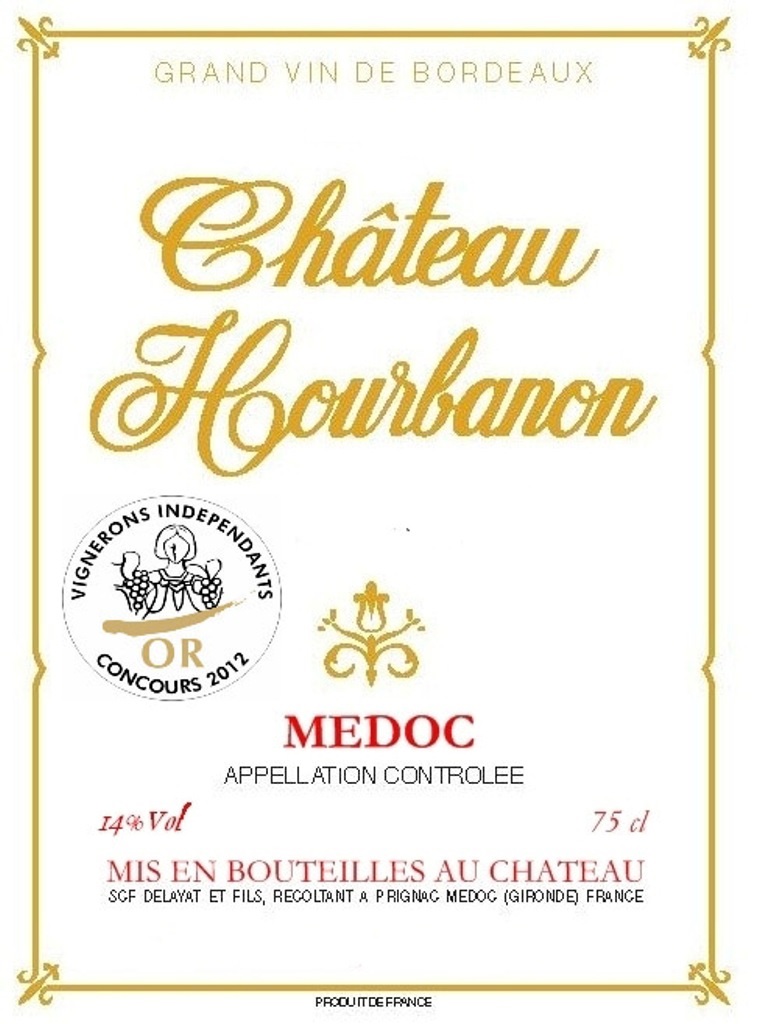
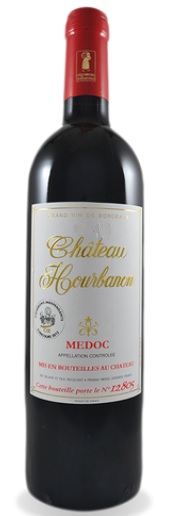
Chateau Hourbanon Medoc is made from 65% Cabernet Sauvignon, 30% Merlot, 5% Cabernet Franc
Aging: Aged 1 year on French oak
Tasting Notes: Straight attack in the mouth with supple, silky and harmonious tannins.
Very mature, Almost jammy fruits aromas with a touch of spicy notes.
Avg Age of Vines: 38 years
Review:
This densely textured wine is ripe with blackberry fruits over firm, smoky tannins. It has a generous feel to it, rich with fruitiness while just moving into a more mature mode. Drink this wine now for its forward fruit, although it will be even better from 2017. WE 90 Points
Chateau Hourbanon Estate
The vineyard Hourbanon appears in the 6th edition of Bordeaux and Its Wines, Editions Feret (the bible of Bordeaux wines), classified under the headings of Crus Artisans and Farmers in 1893. At that time the vineyard belonged to the Drouillet family, one member of whom was mayor of Lesparre.
In 1898, according to the 7th edition of Bordeaux and Its Wines, the vineyard became Cru Bourgeois, still belonging to the same family and producing 35 tons, or 31,500 liter, equivalent to 42,000 bottles
At that time, the operation is called Cru-Hourbanon, since at that time the Chateau La Cardonne was a neighbor located on the same road, 1km away. Unfortunately, the hardships of operating in the decades that followed is not known. It seems that the vineyard has had ups and downs with the same period of abandonment.
After their return from Algeria, the Montgaillard family acquired the vineyard. The Family Montgaillard operated this small area shared between the vineyards and some cows. They sold grapes to the cooperative, and the brand at that time fell into disuse somewhat.
In 1974 Rémi Delayat, the current owner’s father, acquired this vineyard. It was in pretty bad shape. This dentist from Yvelines, originally from Bresse and passionate about wine decided to restore the credentials in the vineyard of Hourbanon. Remi constructed a modern winery, and rehabilitated the old wine cellar for storing and aging wine bottles. He also renovated the farmhouse. All of this renovation work lasted several years, which his wife Nicole Delayat continued after the premature death of Remi in 1981.
Hugues, their son, took over in 1997. Having bathed in the passion of wine since childhood, he faces this trade directly in contrast to his parents. But certain constants have transcended generations : a passion for wine, respect for the land, and taste for wines of the Médoc.

All older vintage wines have been purchased from a single collectors cellar. Pictures can be requested before shipment.

Grand Veneur Chateauneuf du Pape Blanc Le Miocene is made from 60% Clairette, 40% Roussanne
Pale yellow colour with hints of green, aromas of white flowers (may blossom, honeysuckle).
The palate is pleasantly balanced between liveliness and roundness, which brings out characteristics of dried apricot, honey and elderberry. A Châteauneuf du Pape white displaying a great finesse.
Best between 1 and 8 years.
Soil type Coming from the single vineyard named “La Fontaine”, the plot is facing north.It is made of clay-sand and limestone. Thanks to the northern orientation, it is always very well aired. This sector allow the Roussane and Clairette to mature in great conditions without losing freshness, which we believe is key point. Winemaking & ageing Whole-bunch pressing. Vinification in stainless-steel tanks. Fermentation temperature controlled at 15°C.