" We don't sell the wine without touching the vine "

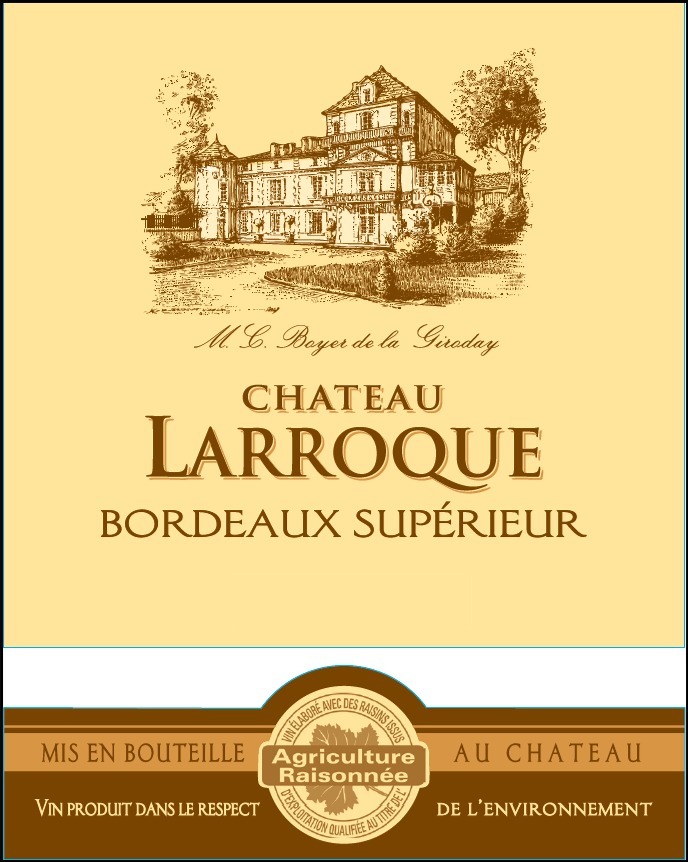
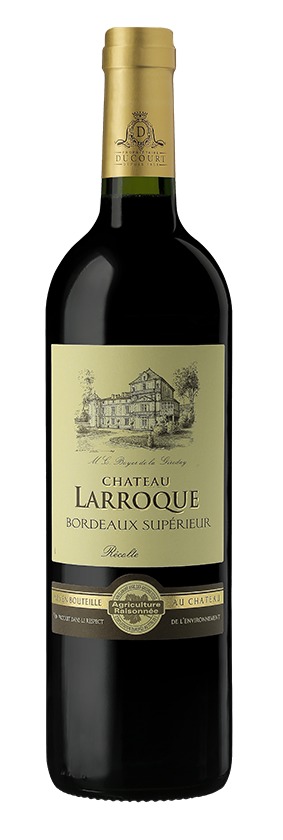
Chateau Larroque Bordeaux Superieur Rouge is a blend of 51% Merlot and 49% Cabernet Sauvignon.
Nose : Red fruits, almond and hazelnut, with a faint vanilla aroma.
Mouth : The silky, velvety attack reveals a pleasant, concentrated and well structured wine. It offers a combination of fruits pastes’ flavors, licorice and toasted notes, and an elegant finish.
The 60-hectare vineyard was rapidly replanted and the château building, which dates from 1348, was restored.
Our family now produces three different-colored wines there: red, white and rosé.
Fermentation : Alcoholic fermentation in thermo-regulated stainless steel vats at around 26°C / 78°F then a gentle vatting for 3 weeks at 30°C / 86°F. Running off and pressing,separation of the press and free-run juice. Malolactic fermentation in thermo-regulated stainless steel vats at around 18°C / 64°F
- 2017 Decanter World Wine Awards Decanter 95 Points
Color : Dark garnet hue
Marie-Christine, the daughter of Henri Ducourt, purchased this prestigious left-bank property in 1979, which lies on the border of the Graves appellation.
Grown on loamy-clay soil.
Macération : Pre-fermentation cold maceration of 24 to 48 hours
Enjoy this wine with charcuterie, roasted meats, BBQ, cheeses.

Larroque Bordeaux Blanc is made from 73% Sauvignon Blanc and 27% Colombard.
No oak.
Color : Pale yellow with green tints.
Nose : Complex aromas of white flowers, exotic fruits, citrus and boxwood, with a touch of minerality.
Mouth : Aromatic, with a nice richness and freshness. Predominant flavors of tart, crisp fruit.
Marie-Christine, the daughter of Henri Ducourt, purchased this prestigious left-bank property in 1979, which lies on the border of the Graves appellation.
The 60-hectare vineyard was rapidly replanted and the château building, which dates from 1348, was restored.
Our family now produces three different-colored wines there: red, white and rosé.
Grown on loamy-clay soil.
Harvest : Machine harvesting in the cool, early morning
Maceration : Skin-contact maceration for several hours, depending on ripeness, and pressing
Fermentation : Beginning of the cold alcoholic fermentation (12°C / 53°F) then an increase in temperature to finish the fermentation at 20°C / 68°F.
Enjoy this wine as an aperitif or during the meal with fish, seafood or chicken salad.
Larroque Bordeaux Blanc is made from 73% Sauvignon Blanc and 27% Colombard.
No oak.
Color : Pale yellow with green tints.
Nose : Complex aromas of white flowers, exotic fruits, citrus and boxwood, with a touch of minerality.
Mouth : Aromatic, with a nice richness and freshness. Predominant flavors of tart, crisp fruit.
Marie-Christine, the daughter of Henri Ducourt, purchased this prestigious left-bank property in 1979, which lies on the border of the Graves appellation.
The 60-hectare vineyard was rapidly replanted and the château building, which dates from 1348, was restored.
Our family now produces three different-colored wines there: red, white and rosé.
Grown on loamy-clay soil.
Harvest : Machine harvesting in the cool, early morning
Maceration : Skin-contact maceration for several hours, depending on ripeness, and pressing
Fermentation : Beginning of the cold alcoholic fermentation (12°C / 53°F) then an increase in temperature to finish the fermentation at 20°C / 68°F.
Enjoy this wine as an aperitif or during the meal with fish, seafood or chicken salad.
Larroque Bordeaux Blanc is made from 73% Sauvignon Blanc and 27% Colombard.
No oak.
Color : Pale yellow with green tints.
Nose : Complex aromas of white flowers, exotic fruits, citrus and boxwood, with a touch of minerality.
Mouth : Aromatic, with a nice richness and freshness. Predominant flavors of tart, crisp fruit.
Marie-Christine, the daughter of Henri Ducourt, purchased this prestigious left-bank property in 1979, which lies on the border of the Graves appellation.
The 60-hectare vineyard was rapidly replanted and the château building, which dates from 1348, was restored.
Our family now produces three different-colored wines there: red, white and rosé.
Grown on loamy-clay soil.
Harvest : Machine harvesting in the cool, early morning
Maceration : Skin-contact maceration for several hours, depending on ripeness, and pressing
Fermentation : Beginning of the cold alcoholic fermentation (12°C / 53°F) then an increase in temperature to finish the fermentation at 20°C / 68°F.
Enjoy this wine as an aperitif or during the meal with fish, seafood or chicken salad.
Larroque Bordeaux Blanc is made from 73% Sauvignon Blanc and 27% Colombard.
No oak.
Color : Pale yellow with green tints.
Nose : Complex aromas of white flowers, exotic fruits, citrus and boxwood, with a touch of minerality.
Mouth : Aromatic, with a nice richness and freshness. Predominant flavors of tart, crisp fruit.
Marie-Christine, the daughter of Henri Ducourt, purchased this prestigious left-bank property in 1979, which lies on the border of the Graves appellation.
The 60-hectare vineyard was rapidly replanted and the château building, which dates from 1348, was restored.
Our family now produces three different-colored wines there: red, white and rosé.
Grown on loamy-clay soil.
Harvest : Machine harvesting in the cool, early morning
Maceration : Skin-contact maceration for several hours, depending on ripeness, and pressing
Fermentation : Beginning of the cold alcoholic fermentation (12°C / 53°F) then an increase in temperature to finish the fermentation at 20°C / 68°F.
Enjoy this wine as an aperitif or during the meal with fish, seafood or chicken salad.

Xavier Vignon Chateauneuf-du-Pape Rouge Cuvee Anonyme 2019 is made from 60% Grenache, 15% Mourvedre, 10% Syrah and the rest is "field blend" with the following grapes : grenache, vaccarese, counoise, mourvèdre, terret noir and muscardin.
One of Xavier Vignon's first almost anonymous blends only in MAGNUMS !
The grapes come from "collection vines", where many grape varieties are planted together, making it difficult to identify the exact share of each variety: grenache, vaccarese, counoise, mourvèdre, terret noir and muscardin.
Partially destemmed and vinified in a mix of demi-muids and tank, it offers a beautifully pure, vibrant bouquet of black raspberries, white and black pepper, candied orange, and violets. Complex, layered, and nuanced, this beauty is medium to full-bodied, has a seamless texture, and a great finish. It has both elegance and richness, and will keep for 15+ years.
Pairing: Duck in sauce with olives. Ravioli with porcini mushrooms, cream of parsnip and bacon crisps. Partridge leg confit with olive oil.
Review:
"The flagship from Xavier is the 2019 Châteauneuf Du Pape Cuvee Anonyme, and in 2019 it’s 60% Grenache, 15% Mourvèdre, 10% Syrah, and the balance a mix of permitted varieties. Partially destemmed and brought up in a mix of demi-muids and tank, it offers a beautifully pure, vibrant bouquet of black raspberries, white and black pepper, candied orange, and violets. Complex, layered, and nuanced, this beauty is medium to full-bodied, has a seamless texture, and a great finish. It has both elegance and richness, and will keep for 15+ years."
- Jeb Dunnuck (October 2020), 95-97 pt
Chateau Larroque Bordeaux Superieur Rouge is a blend of 63% Merlot, 32% Cabernet Sauvignon and 5% Cabernet Franc.
Color : Dark garnet hue
Nose : Red fruits, almond and hazelnut, with a faint vanilla aroma.
Mouth : The silky, velvety attack reveals a pleasant, concentrated and well structured wine. It offers a combination of fruits pastes’ flavors, licorice and toasted notes, and an elegant finish.
Marie-Christine, the daughter of Henri Ducourt, purchased this prestigious left-bank property in 1979, which lies on the border of the Graves appellation.
The 60-hectare vineyard was rapidly replanted and the château building, which dates from 1348, was restored.
Our family now produces three different-colored wines there: red, white and rosé.
Grown on loamy-clay soil.
Macération : Pre-fermentation cold maceration of 24 to 48 hours
Fermentation : Alcoholic fermentation in thermo-regulated stainless steel vats at around 26°C / 78°F then a gentle vatting for 3 weeks at 30°C / 86°F. Running off and pressing,separation of the press and free-run juice. Malolactic fermentation in thermo-regulated stainless steel vats at around 18°C / 64°F
Enjoy this wine with charcuterie, roasted meats, BBQ, cheeses.
Review:
"An attractive nose of oak overlaying seductive dark red fruits with hints of blackcurrant leads into a complex palate with silky tannins. Soft, earthy flavours of dark cherry and currant matches silky tannins to finish."
- 2017 Decanter World Wine Awards Decanter 95 Points
Marie Christine, the daughter of Henri Ducourt, purchased this prestigious left-bank property in 1979, which lies on the border of the Graves appellation. The 60-hectare vineyard was rapidly replanted and the château building, which dates from 1348, was restored. The family now produces three different-colored wines there: red, white and rosé.
In 1858, Ducourt family settled at Château des Combes in Ladaux, a small rural village in the south east of Bordeaux, in the heart of Entre-Deux-Mers area. Over time, new generations have followed in their footsteps; a passion for wine has become a profession, and their knowledge and the estate have grown ever greater as they have been passed down the line.
Pierre Ducourt, then his children and his grand-children farmed several hectares of vines that belonged to the estate. The arrival of the grandfather, Henri Ducourt, at the property marked an important turning point in the family business. He, with the help of his three children (Marie Christine, Philippe and Bernard), decided to drastically revitalize the company and turned the family vineyard into one of Bordeaux’s largest winemaking facilities, with 450 hectares of land and 14 chateaus in 6 different AOC's.
The crocodile is the emblem of Henri Ducourt’s vigorous business spirit, which lives on today, as strong as ever, in each family member. And what better ambassadors could exist to remind people that Entre-Deux-Mers is where this family adventure began?
In 1962, Henri Ducourt, a young winemaker, used to work 14 hours a day managing the 20 hectares of vines he had inherited from his father. He had a good friend, his neighbor, who owned 14 hectares and used to work with his two sons. At this time, suffice to say that running a vineyard was not the career that parents wished for their children, preferring instead to steer them towards more stable jobs. Some though, including Henri, were obstinate and unwilling to part from the vineyard. So, hard-working and hard-headed, Henri Ducourt slowly but surely bought the land and the vines of the neighboring producers and found himself by the mid-80’s at the head of almost 300 hectares of vineyards! One day, as much to poke fun as through admiration, the son of his friend drew a crocodile on a sign to represent the tenacity, lucidity and cold-blooded business spirit of Henri Ducourt, then planted this sign among the far-reaching vines of his neighbor.
Amused by the gesture, Henri Ducourt was inspired by the crocodile when he rebuilt the winery and asked that the new vats were decorated with this symbol. Today, Henri’s children and grandchildren manage 450 hectares of vineyards, always persistent, ready for new challenges, and faithful to what their parents have built. The crocodile has since become the emblem of the family.
Graduated as Oenologist in 2002 (University of Toulouse).
Before joining Ducourt in 2014, he worked for various estates :
- Domaine de l’Hortus in Pic Saint Loup
- Les caves de Sieur d’Arques in Limoux
- Chateau Carbonnieux, Grand Cru Classé in Pessac Léognan
The Ducourt's have always known that quality grapes are essential for making a good wine. Therefore they take the utmost care in the vineyards, to get the best from every plot of land. The size of the business also allows them to make numerous investments in the latest tools, which enable to unite traditional knowledge with the latest technologies, and therefore become ever more precise and respectful of the environment in their work.
The latest equipment
They regularly invest in new equipment for two main reasons : a desire to constantly evolve and improve quality while reducing the amount of strenuous and dangerous work undertaken by their co-workers.
With the development of the vineyard's surface, the harvests are now carried out with the help of the latest generation of harvesting machines, which make it possible to collect the grapes in the cool of the morning. Harvest is quicker offering more flexibility and quality improvement.
Among the latest acquisitions is a machine that allows to plant using a GPS guidance as well as an innovative and precise spraying system and flexible frames that allow to reduce waste and the amount of treatment products used.
A Grand-Cru-worthy setup
The family invests in equipment that is worthy of a Grand Cru, and therefore push further in the constant quest for quality, which applies to the entire range of wines.
The new pressing system allows them to press the grapes in a completely inert environment to prevent any oxygenation of the juice and to preserve the aromas of each varietal, to obtain more intense and fresher wines. The wineries and the stainless-steel vats are thermo-regulated in order to keep the juice in the best conditions possible and to maintain complete control over the entire fermentation process. They have also invested in a cross-flow filtration system for filtering wines before bottling, which ensures optimal quality and no waste. Finally, to improve safety for the co-workers they also regularly invest in new equipment such as carbon-monoxide detectors, helping to prevent accidents including asphyxiation during the cleaning of the vats. The most recent investment to date involves the bottling line that was set up with the collaboration of the employees in order to reduce their workload.
6 generations of shared experience
They have the good fortune to be able to build on several generations of winemaking experience and produce wines that respect their local typicity. They frequently organize tastings of two old vintages so as to improve their understanding of the wines’ evolution over time, and so as to be able to really tell people when is the best time to drink the wines.

Lovely salmon pink color. A very delicate nose of strawberry and redcurrant fruit with floral undertones. There is a silky richness on the palate full of red berries balanced with a subtle bready texture. Very accessible. Will also develop nicely over time.
Colmant Brut Rose NV is made from 75% Pinot Noir and 25% Chardonnay
This wine spends a minimum of 24 months on the lees at a consistent temperature of 14C before degorgement.15% of the base wine has been barrel fermented.
Pinot Noir 75%, Chardonnay 25% (Franschhoek, Robertson and Elgin).
15% of the blend is made of reserve wine from the previous vintages and 15% of the base wine is barrel fermented.
This wine spends a minimum of 24 months on the lees at a consistent temperature of 14°C before degorgement.
Perfect as a summer sundowner. A delicious complement to white meat, strawberry dessert and decadent dark chocolate.
Review:
"The Brut Rosé (disgorged March 2018) is a blend of 75% Pinot Noir and 25% Chardonnay with 15% base wine and 15% reserve wine, with the Pinot Noir macerated on its skins for color, matured on the lees for 24 months. Deep salmon in color, it has a fine mousse and attractive strawberry and cherry scents on the nose - no shy and retiring rosé here. The palate is well balanced with Braeburn apples, hints of strawberry and a touch of tart cherries fanning out toward the creamy-textured, satisfying finish. A sparkling rosé that’s proud to be pink!- Neal Martin"
- Vinous (August 28th 2018), 91 pts

Rebuli Prosecco is a noble wine with a bright straw color, made from a selection of Prosecco grapes, which highlights the flavors and perfumes of the area. It is ideal for important occasions and as an aperitif. It is also excellent with risotto and noble meat.
"Pretty silvery straw color. Orange, juicy lemon, peach aromas with a crisp, lightly effervescent, fruity-yet-dry medium body and a long, tangy mineral, starfruit and spice accented finish. Exceptional flavorful, balanced and stylish. A perfect aperitif."
World Wine Championship Award: GOLD MEDAL
Beverage Testing Institute - May 9th 2011 - 91 points (Exceptional)
"Toasty, which makes this a little more champagnelike and perhaps more familiar to consumers. Nice balance; quite refreshing."
- Washington Post (Dec 08) - VERY GOOD
"This wine is so much fun that it seems vaguely illegal. Lightly floral in aroma, it shows fresh but restrained fruit flavors. The effervescence is abundant but soft, yet the wine remains structural and refreshing thanks to crisp acidity. Clearly the top pop for parties." - Washington Post (2006)
"Very pale straw. Very fine mousse. Nice elegant bead. Aromas of fresh bread dough, pear, touch of marzipan. Light attack. Semi-dry. Licorice note on palate. Soft, light. Simple, light pear flavors."
- International Wine Review (Dec 08)
This large Spumante estate with just over 100 acres of vines produces high-quality Prosecco. The non-vintage Rebuli Prosecco di Valdobbiadene Extra Dry is light-bodied and flowery with plenty of white peach, orange and pineapple notes in its exotic aromatics and flavors. It is off-dry, but most consumers would consider it to be a dry sparkling wine. Drink it over the next 12-18 months.-Robert Parker 90 Points

Produced from 100% Chenin Blanc planted on clay and flint stones based soils.
Vinification: aged in stainless steel tanks with temperature controlled fermentation. Aged on the lees for 4 months.
Kieselguhr filtration.
This sparking wine is fresh and fruity. Rich and easy to drink, which makes it a wonderful aperitif. For the aficionados this is an excellent food friendly wine. Its quality makes it a great alternative to Champagne.
"The two sparkling wines should not be missed. They’re both terrific examples of how good sparkling Vouvray can be. Both are 100% Chenin Blanc cuvees, with the non-vintage Chateau Gaudrelle Vouvray Brut showing lots of effervescence and plenty of flowery brioche, buttered citrus, melon and dried apricot notes. It is crisp, fresh, and ideal for drinking over the next several years."
-Wine Advocate 90 pts
"Just off-dry, this almond- and apple-flavored wine achieves a fine balance of crispness and richness. There is just a touch of honey, intertwined with delicious citrusy acidity."
- Wine Enthusiast , 90 pts

Opus One is made from 93% Cabernet Sauvignon, 4% Cabernet Franc, 1% Malbec, 1% Merlot and 1% Petit Verdot
Opus One 2021 is made from 93%, Cabernet Franc 4%, Petit Verdot 2%, Merlot 0.5%, and Malbec 0.5%.
The Opus One 2021 effuses seductive, dark-fruit aromas of crushed cassis, blackberry, and black cherry with subtle hints of violet, vanilla, and baking spices. Bright and fresh on the attack, concentrated flavors mirror the aromas and are coupled with an exceptionally plush, creamy texture in the mid-palate from the fine-grained tannins. Poignant notes of black tea, licorice, and dark chocolate lead to
Of the great European wine families, the Rothschilds are perhaps the best known. And Baron Philippe de Rothschild is perhaps the best known of this great family. At the age of 20, Baron Philippe took on the management of Château Mouton Rothschild from his father Baron Henri. Philippe’s vision changed the world of wine: he invented Château bottling, commissioned great artists to illustrate his wine labels – and, in partnership with Robert Mondavi in 1979, created Opus One.In the 1980s, after her father’s death, Baroness Philippine de Rothschild left a stage career that included the Comédie Française and the Renault-Barrault Theatre Company, bringing her own exquisite style and creativity to the design, construction, and operation of Opus One.Among great New World wine pioneers, Robert Mondavi is an international icon. Bringing a passion for excellence to everything he did, Robert Mondavi led a renaissance in California fine wine for over six decades. Among other accomplishments, he introduced temperature-controlled fermentation, French oak barrel aging, and high-density viticulture to a fledgling American wine industry. But life was not only wine for Robert Mondavi: he broadened the American cultural palate by marrying fine wine to food, music, and the arts. One of few Americans to have received the French medal of the Legion of Honor, Robert Mondavi showed extraordinary vision as co-founder of Opus One.
Review:
An enticing aroma of violets, cherry blossoms, fresh blue and black fruit and great structure define this beautiful, age-worthy wine. Subtle layering of fruit and oak spices between firm, fine-grained and supportive tannins gives it a calm intensity. So elegant and polished. Hints of cinnamon and graphite accent blackcurrant and blueberry flavors that linger and grow in a long finish. Already attractive to drink, but best after 2029.
-James Suckling 99 Points

Mordoree Tavel Rose Dame Rousse is made from Grenache 60 %, Cinsault 10%, Syrah 10 %, Mourvèdre 10%, Clairette 5%, and Bourboulenc 5%.
Nose : steady rose, brilliant and limpid.
Aromas : very complex with flowers, red and white fruits aromas.
Palate : rounded, full bodied with a long lasting aniseed and fruity finish.
Ageing potential : 4 to 6 years
Surface : 9 Ha. Yield : 44 Hl./Ha. Vineyard age : 40 years Terroir : Clay / chalk and sandy with pebble stones. Harvest : by hand Vinification : 100% destemming, cold maceration during 48 h., pneumatic pressing, fermentation at 18° C. Estate bottle
Food pairing: cold meat and delicatessen, poultry, white meats, grilled meats, fried fish, fish soup, pastas, pizzas and all Asian cuisine.