
" We don't sell the wine without touching the vine "
| BUY MORE! SAVE MORE! | ||||||||||||||||||||
|
| Country: | France |
| Regions: | Rhone Chateauneuf du Pape |
| Winery: | Clos Saint Jean |
| Grape Type: | Grenache |
| Organic: | Yes |
| Vintage: | 2021 |
| Bottle Size: | 750 ml |
Clos Saint-Jean is a 41-hectare estate in Châteauneuf-du-Pape run by brothers Vincent and Pascal Maurel. Considered by many critics and wine-writers as the preeminent estate espousing the modern style of winemaking in Châteauneuf, this cellar is one of the oldest in the region, having been founded in 1900 by the greatgreat-grandfather of Vincent and Pascal, Edmund Tacussel. A short time after its founding and well before the AOP of Chateauneuf-du-Pape was created in 1923, Edmund began bottling estate wines in 1910.
The farming at Clos Saint-Jean is fully sustainable due to the warm and dry climate, which prevents the need for chemical inputs. Instead, Vincent and Pascal employ organic methods for pest control, mainly pheromones, to prevent pests from taking up residence in their vines, a process called amusingly enough in French, confusion sexuelle. The vines tended manually, and harvest is conducted in several passes entirely by hand.
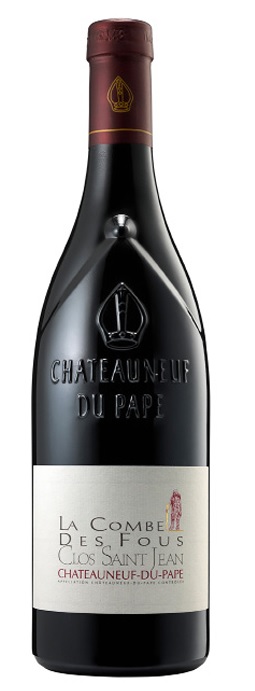
Combe des Fous literally means, the hill of the fool. The hill, in this case, is located in the far southern reach of Le Crau which was left barren for many centuries because the layer of galets was so exceedingly deep that everyone assumed vines could never survive there. The fool in this situation is Edmund Tacussel, the great-great-grandfather of Vincent and Pascal Maruel who planted a Grenache vineyard on this site in 1905. That old-vine Grenache form the heart of this cuvée with a small amount of Syrah, Cinsault and Vaccarèse. La Combe des Fous is only made in the best vintages.
Review:
This has good concentration and energy to the dense core of dark fruit and bitter cherry, with great poise and elegance despite its ripeness (an impressive feat for the vintage). Guided by finely crushed mineral accents and tannins, this reveals pretty high-toned floral notes and leafy tobacco. Grenache, Syrah, Mourvedre, Cinsault, Vaccarese and Muscardin. Drink now through 2032. 900 cases made.
-Wine Spectator 95 Points
“This may well be one of the most exciting addresses not only in France, but in the entire wine world.... In short, these wines are not to be missed!”
– ROBERT PARKER
Once harvested, the grapes are transported to the cellar in small bins. The white varieties are pressed directly with Grenache Blanc and Clairette being fermented and aged in stainless steel tanks while the Roussanne is fermented and aged in barrel. The reds are almost entirely destemmed with about 10% whole clusters retained. Fermentation follows in concrete vats. Macerations are long, averaging 35 days on the skins. The Grenache sees a gentle maceration with delestage, while the Syrah and Mouvredre receive pigeage. All of the Grenache is aged in concrete with the exception of Sanctus Sanctorum, a single plot of old-vine Grenache, that in exceptional vintages, is aged in demi-muid and bottled only in magnum. Syrah and Mourvedre are aged in barriques and demi-muids. Aging for all the reds is about 12 months. The Châteauneuf-du-Pape Vieilles Vignes in bottled especially for European Cellars and is selected by the brothers with input from Philippe Cambie and Eric Solomon. In addition to the Sanctus Sanctorum, two additional small cuvées are made: La Combe des Fous and Deus ex Machina – each sourced primarily from Le Crau, the power and finesse of which is apparent in both wines. The Deus ex Machina is deepened with the inclusion of the old vine Mourvedre that the Maurels farm on the sandy soils of Bois–Dauphin.
Clos Saint Jean is a 41 hectare estate in Châteauneuf-duPape run by brothers Vincent and Pascal Maurel. Considered by many critics and wine-writers as the preeminent estate espousing the modern style of winemaking in Châteauneuf, this cellar is one of the oldest in the region having been founded in 1900 by the great-great-grandfather of Vincent and Pascal, Edmund Tacussel. A short time after its founding and well before the AOP of Chateauneuf-du-Pape was created in 1923, Edmund began bottling estate wines in 1910. The various vineyards of Clos Saint Jean are located primarily in the region of Le Crau. This plateau is perhaps the most iconic of the many terroirs of Châteauneuf-duPape – iron-rich red clays topped with galets. While about 60% of their vineyards are located here, specifically in the lieu-dits of Côteau de Saint Jean and Cabane de Saint-Jean, another 40% are located in alluvial clay and sandy soils adjacent to the plateau. They also own a small parcel of Mourvedre in the lieu-dit of Bois-Dauphin near Château Rayas planted on sandy, limestone-rich soils. The farming at Clos Saint Jean is fully sustainable due to the warm and dry climate which obviates the need for chemical inputs. Vincent and Pascal employ organic methods for pest control, mainly pheromones to prevent pests from taking up residence in their vines a process called amusingly enough in French, confusion sexuelle. The vines are also worked manually and harvest is conducted in several passes entirely by hand.

Clos Saint-Jean is a 41-hectare estate in Châteauneuf-du-Pape run by brothers Vincent and Pascal Maurel. Considered by many critics and wine-writers as the preeminent estate espousing the modern style of winemaking in Châteauneuf, this cellar is one of the oldest in the region, having been founded in 1900 by the greatgreat-grandfather of Vincent and Pascal, Edmund Tacussel. A short time after its founding and well before the AOP of Chateauneuf-du-Pape was created in 1923, Edmund began bottling estate wines in 1910.
The farming at Clos Saint-Jean is fully sustainable due to the warm and dry climate, which prevents the need for chemical inputs. Instead, Vincent and Pascal employ organic methods for pest control, mainly pheromones, to prevent pests from taking up residence in their vines, a process called amusingly enough in French, confusion sexuelle. The vines tended manually, and harvest is conducted in several passes entirely by hand.
Deus ex Machina is a literary and dramatic term for a miraculous intervention that interrupts a logical course of events in a plot or play. A suitable name for a cuvée that had it’s start in the torrid vintage of 2003 when Philippe Cambie and Vincent Maurel made the decision to harvest at the end of September, weeks after their neighbors. Deus ex Machina is a blend of old vine Grenache from La Crau, aged in tank with equally ancient Mourvedre from the sandy soils of BoisDauphin aged in demi-muid. Deus ex Machina is only made in the best vintages.
Review:
Lastly, the 2022 Châteauneuf Du Pape Deus-Ex Machina shows a similar profile to the Combes des Fous, yet it brings another level of tannins and concentration. Kirsch liqueur, white flowers, sandalwood, cured meats, and graphite notes all shine here, and it's full-bodied, has a deep, layered, powerful, yet weightless profile, lots of ripe tannins, and a blockbuster of a finish. This ripe, sexy, seamless, incredibly impressive beauty will compete with anything in the vintage. As usual, this cuvée is 60% Grenache and 40% Mourvedre, which is brought up in roughly 40% new demi-muids.
Review: Jeb Dunnuck 97 Points

La Despensa Boutique Cinsault is made from 100% Cinsault.
A genuinely unique wine - they are the only producers of Cinsault in Colchagua! From a new vineyard planted in 2017, the team at La Despensa thinks they’ve hit the jackpot with this variety in this valley. Much more structure, color and intensity than the typical Chilean Cinsaults from further south, this is an easy drinking but serious version of this wonderfully fruity variety!
Review:
"Apparently the first and only Cinsault from Colchagua, the 2021 Boutique Cinsault was produced with vines planted in 2017 and worked organically (but is not certified), and it's much darker and more structured than the examples from the south. It fermented in concrete with selected yeasts and went through malolactic in stainless steel and then 60% of the volume matured in used barriques for six months. It has 13.5% alcohol and kept good freshness, and it's varietal, balanced and easy to drink but not banal. 1,200 bottles were filled in March 2022. - Luis Gutiérrez"
- Robert Parker's Wine Advocate (April 2023), 91 pts

La Despensa Boutique Pool Blend 75% Cinsault, 15% Pais, 5% Marsanne and 5% Roussanne.
A genuinely unique wine - La Despensa is the only producer of Cinsault in Colchagua and Pais from this valley is also extremely rare! The Cinsault and the 2 whites come from a new vineyard planted in 2017 and the Pais from a 150 year old, dry-farmed vineyard in Pumanque about 20 minutes from the winery that they run themselves organically. The Cinsault and Pais give notes of raspberry and strawberry and the white Roussanne and Marsanne a little mouthfeel and a hint of tropical fruit.
Organically grown grapes (not certified) from our own vineyard in Santa Ana, and Pumanque in the Colchagua Valley. Irrigated as sparingly as possible via drip irrigation (dry-farming for the 150 year old Pais). Hand harvested and sorted personally by me in the vineyard (I personally check every single bunch), then destemmed with the crusher removed from the destemmer. Grapes are fermented in open top bins and concrete tank and blended immediately after pressing. MLF occurs with the wine already blended. Wines are racked in November and again in January before being bottled after about 10 months ageing in 50% neutral oak barrels and 50% Flextank.
Versatile, goes well with beef, chicken, pasta, great for Summer BBQs
Review:
"The red blend 2021 Wines Pool Blend was produced with an unusual blend, especially for a wine from Colchagua, of 75% Cinsault, 15% País and 5% each Marsanne and Roussanne. It has kept a moderate 13.5% alcohol and retained good freshness (pH 3.44) after maturing exclusively in Flextank and being bottled unoaked. This is fruit-driven and straightforward, with a medium-bodied palate and fine tannins. 2,400 bottles produced. It was bottled in March 2022. - Luis Gutiérrez"
- Robert Parker's Wine Advocate (April 2023), 90 pts

La Despensa Boutique Field Blend is made from 45% Grenache, 35% Syrah, 15% Mourvedre and 5% Roussanne.
This is La Despensa's flagship Rhône-blend, produced from grapes from their own, organic vineyard in Colchagua. Their passion is to produce very high-quality grapes - it’s the vineyard work that they love the most. So this blend is always a little different year after year, as they make whatever the vineyard gives them. In 2020 they incorporated a little Roussanne to the blend, which adds some mouthfeel and a tiny background note of tropical fruit, to accompany the fresh fruit and structure that the other varieties bring out.

Mordoree Chateauneuf-du-Pape La Reine des Bois is made from Grenache 75 %, Mourvèdre 10%, Syrah 10 % , Counoise 3% & Vaccarese 2%.
This premium cuvee - whose name means "Queen of the Woods" - is from 65-year-old vines, planted on Villafranchian-era terrasses. Yield is 30 hl/ha.
Deep ruby red; opaque. Aromas of red fruits change to wooden touches of leather, black truffles and coffee. Fat, concentrated and full flavored with a very long liquoriced and fruity finish.
Pairs with red meats, sauce dishes, game animals (woodcock, wild boar) and semi mature cheeses.
Review:
"The 2019 Châteauneuf Du Pape Cuvée De La Reine des Bois is a deeper, more masculine wine with gorgeous cassis and blackberry fruits as well as graphite, licorice, crushed stone, violets, and lavender nuances. Rich, full-bodied, and incredibly concentrated, it has a brilliant sense of freshness and purity as well as length on the finish. It's going to require 4-5 years of bottle age, but this straight-up thrilling Châteauneuf du Pape will have 20-25 years of prime drinking."
- Jeb Dunnuck (November 2021), 98+ pts

Alain Jaume Domaine du Clos de Sixte Lirac is made from 50% Grenache, 35% Syrah, 15% Mourvedre
An intense red garnet color. On the nose, aromas of red and black ripe fruit (kirsch and wild blackberry). The mouth is full, with aromas of blackcurrant liqueur and spice. Tannins are both harmonious and elegant thanks to the fleshiness of the wine. Hints of licorice and vanilla on the finish, which gives the wine length and complexity.
Soil type LIRAC vineyard is facing Chateauneuf du Pape, opposite side of the Rhône river. As showed by the picture and following geologist George Truc, soils are almost similar in both side. They are marked by the violence wrought by the Rhone river. It consists of a layer of marine molasses of the Miocene period covered by alpine alluvium. The presence of a great number of rounded stones known as "galets" in the earth is evidence of the time when the Rhone, then a torrent, tore fragments of rock from the Alps and deposited them on the plain. LIRAC is one of the up-coming best area from the southern Rhône valley, as it delivers outstanding wines. Winemaking & ageing Traditional wine-making in stainless still vats. Hand sorted bunches, crushed and destemmed grapes. Fermentation temperature : 30°C. 18 days of vatting with pigeages.

Cattail Creek Cabernet Sauvignon North Coast is made from 100 percent Cabernet Sauvignon.
A bold and structured Cabernet Sauvignon from California's North Coast, sourced from cooler hillside vineyards that deliver beautiful fruit with good acidity. The nose opens with classic Cabernet notes of dark berries, graphite, and hints of black olive. The palate offers concentrated blackberry, plum, and almond wood, with loads of tannin structure that will age beautifully. This well-balanced Cabernet with great purity can be enjoyed now or cellared for further development.



