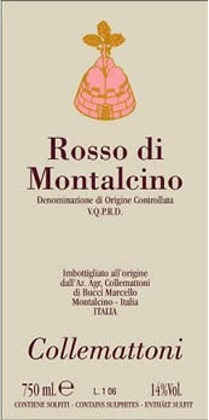
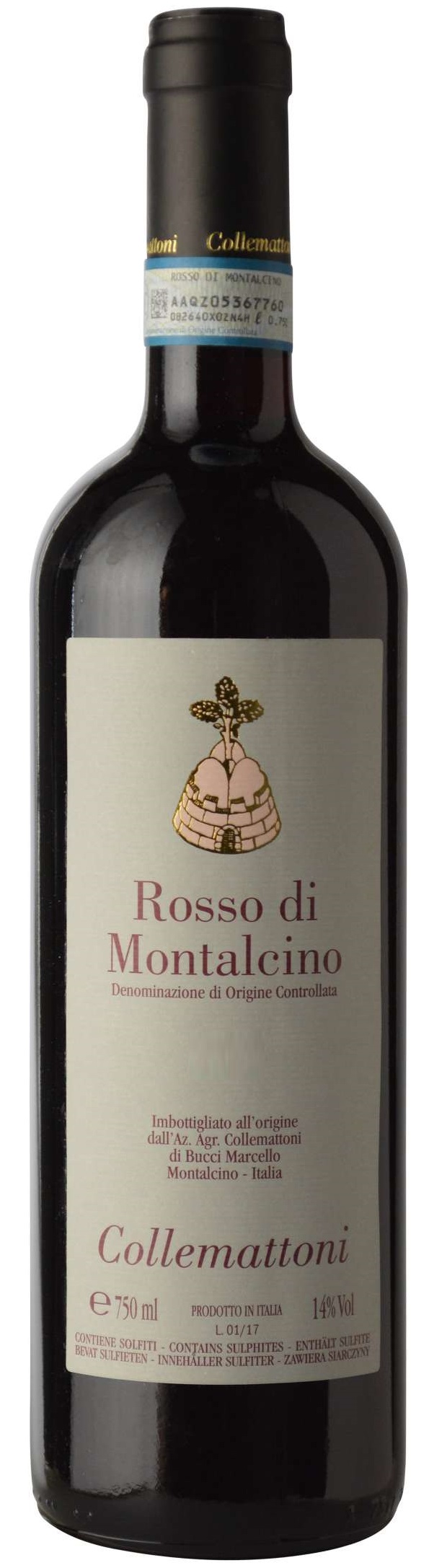
" We don't sell the wine without touching the vine "
| Country: | Italy |
| Region: | Tuscany |
| Winery: | Collemattoni |
| Grape Type: | Sangiovese |
| Vintage: | 2019 |
| Bottle Size: | 750 ml |

Color: intense ruby red.
Bouquet:violet flowers, black cherry and wild black fruits.
Taste: warm, dry and with good balance.
Coming from a parcel with 8-13 year old vines planted in sandy clay and marl soils.
Harvest is 100% destemmed with a soft pressing, fermentation in stainless steel tanks at controlled temperature of 28-30°C, pumping over for the first week of maceration followed by skin-contact maceration for 20-25 days with rack and return technique (delestage).
Malolactic fermentation completed.
Wine is slightly filtered before bottling.
Pairs with steak, pheasants and strong cheese.

Collemattoni Brunello di Montalcino is made from 100 percent Sangiovese.
Color: brilliant red with burgundy reflects; Bouquet: penetrating with memories of wild black fruits, black cherry and noble wood; Taste: warm, dry and persistent
Coming from a parcel with 10-15 year old vines planted in sandy clay and marl soils.
Harvest is 100% destemmed with a soft pressing, fermentation in stainless steel tanks at controlled temperature of 28-30°C, pumping over for the first week of maceration followed by skin-contact maceration for 20-25 days with rack and return technique (delestage).
Malolactic fermentation completed.
Wine is slightly filtered before bottling.
Collemattoni Brunello di Montalcino is made from 100 percent Sangiovese.
Color: brilliant red with burgundy reflects; Bouquet: penetrating with memories of wild black fruits, black cherry and noble wood; Taste: warm, dry and persistent
Coming from a parcel with 10-15 year old vines planted in sandy clay and marl soils.
Harvest is 100% destemmed with a soft pressing, fermentation in stainless steel tanks at controlled temperature of 28-30°C, pumping over for the first week of maceration followed by skin-contact maceration for 20-25 days with rack and return technique (delestage).
Malolactic fermentation completed.
Wine is slightly filtered before bottling.
Review:
"Black cherry and plum with a touch of smoke , vanilla. And toast on the nose. Powdery tannins coat the mouth and has a long persistence. Powerful and fresh while a little warming on the finish."
- Decanter Wolrd Wine Awards (June 2023), 97 pts

Collemattoni Brunello di Montalcino Riserva is made from 100 percent Sangiovese.
Intense ruby red with brilliant burgundy reflects in color. Reminiscent of wild black fruits, vanilla and spices on the nose and dry, warm, slightly austere but velvety in the palate.
This wine comes from the oldest vineyard of Collemattoni: Fontelontano. Less than half hectare. It's one of the few Single Vineyard Brunello di Montalcino riserva.
Coming from a parcel with 15-18 year old vines planted in sandy clay and marl soils.
Harvest is 100% destemmed with a soft pressing, fermentation in stainless steel tanks at controlled temperature of 28-30°C, pumping over for the first week of maceration following by skin-contact maceration for 20-25 days with rack and return technique (delestage).
Malolactic fermentation completed. The delestage and the pumping over are then spaced out along the process.
Wine is slightly filtered before bottling.
Review:
This is intense with aromas of dried cherries, sweet licorice, cloves, crushed walnuts and hints of chocolate and undergrowth. Full-bodied, deep and structured with taut, tightly packed tannins. Long and persistent. Drink or hold.
-James Suckling 94 Points

Tenute Silvio Nardi Brunello di Montalcino is made from 100 percent Sangiovese.
Quite intense ruby red color with garnet highlights. Intense and complex aromas at the nose, rich in ripe fruits, spices and toasted notes. Smooth and bodied at the palate, with great persistence, elegant and wide concentration. Tannins are dense and velvety.
Reviews:
Blackberry, black-truffle and black-cherry aromas follow through to a medium body with juicy fruit and a long, flavorful finish. Polished, pretty tannins here. Nicely crafted. Drink after 2026.
-James Suckling 94 Points
In the bottle with the burgundy-colored label, the Tenute Silvio Nardi 2019 Brunello di Montalcino is a layered and generous wine with black fruit, cherry, spice and a hint of Provençal mixed herbs on black olive. There are further hints of underbrush, crushed slate, petrichor from schistic soils, and toasted almond that adds some sweetness from French oak. The tannins are velvety and soft, but this wine is regularly balanced throughout. It's well made in an ample production of 150,000 bottles.
- Robert Parker's Wine Advocate 94 Points
A spicy version, whose black pepper and Szechuan peppercorn notes highlight the core cherry and strawberry flavors. Underbrush and iron accents also enter the mix, while this stays balanced and long as the tannins leave their grip on the finish.
-Wine Spectator 94 Points

Tenute Silvio Nardi Rosso di Montalcino is made from 100 percent Nebbiolo.
Intense ruby red color. Aromas characterized by hints of ripe red fruits, and hints of spices. On the palate it is warm, soft, and full with strong but velvety integrated tannins. Good persistence.
Pairs with meat, cheese, and game.
Color: intense ruby red.
Bouquet:violet flowers, black cherry and wild black fruits.
Taste: warm, dry and with good balance.
Coming from a parcel with 8-13 year old vines planted in sandy clay and marl soils.
Harvest is 100% destemmed with a soft pressing, fermentation in stainless steel tanks at controlled temperature of 28-30°C, pumping over for the first week of maceration followed by skin-contact maceration for 20-25 days with rack and return technique (delestage).
Malolactic fermentation completed.
Wine is slightly filtered before bottling.
Pairs with steak, pheasants and strong cheese.
Review:
"Aromas of violet, baking spice and underbrush emerge from the glass. The savory palate shows dried black cherry, star anise and clove alongside polished tannins. Drink through 2026. - KERIN O’KEEFE"
- Wine Enthusiast (July 2022), 90 pts
Collemattoni takes its name from the farmhouse, which, over time, has become the trademark of our winery and of our wines. The farmhouse dates back to at least 1672, year in which it is registered in the parish archives as a family home. Collemattoni is located on a hill top on the south side of the municipal area of Montalcino, just a short distance from the village of Sant’Angelo in Colle.
At the beginning of 1980, Adon Bucci ( father of Marcello Bucci) bought the land and the farm house from the Church and the Bucci family started to produce wine. The 1988 has been the first vintage of Collemattoni Brunello di Montalcino.
Azienda Agricola Collemattoni owns 12 hectares:
7.5 hectares of Sangiovese grown in the villages of Collemattoni (2.5ha), Fontelontano (0.5ha), Sesta (2.70ha) and Cava (1.80ha).
The 4.5ha of Merlot, Canaiolo, Colorino and Trebbiano are all grown in the village of Orcia.
The age of the vines ranges between 5 years old for the youngest and 18 years old for the oldest vineyards.
The have been using organic farming methods for several years and the 2016 vintage will bear the organic certification.

Cortenova Prosecco Spumante NV is 100 percent Prosecco
This Prosecco comes from the highly esteemed area of Valdobbiadene. There are two recognized quality zones for Prosecco, Conegliano and Valdobbiadene. Of the two, Valdobbiaden has always been recognized a having the superior quality due to its naturally higher acidity and its more northern location.
The vineyards lie at 350 meters above sea level. The vines are an average of 25 years old.
The grapes are soft pressed and the free run juice is placed in stainless steel. There is a brief maceration period of 4 hours. Specially selected yeast are added and fermentation is controlled at 20° C. There is no malolactic fermentation and the wine is transferred to autoclaves and a second fermentation is induced following the Charmat tradition. When the desired atmospheric pressure is reached (usually 1 month) the wine is bottled.
Light straw colored with greenish reflections. The perlage is fine and continuous. Fragrant bouquet full of flowers and almonds. In the palate it is fresh and clean with a soft body and a pleasing sparkle. The fruit is subtle and reminiscent of apples and pears with a hint of almond in the background. The finish is inviting.
Can be drunk by itself as an aperitif or with seafood and fish, pastas with cream sauces, chicken and fresh cheeses.
Review:
"Pale straw color. Bright, attractive aromas and flavors of roasted lemons and kiwis, green nectarine, nougat, and grass with a soft, vibrant, spritzy, dry-yet-fruity medium body and a tingling, complex, medium-length spiced clementine and delicate herbal honey finish with silky, crunchy, fruit tannins and no oak. A delicious, nicely layered Prosecco with an elegant style." - Beverage Testing Institute (November 23rd 2015), 91 pts, Best Buy

Rubus Reserve Pinot Noir Russian River is made from 100 percent Pinot Noir.
The Rubus Project was created by Fran Kysela as a way to source & sell incredible wines at value prices. All wines in this international project are hand-selected by Fran Kysela. Rubus wines are fruit driven, true-to-type values that over deliver - a true representation of quality for the consumer at an excellent price.
Rubus Reserve Pinot Noir is sourced from Russian River Valley. It shows complexity with raspberry and cherry notes that dance on the tongue.
-150x300.jpg "Lexicon Cabernet Sauvignon Napa Valley 2020")
Lexicon Cabernet Sauvignon Napa Valley is made from 100 percent Cabernet Sauvignon.
Lexicon varietal wines are carefully selected by Fran Kysela to show the essence of each variety, along with its terroir of origin, both of which are essential elements of a good wine.
Lexicon Cabernet Sauvignon offers rich and concentrated fruit aromas of red and black currant, cassis and black cherry along with black pepper and dried herb accents. It is soft and generous in the mouth, intense and complex, with supple tannins and elegant structure.
Pair with: Grilled meat, ribeye steak, filet mignon, roasted lamb with fresh herbs, cheesburger, semi-hard cheeses, truffled brie, portobello mushrooms.

Jean-Michel Sorbe Quincy Blanc is made from 100 percent Sauvingon Blanc.
The first nose is expressive and opens up to notes of acacia, citrus (lemon, grapefruit). Full on the palate with lovely freshness. This wine boasts nice balance and good length.
The vines are 15 to 20 years old and are located on the left bank of the Cher River, southwest of Quincy. This vineyard enjoys good exposure to the sun and overlies hillocks composed of sandy alluvial deposits and gravel dating back to the Quaternary Period. Each terroir is managed with minimal intervention in an environmentally friendly approach. Vinification: Slow pressing. Fermentation took place under controlled temperatures (18°C).The wine was aged on fine lees for a minimum of 4 months. It was filtered only once before being bottled.
Pair with crustaceans, asparagus, or goat's cheeses.
After pouring, allow the wine to breathe for a few moments in the glass before enjoying so that it may fully release all of its aromas.

This California Cabernet Sauvignon has rich flavors with a hint of black currant and cherry. The tannins are soft, leading to a smooth finish with a hint of oaked vanilla and a touch of eucalyptus/mint freshness.
100% California AVA Cabernet Sauvignon.
Average age of the vines: 15 years.
Picked at premium ripeness. Fermented in static tanks with pump-overs three times per day.
Aged five months French oak Barrels.
Alcohol: 13.5%
RS 0.5 g/l
TA 5.7 g/l
Serve this deep purple hued beauty with a variety of hearty dishes ranging from Osso Bucco to grilled red meats and cheeses.