" We don't sell the wine without touching the vine "
| Country: | France |
| Region: | Burgundy |
| Winery: | Maurice Ecard |
| Grape Type: | Pinot Noir |
| Organic: | Yes |
| Vintage: | 2014 |
| Bottle Size: | 750 ml |
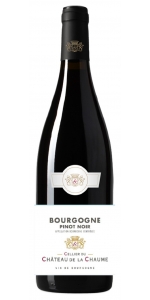
Chaume Bourgogne Rouge Pinot Noir 2022 is made from 100% Pinot Noir.Color: bright ruby red
Bouquet: blackcurrant, raspberry and hints of blackberry
Bouche / Palate: smooth attack, balanced, fine tannins and smooth finish
Butterflied lamb, char-grilled steak, venison. Dishes like cassoulet or duck with olives if they're more rustic. Roast goose.
Bavencoff Bourgogne Pinot Noir is made from 100 percent Pinot Noir.
Color of medium intensity, purplish in its youth at present, changing to ruby then garnet, after several years in the bottle.
The nose offers intense aromas of cherries, kirsch and fresh strawberry. The palate is the perfectly balanced between round tannins and an elegant freshness. It is harmonious and medium-bodied with a silky and elegant texture and a delicious lingering finish.
Alcoholic fermentation in stainless tanks for 3 weeks. Malolactic fermentation : 80% in stainless tank and 20% in one year old casks (Allier).Manual harvest.
Produced from 100% Pinot Noir planted on clay and limestone soils.
Grilled or boiled red meats, roasts, mild game, soft cheeses like Camembert and Brie.
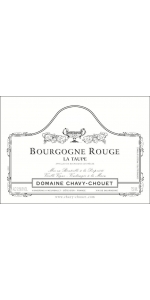
Chavy-Chouet Bourgogne Rouge La Taupe is made from 100 percent Pinot Noir.
Chavy-Chouet's Pinot Noir is classified as humble Bourgogne Rouge, but the fruit for it comes from an excellent single-vineyard site near Pommard. La Taupe's parcel was once part of the Pommard AOC.
The wine is juicy with a great mouthfeel. It has classic Bourgogne Rouge aromas, with a candied cherry character as well as strawberry, raspberry and spice, yet the structure and length of finish reminds one of a Pommard - ripe & rich with a bigger body.
Average age of the vines: 70 years old.
Density of planting: 10,000 vines per hectare.
Soil: clay
100% distemmed.
Very little intervention. Less pigeage (punch down of the cap) but some remontage (pump-over)
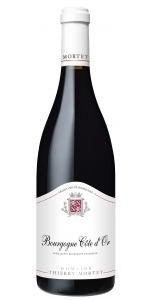
Mortet Bourgogne Cote d'Or Rouge is made from 100 percent Pinot Noir.
A parcel of 90 ares, one part is 20 years old and the other part is 55 years old. Its is called Les Pressonniers, in Gevrey-Chambertin.
Bourgogne Rouge Côte d’Or comes from a plot of Gevrey-Chambertin vines, giving delicate fruit and body, as well as the character and complexity of the Gevrey-Chambertin terro
Mortet Bourgogne Cote d'Or Rouge is made from 100 percent Pinot Noir.
A parcel of 90 ares, one part is 20 years old and the other part is 55 years old. Its is called Les Pressonniers, in Gevrey-Chambertin.
Bourgogne Rouge Côte d’Or comes from a plot of Gevrey-Chambertin vines, giving delicate fruit and body, as well as the character and complexity of the Gevrey-Chambertin terro
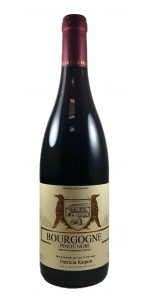
Patricia Raquin Bourgogne Rouge Fut de Chene is made of 100 percent Chardonnay.
The animals shown on the label are dogs, from the breed called Borzoi, or "Russian Wolfhound", which means "fast" in Russian. Patricia and Alain Corcia are the proud owners of 2 Borzois and they designed the label to represent the dogs as the guardians of the vaulted ageing cellar inside their house.
The wine is produced from 100% Pinot Noir grapes grown on gravel and silt soils, aged in French oak barrels. Medium to full bodied, earthy, fruity and mineral. Structure and tannin on the finish. The wine pairs well with any hearty red meats and cheeses.
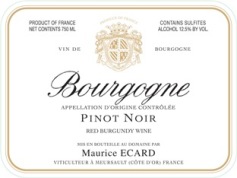
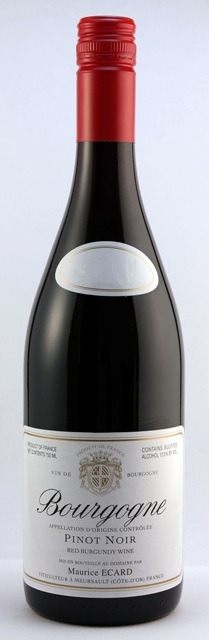
Ecard Maurice Bourgogne Rouge Pinot Noir is 100 percent PInot Noir.
Supple, fresh red wine with distinct fruitiness and showing a lot of the characteristics of the terroir from where the vines are situated with cherry, blackcurrant and raspberry aromas. Discreet tannins in the flavors give a more feminine image.
Growing in light and stony soil made up mainly of clay. The alcoholic vinification takes place in stainless steel vats followed by malolactic fermentation and aging for 6 months in 2 – 4 year old oak barrels.
A good all round red wine for meat courses, grills, barbecues and light cheeses.
The Maurice Ecard Estate
The Domaine dates back to before 1789 and produces some of the best Premiers Crus in Savigny. Owner Maurice Ecard, who is now retired, was considered by many experts to be the father of the appellation.
His wines are now produced by Vincent Sauvestere. Vincent's paternal family has been firmly established in Meursault since the 18th Century. His father and grandfather were both "Maitres de Chais" for one of the most prestigious Wine Houses in the heart of Meursault. Vincent's father, Roger, created his own company in the early fifties with the acquisition of a Wine Merchant founded in 1891. He also had his own vines, inherited from his mother. In 1988, Roger handed over the running of the company to Vincent. When Vincent, born in Nuits Saint Georges in 1961, took control of the Domaine, it consisted of only 6 hectares (14.81 acres) of vines. Today the Domaine covers 40 hectares (98.77 acres) from Chablis to Meursault. In addition, Vincent has acquired other viticultural Domaines in Chablis, the Côte Chalonnaise and recently in the Rhone Valley.
The Domaine is proud to possess two Grand Cru wines, Corton Charlemagne & Corton Marechaudes, as well as twelve Premiers Cru wines. Through his family's traditional winemaking skills, passed down from generation to generation, and his years of oenological studies, Vincent now advocates:
- Expression of the unique terroir characteristics from each individual vineyard by using traditional winemaking methods.
- Well structured and easy drinking Burgundies :
- Pleasing to the eye
- Soft and supple flavors
- Lingering aftertaste with excellent ageing attributes.
Vincent's constant aim is quality and respect for all wines.
The Maurice Ecard Vineyard
Th domaine is cultivated through organic methods and produces wines that purely and distinctly reflect the terroir. The Premiers Crus include: "Narbantons", "Jarrons", "Serpentieres", "Peuillets" and "Les Clous". The yields are never over 35 hl/ha. The vines are pruned and, when fully mature, harvested by manual selection. Vinification involves 75 to 100% destemming, a classic fermentation, pigeage, racking of the gross lees, 15-18 months in oak (15% new from Damy).
My First comment tasting this wine is "wow!" It's delicious; our flagship wine at Paradigm and it delivers. Dense, deep, ripe aromas of black berry and black cherry-like fruit layered with caramel and toastiness from a nice mix of French Oak barrels. Flavors coat the palate with matching notes in a classic Cabernet Sauvignon presentation. One of our best Cabs to date!
Paradigm Cabernet Sauvignon is made from 96% Cabernet Sauvignon, 3% Merlot , 1% Petit Verdot
Review:
"Owned and managed by the Harris family, Paradigm winery produced its first vintage in 1991 in Oakville with winemaker Heidi Barrett. A self-contained winery estate with 50 acres of vineyards, Paradigm maintains a hands-on approach to all winemaking and vineyard operations. The 2015 Cabernet Sauvignon consists of 89% Cabernet Sauvignon, 6% Merlot, 3% Petit Verdot and 2% Cabernet Franc, and is aged in both new and used French oak for 20 months, then aged a further 20 months in bottle before release. The total production for this vintage was 5,544 bottles." Blind tasted by Dave Allen, Stephen Brook, Terry Kandylis (at Decanter Magazine's December 2019 Californian Cabernet 2015 Panel Tasting, London, 17 Sep 2019)
- Decanter 95 Points
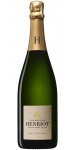
Henriot Brut Souverain is made from 50% Pinot Noir, 40% Chardonnay, 10% Pinot Meunier.
The Brut Souverain is the most historical cuvée in the region, as it was the first cuvée Apolline Henriot produced in 1808. Apolline aspired to put the light on her vineyards through the expression of a champagne. According to her, one year was not enough to tell the story of the terroirs, so she decided to put wines in reserve each year to incorporate them into a future blend. Therefore, she founded the House by creating a Champagne that would have blending as its fundamental principle. The House respects this philosophy today and uses every terroir in this multi-cru, multi-vintage cuvée. It was named Brut Souverain by Ernest Henriot, Apolline's grandson, when the House was appointed the official champagne supplier to the Courts of the King of Holland and of the Emperor of Austria-Hungary.
Review:
A superprecise, reductive style due to bright lime-peel aromas enhanced by chalky minerality with linden tree and yellow plums. Light-bodied, it has zesty acidity with pinprick bubbles, a tight-knit structure and a chewy yet very polished finish.
-James Suckling 95 Points