
" We don't sell the wine without touching the vine "
| Country: | France |
| Region: | Burgundy |
| Winery: | Florence Cholet |
| Grape Type: | Pinot Noir |
| Organic: | Yes |
| Vintage: | 2020 |
| Bottle Size: | 750 ml |

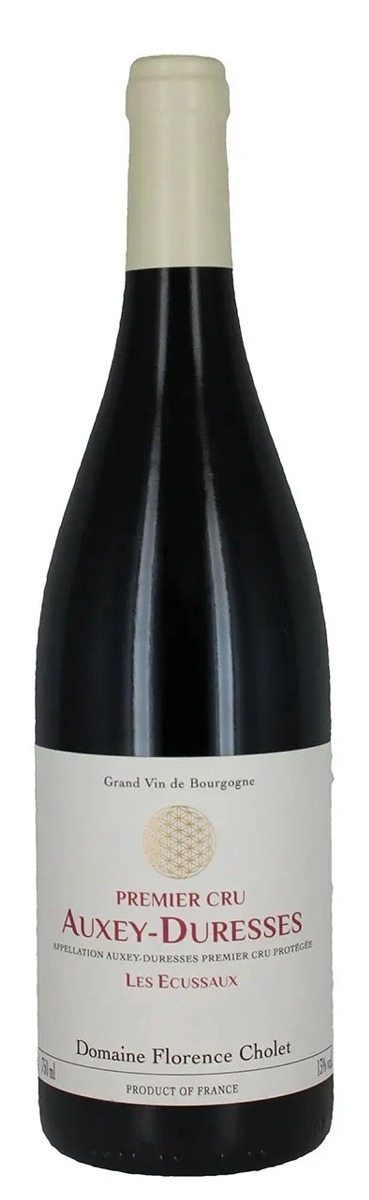
Florence Cholet Auxey-Duresses Rouge Premier Cru Les Ecussaux is made from 100 percent Pinot Noir.
The nose expresses a nice bouquet of black fruits, cherry and violet. The mouth provides a rich and supple wine with a good tannin structure.
Florence Cholet Auxey-Duresses Rouge Premier Cru Les Ecussaux is made from 100 percent Pinot Noir.
The nose expresses a nice bouquet of black fruits, cherry and violet. The mouth provides a rich and supple wine with a good tannin structure.

Florence Cholet Auxey-Duresses Rouge is made from 100 Pinot Noir 60 year old vines.
Auxey-Duresses exhibits intense and juicy aromas of cherries, raspberries, and spices. This is a charming wine that has harmonious and delicate tannins, and a fine texture in the mouth. Medium-bodied, elegant and complex with great concentration and structure.
Florence Cholet Auxey-Duresses Rouge is made from 100% Pinot Noir.
Auxey-Duresses exhibits intense and juicy aromas of cherries, raspberries, and spices. This is a charming wine that has harmonious and delicate tannins, and a fine texture in the mouth. Medium-bodied, elegant and complex with great concentration and structure.

Florence Cholet Meursault Blanc is made from 100 percent Chardonnay.
This classic Meursault offers expressive and complex aromas of white flower, white fruit, and herbal aromas. Bright acidity and minerality emerge on the palate from this beautifully balanced and structured white, followed by subtle hints of vanilla and toasted brioche nuances in a refreshing finish.
Pair with fresh Truffle Pasta, Beaufort Cheese, Pike Quennelles.
Florence Cholet Meursault Blanc is made from 100 percent Chardonnay.
This classic Meursault offers expressive and complex aromas of white flower, white fruit, and herbal aromas. Bright acidity and minerality emerge on the palate from this beautifully balanced and structured white, followed by subtle hints of vanilla and toasted brioche nuances in a refreshing finish.
Pair with fresh Truffle Pasta, Beaufort Cheese, Pike Quennelles.
Florence Cholet Auxey-Duresses Rouge Premier Cru Les Ecussaux is made from 100 percent Pinot Noir.
The nose expresses a nice bouquet of black fruits, cherry and violet. The mouth provides a rich and supple wine with a good tannin structure.
Globe-trotting winemaker Florence Cholet returned to the tiny village of Corcelles-les-Arts in the Cote d'Or area - east of Puligny Montrachet, right across Meursault - in 2019 to take over the four generation-family estate. Florence's father Christian officially founded the estate in 1976 as Domaine Christian Cholet-Pelletier, and was then joined in 1982 by his wife Anne.
Florence gained experience and worked across France, USA and Australia. She studied biology and biochemistry at the University of Burgundy, Dijon. She has a licence in viticulture and a Master degree in oenology. She also worked at an independent laboratory in Morey Saint Denis.
As a young and ambitious winemaker, Florence changed many of the original vineyard practices, such as they no longer use pesticides or herbicides, and new oak is used sparingly. The vineyards are ploughed and since 2017 fermentations have used wild yeasts.

Belle Glos Balade Pinot Noir is made from 100 percent Pinot Noir.
Tasting Notes
he word "Balade", French for "Wandering," is a fitting term for Belle Glos' annual exploration of single-vineyard pinot noir tracts on the west coast. As such, each vintage is very limited.
This Pinot Noir opens with aromas of blackberry, cherry, and delicate floral notes mingling with hints of cedar and baking spice. On the palate, you’ll experience layers of dark plum, juicy black raspberry, and subtle undertones of cocoa and vanilla, all wrapped in a plush, silky texture. Soft tannins and a balanced acidity contribute to a smooth, lingering finish, making it a perfect match for grilled meats, roasted vegetables, or simply as a luxurious glass to enjoy on its own.
Review:
This appellation is an ideal place to produce this brand's bold style of Pinot Noir, as elegance persists with power. In this bottling, aromas of black plum, blackberry and mahogany lead into a rich, creamy palate layered in wild mint, pepper and dark fruit. A searing acidity leads into a candied vanilla finish.
— Matt Kettmann Wine Enthusiast: 94 Points

Jean Arthaud Bourgogne Blanc is made from 100% Chardonnay.
Located in the south of the Mâconnais region, the Pouilly Fuissé AOP covers four communes Its patchwork of Climats produces white wines that are well suited to fine cuisine. Our Pouilly Fuissé comes from vines nestling between the Roche de Solutré and the Roche de Vergisson. It combines the firm crispness created by the limestone soils with the smoothness derived from the more clay rich soils to produce a well rounded wine.
Fruity aromas of peaches, lemons and Granny Smith apples interwoven with lighter notes of jasmine and acacia Mineral and buttery overtones subtly round off the bouquet.



