
" We don't sell the wine without touching the vine "
| Country: | United States |
| Regions: | Washington Washington (Red Mountain) |
| Winery: | Force Majeure |
| Grape Type: | Syrah |
| Vintage: | 2017 |
| Bottle Size: | 750 ml |

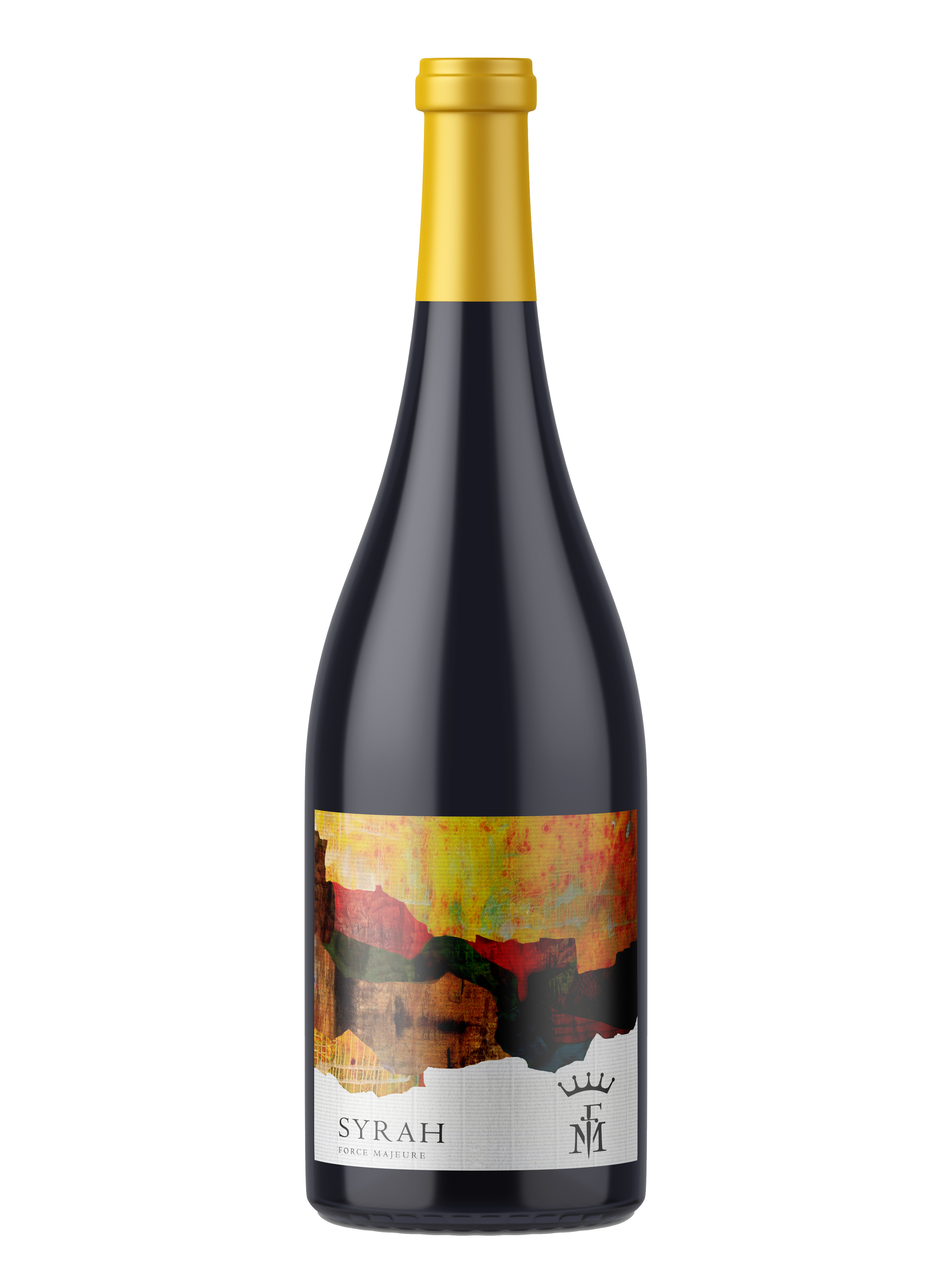
Force Majeure estate Syrah is made from 100 percent Syrah.
The Force Majeure estate Syrah is cultivated in a combination of the 8 soil types that exist in the vineyard, with most of it being planted in very steep, very rocky locations, but some also planted in deeper, loamier soils.
The estate Syrah typically exhibits a broad spectrum of black, blue and red fruits, dried herbs and jasmine, fennel, smoked meats and crushed rock along with very fine tannins, great length, balance and complexity.
Appellation Red Mountain Varietal(s) 100% Syrah
Soil type Very steep, rocky locations, but some also planted in deeper, loamier soils
Vinification 22% whole cluster, remainder destemmed. Fermented in concrete, open top and closed top stainless. ~25% new French oak for 18 months, mostly larger format (300L to 500L) Native yeast, cold soak up front Macerations up to 30 days; pumpovers and punch-downs 100% free run. The wine is bottled unfined and unfiltered.
Production 500 (9-liter cases)
Review:
-Jeb Dunnuck 97 Points
-Eric Guido (Vinous) 95 Points
-Anthony Mueller (Robert Parker) 94 Points

The estate Cabernet Sauvignon is grown primarily along the southwest ridge of the vineyard. The vines produce small berries with bountiful flavor, concentration and intensity, but also a good degree of finesse, excellent structure and layers of complexity that will continue to develop during extended bottle aging for those who want to cellar and age their wines. The wine is powerful, elegant, full-bodied.
Bottled unfined and unfiltered.100% free run
Pumpovers and punch-downs, up to 45 day macerations
Native yeast, 5 day cold soaks
22 months in 75% new French oak barrels
Fermented in concrete and stainless closed top tanks.
Review:
-Jeb Dunnuck 95 Points
-Anthony Mueller (Robert Parker) 95 Points
-Wine Spectator's Insider 93 Points
-Stephen Tanzer (Vinous) 92 Points

Force Majeure Epinette is made from 46% Merlot, 35% Cabernet Franc, 16% Cabernet Sauvignon, 3% Petit Verdot.
Epinette is Force Majeure's Right-bank Bordeaux-inspired blend, and was named after an avenue in Libourne (France) that leads to Pomerol and Saint-Émilion, the home of Merlot and Cabernet Franc. Epinette is also the name of a musical instrument akin to a piano, as well as a word for pine tree, which is a fitting nod to their home in Washington state.
The wine itself is a blend of primarily Merlot and Cabernet Franc, with smaller amounts of Cabernet Sauvignon and Petit Verdot, proportions of which change depending on the vintage. The Merlot and Cabernet Franc are grown in lower areas of the vineyard with deep, well-drained soils, much less rocky than the soils of our Rhone varietals.
Review:
-Jeb Dunnuck 95 Points
-Anthony Mueller (Robert Parker) 94 Points

Force Majeure Parvata is made from 69% Mourvedre, 21% Syrah, 10% Grenache (2016) / 43% Mourvedre, 25% Grenache, 23% Syrah, 4% Cinsault, 5% Counoise
Parvata means “mountain” in sanskrit, and is the name for this southern Rhône-inspired blend, grown mostly in the sandy, loamy soils of the lower section of the Red Mountain vineyard, which bring to the wine a good degree of finesse and high-toned aromatic notes, white pepper, dried herbs and grapefruit peel.
Review:
-Jeb Dunnuck 95 Points
-Anthony Mueller (Robert Parker) 95 Points
Force Majeure Cabernet Sauvignon Red Mountain is made from 100 percent Cabernet Sauvignon.
The estate Cabernet Sauvignon is grown primarily along the southwest ridge of the vineyard. The vines produce small berries with bountiful flavor, concentration and intensity, but also a good degree of finesse, excellent structure and layers of complexity that will continue to develop during extended bottle aging for those who want to cellar and age their wines. The wine is powerful, elegant, full-bodied.
Bottled unfined and unfiltered.100% free run
Pumpovers and punch-downs, up to 45 day macerations
Native yeast, 5 day cold soaks
22 months in 75% new French oak barrels
Fermented in concrete and stainless closed top tanks.
Review:
Another gem is the 2019 Cabernet Sauvignon Red Mountain Estate, a deep, concentrated, powerful Red Mountain Cabernet Sauvignon that I suspect will be up there with the legendary wines from this terroir. Beautiful cassis, graphite, lead pencil shavings, and damp earth notes give way to a full-bodied effort that has a liqueur of rocks-like minerality, flawless balance, building yet polished tannins, and a great finish. Hide bottles for 4-5 years, and it will evolve for 25-30 years if properly stored. Best After 2026.
-Jeb Dunnuck 98+ Points
"Blackberry, crushed rock, black cherry and spice aromas lead to ripe, intense, seamless, balanced dark-fruit flavors. The tannins give a firm grip. An extended finish caps it off. It's glorious. - SEAN P. SULLIVAN" - Wine Enthusiast (November 2022), 95 pts "A gutsy red that retains a sense of style and polish, with expressive blackberry, espresso and toasty spice flavors that build structure toward broad-shouldered tannins. Drink now through 2030. —Tim FISH." - Wine Spectator (Insider, January 4th 2023), 94 ptsReview:
-Jeb Dunnuck 98 Points
-Owen Bargreen (Vinous) 97 Points
-Wine Enthusiast 95 Points
Force Majeure Epinette is made from 79% Merlot, 8% Cabernet Sauvignon, 8% Cabernet Franc, and 5% Petit Verdot .
Epinette is Force Majeure's Right-bank Bordeaux-inspired blend, and was named after an avenue in Libourne (France) that leads to Pomerol and Saint-Émilion, the home of Merlot and Cabernet Franc. Epinette is also the name of a musical instrument akin to a piano, as well as a word for pine tree, which is a fitting nod to their home in Washington state.
The wine itself is a blend of primarily Merlot and Cabernet Franc, with smaller amounts of Cabernet Sauvignon and Petit Verdot, proportions of which change depending on the vintage. The Merlot and Cabernet Franc are grown in lower areas of the vineyard with deep, well-drained soils, much less rocky than the soils of our Rhone varietals.
Review:
-Jeb Dunnuck 97 Points
Force Majeure estate Syrah is made from 100 percent Syrah.
The Force Majeure estate Syrah is cultivated in a combination of the 8 soil types that exist in the vineyard, with most of it being planted in very steep, very rocky locations, but some also planted in deeper, loamier soils.
The estate Syrah typically exhibits a broad spectrum of black, blue and red fruits, dried herbs and jasmine, fennel, smoked meats and crushed rock along with very fine tannins, great length, balance and complexity.
AppellationRed Mountain Varietal(s) 100% Syrah
Soil type Very steep, rocky locations, but some also planted in deeper, loamier soils
Vinification 22% whole cluster, remainder destemmed. Fermented in concrete, open top and closed top stainless. ~25% new French oak for 18 months, mostly larger format (300L to 500L) Native yeast, cold soak up front Macerations up to 30 days; pumpovers and punch-downs 100% free run. The wine is bottled unfined and unfiltered.
Production 500 (9-liter cases)
Review:
-Jeb Dunnuck 99 Points
Force Majeure is an ultra-premium winery located in the Walla Walla Valley, specializing in estate-grown, single-vineyard Bordeaux and Rhône-inspired wines. Our wines are meticulously crafted by former Bryant Family Vineyard Winemaker, Todd Alexander. From its inception, Force Majeure has been defined by unwavering commitment to outstanding viticulture and exemplary winemaking. Our original estate vineyard is located in the famous Red Mountain AVA and we have added two new vineyard sites over the past couple of years in the Walla Walla Valley. Our estate vineyards are painstakingly farmed by a stellar team.
“Force Majeure” describes the relentless, powerful elements of Nature that form the terroir of our vineyard. It also identifies the “unstoppable force” initiated when the highest level of viticulture is combined with the highest level of winemaking talent.
Our wines are produced in small quantities and are available via mailing list, as well as through a few select retailers and finer restaurants. We invite you to add your name to our mailing list to receive upcoming wine allocation offers. Wines are typically released two to three times per year.
RED MOUNTAIN AVA
Drawing inspiration from the great vineyards of Bordeaux, the Northern and Southern Rhône valleys, as well as parts of Spain, and with a desire to challenge existing viticultural practices in Washington state, we embarked on an ambitious plan to pioneer the very first vineyard on the steep, rocky upper slopes of Red Mountain, from where we knew we could create wines that were profound and powerful yet balanced and finessed, distinct and world-class. Most importantly, we knew the site would be unique and singular.
The effort to develop our Red Mountain estate site involved the careful matching of varietal and clonal selections, trellising and irrigation to the eight distinct soil types in our vineyard that were formed by the ancient Missoula floods, winds and volcanic activity. The outcome is a vineyard articulated into many small “micro-blocks,” maximizing the potential of this unique and dynamic site. This steep vineyard ranges in elevation from 960 to 1,230 feet and is, of course, completely farmed by hand. The rocky upper-slope with shallow soil is well suited to the cultivation of varietals such as Syrah and Grenache, while the lower blocks of the vineyard are comprised of deep, well-drained Warden soils, where varietals such as Cabernet Sauvignon, Merlot and Cabernet Franc excel.
The overall exposure of the site is west/southwest, and the Syrah planted on the hill is tightly spaced to provide some shade on the fruit. The soils have a volcanic foundation, being composed of fractured basalt, concreted ash and wind-blown loess with a high calcium carbonate content and granite erratics from the Missoula floods. The site was purchased in 2004 and development began in 2006.
ROCKS DISTRICT OF MILTON-FREEWATER AVA
We have recently acquired a small vineyard in the Walla Walla Valley, one-hour drive from Red Mountain. The property is partially within the boundaries of the The Rocks District of Milton-Freewater AVA, on the Oregon side of the border, and is located adjacent to the site of our new winery. The portion of the vineyard outside The Rocks District is within the borders of the Walla Walla Valley AVA. The Rocks District is an alluvial fan, and the cobbles that define the area are a result of deposits left by the Walla Walla River. This vineyard was planted between 1992 and 1994, and has a diverse soil profile that sets it apart from other vineyards in the area, and certainly from our Red Mountain site. The amount of soil covering the cobble stones is highest at the north end of the property and most shallow at the southern end. This gives us a lot of diversity within a small area, and the grapes will have different characteristics depending on the soil composition where they are grown. This vineyard is in an area proven to have very distinct terroir, and we know we can push the site further by bringing it under our care and attention.
THE NORTH FORK OF THE WALLA WALLA RIVER
Over the past couple of years, we have been in search of additional land to develop vineyards that differ from our Red Mountain estate, yet are capable of matching or exceeding the quality we achieve from that site. This search resulted in the acquisition of The Rocks District site mentioned previously, as well as the discovery of a new and exiting region about 15 minutes away from there.
As you move east from The Rocks District and our new winery, in about 15 minutes drive the topography changes dramatically – from flat lands with cobblestone soils to deep canyons with tall, steep hills as you approach the Blue Mountains that line the eastern ridge of the Walla Walla Valley. The area is wild and untamed, with only a couple of small vineyards located nearby. This area does not yet have a name, but the locals refer to it the as “The North Fork” because the North Fork of the Walla Walla River runs along the bottom of the canyon.
We have recently acquired a large piece of land in this area. It is a spectacularly beautiful site, and its elevation rises to almost 2100 feet. As it is so close to the Blue Mountains, it receives significantly more rainfall than many other parts of the Walla Walla Valley and Red Mountain. The high temperatures in the summer are more moderate, and the cold temperatures in the winter are less extreme than on the valley floor. The growing season at this site will be longer than either site in The Rocks District or Red Mountain.
This is a huge and exciting step into new and mostly unexplored territory, but promises to feed our passion for hillside sites and the wines made from them. We believe this site is capable of nurturing some of the best wine grapes, not just in the Pacific Northwest, but in North America. The combination of climatic characteristics, exposure and aspects as well as soil composition should make this land one of the most exciting new viticultural areas in the United States. In the future, this region is sure to be a new, single AVA. The size of that future AVA may be as small as 500 acres.
_________________________________
The unique topography and geological variants in these vineyards provide us with a versatility that allows us to cultivate a variety of compelling fruit characterized by stunning intensity, depth, concentration and complex flavors. The sites are all distinct and singular – yet taken together, they provide a fascinating exposition of the terroir in this region of the world.

James Goddard was an ancestor of the Clarke family. Born in West Sussex, England in 1823, James spent his 74 years as a sailor, a whaler, a bullock driver, farmer, prospector, miner and hotel keeper. From an illiterate runaway living rough on the streets of London, he became a rich, successful and admired pillar of South Australian society.
James arrived in Adelaide in 1839 as a 16-year-old sailor. Twelve years later, his life changed forever with the news of gold findings. For the next 20 years, James roamed the country learning the geology that improved his chances of prospecting.
James Goddard Shiraz is made from 100 percent Shiraz.
In 1870, he tried his luck near his farm in the Barossa Valley and discovered the region’s first gold deposits, creating the prosperous Lady Alice Mine. The Lady Alice Mine, though it is no longer operational, was & still is the most successful gold mine in South Australia. From these roots, the Thorn-Clarke family has been connected to the region for the last 150 years.
James Goddard Shiraz is a blend Shiraz sourced from the Milton Park vineyard in the north of Eden Valley, and the St Kitts vineyard in the far northern area of the Barossa. Fruit is harvested in the cool of the night to maintain maximum flavour and freshness and it is fermented for 8 days. The ferment is pumped over twice daily to extract the colour and flavour from the fruit. Once finished fermentation the wine was then matured in a blend of French and American oak for a period of 10 to 12 months depending on the vintage.
Deep vibrant red with purple hues to the rim. The nose shows lifted plums, vibrant purple berries and a delicate spice note. The palate has concentrated satsuma plum, blackberry with lovely charry oak in the background. Long, juicy and even with plush fruit on the finish.
Review:
“Blended from two estate vineyards, St. Kitts and Milton Park, this shiraz offers its richness without any aggression or overt perfume. It’s just lush and delicious, a friendly embrace of firm tannins and purple-red fruit. The texture and flavor combine in a saturated meatiness, for Korean barbecue.”
- Wine & Spirits Magazine, 92 points

Alejandro Bulgheroni Lithology Beckstoffer Las Piedras Cabernet Sauvignon is made from 100 percent Cabernet Sauvignon.
From a St. Helena vineyard planted by early Napa settler Edward Bale more than 150 years ago, and later serving as the estate vineyard for the area’s first winery built by Henry Pellet in 1860, the Las Piedras site always gives us our prettiest wine. When placed next to Dr. Crane and To-Kalon wines, the Las Piedras show a certain elegance, with a very graceful entry and finely detailed complexity. We produce it with at least 75% new French oak, so there is a floral, spicy, and vanilla accent to the intense red and black fruits, cassis, and black cherry liqueur. What distinguishes this bottling is the beautifully fine tannins, delicate texture, and stunning purity. (Less than 100 cases made.)
Fermentation 70% Oak, 24% Concrete, 6% Puncheon
Review:
-Jeb Dunnuck 98 Points

Chaume Bourgogne Rouge 2024 is made from Pinot Noir.
Color: bright ruby red. Bouquet: blackcurrant, raspberry and hints of blackberry. Palate: a smooth, balanced attack with fine tannins and a supple finish.
Pairs with butterflied lamb, char-grilled steak or venison; rustic dishes such as cassoulet or duck with olives; or roast goose.



