" We don't sell the wine without touching the vine "
| BUY MORE! SAVE MORE! | ||||||||||||||||
|
| Country: | United States |
| Regions: | Oregon Oregon (Willamette) |
| Winery: | Fullerton Wines |
| Grape Type: | Chardonnay |
| Organic: | Yes |
| Vintage: | 2017 |
| Bottle Size: | 750 ml |
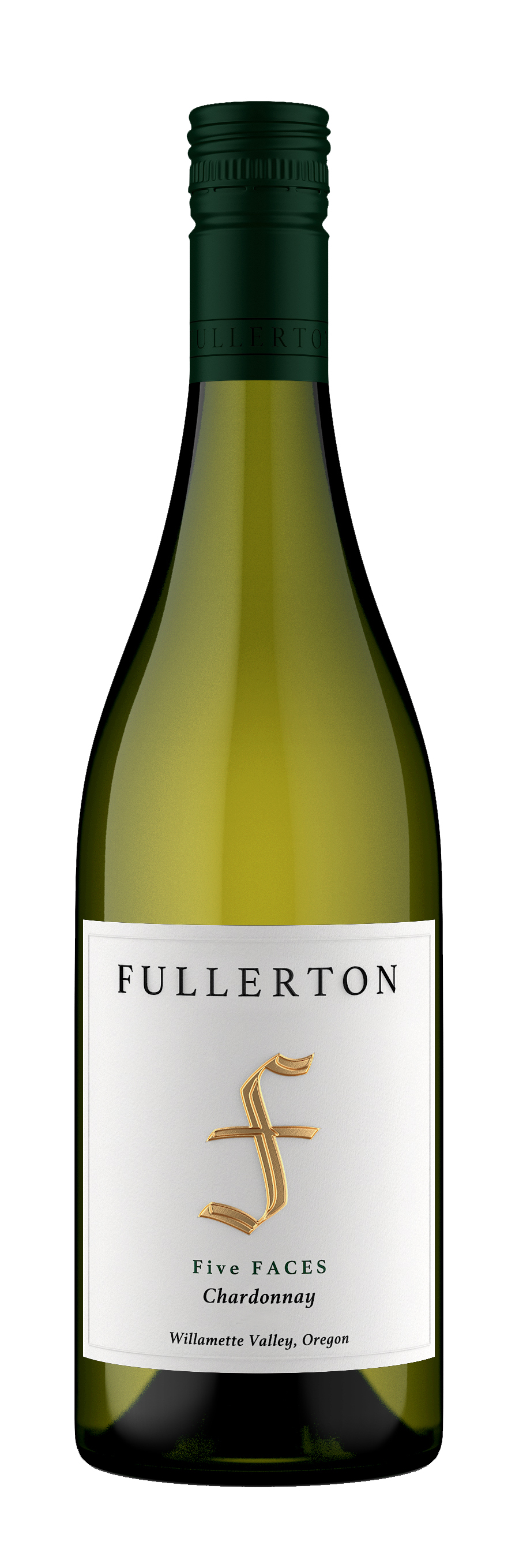
Fullerton Five Faces Chardonnay is made from 100 percent Chardonnay.
Five FACES is an acronym for the Fullerton family – Filip, Alex, Caroline, Eric, and Susanne. The wines blend fruit from multiple vineyards in Willamette Valley, mainly in the north of the valley with one to the west in the Van Duzer Corridor. A full representation of the Willamee Valley’s soil types is on display with one volcanic vineyard, two loess (windblown) vineyards, and two sedimentary vineyards. The vineyards range in elevation from 550-700 feet.
Honeydew melon, japanese pear, apricot, honeysuckle, apple-blossom, nutmeg, brioche, and lemon curd. Melon is echoed on the palate with notes of lemon, tangerine, toasted almonds, and fennel. Lovely and integrated acidity balances the palate weight from 17 months on the lees.
17 months in 10% new French Oak
Paris with creamy dishes and cheeses. Chicken and Turkey.
Great wine speaks profoundly, a universal language transcending any one culture. Hailing from northern Europe, the Fullerton family speaks many languages, and delights in sharing the language of wine with others. Fullerton Wines crafts elegant and distinctive Pinot Noirs and Chardonnays that transport you to their place, Oregon’s Willamette Valley.
A family of enophiles, the Fullertons can trace their love of wine to Eric, who was first introduced to wine growing and production during his teenage years when he worked as a cellar hand in Germany (a story in and of itself). A few years later, his best friend in Denmark inherited an impressive cellar of Bordeaux and Burgundy wines. Together, they sought younger bottlings of the cellared wines, and held vertical tastings. Their interest in wine grew, and they began traveling throughout France discovering new producers to fuel their expanding passion.
When Eric and Susanne met in Stockholm, it did not take long for Susanne to fall in love with Eric and the wines he respected. Marriage soon followed, and they continued tasting, savoring, and cellaring wine.
In 2010, Alex Fullerton graduated from the University of Oregon with an Economics degree. Alex and Eric were tasting wine at Penner-Ash Wine Cellars, and began discussing home-brewing and the process of fermentation. The conversation led to the idea of Alex making wine. A couple of minutes later, Lynn Penner-Ash entered the room, and Eric asked her how Alex could enter the industry. Coincidentally, a harvest intern had dropped out that morning, and she needed a replacement. The next day Alex was offered a job as an intern, and later became a cellar hand at Penner-Ash. His passion ignited.
Alex next took off to New Zealand to work at Drylands Winery in Marlborough. Although the experience didn’t align with the handcrafted winemaking tradition in Oregon, he came back determined to learn more about growing and production. Penner-Ash welcomed him back again for the 2011 harvest, and he worked the following 2012 harvest at Bergström Wines under winemaker Josh Bergström. Lynn Penner-Ash and Josh Bergström both mentored and inspired Alex, deepening his knowledge of winemaking.
Fullerton Wines began in a garage in 2011. Alex and Eric partnered with their good friend Roger Wallberg and made a few barrels of Pinot Noir. Despite the challenging vintage, the wine impressed and Fullerton Wines was born. Today, Fullerton Wines crafts treasured Willamette Valley wines, focused purely on the Burgundian varietals of Pinot Noir and Chardonnay.
Alex Fullerton worked at Penner-Ash and Bergstrom in Willamette Valley, Oregon and Drylands in Blenheim, NZ majored in Economy @ UO, Studied Organic chemistry @ PSU and Viticulture & Enology @ OSU.
Vineyards: Ivy Slope (Estate) Chard, Croft PN, Fir Crest PN, Arbor Brook PN, Lichtenwalter PN, Bjornson PN, Momtazi PN, Ch Bianca Chard, Bella Vida PN, Apolloni PN, Bennett PN, La Velle PG, May's Vineyard Syrah.
Ivy Slope (Estate) 0.5 Acres All others by Acerage contracts.
Age of the vines: 7 - 50 years.
Everything is at a minimum Sustainable, Momtazi is Biodynamic and Croft is Organically certified.
Our holistic viticulture produces energetic fruit, great wine, and a healthier world.
Great wine requires great fruit. Growing high-quality grapes demands that we care for the soil in which the vines grow. Grapes, more than any other crop, convey the characteristics and health of their site. It is widely known that the best wines come from grapes grown in well-drained soils. Grape growers and winemakers are becoming increasingly aware of the devastating effects of synthetic fertilizers and herbicides on the structure, drainage, infiltration, and overall health of the soil. At Fullerton Wines, our pursuit of great wine guides us to organic and biodynamic farming methods because of its ability to build up healthy soils while also sequestering carbon into the soil (thereby helping to mitigate climate change). Through these methods, we improve the aggregate stability, drainage, water-holding capacity, and infiltration of the soils. We also reduce erosion and nutrient leaching.

Fullerton Three Otters Pinot Noir is made from 100% Pinot Noir - 40 years old
11 months in 25% new Oak and 75% neutral
Bella Vida Vineyard is perched high in the heart of the Dundee Hills. This picturesque site provides elegant fruit from the storied Jory soils of the AVA. LIVE certified.
Aromas of cherry and raspberry flow into finely-tuned layers of cedar, cocoa, licorice, and baking spices. The palate pulses with energy as the silky tannins and gorgeous mid-palate captivate your senses. A radiant and profound experience.
A co-fermentation of Dijon clones 113, 667, and 777, this wine expresses the volcanic soils of the Dundee Hills elegantly, yet powerfully. Upon arrival, the grapes were immediately de-stemmed into an open-top two-ton fermenter. Following a seven day cold soak, the wine started fermenting slowly at a cool temperature. To manage extraction, we utilized one to two punch-downs and one pump-over per day, with two rack-and-returns at the beginning and middle of fermentation. As fermentation neared the end, the must was heated to achieve a peak temperature of 94° F resulting in optimum extraction, and then we immediately chilled the wine to extend the time on the skins, while switching to one pump-over per day to limit harsh, seed-tannin extraction. After a total of 19 days on the skins, we drained and pressed the wine, keeping the free-run and press fractions separate. This bottling contains only the free run fraction. Following two days of settling, the wine was racked to barrel and aged for 11 months in 25% new French oak and one month in tank prior to being bottled unfined and unfiltered.
Fullerton Three Otters Pinot Noir is made from 100% Pinot Noir - 40 years old
11 months in 25% new Oak and 75% neutral
Bella Vida Vineyard is perched high in the heart of the Dundee Hills. This picturesque site provides elegant fruit from the storied Jory soils of the AVA. LIVE certified.
Aromas of cherry and raspberry flow into finely-tuned layers of cedar, cocoa, licorice, and baking spices. The palate pulses with energy as the silky tannins and gorgeous mid-palate captivate your senses. A radiant and profound experience.
A co-fermentation of Dijon clones 113, 667, and 777, this wine expresses the volcanic soils of the Dundee Hills elegantly, yet powerfully. Upon arrival, the grapes were immediately de-stemmed into an open-top two-ton fermenter. Following a seven day cold soak, the wine started fermenting slowly at a cool temperature. To manage extraction, we utilized one to two punch-downs and one pump-over per day, with two rack-and-returns at the beginning and middle of fermentation. As fermentation neared the end, the must was heated to achieve a peak temperature of 94° F resulting in optimum extraction, and then we immediately chilled the wine to extend the time on the skins, while switching to one pump-over per day to limit harsh, seed-tannin extraction. After a total of 19 days on the skins, we drained and pressed the wine, keeping the free-run and press fractions separate. This bottling contains only the free run fraction. Following two days of settling, the wine was racked to barrel and aged for 11 months in 25% new French oak and one month in tank prior to being bottled unfined and unfiltered.
Review:
Vivid red. Displays fresh red/dark berry and pungent floral aromas, along with suggestions of cola, mocha and five-spice powder. Appealingly sweet and energetic on the palate, offering intense black raspberry, cherry-cola, spicecake and rose pastille flavors that tighten up slowly on the back half. Fine-grained tannins frame the well-defined finish, which lingers with impressive, red fruit liqueur-driven persistence. (all de-stemmed fruit and 25% new French oak). - Josh Raynolds" - Antonio Galloni's Vinous (June 2019), 93 pts

Clear, golden straw, with a slight greenish tinge. The nose is intense with yellow apple, Calamansi lime, apricot, quince, white flowers, flinty minerals, and brioche. The palate is light and quaffable.
Alcohol: 12.5%
Acid TA: 6.34g/L
pH: 3.22

Fullerton Three Otters Pinot Noir is made from 100% Pinot Noir - 7-40 years old
This Willamette Valley blend hails mainly from three different vineyards in the north, east, and south of the Willamette Valley, with a smaering from five of Fullerton's other sites. The soils of the vineyards represent the breadth and diversity of the Willamee Valley with both sedimentary- and volcanic-based soils.
Blueberry and ripe strawberry with a dash of baker’s spice, bramble, and herbs. The palate carries the fruit forward elegantly with balanced tannins following. Intriguing complexity and depth—an impressive wine for all.
This wine comes from 100% destemmed rotator barrels fermented at ambient temperature reaching a peak temperature of 73° F. The rotator barrel spun twice daily during fermentation yielding a gentle extraction. After fermentation, the wine went through a three-week extended maceration, allowing the tannins to polymerize, soffening the wine. Aged for 12 months in French oak barrels and three months in tank, the wine was then bottled after filtration.
This wine is handled very gently in the cellar allowing the nuances of the delicate fruit to be preserved and the wine to be very approachable in its youth. We have a preference for pump-overs versus punch-downs for its smoother extraction and softening effect on the tannin. To retain freshness and verve we age most of the wine in tank. However, we softened up and rounded out about 25% of the blend in barrel. The result is a fresh, fruit forward, yet earthy and intriguing, Pinot Noir.
Serve this wine slightly chilled, and pair it with dishes of earthy mushrooms, like chanterelles and morels, light cuts of meat, charcuterie and cheese.

Kershaw Chardonnay Deconstructed Groenland Shale CY548 is made from 100 percent Chardonnay.
The inspiration for this Chardonnay stems from my belief that the Elgin region has both a signature grape as well as particular terroirs within its demarcated boundary that reflect regional credentials. This Chardonnay was selected from a sub-region of Elgin from a specific vineyard and an individual clone (CY548).
Tasting Notes:
Sourced from the foothills of the Groenland Mountain in Northern Elgin this clone has been taken from Corton Charlemagne cuttings. It produces wines that have aromatics oscillating between lemon blossom, white flowers, petrichor and struck stone. Full in body they exude concentration with white stone fruit yet reinforced with an austere texture and robustness that makes for excellent aging potential. The Bokkeveld Shales adds structure and concentration to the flavor.
Vineyards:
Sourced from the foothills of the Groenland Mountain in Northern Elgin this clone has been taken from Corton Charlemagne cuttings.
Winemaking:
Grapes were hand-picked in the early autumnal mornings, placed into small lug baskets and tipped directly into a press before being gently whole-bunch pressed up to a maximum of 0.6 bar or until a low juice recovery of 580 liters per ton was obtained. The juice gravity-flowed directly to barrel (no pumps were used at all) without settling. The unclarified juice had no enzymes or yeast added to it and therefore underwent spontaneous fermentation until dry, with malolactic discouraged. The wine rested in barrel for 4 months prior to judicious sulfuring and a further 7 months’ maturation in barrel before racking and bottling.
Barrel: Selection: A small number of artisanal coopers are selected from mostly Burgundy, with only French oak was chosen. Up to 40% of the oak is new with the remainder split into 2nd and 3rd fill barrels of predominantly 228 litres.
Look at pairing this with textured fish, straightforward chicken dishes, pan-fried or grilled pork dishes, soft-rind cheeses, cream or creamy dishes be it with pasta or the aforementioned fish, chicken or pork, to allow the complexity of the wine to shine through. If using mustard, preferably use Dijon mustard as it uses verjus (soured grape juice) and not vinegar. Also look to delicate herbs (tarragon, dill, basil, parsley) rather than hard stalked herbs (rosemary, thyme, oregano, etc). Avoid smoked meats or fish as well as highly spiced dishes as this can overwhelm the wine and clash with the oak. I would try oysters; Lobster grilled or boiled but not thermidor as it is too rich; turbot, dover sole, sea bass, yellowtail with a shellfish sauce; fish pie; roasted free-range chicken with tarragon; roast loin of pork with garlic and ginger; truffle risotto; pasta in a clam sauce; slice of brie de meaux.
Review:
"Perfume of flowers, minerals and citrus zest. The palate is dense and focused, almost chewy with an opulent mandarin mid palate and long, savory finish. Matured in 50% new oak that is seamlessly integrated with the wine."
- International Wine Review (Richard Kershaw Lifts Elgin To New Heights, February 2019), 94 pts

With its maritime influence, California's Monterey region has an extended growing season that yields wines with full flavor development and great acid balance.
Mandolin Chardonnay has a lush tropical fruit core, balanced by crisp acidity and nicely integrated oak.
The grapes for this Chardonnay were sourced from vineyards in the Santa Lucia Highlands AVA of Monterey County, where high winds, dry days, and bay fogs create a cool, but very long, growing season. These growing conditions are ideal for cool-climate grapes such as Chardonnay, and lead to full, forward fruit flavors and ideal acidity. Grapes were harvested at an ideal balance of sugar and acid, and the wine was fermented in 1-2 year-old French oak barrels. This wine did not undergo malo-lactic fermentation, thus preserving its bright acidity. Total Acidity: 0.70 pH: 3.45 Residual Sugar: 0.51 g/liter

Familia Zuccardi 'Finca Piedra Infinita' Supercal is made from
Appellation: Finca Piedra Infinita, IG Paraje Altamira,Valle de Uco, Mendoze
Vinification: Manually selected grapes, filling of tanks by gravity. Fermentation with native yeasts in concrete vessels without epoxy. Aging in concrete vessels. The 2020 was a very particular vintage, characterized by limited yields and a high speed of maturity, which made it one of the fastest and most challenging on record.
In the search for the purest expression of the identity of Finca Piedra Infinita vineyard, we reached this small plot of 0.73 hectares. Located on its north-east side, it shows the typical facet of Paraje Altamira soil, with large gravels and granite stones covered with calcareous material at a depth of 50 cm.
Altitude: 3,609 feet above sea level
Soil Type: Short alluvial soil covered with calcareous materials
Alcohol: 14% Total Acidity: 5.6g/l
TASTING NOTES:
Color: Bright ruby color
Aroma: Dark berries, black olive tapenade, and iron
Flavor: Rich on the palate, with firm tanins
Review:
A very young, beautiful malbec that is still a bit reductive now. Fresh herbs, white pepper, violets, iron and some ripe black cherries to the nose. Full-bodied on the palate with plenty of powerful, fine tannins. Mineral and super fine-grained. Needs time. Better after 2026.
-James Suckling 98 Points

This dry Rosé is very aromatic on the fruitiness with a great style and elegance.
Average age of the vines is 25 years old.
We produce a part of this cuvee with 12 hours skin maceration and another part from directly pressed grapes.
Wine was slightly filtered before bottling to insure the wine remains stable.
This wine is the perfect friend for barbecue, salads and of course aperitif. This is ideal for warm days in the garden, as well as elegant poultry dishes.