" We don't sell the wine without touching the vine "
| Country: | France |
| Regions: | Loire Vouvray |
| Winery: | Gaudrelle |
| Grape Type: | Chenin Blanc |
| Organic: | Yes |
| Vintage: | 2022 |
| Bottle Size: | 750 ml |

Clos des Cazaux Gigondas Le Souiras is 100% Grenache.
“Le Souiras” is the terroir located at the very South end of the Gigondas appellation. Here, in the midst of the Dentelles de Montmirail, an extraordinary calcareous massif, we planted grapevines on slopes surrounded by Mediterranean vegetation.
We are situated at an altitude of 250 meters, where the nights are cooler. The terroir is stony with a layer of grey and blue clay under the topsoil. The slopes face West and are protected from the strong summer sun by the Montmirail hill. Due to this ideal microclimate, our old Grenache grapevines contain all the complexity and balance of this sunny terroir.
Color : Dark intense ruby color.
Bouquet : Notes of little red fruits, white pepper, caramel and juniper.
Palate : The first impression is arresting and generally qualified as round, complex and dense.
The aromas of black cherry, mocha and white pepper are very intense. The palate is powerful, elegant and velvety.
The finish is long, with very silky tannins and a very slight bitterness that gives this exceptional Grenache an impression of freshness.
Review:
"A brilliant wine that has so much to love, the 2022 Gigondas Le Souiras is all Grenache that was brought up in barrels. It exhibits a vivid ruby hue as well as classic kirsch and blackberry fruit intermixed with peppery garrigue, spice, and ample Provençal nuances. This medium-bodied, fresh, focused 2022 has a beautiful sense of elegance, fine tannins, and the balance to evolve gracefully over the coming 10-12 years."
- Jeb Dunnuck (December 5th 2024), 94 pts

Alexandre Monmousseau Gaudrelle Vouvray Reserve Personelle is made from 100 percent Chenin Blanc
Fine Chenin Blanc typicity, with aromas of ripe apples and honeyed notes. Rich, smooth, rounded palate with great structure and weight. Has the acidity to support ageing for 10 years.
Chateau Gaudrelle Vouvray Reserve Personelle 2009 is 100 percent Chenin Blanc
Fine Chenin Blanc typicity, with aromas of ripe apples and honeyed notes. Rich, smooth, rounded palate with great structure and weight. Has the acidity to support ageing for 10 years.

Produced from 100% Chenin Blanc planted on clay and flint stones based soils.
Vinification: aged in stainless steel tanks with temperature controlled fermentation. Aged on the lees for 4 months.
Kieselguhr filtration.
This sparking wine is fresh and fruity. Rich and easy to drink, which makes it a wonderful aperitif. For the aficionados this is an excellent food friendly wine. Its quality makes it a great alternative to Champagne.
"The two sparkling wines should not be missed. They’re both terrific examples of how good sparkling Vouvray can be. Both are 100% Chenin Blanc cuvees, with the non-vintage Chateau Gaudrelle Vouvray Brut showing lots of effervescence and plenty of flowery brioche, buttered citrus, melon and dried apricot notes. It is crisp, fresh, and ideal for drinking over the next several years."
-Wine Advocate 90 pts
"Just off-dry, this almond- and apple-flavored wine achieves a fine balance of crispness and richness. There is just a touch of honey, intertwined with delicious citrusy acidity."
- Wine Enthusiast , 90 pts

Les Gentilhommes Pouilly Fuisse Premier Cru Clos Reyssier is made from 100 percent Chardonnay.
A gentilhomme is a gentleman characterized by his delicacy, thoughtfulness, and courtesy. "Les Gentilhommes" was created by brothers Richard and Stephane Martin as brand embodying the gentleman's character combined with Burgundian know-how.
From the work in the vineyard to the vinification in barrel, they are inspired to share these noble values. Quality, authenticity and long family tradition are the foundation of these wines.
Les Gentilhommes Pouilly Fuisse Premier Cru Clos Reyssier's description

Alexandre M Vouvray La Serpette Tendre is made from 100% Chenin Blanc.
Nose of coconut and slightly vanilla. The very "Caribbean" mouth of nutmeg brown sugar, white rum and candied citrus fruits. Like a sweet wine, without the sugar.
La Serpette (pruning knife) is one of the most important vintner's tool. This is the symbol of the work made by hand, just to express the very important part of hand making in wine which reflect the terroir. Wine is not "made" in the cellar as everything stars in the vineyards, from the vineplant.
Asian cuisine as well as exotic food. Well pair with spices. Nice with the classic foie gras and with matured cheeses.
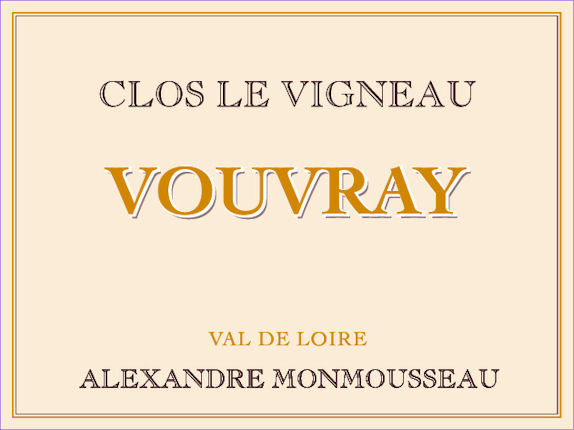
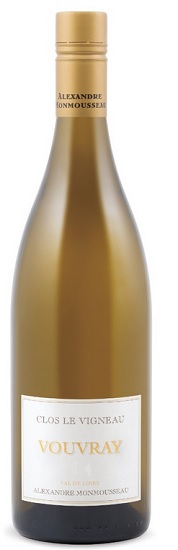
Gaudrelle Monmousseau Clos le Vigneau Vouvray is made from 100% Chenin Blanc
Clos Le Vigneau is a single vineyard from an area known as "les Gués d'Amant" or "Lover's Gap". Most of the vines were planted in 1929.
Off dry in style with honey, earth and apricot notes. Wines from the town of Vouvray have been known to age well for 40 years. This particular bottling should hold for at least 5-7 years.
Chateau Gaudrelle is owned by fifth generation winemaker Alexandre Monmousseau. Alexandre's father, Armand Monmousseau, is the former head of his family's sparkling wine firm in Montrichard. Alexandre, intense and confident, received his schooling in Beaune and is one of the leaders of the Sec-Tendre (soft-dry) movement that includes producers like Huet and Champalou..
Monmousseau also produces Kysela's famous Vouvray, Clos le Vigneau.
The AOC of Vouvray covers 9 villages:
• Vouvray
• Vernou sur Brenne
• Noizay
• Chançay
• Reugny
• Parçay
• Meslay
• Rochecorbon
• Tours-Sainte Radegonde, which is the birth place of the vineyard (end of the 4th century).
"It is amazing how good a value Vouvray has remained despite the fact that it is such a popular wine from Loire. The appellation was founded in 1936 and covers nine villages in the region. You can find sparkling wines at this estate – sec (dry) or demi-sec (basically off-dry, although for most consumers these would be considered dry) – as well as their sweet wines, which vary considerably in their degrees of sweetness and are referred to as moelleux. All four of the following cuvees performed brilliantly in my tasting." - Robert Parker's Wine Advocate (June 2012)
Today the Monmousseau family farms 14 hectares (34.6 acres) of land: 6 hectares for Clos le Vigneau, 8 hectares for Château Gaudrelle. Clos Le Vigneau is a single vineyard from an area known as “les Gués d'Amant” or “Lover’s Gap”. Most of the vines were planted in 1929. The soil is a mixture of argilo-calcaire, silex and gravel. Alexandre Monmousseau believes in low yields for concentration and flavor. The grapes are hand harvested. Pressing is long and slow, fermentation is in stainless steel with two rackings and a light filtration before bottling.

Yellow strawâ€colored, medium low intensity. Pungent, delicate and complex, with clear almonds notes and autolysis. The mouth is slightly soft, wityhout being sweet, the palate is round and fat with an excellent structure, volume and character but at the same time, the wine is still very fresh and saline. Long finish for this persistent wine.
As aperitif, while cooking, and accompanying the whole meal with it. It is ideal matching seafood and products of saline flavour and with acidity.

Weingut Prager Achleiten Riesling Smaragd is made from 100 percent Riesling.
Franz Prager, co-founder of the Vinea Wachau, had already earned a reputation for his wines when Toni Bodenstein married into the family. Bodenstein’s passion for biodiversity and old terraces, coupled with brilliant winemaking, places Prager in the highest echelon of Austrian producers.
Smaragd is a designation of ripeness for dry wines used exclusively by members of the Vinea Wachau. The wines must have a minimum alcohol of 12.5%. The grapes are hand-harvested, typically in October and November, and are sent directly to press where they spontaneously ferment in stainless-steel tanks.
Achleiten sits east of Weißenkirchen and is one of the most famous vineyards in the Wachau. The steeply-terraced vineyard existed in Roman times. Some sections have just 40 cm of topsoil over the bedrock of Gföler Gneiss, amphibolitic stone, and slate. “Destroyed soil,” as Toni Bodenstein likes to say.
Tasting Notes:
Austrian Riesling is often defined by elevated levels of dry extract thanks to a lengthy ripening period and freshness due to dramatic temperature swings between day and night. Wines from Achleiten’s highly complex soils are famously marked by a mineral note of flint or gun smoke, are intensely flavored, and reliably long-lived.
Food Pairing:
Riesling’s high acidity makes it one of the most versatile wines at the table. Riesling can be used to cut the fattiness of foods such as pork or sausages and can tame some saltiness. Conversely, it can highlight foods such as fish or vegetables in the same way a squeeze of lemon or a vinaigrette might.
Review:
The 2020 Ried Achleiten Riesling Smaragd offers a well-concentrated, fleshy and spicy stone fruit aroma with crunchy and flinty notes. It needs some time to get rid of the stewed fruit flavors, though. Full-bodied, fresh and crystalline, this is an elegant, complex and finely tannic Riesling that needs some years rather than a carafe to polymerize the tannins and gain some finesse. Tasted at the domain in June 2021.
At Prager, I could not determine that 2020 would be inferior to the 2019 vintage; on the contrary, the 2020 Smaragd wines fascinated me enormously in their clear, cool, terroir-tinged way. A 38% loss had occurred mainly because of the hail on August 22, although predominantly in the Federspiel or Riesling vineyards. There was no damage in the top vineyards such as Ried Klaus, Achleiten or Zwerithaler. "Interestingly, the vines are in agony for about two weeks after the hail. There was no more growth, no development of ripeness and sugar," reports Toni Bondenstein. The Veltliner then recovered earlier, while even picking a Riesling Federspiel in October was still a struggle. "Why Riesling reacted more intensively to the hail, I don't know myself either," says Bodenstein. Whole clusters were pressed to preserve acidity and to compensate for the lower extract, and compared to 2019, the 2020s were left on their lees longer. In June, however, the 20s in particular showed outstanding early shape.
-Wine Advocate 94 Points
Light yellow-green, silver reflections. Yellow stone fruit nuances with a mineral underlay, notes of peach and mango, a hint of tangerine zest, mineral touch. Juicy, elegant, white fruit, acidity structure rich in finesse, lemony-salty finish, sure aging potential.
-Falstaff 95 Points

Garnet red in the glass. The nose is full of red cherry, raspberry, and black currant, backed by rose pedal, cinnamon, clove, porcini, toasted vanilla, rosemary blossom and thyme. Ripe strawberry, sour cherry, and damson plum, give way to an airy, and velvety texture reigned in by a firm acidic backbone. The long finish is full of floral character, backed by sweet earth and loads more spice.
Alcohol:12.9%
Acid TA: 5.7 g/L
pH: 3.45