
" We don't sell the wine without touching the vine "
| Country: | Germany |
| Region: | Mosel |
| Winery: | Weingut Albert Gessinger |
| Grape Type: | Riesling |
| Vintage: | 2015 |
| Bottle Size: | 750 ml |

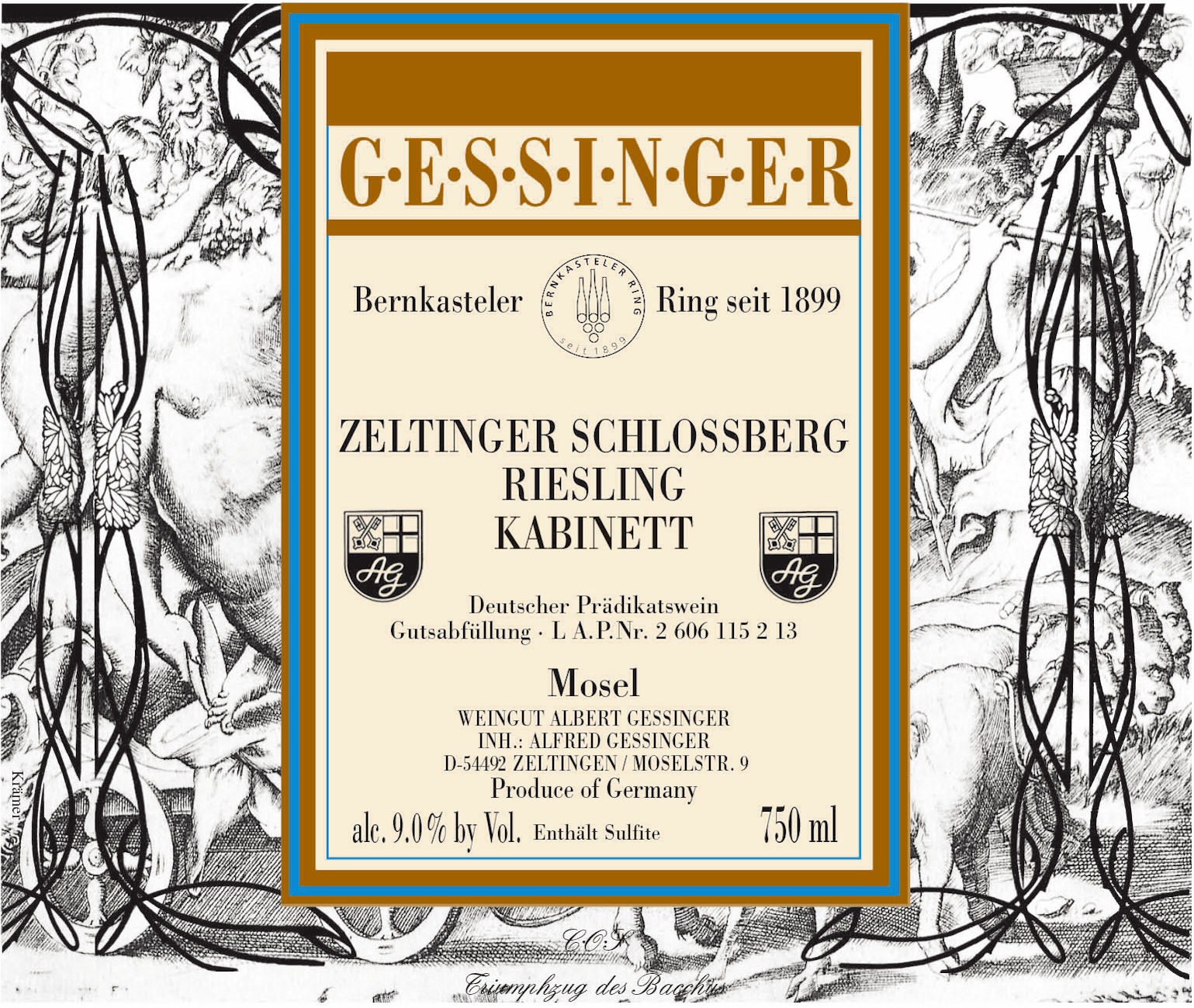
Gessinger Zeltinger Schlossberg Kabinett is 100 percent Riesling.
Zeltinger Schlossberg is the little sister of the well-known grand cru site Zeltinger Sonnenuhr. Behind the old village center of Zeltingen rises the steep slope "Zeltinger Schlossberg". On the exposed vineyards of blue Devonian slate, juicy wines full of character and minerality ripen.
The Zeltinger Schlossberg Riesling Kabinett is made from fruit picked at around 86° Oechsle and was fermented to fruity-styled levels of residual sugar (42 g/l). It has a quite restrained and smoky nose of anise, Conference pear, bergamot, rose, lime tree, dill, and eucalyptus. The wine proves superbly playful, finely juicy, and fruity on the palate. This rounder and richer side is nicely buffered off by more structure and intensity in the very long and smoky finish. The feel of residual sugar is already well integrated in the after-taste, which is already more off-dry than fully fruity as lime and grapefruit skin dominate.
Acidity 8.6 g/l
Residual sugar 42 g/l
perfect match to Asian cuisine, spicy food as well as BBQ.

Gessinger Zeltinger Sonnenuhr Riesling Auslese Alte Reben Caldo Infernale made from 100 percent Riesling.
The Zeltinger Sonnenuhr Riesling Auslese Caldo Infernale was produced from over 100-year-old ungrafted vines in the Gewann “im Kalk,” the original part of the vineyard. This is a typical Devonian slate Riesling with fruity elegance and great durability.
Although riper elements of yellow peach, coconut, Victoria pineapple, and almond cream directly capture the attention, the nose maintains a fresh character with minty and zesty notes. The wine shows ripe and sweet elements on the palate, and has quite some creamy and juicy elements such as canned yellow peach and pineapple. The finish brings the right amount of zest to lift up the aromatics and adds focus and tension, while there is an almost Eiswein-type of acidity in the aftertaste. This is a gorgeous Auslese.

Gessinger Zeltinger Sonnenuhr Riesling Beerenauslese is made from 100 percent Riesling.
This deep yellow-colored wine offers a quite aromatic nose made of mirabelle, ripe apple, almond cream, date, ether oil, and earthy spices. It proves nicely complex and delicately oily on the otherwise focused and delicately racy palate, and leaves a subtly unctuous and still quite sweet feel of honeyed dried fruits, starfruit, kumquat, and almond cream in the precise and persistent finish. Some fresher elements of citrusy fruits and grapefruit already lighten up the aftertaste and hint at the greatness to come. This beautiful dessert wine is still really in its infancy but will develop into quite a beauty at maturity, once the candy floss driven sweetness will have receded into the background.
The Riesling Beerenauslese remains on the lees for several months to add a creamy texture to the mineral notes and to enhance the mouth-feel and drinkability.Zeltinger Sonnenuhr Riesling Beerenauslese Alte Reben was made from botrytized fruit hand-picked at a whopping 150° Oechsle from old ungrafted vines, spontaneously fermented and vegan. Fermentation with preferably wild yeasts gives this wine a unique and authentic taste, reflecting the extreme vineyard sites of the Mosel Valley. A cool temperature allows a slow fermentation which can continue for as long as the wine and the vintage requires.
Perfect match to sweet-and-sour dishes as well as spicy food.

Dr. Leimbrock Brauneberger Juffer Sonnenuhr Riesling Kabinett is made from 100 percent Riesling.
Brauneberger Juffer and Juffer-Sonnenuhr are one of the most prestigious vineyards in the winegrowing region Mosel. The vineyard faces south and provides best conditions to plant the Riesling vines.
Juicy and aromatic with a wonderful drinking flow and aromas of melon, stone fruit and apple. Makes you want the next sip.
ABV: 9.1%
TA: 7.5
RS: 36.5 g/liter

Filippino Elio Barbaresco San Cristoforo Riserva 10 Anni is made from 100% Nebbiolo.
This Riserva 100% Nebbiolo is produced on the hillsides of the San Cristoforo vineyard in Neive. A beautiful wine, full of fruity aromas, violet and raspberries, along with spicy hints of cinnamon, tobacco and vanilla. Full-bodied and elegant with intense flavors.
The best grapes are delicately pressed and the stalks are removed. The must ferments in stainless steel vats at a controlled temperature of 26°C with a maceration of 25 days. After racking, the new wine is put into 15-25 hl Slavonian oak casks for long months. Next, it is bottled and left to age for at least 7 years. The tenth year the wine is ready for the market.
Review:
-Jeb Dunnuck 94 Points
-Wine Enthusiast 90 Points
-James Suckling 93 Points
Gessinger Zeltinger Schlossberg Kabinett is 100 percent Riesling.
Weingut Gessinger joined the Bernkastel Ring in 1899 and for years their wines only appeared at their September auction. Gessinger is quite small, less than 2,000 cases and all his whites are 100% Riesling planted on Devon Slate (best soil type of the area).
The Weingut Albert Gessinger Estate
The Gessinger family migrated from Northern Italy in the late 1500’s and settled in the middle Mosel region of Zelting, where they worked as artistic masons on churches being constructed in the area. Quickly, they found themselves drawn to viticulture, the prime occupation of the region since Roman times and before. Weingut Albert Gessinger was founded in 1680. In 1820, Peter Gessinger, through marriage, acquired additional vineyards in Zeltingen and Gessinger became one of the first family owned companies in the middle Mosel dedicated exclusively to viticulture. In the 1890s, Weingut Gessinger joined the first organization dedicated to supporting quality wine production in Germany, the Union of Winery Owners of Koblenz. In 1899, Weingut Gessinger joined the Bernkastel Ring, an exclusive group to which they have belonged for over 100 years. The members of the Ring, the finest producers in Germany, sell select wines to connoisseurs from around the world. Today, Alfred Gessinger owns the property and continues the family tradition of wine making going back centuries.
The Weingut Albert Gessinger Vineyard
The Estate consists of 8 acres or 3.2 hectares. The plantings are broken down as follows: 80% Riesling, 15% Spatburgunder (Pinot Noir), 5% Dornfelder (new red wine clone developed in 1956). All vineyards are located in the middle Mosel town of Zelting. Weingut Gessinger joined the Bernkastel Ring in 1899 and for years their wines only appeared at their September auction. Gessinger is quite small, less than 2,000 cases and all his whites are 100% Riesling planted on Devon Slate (best soil type of the area).

Young and present, this is an energetic and bold expression of violets, lavender, and cassis mixed with dark chocolate, cherry, plum, and graphite. A wine happy to be tucked away in the cellar, and it’s also expressing itself beautifully now.
Review:
-Joe Czerwinski 100 Points
-Decanter 99 Points
-Wine Advocate 98 Points
-The Wine Independent 98 Points

Duorum was founded in the Douro Superior by two of Portugal's most celebrated winemakers — João Portugal Ramos and José Maria Soares Franco, the long-time hand behind Barca Velha. Their Vintage Port is a field blend from old, often centenarian vines and is declared only in the finest years. Powerful and built for the long haul, it is a classic expression of the Douro's greatest sites.
Review:
The 2017 Vintage Port, the first declared vintage here since the 2011, is a field blend from centenarian vines. It is equal parts Touriga Nacional and Touriga Franca with 20% Tinta Roriz. This is round and luscious on opening. With some air, it becomes a very different wine, showing its class and its muscle. It shows far more power and pop as it airs out, becoming very persistent. It's always most notable, though, for the rich fruit and velvety texture. It should steadily improve for the next ten to 15 years and age effortlessly for some time after that.
Wine Advocate (Mark Squires) 95 Points



