" We don't sell the wine without touching the vine "
| BUY MORE! SAVE MORE! | ||||||||||||||||||||
|
| Country: | Germany |
| Region: | Mosel |
| Winery: | Weingut Albert Gessinger |
| Grape Type: | Riesling |
| Vintage: | 2020 |
| Bottle Size: | 375 ml |
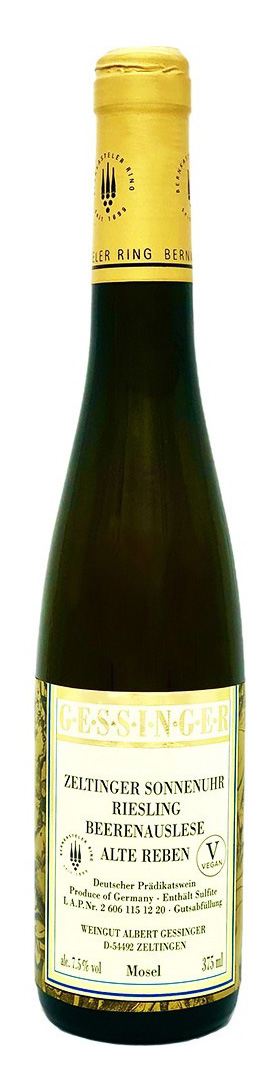
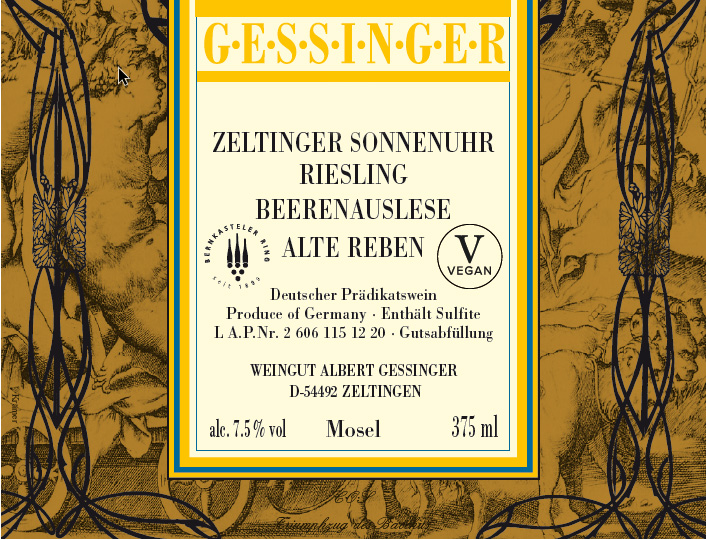
Gessinger Zeltinger Sonnenuhr Riesling Beerenauslese is made from 100 percent Riesling.
This deep yellow-colored wine offers a quite aromatic nose made of mirabelle, ripe apple, almond cream, date, ether oil, and earthy spices. It proves nicely complex and delicately oily on the otherwise focused and delicately racy palate, and leaves a subtly unctuous and still quite sweet feel of honeyed dried fruits, starfruit, kumquat, and almond cream in the precise and persistent finish. Some fresher elements of citrusy fruits and grapefruit already lighten up the aftertaste and hint at the greatness to come. This beautiful dessert wine is still really in its infancy but will develop into quite a beauty at maturity, once the candy floss driven sweetness will have receded into the background.
The Riesling Beerenauslese remains on the lees for several months to add a creamy texture to the mineral notes and to enhance the mouth-feel and drinkability.Zeltinger Sonnenuhr Riesling Beerenauslese Alte Reben was made from botrytized fruit hand-picked at a whopping 150° Oechsle from old ungrafted vines, spontaneously fermented and vegan. Fermentation with preferably wild yeasts gives this wine a unique and authentic taste, reflecting the extreme vineyard sites of the Mosel Valley. A cool temperature allows a slow fermentation which can continue for as long as the wine and the vintage requires.
Perfect match to sweet-and-sour dishes as well as spicy food.
The Weingut Albert Gessinger Estate
The Gessinger family migrated from Northern Italy in the late 1500’s and settled in the middle Mosel region of Zelting, where they worked as artistic masons on churches being constructed in the area. Quickly, they found themselves drawn to viticulture, the prime occupation of the region since Roman times and before. Weingut Albert Gessinger was founded in 1680. In 1820, Peter Gessinger, through marriage, acquired additional vineyards in Zeltingen and Gessinger became one of the first family owned companies in the middle Mosel dedicated exclusively to viticulture. In the 1890s, Weingut Gessinger joined the first organization dedicated to supporting quality wine production in Germany, the Union of Winery Owners of Koblenz. In 1899, Weingut Gessinger joined the Bernkastel Ring, an exclusive group to which they have belonged for over 100 years. The members of the Ring, the finest producers in Germany, sell select wines to connoisseurs from around the world. Today, Alfred Gessinger owns the property and continues the family tradition of wine making going back centuries.
The Weingut Albert Gessinger Vineyard
The Estate consists of 8 acres or 3.2 hectares. The plantings are broken down as follows: 80% Riesling, 15% Spatburgunder (Pinot Noir), 5% Dornfelder (new red wine clone developed in 1956). All vineyards are located in the middle Mosel town of Zelting. Weingut Gessinger joined the Bernkastel Ring in 1899 and for years their wines only appeared at their September auction. Gessinger is quite small, less than 2,000 cases and all his whites are 100% Riesling planted on Devon Slate (best soil type of the area).

Gessinger Zeltinger Sonnenuhr Riesling Auslese Alte Reben Caldo Infernale made from 100 percent Riesling.
The Zeltinger Sonnenuhr Riesling Auslese Caldo Infernale was produced from over 100-year-old ungrafted vines in the Gewann “im Kalk,” the original part of the vineyard. This is a typical Devonian slate Riesling with fruity elegance and great durability.
Although riper elements of yellow peach, coconut, Victoria pineapple, and almond cream directly capture the attention, the nose maintains a fresh character with minty and zesty notes. The wine shows ripe and sweet elements on the palate, and has quite some creamy and juicy elements such as canned yellow peach and pineapple. The finish brings the right amount of zest to lift up the aromatics and adds focus and tension, while there is an almost Eiswein-type of acidity in the aftertaste. This is a gorgeous Auslese.
Gessinger Zeltinger Sonnenuhr Riesling Auslese Alte Reben Caldo Infernale made from 100 percent Riesling.
The Zeltinger Sonnenuhr Riesling Auslese Caldo Infernale was produced from over 100-year-old ungrafted vines in the Gewann “im Kalk,” the original part of the vineyard. This is a typical Devonian slate Riesling with fruity elegance and great durability.
Although riper elements of yellow peach, coconut, Victoria pineapple, and almond cream directly capture the attention, the nose maintains a fresh character with minty and zesty notes. The wine shows ripe and sweet elements on the palate, and has quite some creamy and juicy elements such as canned yellow peach and pineapple. The finish brings the right amount of zest to lift up the aromatics and adds focus and tension, while there is an almost Eiswein-type of acidity in the aftertaste. This is a gorgeous Auslese.

Gessinger Zeltinger Sonnenuhr Riesling Spatlese St. Josef is made from 100 percent Riesling.
The Zeltinger Sonnenuhr Riesling Spätlese St. Josef - formerly know as Josefsberg- was produced from fruit harvested from 120-year-old vines in a prime Rothlay part of the vineyard known locally as Josefsberg, next to the cross of St. Josef - the patron of vineyard growers. Here grow old, ungrafted Riesling vines whose particular small and loose grapes develop a lot of aroma.
It was made from fruit picked at the end of the harvest and was fermented down to sweet levels of residual sugar. It offers a backward nose made of white peach, melon, smoke, herbs, and minerals. On the pleasant racy palate and the wine leaves a beautiful feel of ripe fruits packed into zesty minerals in the finish. The featherlight side of this Spätlese paired with its flavor intensity are simply a thing of beauty. However, during the years this wine will reveal all its facets.
Perfect match to Asian cuisine as well as spicy food.

Gessinger Zeltinger Schlossberg Kabinett is 100 percent Riesling.
Zeltinger Schlossberg is the little sister of the well-known grand cru site Zeltinger Sonnenuhr. Behind the old village center of Zeltingen rises the steep slope "Zeltinger Schlossberg". On the exposed vineyards of blue Devonian slate, juicy wines full of character and minerality ripen.
The Zeltinger Schlossberg Riesling Kabinett is made from fruit picked at around 86° Oechsle and was fermented to fruity-styled levels of residual sugar (42 g/l). It has a quite restrained and smoky nose of anise, Conference pear, bergamot, rose, lime tree, dill, and eucalyptus. The wine proves superbly playful, finely juicy, and fruity on the palate. This rounder and richer side is nicely buffered off by more structure and intensity in the very long and smoky finish. The feel of residual sugar is already well integrated in the after-taste, which is already more off-dry than fully fruity as lime and grapefruit skin dominate.
Acidity 8.6 g/l
Residual sugar 42 g/l
perfect match to Asian cuisine, spicy food as well as BBQ.

A late harvest Riesling with fruity sweetness and great aging potential, aromatic bouquet of honey, melon, ripe fruits. Grapes come from Brauneberger Juffer and Juffer-Sonnenuhr - one of the most prestigious vineyards in the Mosel winegrowing region. The vineyard faces south and provides the best conditions for growing Riesling.
Pairs well with pâté, Asian cuisine.

Aalto P.S. Pagos Seleccionados Tinto is made from 100 percent Tempranillo.
Climatic conditions
The farming year began with a mild autumn and little precipitation. A very dry winter started with -9ºC reaching at the end higher temperatures than normal for that time of the year. Spring and summer characterized by little rain, only some rain showers in July and late August avoided the hydric stress of the vines. The vegetative cycle of the vine developed with big variations of temperatures, alternating warm and atypical low temperatures of 4ºC for mid-June. The ripening of the grapes happened under very good conditions and the harvest started on 24th September 2019.
100% Tinto Fino (Tempranillo) primarily from very old vines – 60 to 90 years old – from selected plots in La Horra and La Aguilera. The harvest was done by hand, in small boxes of 15 kilos that are thoroughly inspected, bunch by bunch, on the selection table.
Tasting notes
Review:
Lots of depth here, with ripe blackberries and some nicely baked black cherries, roasted herbs, incense, dark spices, mussels and a balsamic tinge. An admirably fine dollop of tannins on the palate, which are immaculate and juicy, as they thoroughly dunk into the black fruit, melting into a persistent finish that lasts for over a minute. Very impressive. Drink or hold.
-James Suckling 96 Points

Continuum Red Blend 2022 is made from 45% Cabernet Sauvignon, 43% Cabernet Franc, 8% Petit Verdot, 4% Merlot.
2022 tells a story of subtle drama of the seasons. Aromatically effusive, 2022 Continuum is a seductive wine with an upright and regal core. Elegantly interwoven notes of black plum, black cherry, cacao, forest floor and tobacco leaf mingle with our sage mountain garrigue and volcanic minerality. Energetic and expressive, 2022 Continuum is a harmoniously integrated wine with structural complexity wrapped in a velvet robe.
WINEGROWING- Continuum is estate grown on our Sage Mountain Vineyard. It’s location, high on Pritchard Hill along the eastern ridge above Oakville, overlooks Napa Valley and the San Francisco Bay. The rocky, volcanic soils of the site focus the vine’s energy keeping yields low yielding fruit of depth and complexity. 38 acres of mature estate vineyard, planted in 1991 and 1996, with additional plantings in 2004, 2010, together comprise 38 distinct vineyard blocks. Cabernet Sauvignon, Cabernet Franc, Petit Verdot, and Merlot are grown from 1300 to 1600 feet in elevation, on western and southern facing aspects with slight northern and eastern slopes in places. This diversity of plantings on our volcanic soils are the essence of the complexity of Continuum.
PRODUCTION- Continuum is 100% estate grown, produced and bottled. All fruit is selectively hand-harvested at night. The fruit is then sorted before and after de-stemming, and gravity fed into French oak or concrete tanks. A threeday cold soak is followed by fermentation, receiving three to four pumpovers daily, and délestage two to three times in total during the most active period. The wine remains on skins in tank for 20 to 40 days. All lots are then drained, basket pressed, and transferred with lees for malolactic fermentation and aging. Continuum spent 22 months in barrel. 63 percent of French oak barrels were new and 35 percent were once used. A single concrete amphora was also used for aging. The wine clarified slowly and settled naturally in our cold barrel room, was racked sparingly and bottled without fining or filtration. Each vineyard lot was tasted and carefully considered many times to assemble the blend.
Review:
Perfumed aromas of subtle currants, roses, lavender and sage, following through to a medium body with super-fine tannins that caress the palate and leave it fresh and inspired.
- James Suckling 99 Points