" We don't sell the wine without touching the vine "
| BUY MORE! SAVE MORE! | ||||||||||||||||||||
|
| Country: | Germany |
| Region: | Mosel |
| Winery: | Weingut Albert Gessinger |
| Grape Type: | Riesling |
| Vintage: | 2020 |
| Bottle Size: | 375 ml |
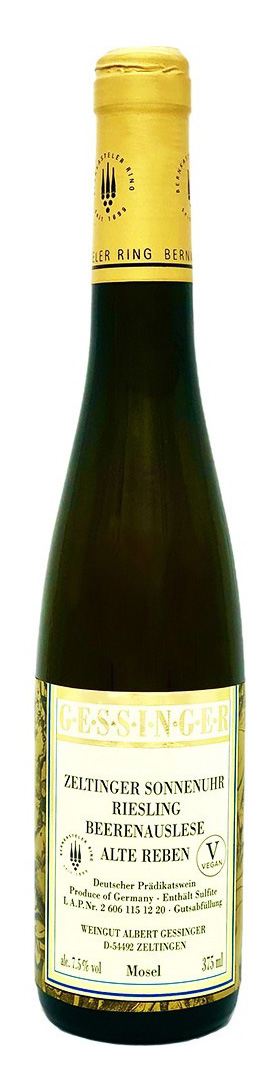
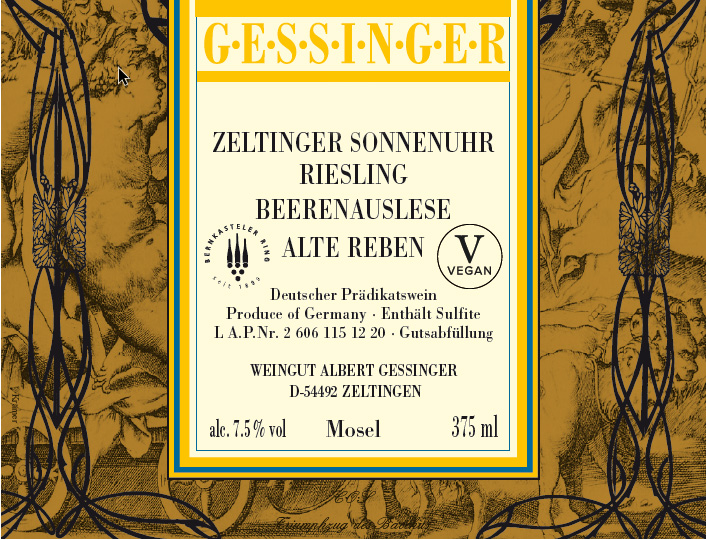
Gessinger Zeltinger Sonnenuhr Riesling Beerenauslese is made from 100 percent Riesling.
This deep yellow-colored wine offers a quite aromatic nose made of mirabelle, ripe apple, almond cream, date, ether oil, and earthy spices. It proves nicely complex and delicately oily on the otherwise focused and delicately racy palate, and leaves a subtly unctuous and still quite sweet feel of honeyed dried fruits, starfruit, kumquat, and almond cream in the precise and persistent finish. Some fresher elements of citrusy fruits and grapefruit already lighten up the aftertaste and hint at the greatness to come. This beautiful dessert wine is still really in its infancy but will develop into quite a beauty at maturity, once the candy floss driven sweetness will have receded into the background.
The Riesling Beerenauslese remains on the lees for several months to add a creamy texture to the mineral notes and to enhance the mouth-feel and drinkability.Zeltinger Sonnenuhr Riesling Beerenauslese Alte Reben was made from botrytized fruit hand-picked at a whopping 150° Oechsle from old ungrafted vines, spontaneously fermented and vegan. Fermentation with preferably wild yeasts gives this wine a unique and authentic taste, reflecting the extreme vineyard sites of the Mosel Valley. A cool temperature allows a slow fermentation which can continue for as long as the wine and the vintage requires.
Perfect match to sweet-and-sour dishes as well as spicy food.
The Weingut Albert Gessinger Estate
The Gessinger family migrated from Northern Italy in the late 1500’s and settled in the middle Mosel region of Zelting, where they worked as artistic masons on churches being constructed in the area. Quickly, they found themselves drawn to viticulture, the prime occupation of the region since Roman times and before. Weingut Albert Gessinger was founded in 1680. In 1820, Peter Gessinger, through marriage, acquired additional vineyards in Zeltingen and Gessinger became one of the first family owned companies in the middle Mosel dedicated exclusively to viticulture. In the 1890s, Weingut Gessinger joined the first organization dedicated to supporting quality wine production in Germany, the Union of Winery Owners of Koblenz. In 1899, Weingut Gessinger joined the Bernkastel Ring, an exclusive group to which they have belonged for over 100 years. The members of the Ring, the finest producers in Germany, sell select wines to connoisseurs from around the world. Today, Alfred Gessinger owns the property and continues the family tradition of wine making going back centuries.
The Weingut Albert Gessinger Vineyard
The Estate consists of 8 acres or 3.2 hectares. The plantings are broken down as follows: 80% Riesling, 15% Spatburgunder (Pinot Noir), 5% Dornfelder (new red wine clone developed in 1956). All vineyards are located in the middle Mosel town of Zelting. Weingut Gessinger joined the Bernkastel Ring in 1899 and for years their wines only appeared at their September auction. Gessinger is quite small, less than 2,000 cases and all his whites are 100% Riesling planted on Devon Slate (best soil type of the area).
Gessinger Zeltinger Sonnenuhr Riesling Auslese Alte Reben Caldo Infernale made from 100 percent Riesling.
The Zeltinger Sonnenuhr Riesling Auslese Caldo Infernale was produced from over 100-year-old ungrafted vines in the Gewann “im Kalk,” the original part of the vineyard. This is a typical Devonian slate Riesling with fruity elegance and great durability.
Although riper elements of yellow peach, coconut, Victoria pineapple, and almond cream directly capture the attention, the nose maintains a fresh character with minty and zesty notes. The wine shows ripe and sweet elements on the palate, and has quite some creamy and juicy elements such as canned yellow peach and pineapple. The finish brings the right amount of zest to lift up the aromatics and adds focus and tension, while there is an almost Eiswein-type of acidity in the aftertaste. This is a gorgeous Auslese.
Gessinger Zeltinger Sonnenuhr Riesling Auslese Alte Reben Caldo Infernale made from 100 percent Riesling.
The Zeltinger Sonnenuhr Riesling Auslese Caldo Infernale was produced from over 100-year-old ungrafted vines in the Gewann “im Kalk,” the original part of the vineyard. This is a typical Devonian slate Riesling with fruity elegance and great durability.
Although riper elements of yellow peach, coconut, Victoria pineapple, and almond cream directly capture the attention, the nose maintains a fresh character with minty and zesty notes. The wine shows ripe and sweet elements on the palate, and has quite some creamy and juicy elements such as canned yellow peach and pineapple. The finish brings the right amount of zest to lift up the aromatics and adds focus and tension, while there is an almost Eiswein-type of acidity in the aftertaste. This is a gorgeous Auslese.

Gessinger Zeltinger Sonnenuhr Riesling Spatlese St. Josef is made from 100 percent Riesling.
The Zeltinger Sonnenuhr Riesling Spätlese St. Josef - formerly know as Josefsberg- was produced from fruit harvested from 120-year-old vines in a prime Rothlay part of the vineyard known locally as Josefsberg, next to the cross of St. Josef - the patron of vineyard growers. Here grow old, ungrafted Riesling vines whose particular small and loose grapes develop a lot of aroma.
It was made from fruit picked at the end of the harvest and was fermented down to sweet levels of residual sugar. It offers a backward nose made of white peach, melon, smoke, herbs, and minerals. On the pleasant racy palate and the wine leaves a beautiful feel of ripe fruits packed into zesty minerals in the finish. The featherlight side of this Spätlese paired with its flavor intensity are simply a thing of beauty. However, during the years this wine will reveal all its facets.
Perfect match to Asian cuisine as well as spicy food.
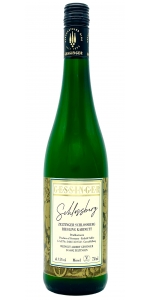
Gessinger Zeltinger Schlossberg Kabinett is 100 percent Riesling.
Zeltinger Schlossberg is the little sister of the well-known grand cru site Zeltinger Sonnenuhr. Behind the old village center of Zeltingen rises the steep slope "Zeltinger Schlossberg". On the exposed vineyards of blue Devonian slate, juicy wines full of character and minerality ripen.
The Zeltinger Schlossberg Riesling Kabinett is made from fruit picked at around 86° Oechsle and was fermented to fruity-styled levels of residual sugar (42 g/l). It has a quite restrained and smoky nose of anise, Conference pear, bergamot, rose, lime tree, dill, and eucalyptus. The wine proves superbly playful, finely juicy, and fruity on the palate. This rounder and richer side is nicely buffered off by more structure and intensity in the very long and smoky finish. The feel of residual sugar is already well integrated in the after-taste, which is already more off-dry than fully fruity as lime and grapefruit skin dominate.
Acidity 8.6 g/l
Residual sugar 42 g/l
perfect match to Asian cuisine, spicy food as well as BBQ.
Gessinger Zeltinger Schlossberg Kabinett is 100 percent Riesling.
Zeltinger Schlossberg is the little sister of the well-known grand cru site Zeltinger Sonnenuhr. Behind the old village center of Zeltingen rises the steep slope "Zeltinger Schlossberg". On the exposed vineyards of blue Devonian slate, juicy wines full of character and minerality ripen.
The Zeltinger Schlossberg Riesling Kabinett is made from fruit picked at around 86° Oechsle and was fermented to fruity-styled levels of residual sugar (42 g/l). It has a quite restrained and smoky nose of anise, Conference pear, bergamot, rose, lime tree, dill, and eucalyptus. The wine proves superbly playful, finely juicy, and fruity on the palate. This rounder and richer side is nicely buffered off by more structure and intensity in the very long and smoky finish. The feel of residual sugar is already well integrated in the after-taste, which is already more off-dry than fully fruity as lime and grapefruit skin dominate.
Acidity 8.6 g/l
Residual sugar 42 g/l
perfect match to Asian cuisine, spicy food as well as BBQ.
Pago de Carraovejas Ribera Del Duero is made from 90% Tempranillo, 6% Cabernet Sauvignon and 4% Merlot
The most honest interpretation of the Carraovejas Valley.
Body, structure and balance with a vibrant background. Delicacy, harmony and passion for detail are perceived in a wine that reflects the unique character of the valley in an outstanding way.
The 2022 vintage was characterized by cool winter months and extremely low rainfall, reaching limits that had not been observed for years. Due to the good rainfall of the previous year, the vines had good accumulated water reserves, which allowed the vineyard to have a good phenological cycle and normal development. Budding and flowering were perfectly developed in each of the varieties worked, and a homogeneous and balanced development of the plants was achieved. The summer was excessively hot, with several episodes of heat waves, which were mitigated by drip irrigation. Veraison, which was slower than in previous years, and ripening began in early August and the berries developed very uniformly. Harvest began on September 12 and ended on September 28.
Pago de Carraovejas 2022 is the most honest reflection of the valley to which it owes its name. An environment in which the vines climb the slopes to form a unique landscape. On the surface, its tertiary soil of limestone marl, clay and sandstone outcrops force the vines to self-regulate and give their best. Plots that converge in an orography marked by its unique mesoclimate. The vineyards are distributed from the middle zones to the moors that exceed 900 meters in altitude; from the gentle undulation that descends towards the stream, to the plots that exceed 30% slope. South- and north facing slopes, each with its own personality, create the profile of the Carraovejas Valley.
The grapes for Pago de Carraovejas 2022 were harvested by hand after an initial selection of bunches in the vineyard. Subsequently, in the winery, a double selection was made: first by cluster then by berry. Gravity must production allows maximum respect for the raw material. During the fermentation process, indigenous yeasts and lactic bacteria from our own estate were used. The wine was aged in French and American oak barrels for 12 months. The entire process was marked by precision and care in every detail. For greater protection, the wine contains sulfites. Finally it was clarified with natural egg white and bottle in spring of 2024.
Review:
A concentrated, dense Ribera del Duero, but there is a lot to like if you enjoy plushness, with its lush blackberry fruit and dark chocolate. Fine-grained and full-bodied on the palate, but fresh and still pretty tense, with chalky tannins. Drink from 2025.
-James Suckling 93 Points

Clear, golden straw, with a slight greenish tinge. The nose is intense with yellow apple, Calamansi lime, apricot, quince, white flowers, flinty minerals, and brioche. The palate is light and quaffable.
Alcohol: 12.5%
Acid TA: 6.34g/L
pH: 3.22