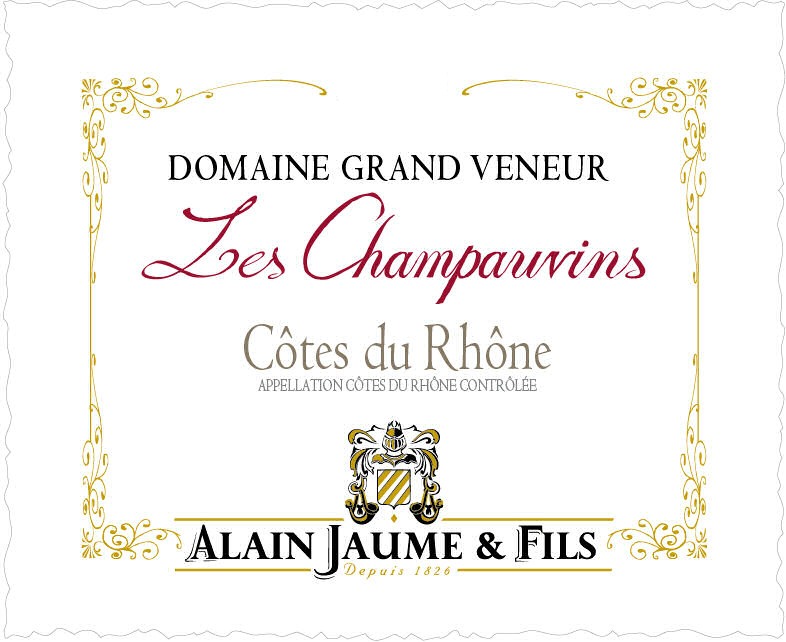
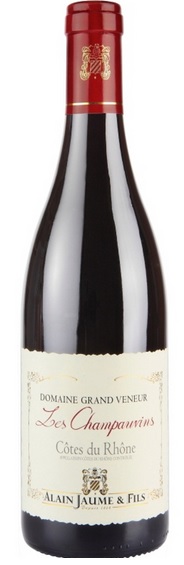
" We don't sell the wine without touching the vine "
| BUY MORE! SAVE MORE! | ||||||||||||||||
|
| Country: | France |
| Region: | Rhone |
| Winery: | Grand Veneur |
| Grape Type: | Grenache |
| Organic: | Yes |
| Vintage: | 2023 |
| Bottle Size: | 750 ml |
Intense, brilliant garnet-red colour. It reveals lovely fruit, loads of body and a heady bouquet of ground peppers, raspberries cherry liqueur, currants, and spice box. Full-bodied and dense, it tastes more like a "baby Châteauneuf" than a Côtes du Rhône.
A complete wine, rich and elegant, thanks to the harmony of all the elements which make it up.
Drink between 1 and 6 years.
Soil type DOMAINE GRAND VENEUR “Les Champauvins” stretches on 34 ha classified in Côtes du Rhône. The plots are located in the northern border of Châteauneuf du Pape, exactly from 3 meters outside the appellation. A small lane of rocks going through the rocky plateaux has been decided to be the AOC limit in 1936. Here, soils are made of red clay and rocks (pebbled stones of quartz). The quantity of rocks can be amazing as they can completely cover the soil (see picture). In summer and during the day, the rocks temperature will increase to 55°C. This accumulated heat will be get back to the vines during nights . Day after day, this unique phenomenon allow the grapes to reach a perfect maturity and produce a unique wine. Winemaking & Ageing Traditional, in stainless steel vats. Harvest crushed and destemmed. Fermentation in temperature controlled vats at 28°C. Eighteen-day vating period with “pigeage”. Grenache is aged in concrete vats, Syrah and mourvèdre in 4 year old barrels. Inte“baby Châteauneuf” than a Côtes du Rhône. A
Review:
-Vinum Wine Magazine 90 Points
The Grand Veneur Estate
In 1320 Pope Jean XXII planted the first vines of Chateauneuf-du-Pape, but it was only in 1360 that the wines of the region first gained fame. Oddly, the wine that gave Chateauneuf-du-Pape its original reputation was the Blanc and not the Rouge. The white wine was a favorite of Pope Innocent VI. The Domaine dates back to 1826, having been founded at that time by Mathieu Jaume. Since 1979, Alain Jaume has run the Domaine and now has the help of his two sons: Sebastien and Christophe.
"Popes throughout history have liked their juice, and when the papal see moved to Avignon in the 13th century, that juice was Chateauneuf-du-Pape ("the pope's new castle") made from grapes grown nearby in the Southern Rhone. The castle is a ruin now, the papal court long gone back to Rome, but the wines that bear the pope's coat of arms emblazoned on the bottle are still produced more or less according to the long-standing recipe. Not every winemaker uses all 13 of the grapes in the proscribed blend, though. At Domaine Grand Veneur, an estate that dates to 1826, Alain Jaume and his sons Sebastien and Christophe emphasize Grenache blended with Syrah and Mourvedre."
- Los Angeles Times
"Improved Chateauneuf with very accomplished, stylish reds since the late 1990s; also very good Vacqueyras and Cotes-du-Rhone Villages." - Anthony Dias Blue's pocket guide to wine 2006
"Grand Veneur is one of the most brilliant estates in Chateauneuf du Pape as well as the force behind the negociant wines sold under the Alain Jaume label. Virtually everything they produce has merit. Some of this estate’s 2009 red wines are just hitting the market as they are bottled early to preserve their fruit and freshness. I can’t say enough about the job Alain Jaume’s two sons, Sebastian and Christophe, have done with this estate. The impeccable attention to detail in the vineyards, the meticulous vinification, and the careful bottling benefit every consumer." - Wine Advocate (#190, August 2010)
"Great bargains continue to emerge from Domaine Grand Veneur as well as from their negociant arm of the business, labeled Alain Jaume" - Wine Advocate (#195, June 2011)
"Don't miss the following "Best Buys" reviewed in several previous issues: Alain Jaume 2010 Cotes du Rhone Haut de Brune (87), Grand Veneur 2010 Cotes du Rhone Blanc (88), Grand Veneur 2009 Cotes du Rhone Les Champauvins (89), Grand Veneur 2009 Cotes du Rhone Reserve Blanc (89), Grand Veneur 2010 Cotes du Rhone Blanc (91), Grand Veneur 2010 Cotes du Rhone Rose (86), Grand Veneur 2009 Lirac Clos de Sixte (91), and Grand Veneur 2010 Cotes du Rhone Blanc de Viognier (89). Credit Christophe and Sebastian Jaume for making this one of the most impeccably run estates in the Rhone Valley. To reiterate, this is an estate at the top of its game and the wines remain fairly priced as well. The 2010 Grand Veneur Chateauneuf du Papes reveal youthful, crisper, more focused styles than their 2009 counterparts. I suspect their pHs are lower, the total acids slightly higher, and the alcohols perhaps .5 to 1% lower across the board." - Wine Advocate (issue197, October 2011)"
The Grand Veneur Vineyard
The estate is located in the commune of Orange and consists of 50 hectares (123 acres). It covers four different appellations: Chateauneuf-du-Pape, Cotes-du-Rhone Villages, Cotes-du-Rhone and Lirac.
The family produces wines under two labels:
- Domaine Grand Veneur – Estate
- Alain Jaume – Negociant
Some wine by Grand Veneur:
Annual production:
- Cotes du Rhone Villages CHAMPAUVINS : +/- 9,000 cases
- Lirac Rouge CLOS DE SIXTE : +/- 5,000 cases
- Chateauneuf du Pape Rouge Grand veneur : 3,300 cases
- Chateauneuf du Pape Blanc Grand veneur : 400 cases
- Chateauneuf du Pape LES ORIGINES red : 1,700 cases
- Chateauneuf du Pape LA FONTAINE white : 300 cases
- Chateauneuf du Pape VIEILLES VIGNES : 530 cases

Bernardins Beaumes de Venise Rouge Cru Cotes du Rhone is made from 65% Grenache, 25% Syrah, 5% Mourvedre and 5% Grenache Blanc.
Bright ruby color with cherry tinges. Complex black fruit aromas on the nose enhanced by spicy notes. Rounded palate with good length.
The wine is drinking well right now and can be kept for another 10 years.
Situation
Spreads out over the south-east side of the Dentelles de Montmirail hills, in Beaumes de Venise in the southern part of the Rhone valley.
Terroir
On a poor sandy, hungry and arid soil consisting of tender limestone and gritty zones of sandy mollasse.
In the vineyard
The vineyards and their terroir are the essence of our wines. This is where everything starts and where we focus our efforts throughout the year. You can’t make great wine without great grapes.
The viticulture is essentially done by hand. Five people work full-time in the vineyards. They are supplemented by seasonal employees who work during bunch thinning and the harvest in order to bring out the very best in our vines. Working by hand and the attention each vine gets are fundamental. Pruning, de-budding, trellising, leaf removal and picking are thus carried out by hand with the utmost care.
We prepare the soil by using good old-fashioned ploughing. Organic compost is made from grape marc (the discarded stalks and skins).
As a way of protecting the plants, we only use phytosanitary products when necessary and within strict guidelines by staggering the treatments appropriately, to minimise the amount of chemicals used. We prefer to use as much as possible manual and organic techniques . Leaving natural grass cover, removing buds and leaves from the vines, preserving biodiversity around the vineyard: olive, almond and cypress trees, wild rosemary and capers.
Winemaking
We make two red wines at the estate. Terroir wines shaped by the two classic Côtes du Rhône varieties: Grenache and Syrah. We don’t follow any winemaking recipe but are constantly searching for the perfect expression of terroir and each vintage’s particular characteristics. We don’t go for overripe grapes and over-extraction, as we think the wine has to stay refreshing and balanced.
Leaving the wine for 15 days in concrete vats, we try to gently extract the tannins and anthocyanins essential for the wine’s structure and colour. The wine doesn’t come into any contact with wood during ageing. This way the characteristics of our terroir can fully express
Serve with a meal especially red meat, game and cheese.
Review:
-Decanter 95 Points
-Decanter 93 Points

Grand Veneur Cotes Du Rhone Les Champauvins is made of 70% Grenache, 20% Syrah and 10% Mourvedre
Intense, brilliant garnet-red colour. It reveals lovely fruit, loads of body and a heady bouquet of ground peppers, raspberries cherry liqueur, currants, and spice box. Full-bodied and dense, it tastes more like a "baby Châteauneuf" than a Côtes du Rhône.
A complete wine, rich and elegant, thanks to the harmony of all the elements which make it up.
Drink between 1 and 6 years.
Soil type DOMAINE GRAND VENEUR “Les Champauvins” stretches on 34 ha classified in Côtes du Rhône. The plots are located in the northern border of Châteauneuf du Pape, exactly from 3 meters outside the appellation. A small lane of rocks going through the rocky plateaux has been decided to be the AOC limit in 1936. Here, soils are made of red clay and rocks (pebbled stones of quartz). The quantity of rocks can be amazing as they can completely cover the soil (see picture). In summer and during the day, the rocks temperature will increase to 55°C. This accumulated heat will be get back to the vines during nights . Day after day, this unique phenomenon allow the grapes to reach a perfect maturity and produce a unique wine. Winemaking & Ageing Traditional, in stainless steel vats. Harvest crushed and destemmed. Fermentation in temperature controlled vats at 28°C. Eighteen-day vating period with “pigeage”. Grenache is aged in concrete vats, Syrah and mourvèdre in 4 years old barrelsnte“baby Châteauneuf” than a Côtes du Rhône. AReview:
-James Suckling 92 Points

Grand Veneur Cotes Du Rhone Les Champauvins Blanc is made 100% Viognier. Located in the area known as "Les Champauvins", close to Domaine Grand Veneur. The soils are clay-sand and limestone. They enable the white grape varieties to ripen slowly, thus preserving their excellent aromatic finesse.
A great Viognier, conceived and produced with finesse and freshness in mind. Bright, limpid pale yellow color. Intense, delicate nose of floral and white-fleshed fruit aromas. Fresh, mineral and airy on the palate. White peach and pear aromas are the most expressive. The fruity characters are long-lasting, evolving into notes of apricot after a few hours' aeration.
Review:
-James Suckling 91 Points

Grand Veneur Cotes du Rhone Rouge Reserve is made from 60% Grenache Noir, 35% Syrah and 5% Cinsault.
The colour is purple-tinged garnet.The aromatic range of the nose goes from fresh berries (wild raspberry, blackcurrant, blackberry) to spices.The palate is big and full-flavoured, with silky-smooth tannins and aromas of the fruit already mentioned. The finish introduces touches of liquorice and pepper. A Côtes du Rhône with great complexity for an every day drinking.
A classic Rhône to drink between 1 and 4 years.

SALE
Grand Veneur Cotes du Rhone Rouge Reserve is made from 60% Grenache Noir, 35% Syrah and 5% Cinsault.
The colour is purple-tinged garnet.The aromatic range of the nose goes from fresh berries (wild raspberry, blackcurrant, blackberry) to spices.The palate is big and full-flavoured, with silky-smooth tannins and aromas of the fruit already mentioned. The finish introduces touches of liquorice and pepper. A Côtes du Rhône with great complexity for an every day drinking.
A classic Rhône to drink between 1 and 4 years.

The Cotes du Rhone Reserve from Domaine Grand Veneur — the Alain Jaume family's estate in Orange — is a Grenache-led blend with Syrah, Cinsault and Mourvedre off the appellation's limestone, sand and red-clay terraces. Vinified in tank and bottled young, it's all wild raspberry, blackcurrant and blackberry with a lick of licorice and pepper: a supple, everyday southern Rhone red. Shown here in the 375ml half-bottle.

Domaine Jean Grivot Clos de Vougeot Grand Cru is made from 100 percent Pinot Noir.
Domaine Jean Grivot is among the great names in Burgundian wine. Étienne Grivot and his wife Marielle took over from Étienne’s father Jean Grivot in 1987. The vineyards are densely planted and farmed organically “sans certification” while the aim in the cellar is for balance and clear expression of terroir.
Jean Grivot’s 38.3 acres spread across 22 appellations with vineyards in the communes of Vosne-Romanée, Vougeot, Chambolle-Musigny, and Nuits-Saint-Georges. Besides the three grand crus, there are 8 premier crus including the much lauded Les Beaux Monts and Suchots in Vosne-Romanée. The grapes are completely de-stemmed and fermentation is spontaneous.
About the Vineyard:
Clos de Vougeot grand cru was acquired by Étienne’s grandfather, Gaston Grivot, in 1919. The total holding is 4.6 acres from the middle of the vineyard to the lower wall and the average vine age is 40 years old. A good Clos de Vougeot should be a complete wine without any one feature standing out. It is a perfect balance of power, aroma, and flavor.
Wine Production:
The grapes are destemmed and maceration à froid usually lasts just a day or two. The alcoholic fermentation is spontaneous and malolactic fermentation occurs in barrel. Depending on the vintage, the proportion of new oak is around 40-70% percent for the grands crus.
Tasting Notes:
The wine shows aromas and flavors of red berries, herbs, and purple flowers. The palate is rich with ripe fruit and medium weight with bright acidity and fine tannins. Aging in 40-70% new Burgundian pièce brings notes of vanilla, toast, and baking spices.
Food Pairing:
Red Burgundy might be the world’s most flexible food wine. The wine’s high acidity, medium body, medium alcohol, and low tannins make it very food-friendly. Red Burgundy, with its earthy and sometimes gamey character, is a classic partner to roasted game birds, grilled duck breast, and dishes that feature mushrooms, black truffles, or are rich in umami.
Review:
-Wine Spectator 95 Points
-Jasper Morris MW 97 Points

Domaine de la Janasse has been in the Sabon family since 1967, today run by siblings Christophe and Isabelle. Their Châteauneuf-du-Pape Blanc — Roussanne-led, with Grenache Blanc and Clairette — is consistently one of the finest whites in the appellation, combining richness with purity and the ability to age for two decades.
Review:
Based on 70% Roussanne and 15% each Grenache Blanc and Clairette and aged 12 months in 20% new French oak with the balance in used barrels and concrete. It has a medium gold hue and delivers remarkable intensity in its ripe stone fruits, fresh croissant, honeyed flowers, and orange blossom nuances. It's medium to full-bodied, has a pure, seamless, layered mouthfeel, beautiful balance, and a fabulous finish that will evolve for 20+ years if well stored. Drink 2025-2045.
Jeb Dunnuck 98 Points
-Jeb Dunnuck 91 Points