" We don't sell the wine without touching the vine "
| BUY MORE! SAVE MORE! | ||||||||||||||||||||
|
| Country: | France |
| Regions: | Burgundy Maconnais |
| Winery: | Guillemot-Michel |
| Grape Type: | Chardonnay |
| Organic: | Yes |
| Vintage: | 2018 |
| Bottle Size: | 1500 ml |
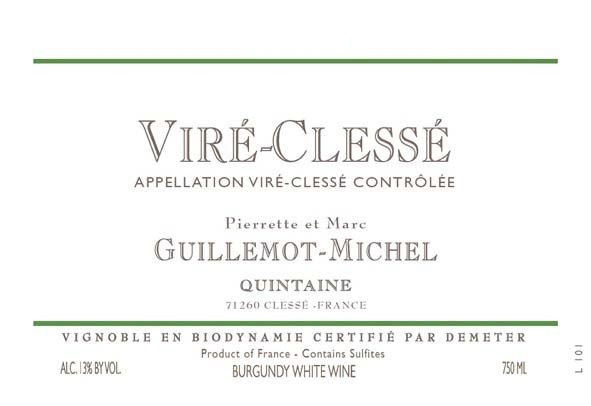
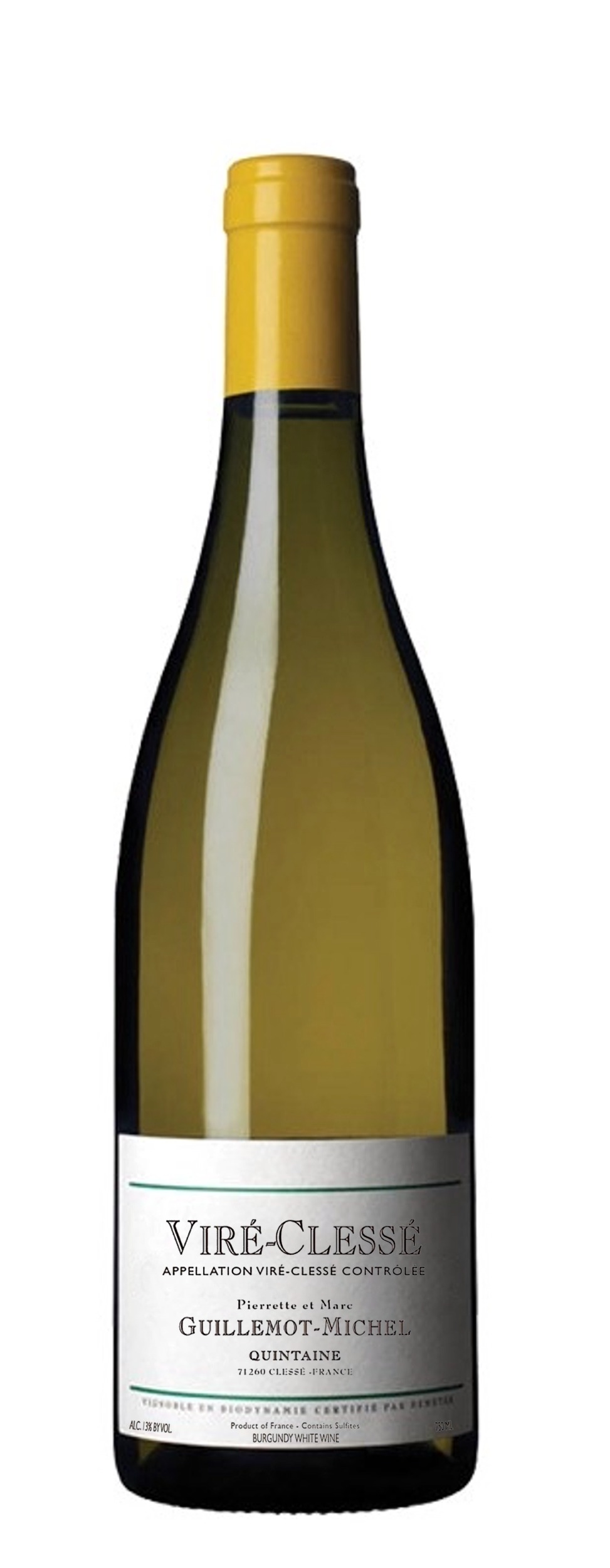
Guillemot-Michel Vire Clesse is made from 100 percent Chardonnay.
Beautifully expressive, with yellow fruits, orange blossom, smoke & flint. Thick and saline on entry, then seriously deep in the mid-palate, with suggestions of exotic fruits perfectly countered by strong minerality. This wine strikes a perfect balance between sweet and salty elements, and it shows vibrant acidity. It boasts a thickness that few other northern Mâconnais can match.
Enjoy with fish (such as sole meuniere), seafood, roasted chicken, goat cheese.
Review:
"The 2018 Viré-Clessé Quintaine is showing beautifully, wafting from the glass with a lovely bouquet of honeyed citrus fruit, fresh pastry and orange blossom. Medium to full-bodied, satiny and supple, it's elegantly textural and refined, with a fragrant core of fruit and a long, penetrating finish. Even though it will reward a bit of bottle age, it's slightly finer-boned than the more concentrated, muscular 2017, so I would opt to drink this immensely charming wine before its older sibling. – William Kelley"
- The Wine Advocate (Issue 249, June 30th 2020), 93 pts
The Domaine Guillemot-Michel Estate
Pierrette and Marc Guillemot took over the Domaine from Pierrette's parents in 1985. Pierrette and Marc are both oenolgists from the school of Beaune and post-graduates from Montpellier. They have applied their studies and have married both scientific and homeopathic principles in their winemaking. The Domaine is located in the commune of Quintaine, adjacent to the village of Clesse, South of Burgundy. Quintaine is recognized as producing some of the finest wines of the Mâconnais, having a special microclimate caused by the close proximity of the Saone river. The winery became biodynamic in 1991. They produce around 3,000 cases yearly and export 85% of the production (UK, USA, Belgium, Swizerland, Germany, Japan, etc)
"A tiny biodynamic estate making highly individual wines; the grapes are picked ripe, resulting in high alcohol levels and viscous textures; residual sugar not uncommon here."
- Anthony Dias Blue's pocket guide to wine 2006
The Domaine Guillemot-Michel Vineyard
This 7-hectare (17.3 acres) vineyard on a clay and limestone based soil has been cultivated through biodynamic and organic methods since 1991 (the Biodynamic method regards the earth as a living organism and strives to renew the soil in order to produce food that is full of vitality and deeply nourishing. Biodynamics notes the interrelationship of all kingdoms - mineral, plant, animal and human - and their intricate correspondence to the rhythms and activities of the larger cosmos). That means they work in harmony with the cycle of the vines and the soil. They don't use any chemicals and prefer mineral and vegetal treatments. They work the soil using manual and mechanical methods but they treat the vines only manually.
The wine is 100% Chardonnay and goes through 100% Malolactic fermentation with no use of oak. The vines average 45 years of age with a typical yield of only 2.5 tons per acre. Marc and Pierrette are constantly experimenting, searching for new ideas, willing to take on board both traditional and modern methods.

Guillemot-Michel Vire Clesse is made from 100 percent Chardonnay.
Beautifully expressive, with yellow fruits, orange blossom, smoke & flint. Thick and saline on entry, then seriously deep in the mid-palate, with suggestions of exotic fruits perfectly countered by strong minerality. This wine strikes a perfect balance between sweet and salty elements, and it shows vibrant acidity. It boasts a thickness that few other northern Mâconnais can match.
Enjoy with fish (such as sole meuniere), seafood, roasted chicken, goat cheese.
Guillemot-Michel Vire Clesse is made from 100 percent Chardonnay.
Beautifully expressive, with yellow fruits, orange blossom, smoke & flint. Thick and saline on entry, then seriously deep in the mid-palate, with suggestions of exotic fruits perfectly countered by strong minerality. This wine strikes a perfect balance between sweet and salty elements, and it shows vibrant acidity. It boasts a thickness that few other northern Mâconnais can match.
Enjoy with fish (such as sole meuniere), seafood, roasted chicken, goat cheese.

Guillemot-Michel Vire-Clesse Charleston is made from 100 percent Chardonnay.
This cuvée is produced from hundred-year old vines that the great-grandfather planted after he returned from World War I. The family wanted to honor his memory and vinify these vines the same way he did, in old demi-muids.
Charleston is a deep and complex wine that gently express itself in the glass, offering juicy white fruit flavors and a lengthy finish.
Charleston is vinified and aged for one year in demi-muids of over 10 years old. During the following harvest, the wine is racked and placed in vats for another 6 months of aging before bottling.
Fish in white sauce, poultry in creamy sauce, hard cheeses.
Review:
The 2020 Viré-Clessé Charleston is the most structured, concentrated wine in the range, mingling notions of crisp orchard and stone fruit with scents of clear honey, white flowers, beeswax and mint in an inviting bouquet. Medium to full-bodied ample and satiny, it's layered and multidimensional, with impressive depth at the core, racy acids and chalky grip. Derived from the Guillemot family's oldest parcel of vines (dating back to 1918), it's built to age.
-Wine Advocate 94 Points
Guillemot-Michel Vire-Clesse Charleston is made from 100 percent Chardonnay.
This cuvée is produced from hundred-year old vines that the great-grandfather planted after he returned from World War I. The family wanted to honor his memory and vinify these vines the same way he did, in old demi-muids.
Charleston is a deep and complex wine that gently express itself in the glass, offering juicy white fruit flavors and a lengthy finish.
Charleston is vinified and aged for one year in demi-muids of over 10 years old. During the following harvest, the wine is racked and placed in vats for another 6 months of aging before bottling.
Fish in white sauce, poultry in creamy sauce, hard cheeses.

Guillemot-Michel Vire-Clesse Retour a la Terre is made from 100 percent Chardonnay.
This cuvée is produced from grapes planted in the "Champ-Rond" vineyard and vinified in 800-liter amphoras.
The wine displays the estate's typical exotic fruit aromas and ripe citrus fruits with an extra dimension of expression due to the amphora's breathing. Ample and generous in the mouth with fine acidity and fantastic purity.
Guillemot-Michel Vire-Clesse Retour a la Terre is aged in 800-liter amphoras. The small grapes ripen beautifully without a high degree of alcohol - they are picked on the last day of the harvest, and the aging in amphora gives the wine a great purity.
The vines are grafted on "Riparia Gloire de Montpellier" - an old root-stock that was obtained in 1880 - producing very low yields with magnificent small grapes of a deep gold color.

Grand Veneur Chateauneuf Du Pape Vieilles Vignes is made from 50% Grenache, 40% Mourvedre, 10% Syrah
Matured in concrete vats (40%) and oak casks (60%)
It boasts an inky/purple color in addition to a gorgeous perfume of crushed rocks, jammy black fruits, charcoal and graphite. Blackberry aroma with an air of dates pressed in alongside – this is sweet-noted. It is easy to appreciate, a sleek and stylish start. The palate holds excellent fruit that runs well and has kick. Its tannins move round freely and a minted finale comes forward. Its dark fruit is tasty, darkens on the finish, where tar and char from its oak enter. It is all very much together, a bundle of harmony, and will gain local attributes as it ages.
An outstanding Chateauneuf du Pape which display the best of its terroir.
The vines are 50 to 100+ year old. They are planted on red clay soils covered with pebble stones.
Harvest is destemmed and crushed. Fermentation temperature is controlled at 30°C. Vatting period of 18 to 20 days. Matured in concrete vats (40%) and oak casks (60%).
The vineyards are located in the north of Châteauneuf du Pape. GRAND VENEUR «Vieilles Vignes» cuvee is produced from the older vines. Thanks to time and an organic growing, roots go very deep in the soil. Yields are naturally low and grapes highly concentrated.
The vines are 50 to 100+ year old. They are planted on red clay soils covered with pebble stones.
Winemaking and aging
Harvest is destemmed and crushed. Fermentation temperature is controlled at 30°C. Vatting period of 18 to 20 days. Matured in concrete vats (40%) and oak casks (60%).
Pair with venisson, duck, braised lamb or strong cheese.
Review:
"Up with the crème de la crème of the vintage, the 2018 Châteauneuf Du Pape Vieilles Vignes is a bigger, richer wine than the Les Origines cuvée and has a beautiful core of smoked black fruits, candied violets, peppery garrigue, and scorched earth-like aromas and flavors. Playing in the medium to full-bodied end of the spectrum, it’s flawlessly balanced and has terrific tannins, a stacked mid-palate, and a great finish. It certainly shows the more front end-loaded, fleshy, mildly concentrated style of the 2018 vintage, yet the balance is top-notch, and it’s just a thrill to drink today. It should evolve nicely for 10-15 years."
- Jeb Dunnuck (October 2020),96 pts

Guillemot-Michel Une Bulle is made from 100% Chardonnay.
This cuvée was created originally to celebrate the wedding of daughter Sophie Guillemot and Gautier!
The Chardonnay grapes come from a historic parcel of the estate - La Lie-Monin - that had been leased for nearly 30 years and that the family decided to cultivate again in 2013 following up a change of viticulture practice (towards organic) from their main neighbor.
"Bulle" is produced with the "methode ancestrale" - meaning only natural sugars are used from grapes that are harvested at optimum maturity, being less acidic and more aromatic, giving a beautiful fresh and elegant sparkling wine of crisp and juicy flavors, firm acidity and a long finish.
White meat, dessert, fruits, mild cheese, delicious on its own
Review:
"Bursting with aromas of apples, pears, almonds, warm bread and dried fruits, the 2019 Méthode Ancestrale Une Bulle is medium to full-bodied, fleshy and concentrated, with lively acids and a pillowy mousse. It's a touch drier than its 2018 counterpart. - William Kelley"
- Robert Parker's Wine Advocate (August 2021), 92 pts

Weingut Prager Achleiten Riesling Smaragd is made from 100 percent Riesling.
Franz Prager, co-founder of the Vinea Wachau, had already earned a reputation for his wines when Toni Bodenstein married into the family. Bodenstein’s passion for biodiversity and old terraces, coupled with brilliant winemaking, places Prager in the highest echelon of Austrian producers.
Smaragd is a designation of ripeness for dry wines used exclusively by members of the Vinea Wachau. The wines must have a minimum alcohol of 12.5%. The grapes are hand-harvested, typically in October and November, and are sent directly to press where they spontaneously ferment in stainless-steel tanks.
Achleiten sits east of Weißenkirchen and is one of the most famous vineyards in the Wachau. The steeply-terraced vineyard existed in Roman times. Some sections have just 40 cm of topsoil over the bedrock of Gföler Gneiss, amphibolitic stone, and slate. “Destroyed soil,” as Toni Bodenstein likes to say.
Tasting Notes:
Austrian Riesling is often defined by elevated levels of dry extract thanks to a lengthy ripening period and freshness due to dramatic temperature swings between day and night. Wines from Achleiten’s highly complex soils are famously marked by a mineral note of flint or gun smoke, are intensely flavored, and reliably long-lived.
Food Pairing:
Riesling’s high acidity makes it one of the most versatile wines at the table. Riesling can be used to cut the fattiness of foods such as pork or sausages and can tame some saltiness. Conversely, it can highlight foods such as fish or vegetables in the same way a squeeze of lemon or a vinaigrette might.
Review:
The 2020 Ried Achleiten Riesling Smaragd offers a well-concentrated, fleshy and spicy stone fruit aroma with crunchy and flinty notes. It needs some time to get rid of the stewed fruit flavors, though. Full-bodied, fresh and crystalline, this is an elegant, complex and finely tannic Riesling that needs some years rather than a carafe to polymerize the tannins and gain some finesse. Tasted at the domain in June 2021.
At Prager, I could not determine that 2020 would be inferior to the 2019 vintage; on the contrary, the 2020 Smaragd wines fascinated me enormously in their clear, cool, terroir-tinged way. A 38% loss had occurred mainly because of the hail on August 22, although predominantly in the Federspiel or Riesling vineyards. There was no damage in the top vineyards such as Ried Klaus, Achleiten or Zwerithaler. "Interestingly, the vines are in agony for about two weeks after the hail. There was no more growth, no development of ripeness and sugar," reports Toni Bondenstein. The Veltliner then recovered earlier, while even picking a Riesling Federspiel in October was still a struggle. "Why Riesling reacted more intensively to the hail, I don't know myself either," says Bodenstein. Whole clusters were pressed to preserve acidity and to compensate for the lower extract, and compared to 2019, the 2020s were left on their lees longer. In June, however, the 20s in particular showed outstanding early shape.
-Wine Advocate 94 Points
Light yellow-green, silver reflections. Yellow stone fruit nuances with a mineral underlay, notes of peach and mango, a hint of tangerine zest, mineral touch. Juicy, elegant, white fruit, acidity structure rich in finesse, lemony-salty finish, sure aging potential.
-Falstaff 95 Points

Maranones 30.000 Maravedies Vinos de Madrid Sierra Gredos is made from 90% Garnacha and 10% local grape varietals called Morenillo (Morate).
“The first of our red wines would be 30,000 maravedíes, which is our Comarca wine, a regional wine, village wine.
30,000 maravedíes is the coming together of all soils, orientations, dominantly Garnacha at 90 percent with a remaining 10 percent of local grapes.
The name also reflects the union between history, the winery, the structure and the place. Álvaro de Luna paid 30,000 maravedíes to buy the whole region from the monks who fostered the cultivation of the vine. It is a historical name. It refers to what was paid for the Valley and pays homage to the Valley. It also evokes what the monks had developed. This history is part of our heritage and we continue it.
This village wine wants to tell you the whole history of the Valley. At the end it delivers a structure tending towards the mineral, the floral, length, fruitiness and ease of drinking.”
30-70 year-old vines produce a vibrant, fresh wine that boasts juicy red berry, wild herb, flower and balsamic flavors with hints of sweet spice. Smooth tannins provide finesse and longevity.