" We don't sell the wine without touching the vine "
| Country: | Germany |
| Region: | Mosel |
| Winery: | Hansen-Lauer |
| Grape Type: | Riesling |
| Vintage: | 2020 |
| Bottle Size: | 750 ml |

Bastgen Berncastel-Cueser Weisenstein Riesling Spatlese Trocken is made from 100 percent Riesling.
Bright, clean, fresh and zesty. Grapefruit like flavors. Fruity aromas and a nice minerality, typical of the Riesling grape grown on blue slate soil. Round, rich and a very long finish. The grapes for this wine are vigorously selected. Botrytis is not tolerated. At harvest the grapes are fully ripened, have a golden color, and a soft tartness. After a long spontaneous fermentation in a traditional 1000L barrel, the wine just reaches the dry stage. This gives the wine a creamy structure that interplays with ripe yellow and exotic fruit aromas.
They meticulously tend 4.5 ha (11.11 acres) of which 80% is Riesling. The soil is made of slate. Their vineyards are located in Kesten and Brauneberg, on a steep terrace, and planted to 50-year old vines. Fortunately for Bastgen, they own part of the famous Brauneberger Juffer Sonnenuhr. The vines produce very small, ripe berries that are very tasty.
Review:
"This dry Mosel riesling is GG in all but name! Complex nose of white peach and red-fleshed vineyard peach with herb garden notes. Very elegant and polished this glides over your palate, the precision of flavor on the medium-bodied palate is very impressive. Then comes the wet stone and red berry finish that doesn’t want to stop. From organically grown grapes. Drink or hold."
- James Suckling (November 2023), 95 pts
Bastgen Berncastel-Cueser Weisenstein Riesling Spatlese Trocken is made from 100 percent Riesling.
Bright, clean, fresh and zesty. Grapefruit like flavors. Fruity aromas and a nice minerality, typical of the Riesling grape grown on blue slate soil. Round, rich and a very long finish. The grapes for this wine are vigorously selected. Botrytis is not tolerated. At harvest the grapes are fully ripened, have a golden color, and a soft tartness. After a long spontaneous fermentation in a traditional 1000L barrel, the wine just reaches the dry stage. This gives the wine a creamy structure that interplays with ripe yellow and exotic fruit aromas.
They meticulously tend 4.5 ha (11.11 acres) of which 80% is Riesling. The soil is made of slate. Their vineyards are located in Kesten and Brauneberg, on a steep terrace, and planted to 50-year old vines. Fortunately for Bastgen, they own part of the famous Brauneberger Juffer Sonnenuhr. The vines produce very small, ripe berries that are very tasty.

Dr. Leimbrock Mulheimer Sonnenlay Riesling Spatlese is made from 100 percent Riesling.
A classic in the residual sweet range that impresses with filigree fruit and mineral spiciness.
The circulating mountain "Mülheimer Sonnenlay" represents a geographical feature of the Moselle. Due to the strong meandering of the Moselle, the mountain was surrounded by the course of the river in geological development in such a way that a so-called circulating mountain arose from it. Located in the northeast-southwest direction, vines are cultivated on both sides of the mountain. The site name "Sonne" and "Lay" (Mosel Franconian for slate) combines the most important prerequisites for the cultivation of Riesling vines. Soils are skeletal-rich, weathered clay-ish shale enriched with sand, stones, and clay. At the beginning of the 1930s, the Mülheim winegrowers proudly pointed out that the local wine was served in the elegant restaurant of the airship "Graf Zeppelin" on its world trips and was obviously very popular.
Pair with spicy dishes, soft cheese, cakes.

A heavenly, full-bodied dry Riesling with forceful minerality from 100-year-old vines grown in the blue slate soil of Graach.
Graach is a small village in the Mosel valley. It’s steep slate slopes produce wines that combine elegance with rustic strength. Grosses Gewächs (GG) is the designation for an estate’s best dry wine from a Grosse Lage (grand cru) vineyard. This limited-production wine was fermented with indigenous yeasts and kept in the barrel, on the full lees, for a year before bottling. The extended maturation time allows the wine to develop greater texture and a deeper natural harmony. This is a fully ripe wine, with vibrant aromatics and a pronounced acidity that gives it a brilliant structural precision.
Review:
Convincing proof that 2020 is an excellent vintage for dry GG on the Mosel! Cool and stony with delicate white-peach and white-currant aromas. Really takes off at the intensely slatey and racy finish.
-James Suckling 95-96 Points

Dr. Loosen Wehlener Sonnenuhr Alte Reben Riesling Grosses Gewachs is made from 100 percent Riesling.
This is one of the greatest vineyards in the Middle Mosel. This precipitously steep, rocky vineyard consistently yields some of the most elegant and sophisticated white wines in the world. Citrus and white peach flavors predominate when the wines are young, turning to a pure expression of the mineral soil as they age.

Gessinger Zeltinger Sonnenuhr Riesling Spatlese St. Josef is made from 100 percent Riesling.
The Zeltinger Sonnenuhr Riesling Spätlese St. Josef - formerly know as Josefsberg- was produced from fruit harvested from 120-year-old vines in a prime Rothlay part of the vineyard known locally as Josefsberg, next to the cross of St. Josef - the patron of vineyard growers. Here grow old, ungrafted Riesling vines whose particular small and loose grapes develop a lot of aroma.
It was made from fruit picked at the end of the harvest and was fermented down to sweet levels of residual sugar. It offers a backward nose made of white peach, melon, smoke, herbs, and minerals. On the pleasant racy palate and the wine leaves a beautiful feel of ripe fruits packed into zesty minerals in the finish. The featherlight side of this Spätlese paired with its flavor intensity are simply a thing of beauty. However, during the years this wine will reveal all its facets.
Perfect match to Asian cuisine as well as spicy food.
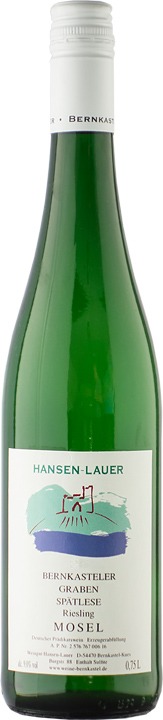
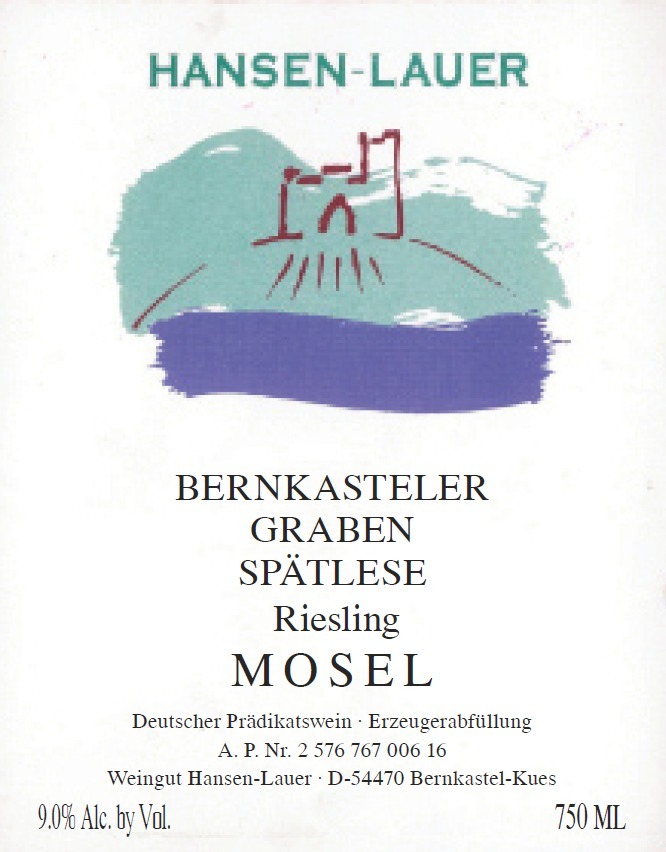
Hansen-Lauer Bernkasteler Graben Riesling Spätlese was grown on grey devonian slate and comes from a vineyard overlooking the picturesque town of Bernkastel-Kues located in a bend of the Middle Mosel. The wine shows everything that makes a classic Mosel Riesling, minerality, acidity and fruit nicely balanced.
The ageing potential of this wine is 15 years.
The grapes were hand-picked at the end of October. The fermentation took two months at low temperatures to preserve some residual sugar. The young wine was left sitting on the fine lees for another three months afterwards giving a rounder balance.
Bottling occured seven months after harvest.
This is a full-grown wine which doesn't need any accompanying dish, but if you are looking for one try to pair it with Roquefort cheese (blue cheese), foie gras or desert like fruit cake.
The Hansen-Lauer Estate
Thomas Hansen is the third in the generation of the Hansen family to produce top quality wines at Weingut Hansen-Lauer in Bernkastel-Kues, overlooking the picturesque Mosel River.
Hansen-Lauer's two hectares of vines are situated amid the Germany's finest growing region which produces many of the best and costliest white wines in the world. Bernkastel-Kues, a picturesque village and tourist mecca overlooking the Mosel River, has long been the home of the finest Rieslings in Germany. Home of Germany's famed Wine Symposium, Bernkastel is a community famed for its celebration of winemaking and good living.
Weingut Hansen-Lauer, with its perfect blend of soil and climate, produces white wines exclusively of the Riesling grape, carefully crafted by master winemaker Thomas Hansen. His expertise assures exquisite wines for the most discriminating wine lover.
The history of the winery goes back more than 400 years. Its 2 hectares of vines are situated around the medieval town of Bernkastel. 90% of the vineyards are planted with Riesling, the leading grape-variety of the Mosel-river. 10% is Spätburgunder, also known as Pinot Noir. Riesling is the wine of the Moselle. This wine is light, elegant and very fine. The most fascinating thing about Riesling is its great diversity of taste. Riesling can taste like a vineyard peach, apple, grapefruit, rose blossom, honey or cut green grass. This list is by no means exhaustive. Just taste it and use your own fantasy and imagination to describe your impressions of smell.

Honeyed style, rich minerality and luscious creaminess. Flavors of baked pineapple and pear. Fresh and juicy on the finish.
From the famous Erbacher Honigberg vineyard. Average of the vines is 20 years old.
Cool fermentation, matured on the lees for 2 months before bottling, with a slight filtration.
Riesling Rheingau Erbacher Honigberg Spatlese goes well with Indian Curry and blue Cheese

ER3 is the very essence of balance and delicacy – the intensity of Côte des Blancs grand crus and the complexity of its perpetual reserve are combined with immense finesse.
ER3 reveals an extremely delicate, blush pink hue. The nose is superb, with a beautifully complex and delicate aromatic palette that offers up aromas of white flowers, redcurrant, and wild strawberry, before unveiling slightly smoky notes. With a particularly fine and ethereal effervescence, the mouth is fresh and vibrant with superb white fruit and citrus evolving into more complex notes of candied fruit, soft spices, and toasted almonds. The finish is incredibly persistent, underpinned by a magnificent chalky minerality.
The wine is aged on lees in the dark in our cellars for three years.
Chardonnay 75% – Pinot Noir 25% / This edition has been made from a base of the 2018 vintage. / Disgorged in May 2022. / Dosage: 4.5 G/L.
Review:
"This graceful rosé Champagne layers a rich base of roasted almond, toast and smoke accents with nectarine and pureed raspberry fruit, oyster shell, blood orange zest and chalk notes. Fresh and fluid on the palate, with a creamy mousse consisting of fine, pinprick-sized bubbles. Long, rich finish. Chardonnay and Pinot Noir. Drink now through 2030. 750 cases made."
-Wine Spectator 95 Points

Luis XIV Vino Noble is a naturally sweet red wine, made from very late Monastrell harvests. All of its sugar and alcohol comes from the grape itself and has been subjected to a long aging in semi-new American oak barrels. In the mouth it is very intense, sweet without cloying, with aromas of stewed plums and a very long finish of spicy oak wood. RATING: Noble Alicante sweet wine