
" We don't sell the wine without touching the vine "
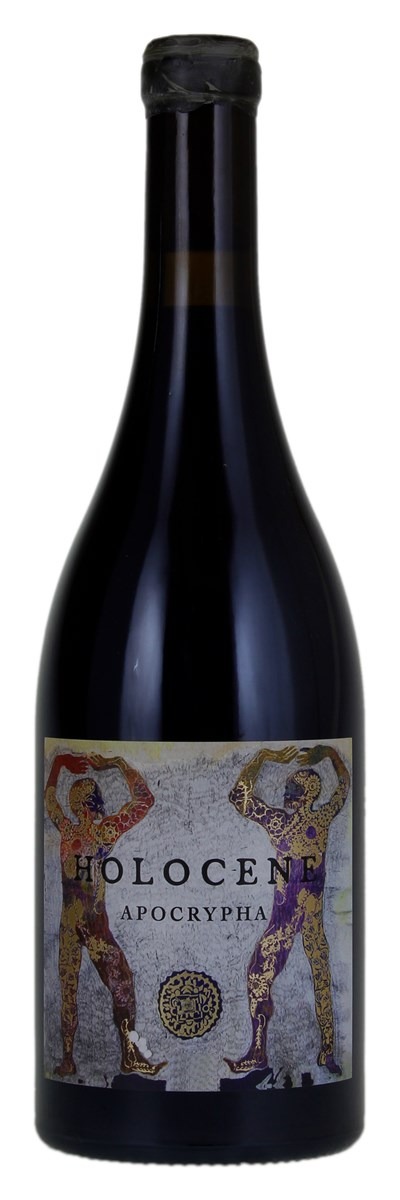
| Country: | United States |
| Region: | Oregon |
| Winery: | Holocene Wines |
| Grape Type: | Pinot Noir |
| Vintage: | 2018 |
| Bottle Size: | 750 ml |

Holocene Apocrypha Pinot Noir is made from 100 percent Pinot Noir.
Apocrypha Pinot Noir tends to showcase the blue and black end of the fruit spectrum, along with a brambly, floral, dried sage and thyme profile, higher acid than the Memorialis and more power.
We tend to enjoy this wine with lamb merguez sausage and saffron rice.

Holocene Memorialis Pinot Noir is made from 100 percent Pinot Noir.
Holocene Pinot Noir Memorialis is a blend of 777, Pommard and 115 clones from MonksGate vineyard in the Yamhill-Carlton AVA, and it saw about 20% new French oak for 16 months prior to bottling. It is always the lighter and more feminine of the two Holocene wines, with red fruits, white flowers, dried herbs, mushroom and forest floor aromatics, bright acidity and a lithe texture, long finish.
By now, everyone knows that the Willamette Valley is an amazing place to grow Pinot Noir. When I relocated from Napa Valley to partner up with Force Majeure Vineyards, I knew I also wanted to start a project where I could focus attention on a varietal and growing region that I loved. Part of the excitement of being in the Pacific Northwest is the ability to have access to so many amazing vineyards and so much diversity, along with the opportunity to push boundaries and try new things – something that is becoming increasingly difficult in other growing regions.
We partner up with a few very small, diverse and amazing vineyards in the Willamette Valley, sourcing fruit from these dry-farmed sites that emphasize low yields, sustainable practices and produce outstanding fruit.
The wines are crafted in the same way I have been making wine since I was carrying it out at Bryant Family Vineyard in the Napa Valley — utilizing very low-impact, non-industrial techniques, native yeasts, little extraction and little new oak, and never filtering or fining. This allows a real sense of place to show through in the wines that is often dimmed when too much manipulation is undertaken.
Our first vintage was 2015, and was released in early 2017. As production is currently extremely small, the best way to get the wines into your hands is to join our mailing list at the “Mailing List” link above to receive an allocation when we have a release. We release wines once per year, and they will be sold on a first come, first served basis, shipped straight to your door.
Review:
The 2021 Pinot Noir Memorialis is more complete and layered, with beautiful ripe cherry and redcurrant fruit as well as spice box, dried, smoky herbs, and savory flower-like aromas and flavors. Textured, medium to full-bodied, and balanced, it has the fruit and texture to shine even today yet the density and structure to evolve for 10-12 years as well.
- Jeb Dunnuck 95 Points

Argot Pinot Noir Sonoma County is made from 100 percent Pinot Noir.
Everything you have come to expect from an Argot Pinot Noir, shone through the filter of a textbook-perfect vintage. We simply can not get over the quality of fruit this wine displays! Intense, yet fresh; fruity, yet spicy; brambly, yet juicy; immediate, yet lingering. A Pinot Noir that displays the variety’s natural come-hither attitude, while succinctly capturing its intriguing nature. There are not enough superlatives to describe this wine. Almost too easy to love!
VINEYARD Multiple vineyards throughout Sonoma County, including both valley floor and high-elevation hillside sites
PRODUCTION 600 cases
VARIETAL 100% Pinot Noir
CRUSH Night harvested by hand beginning in mid-September, concluding at our coolest sit on October 13. Cluster and berry sorted by hand, de-stemmed, no crushing
FERMENT 7-day cold soaks, followed by native fermentation in open-top containers, with the grapes fermenting on their skins for an average time of 14 days.
AGING 16 months, French oak barrels, 7% new, remainder once-used. Never racked prior to bottling. Bottled un-fined, unfiltered.
NOTES Singularly great. 2018 was an all-time vintage for California’s North Coast, achieving rarely before experienced heights. A mild summer gave way to Autumnal perfection, allowing cooler areas the opportunity to ripen their crop while chemistries remained perfect. What arrives in bottle is nothing short of a pinnacle representation of Sonoma County Pinot Noir — profound depth of pure, red Pinot Noir fruits, caressing textures balanced by deep minerality and a quenching acidity.

Lismore Pinot Noir is made from 100 percent Pinot Noir
Complex bouquet of crushed rose petals, wild jasmine and fresh French herbs followed by a palate full of cranberry, raspberry and a long savory finish.
The grapes were picked at optimal ripeness. 30% whole bunch fermented in large 5000 liter vats with gentle pump-overs twice a day. The process allowed for a long extraction period which lends to the fruit expression and structure of this wine. The free run wine was drained off and the fermented grapes were then pressed in a traditional wooden basket press. The wine was racked into 225, 300 and 500 liter barrels where malolactic fermentation took place and the wine was aged for 10 months. 35% new French oak was used.
Review:
"The 2018 Pinot Noir comes from Walker Bay and Kaaimansgat and includes 30% whole-bunch fruit, aged for 11 months in 25% new oak. The bouquet sports vivid red cherry and raspberry fruit that is exceptionally well defined and beautifully integrated with the oak. The palate is medium-bodied with supple tannins, well-judged acidity and a slightly fleshy texture. There is just the right amount of salinity here, and the finish is kept on a tight leash, allowing the detail and precision to be fully expressed. A slight sour edge on the finish keeps you coming back for another sip. Excellent and reassuringly classy. - Neal Martin" - Antonio Galloni's Vinous (November 2019), 92 pts
"Walker Bay and Elandskloof are the twin sources of 30% whole bunch-fermented Pinot from Sam O'Keefe. Juicy, floral and charming, it's a graceful, fruit forward style with some clove and tobacco spice and refreshing acidity. The finish is a little firmer than I remember. 2020-24"- Tim Atkin (South Africa 2020 Special Report), 92 pts

Bydand Pinot Noir Umino Vineyard is made from 100 percent Pinot Noir.
This small, sustainably farmed vineyard perches on a south-facing ridge in the Sebastopol Hills area of the esteemed Russian River Valley AVA, and has produced exceptional Pinot Noir for Bydand since their first vintage. Third-generation farmer David Umino rejected early assessments that the site was too cool for viticulture, and planted Pinot Noir there in 1996. The cold maritime winds in fact help to modulate ripening, and protect the grape’s natural purity and balance - resulting in fruit-driven wines with expressive red fruit and dark berry flavors, balanced with crushed rock and mouth-watering freshness. Velvety tannins coat the palate, providing an alluring and persistent finish.
This site combines the best of the earthy west Sonoma Coast and well-fruited Russian River.

J. Davies Nobles Vineyard Pinot Noir is made from 100 percent Pinot Noir.
The Nobles Pinot Noir starts off with aromas of rich strawberry, black cherry and Earl Grey tea, followed gracefully with coriander and exotic spices. The palate offers a juicy mid-palate of blueberry and plum layered with mocha and rhubarb, closing with a long-integrated acidity.
Review:
Elegant and pure-tasting, with red berry, plum and raspberry flavors that are well-structured. Toasty midpalate, with a rich finish that offers spicy minerality. Drink now through 2026.
-Wine Spectator 92 Points
Holocene Apocrypha Pinot Noir is made from 100 percent Pinot Noir.
Apocrypha Pinot Noir tends to showcase the blue and black end of the fruit spectrum, along with a brambly, floral, dried sage and thyme profile, higher acid than the Memorialis and more power.
We tend to enjoy this wine with lamb merguez sausage and saffron rice.
Review:
"Coming from more volcanic, south-facing soils, the 2018 Pinot Noir Apocrypha was 15% destemmed and will see 16 months in 20% new barrels. It’s a slightly darker-hued and darker fruited effort offering lots of blue fruits, iron, violets, and mineral aromatics. While it was basically not destemmed, there are no obvious stems on either the nose or palate, and it’s beautifully balanced, has bright acidity, medium to full-bodied richness, and a great finish. It’s another rock star of a Pinot Noir from Todd Alexander."
- Jeb Dunnuck (April 2020), 94-96 pts
By now, everyone knows that the Willamette Valley is an amazing place to grow Pinot Noir. When Todd Alexander relocated from Napa Valley to partner up with Force Majeure Vineyards, he knew he also wanted to start a project where he could focus attention on a varietal and growing region that he loved. Part of the excitement of being in the Pacific Northwest is the ability to have access to so many amazing vineyards and so much diversity, along with the opportunity to push boundaries and try new things – something that is becoming increasingly difficult in other growing regions.
He partners up with a few very small, diverse and amazing vineyards in the Willamette Valley, sourcing fruit from these dry-farmed sites that emphasize low yields, sustainable practices and produce outstanding fruit.
The wines are crafted in the same way Todd has been making wine since he was carrying it out at Bryant Family Vineyard in the Napa Valley — utilizing very low-impact, non-industrial techniques, native yeasts, little extraction and little new oak, and never filtering or fining. This allows a real sense of place to show through in the wines that is often dimmed when too much manipulation is undertaken.
The first vintage was 2015, and was released in early 2017.
Review:
"I continue to love these Pinot Noirs under Todd Alexander’s Holocene label. While they’re not from Washington State, I was able to taste these during my visit with Force Majeure (which are also made by Todd) and I’m thrilled to be able to include them here." - Jeb Dunnuck (April 2020)

“1752” is the name of the Damilano Barolo Cannubi Riserva, in honor of the year in which the historic bottle was first marked “Cannubi”. It still exists today perfectly conserved by the Manzone family in Bra, close to Barolo. The bottle is clearly marked as being of “1752” vintage, indicating that Cannubi historically precedes Barolo.
About the Vineyard:
The Cannubi Cru is in found within one of the 6 core zones which comprise a UNESCO heritage site in Italy. A mixture of Tortonian and Helvetian calcareous marl gives the grapes intense aromas of cherry, plum and tobacco, rose and violet in sequence. Its low potassium and high calcium/magnesium content offer the wine a fine and polished touch. The vineyard is located at about 270 m. a.s.l. and has a south-east sun exposure. Barolo Riserva Cannubi 1752 It is a small plot of about 2 hectares of Nebbiolo vines, currently between 30 and 50 years of age.
Tasting Notes:
Garnet ruby red in color, the bouquet is intense and balanced, with notes of violet, red fruit, cherry and plum, spices, liquorice, cocoa, leather and tobacco. Dry, robust, full-bodied, very persistent, rich and velvety
Food Pairing:
This wine is excellent with typical piedmontes pasta (tajarin, ravioli); perfect with red meat, braised and roast meat, game and absolutely ideal with all types of cheeses.
Review:
The purity of this wine is pretty phenomenal with blackberries, strawberries, fresh flowers and licorice. Hints of tar. It’s full-bodied, yet composed and compact with ultra fine tannins and a long, flavorful finish. Very structured. Try after 2024.
-James Suckling 97 Points

Matthews Cabernet Sauvignon Columbia Valley is made from 76% Cabernet Sauvignon, 15%Merlot, 6% Cabernet Franc, 2% Petit Verdot, 1% Malbec.
The 2021 Columbia Valley Cabernet Sauvignon is deep ruby in the glass with purple hues. The rich bouquet of spiced black plum and cocoa nib are balanced with aromas of fresh earth and crushed flint. Intense and opulent flavors of ripe blackberry, cedar, mocha, and black currant coat the broad and balanced palate and the ripe tannin creates a perfect frame for the lush fruit expression. Cherry cordial and cola linger on the long, quenching finish.
Review:
Precise and expressive, with handsome flavors of blackberry, bay leaf and espresso that build richness and structure toward refined tannins.
-Wine Spectator 93 Points
The 2021 Cabernet Sauvignon Columbia Valley is spicy, showing off a gentle peppery tinge and dusty rose tones that give way to dried black cherries. This is wonderfully crisp and refined, with silky textures and depths of dark red fruit propelled by juicy acidity. It tapers off long and structured, yet the tannins are quite sweet. The 2021 finishes with a pleasant crunch and a lingering licorice tinge.
-Vinous 93 Points
The 2021 Cabernet Sauvignon is based on 76% Cabernet Sauvignon, 15% Merlot, 6% Cabernet Franc, 2% Petit Verdot, and 1% Malbec. A rocking wine offering ample red and black plum-like fruit, chocolate, tobacco, and subtle violet-like aromas and flavors, I t's full-bodied and has a terrific mid-palate, velvety tannins, and a great finish.
-Jeb Dunnuck 93 Points



