" We don't sell the wine without touching the vine "
| Country: | France |
| Region: | Bordeaux |
| Winery: | Chateau des Landes |
| Grape Type: | Merlot |
| Organic: | Yes |
| Vintage: | 2015 |
| Bottle Size: | 750 ml |

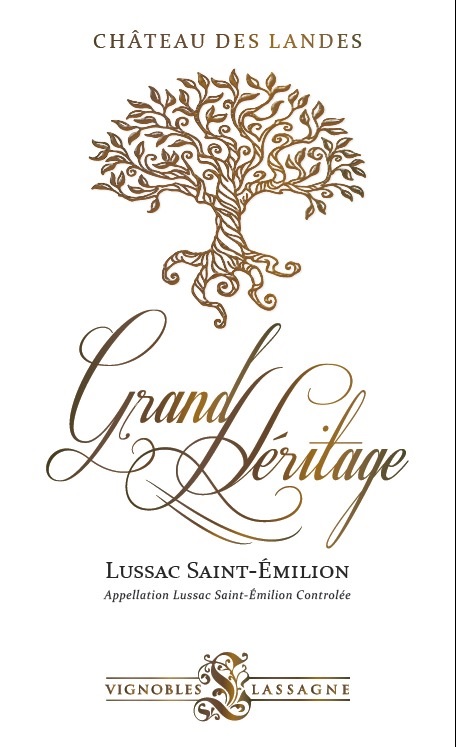
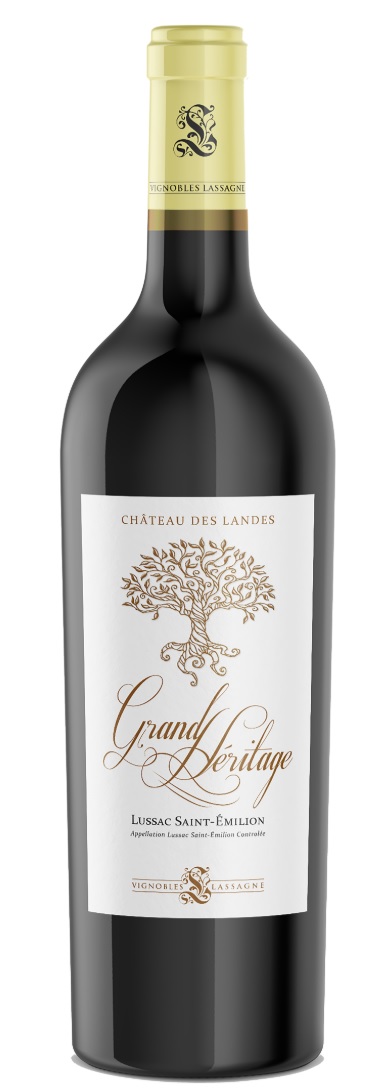
Landes Grand Heritage Lussac Saint Emilion is made from 100 percent Merlot.
First vintage of this wine was 2010 to pay tribute to the founding father of Chateau des Landes - Paul Lassagne. He gave the family a great legacy of terroir, passion and know-how to craft this great cuvee produced from a selection of the finest grapes that are vinified and aged in 600 liter French oak foudres, just like it was done in the old days. The resulting wine is complex and aromatic offering bold aromas and flavors of dark berries, floral tones, spice, oak and vanilla. The palate is onctuous and powerful, well structured with ripe tannins. Well balanced and a complex finish.
Average age of the Vines: 60 years Yield : 50 hectoliters / hectare. Grape picking: harvest by machine. Vats: Stainless steel thermoregulated and computerized. Fermentation: 45 to 50 days with a final 35°C warm steeping. Winemaking: Malolactic fermentation in new oak barrel. Ageing: 16 months in new French Oak barrels from Allier and Limousin. Annual production: 10,000 bottles. (833 cases)
Review:
-James Suckling 90 Points

Landes Cuvee Tradition Lussac Saint Emilion is made from 80% Merlot, 15% Cabernet Sauvignon and 5% Cabernet Franc
Color: deep ruby intense color.
Aroma: racy and aromatic nose with aromas of ripe red fruit.
Taste: this wine is silky, round and smooth first taste, with aromas of raspberries, and blackcurrant, powerful and complex finish.
Landes Cuvee Tradition Lussac Saint Emilion (half-bottle)is made from 80% Merlot, 15% Cabernet Sauvignon and 5% Cabernet Franc
Color: deep ruby intense color.
Aroma: racy and aromatic nose with aromas of ripe red fruit.
Taste: this wine is silky, round and smooth first taste, with aromas of raspberries, and blackcurrant, powerful and complex finish.
Landes Cuvee Tradition Lussac Saint Emilion is made from 80% Merlot, 15% Cabernet Sauvignon and 5% Cabernet Franc
Color: deep ruby intense color.
Aroma: racy and aromatic nose with aromas of ripe red fruit.
Taste: this wine is silky, round and smooth first taste, with aromas of raspberries, and blackcurrant, powerful and complex finish.
Landes Grand Heritage Lussac Saint Emilion is made from 100 percent Merlot.
Color: deep dark ruby intense color
Aroma: racy and aromatic nose with aromas of ripe red fruit, floral notes, wood and spice with a touch of vanilla.
Taste: this wine has a good structure and some powerful aromas of raspberries, blackcurrant, vanilla and it is powerful with a complex finish. The oak is present but not dominant. The tannins are quite well integrated already.
Average age of the Vines: 60 years Yield : 50 hectoliters / hectare. Grape picking: harvest by machine. Vats: Stainless steel thermoregulated and computerized. Fermentation: 45 to 50 days with a final 35°C warm steeping. Winemaking: Malolactic fermentation in new oak barrel. Ageing: 16 months in new French Oak barrels from Allier and Limousin. Annual production: 10,000 bottles. (833 cases)
Review:
More upfront and showy, the 2015 Chateau des Landes Grand Heritage (100% old vine Merlot aged in new French oak) boasts a big, blockbuster nose of spiced black fruits, new saddle leather, and dried herbs to go with a full-bodied, powerful, sexy style on the palate. With ripe tannins and tons of character, drink it any time over the coming 10-15 years.-Jeb Dunnuck 93 Points
Chateau des Lande Estate
Château des Landes was created in 1952 by Paul Lassagne, Nicolas' grandfather. He started with only 2 hectares and grew to 7 hectares in 1979.
His son, Daniel, came along and bought more vineyards surrounding the cellar and he managed to grow to 27 hectares in almost 20 years.
In 2001, Nicolas, came aboard and decided to continue on the family tradition bringing his expertise and his knowledge.
Nicolas is now in charge of the Estate and he manage 27.2 hecatres of vineyards (68 hectares).
27.2 hectares (68 acres) of vineyard with a density of 5,500 vineplants per hecatres ( 2,217 vineplants per acre).
The average age of the vine is 30 years.
The soil is mostly a mix of Clay and limestone, while the subsoil is white clay.

James Goddard was an ancestor of the Clarke family. Born in West Sussex, England in 1823, James spent his 74 years as a sailor, a whaler, a bullock driver, farmer, prospector, miner and hotel keeper. From an illiterate runaway living rough on the streets of London, he became a rich, successful and admired pillar of South Australian society.
James arrived in Adelaide in 1839 as a 16-year-old sailor. Twelve years later, his life changed forever with the news of gold findings. For the next 20 years, James roamed the country learning the geology that improved his chances of prospecting.
James Goddard Shiraz is made from 100 percent Shiraz.
In 1870, he tried his luck near his farm in the Barossa Valley and discovered the region’s first gold deposits, creating the prosperous Lady Alice Mine. The Lady Alice Mine, though it is no longer operational, was & still is the most successful gold mine in South Australia. From these roots, the Thorn-Clarke family has been connected to the region for the last 150 years.
James Goddard Shiraz is a blend Shiraz sourced from the Milton Park vineyard in the north of Eden Valley, and the St Kitts vineyard in the far northern area of the Barossa. Fruit is harvested in the cool of the night to maintain maximum flavour and freshness and it is fermented for 8 days. The ferment is pumped over twice daily to extract the colour and flavour from the fruit. Once finished fermentation the wine was then matured in a blend of French and American oak for a period of 10 to 12 months depending on the vintage.
Deep vibrant red with purple hues to the rim. The nose shows lifted plums, vibrant purple berries and a delicate spice note. The palate has concentrated satsuma plum, blackberry with lovely charry oak in the background. Long, juicy and even with plush fruit on the finish.
Review:
“Blended from two estate vineyards, St. Kitts and Milton Park, this shiraz offers its richness without any aggression or overt perfume. It’s just lush and delicious, a friendly embrace of firm tannins and purple-red fruit. The texture and flavor combine in a saturated meatiness, for Korean barbecue.”
- Wine & Spirits Magazine, 92 points

The aging is as Mounir ages his Burgundies: extremely long, never racked, no fining, no filtration. It would be easy to say that we expected the experience running one of Burgundy’s leading producers, Lucien Le Moine, would show in Mounir’s wines. But the actual results need to be tasted to be believed and understood: a wine with beguiling fruit and savory richness, yet extraordinary finesse and detail.
Mounir Saouma likes to describe Châteauneuf-du-Pape as a mosaic, with all the wild traditions and differences together making for very different interpretations. Omnia, Latin for “all,” is his attempt to encompass the entire region’s terroir and winemaking history (and perhaps future) in one glass. The fruit comes from 9 vineyard parcels across all 5 of the Châteauneuf communes, Châteauneuf-du-Pape, Courthezon, Sorgues, Bedarrides and Orange (in early vintages, when the Saoumas did not have all the vineyards they have today, they would purchase fruit; today, Rotem & Mounir Saouma is 100% Estate). The wine is then vinified and aged in foudres, cement and 500 liter barrels – a little bit of everything.
2019 was another warm and dry vintage in the southern Rhône, marked by insistent drought and repeated heat waves during the season. With little disease pressure or frost, the crop was close to normal size, but bunch and berry-size was reduced during the growing season by the lack of water. The grapes were thus concentrated and rich in sugar and acidity, although potential alcohol levels were often quite high. Vineyards at higher elevations – Châteauneuf du Pape and Gigondas in particular — handled the heat better, and the wines from those AOPs are rich yet also remarkably fresh and energetic. Despite the initial concerns about the growing season, 2019 looks to be a watershed vintage in the Southern Rhône, producing rich wines with exceptional concentration and aging potential
Inviting aromas of sliced strawberries, red cherries and rose. Full-bodied with vibrant acidity and succulent fruit. Fine, structured tannins are vertically aligned with the fruit. More dark-fruited than the nose lets on and entirely delicious. I love the subtle spice here.
-James Suckling 94 Points
Very refined, with silky and fine-grained structure carrying alluring bergamot, rooibos tea, incense, dried cherry and lightly mulled raspberry notes along. A long sanguine thread weaves through the finish. Hard to resist now with so much charm, but this will benefit from cellaring. Grenache, Syrah and Mourvèdre.
-Wine Spectator 94 Points

Octopoda Pinot Noir Russian River 2024 is made from Pinot Noir.
A medium-bodied Russian River Valley Pinot Noir aged in French oak, offering bing cherry and red raspberry fruit, gentle spice and a supple, silky texture — a versatile, food-friendly bottling from one of California's benchmark Pinot regions.
Winery Info: Octopoda is made by the Precision Wine Company, founded by Trevor Sheehan, who spent nearly a decade collecting and trading fine wine and learning winemaking in Bordeaux and Burgundy before launching his California label. The project sources from top vineyard sites to make characterful, value-driven wines.