" We don't sell the wine without touching the vine "
| Country: | France |
| Region: | Beaujolais |
| Winery: | Manoir du Carra |
| Grape Type: | Gamay |
| Organic: | Yes |
| Vintage: | 2019 |
| Bottle Size: | 750 ml |

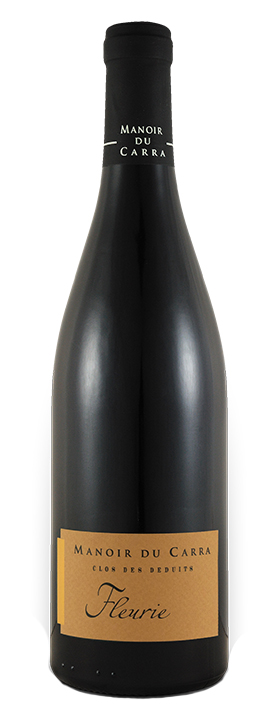
Manoir du Carra Beaujolais Cru Fleurie Clos des Deduits is made from 100% Gamay grapes coming from the lieu dit "Montee de la Tonne".
The vineyard measures 1.5 hectare and the average age of the vines is 50 years. Yield: 48 hl/ha
Manual harvest; Semi-carbonic maceration for 10-12 days; Aging in Foudre for 3-4 months; Slight filtration.
Intense red color, subtle fruity and floral aromas of violet, berry and cinnamon. Ample in the mouth, fruit flavors. Even better after a few years of cellaring.
Excellent with red and game meats, and cheeses.
Manoir du Carra Beaujolais Cru Fleurie Clos des Deduits is made from 100% Gamay grapes coming from the lieu dit "Montee de la Tonne".
The vineyard measures 1.5 hectare and the average age of the vines is 50 years. Yield: 48 hl/ha
Manual harvest; Semi-carbonic maceration for 10-12 days; Aging in Foudre for 3-4 months; Slight filtration.
Intense red color, subtle fruity and floral aromas of violet, berry and cinnamon. Ample in the mouth, fruit flavors. Even better after a few years of cellaring.
Excellent with red and game meats, and cheeses.

The 2005 vintage was the Sambardier family's first release of the Juliénas, the oldest Cru of Beaujolais, that was named for the famous Roman Emperor Julius Caesar.
The vineyards are located in the lieu-dit "En bottiere" on granite and schist soil types.
Young and dynamic winemaker Frederic Sambardier only produces 4,800 bottles or 400 cases (12/750ml) from 0.8 hectare (1.97 acre). The vines average over 50 years old. Skin maceration during fermentation for 10-12 days. Finally, the wine has had 4 months of aging in foudre (large barrel). Egg white fined, the wine is bottled unfiltered.
Imported - 150 cases 6/750 ml
Beautiful ruby red color. Pleasing and graceful, this full-bodied Julienas displays spices and ripe red and black fruit aromas (red currant, blackberry). This well balanced wine shows soft tannins and a long lasting finish. Excellent now, it will show even better after a few years of cellaring.
This is a perfect match with game, poultries, white meats and cheeses or even by itself as an aperitif.

Manoir du Carra Beaujolais Cru Moulin a Vent Les Burdelines is made from 100 percent Gamay,
Cru Moulin-à-Vent is called the “King of Beaujolais” and is known to age the longest and be the most tannic. Measuring 660 hectares (1,630 acres) in size, there are 280 examples of this AOC on the market.
The wine is produced in the lieu-dit “Les Burdelines”, which belongs to the 18 'climates' registered by the National Institute for Designations of Origin.
Intense color between garnet and deep ruby. Red fruit nose with floral, smoky and forest notes. The mouth is rich and well structured. In a few years the aromas will evolve towards more spice, musk and venison

Manoir du Carra Beaujolais Cru Brouilly Terre de Combiaty is 100% Gamay.
Parcels are in the place called “Combiaty”, within the village of St Etienne la Varenne. The soils are dry, made of pink granite, which gives the wine its typicity. Yield is 45-50hl/ha
Nice ruby color, subtle red fruit aromas of raspberry and wild strawberry with floral hints of hyacinth and violet. Full bodied with soft tannins, this Brouilly is best enjoyed young.

Manoir du Carra Beaujolais Cru Fleurie Vers le Mont is made from 100 percent Gamay.
Intense red color, subtle fruity and floral aromas of violet, berry and cinnamon. It also has a distinctive aroma of Peony and Lily flowers, typical of the "Sur le Mont" terroir. Ample in the mouth with plenty of ripe red and black fruit flavors. The structure is full and the tannins are round and elegant. Even better after a few years of cellaring.
Of the top ten Cru sites of Beaujolais, Fleurie is one of the top three. The wines show finesse, fullness, and flavor. Fleurie does age well for 3-5 years from vintage. The area was named for a Romain General named Floricum, not for the word flower in French. The size of this AOC is 875 hectares of grapes (2,161 acres) and about 180 examples of this Cru are available on the market. This Cru is known as the “Queen of Beaujolais” and the earth is slightly unusual for having blue color, due to magnesium in the soil.
Intense red color, subtle fruity and floral aromas of violet, berry and cinnamon. It also has a distinctive aroma of Peony and Lily flowers, typical of the "Sur le Mont" terroir.
It is ample in the mouth and has a lot of ripe red and black fruit flavors. The structure is full and the tannins are round and elegant.
Even better after a few years of cellaring.
Excellent with red and game meats, and cheeses.
Manoir du Carra Beaujolais Cru Fleurie Clos des Deduits is made from 100% Gamay grapes coming from the lieu dit "Montee de la Tonne".
The vineyard measures 1.5 hectare and the average age of the vines is 50 years. Yield: 48 hl/ha
Manual harvest; Semi-carbonic maceration for 10-12 days; Aging in Foudre for 3-4 months; Slight filtration.
Intense red color, subtle fruity and floral aromas of violet, berry and cinnamon. Ample in the mouth, fruit flavors. Even better after a few years of cellaring.
Excellent with red and game meats, and cheeses.
The Domaine Manoir du Carra Estate
Domaine Manoir du Carra is located in the small town of Denice, 5 km from Villefranche-sur-Saone, 45 km south of Mâcon and 40 km north of Lyon. The property dates back to 1850, and has been bequeathed from father to son for five generations. It is now owned by Jean-Noel Sambardier and his wife. Like many Beaujolais producers, part of their wine is sold to negociant, to which they sell at least 25% of their production each year.
The Domaine Manoir du Carra Vineyard
30 hectares (74.10 acres) total, divided along the North-South axis between Beaujolais A.O.C (10 ha= 24.70 acres) and Beaujolais-Villages A.O.C. (20 ha=49.40 acres). The Sambardiers own 50 vineyard plots. The vines are 50-100 years old. Yields are 55 hl/ha.

All older vintage wines have been purchased from a single collectors cellar. Pictures can be requested before shipment.

Zenato Amarone is a blend of Corvina and Rondinella, with a touch of Croatina and Oseleta. Corvina is prized not only for its intense marasca cherry flavor, but also its ability to withstand the drying process. Used in small quantities Rondinella also fares well in drying, and contributes dark color and an alluring floral note. Oseleta provides tannic structure and minerality; while Croatina is introduced to add youthful fruitiness. All this attention to detail pays off in a wine that is immediately approachable yet unmistakably ageworthy.
Ruby red in color, intoxicating aromas of dried black cherries, cassis, truffles, and chocolate fudge leap out of the glass. The resulting wine is silky, luscious, and complex, with a lingering finish.
Pair this wine with osso bucco, Bordelaise sauces, wild boar ravioli, or grilled cowboy ribeyes.
Review:
Restrained fruitiness with aromas of raspberries and earth, alongside a complex spicy blend of freshly ground black pepper, milk, mint, bay leaf and cocoa powder. Very youthful. Full-bodied, dense and balanced, with savory flavors of chocolate and cherries, super-tasty style, tight, chalky yet ripe tannins and a fresh, cleansing acidity. Toasty finish. Drinkable now, but best in a year or two.
-James Suckling 96 Points