
" We don't sell the wine without touching the vine "
| Country: | France |
| Region: | Burgundy |
| Winery: | Maurice Martin |
| Grape Type: | Chardonnay |
| Organic: | Yes |
| Vintage: | 2019 |
| Bottle Size: | 750 ml |

Maurice Martin Saint-Veran is made from 100 percent unoaked Chardonnay.
White gold color with silver or greenish reflections , shiny and soft. Aromas suggest broom, acacia, green apple, lemongrass, citruses. A fresh, dry and fruity, nervous with a good balance.
The grapes for this wine is coming from 2 famous part of the Saint Véran' appellation: Prissé and Davayé.
The wine went through malolactic fermentation. It has been gently filtered before bottling.
Very easy to associate with his very complete balance : grilled fish, creamy risottos, antipasti, salads, sushis, very pleasant at the aperitif.

Maurice Martin Macon-Villages is made from 100 percent Chardonnay.
White gold color with silver or greenish reflections , shiny and soft. Aromas suggest broom, acacia, green apple, lemongrass, citruses. A fresh, dry and fruity, nervous with a good balance.
The grapes for this wine is coming from 3 famous part of the Maconnais' region: Chaintré, Pierreclos and Ozenay.
The wine went through malolactic fermentation. It has been gently filtered before bottling.
Very easy to associate with his very complete balance : grilled fish, creamy risottos, antipasti, salads, sushis, very pleasant at the aperitif.
Maurice Martin Pouilly-Fuisse is made from 100 percent Chardonnay.
Fruity and floral aromas intertwined with vanilla and toasty notes. Harmonious, well balanced and elegant wine.
The grapes for this wine is coming from 2 famous part of the Maconnais' region: Vergisson and Solutré, famous for their Rocks. Hence, the minerality is coming from these rocky soils.
The wine went through malolactic fermentation.
It has been gently filtered before bottling.
Excellent with white meats and fish.

This wine reveals a complex and elegant bouquet that combines ripe fruit, leather and a fine woodiness. Round and warm on the attack, the palate is supported by solid tannins and a pleasant freshness in this harmonious and well textured wine.
The Merlot bring fruity notes and minerality from the clay-limestone terroir, enhanced by the incredibly expressive and spicy Cabernet Franc.
Review:
"A terrific effort from this large and immaculately maintained property on the clay-limestone slopes of the Côtes de Castillon, the 2019 d'Aiguilhe exhibits aromas of cherries and cassis mingled with notions of burning embers, licorice and warm spices. Medium to full-bodied, layered and concentrated, with lively acids, powdery tannins and a mineral finish, it's intelligently matured in tank and large-format oak as well as small barriques. - William Kelley"
- Robert Parker's Wine Advocate (April 2022), 92 pts
"The 2019 d'Aiguilhe has a really lovely bouquet of ample black cherry, mulberry and light floral scents, very pure and delineated. The palate is medium-bodied with cedar-infused red fruit. While not as exuberant as the aromatics, this is nicely detailed and quite poised on the finish. No, I still cannot pronounce its name, but this Castillon Côtes de Bordeaux is well worth seeking out. - Neal Martin"
- Antonio Galloni's Vinous (February 2022), 92 pts

M. Chapoutier Hermitage Monier de la Sizeranne is made from 100 percent Shiraz.
In Hermitage, Syrah achieves its noblest expression and La Sizeranne has become a benchmark wine for the region. M. Chapoutier's roots in the Rhône date back to 1808, when the family first settled in Tain l'Hermitage. The family purchased a winery owned by Comte Monier de la Sizeranne and over time, acquired a number of excellent vineyards, including some of the oldest in France. M. Chapoutier was the first winery to put Braille on a wine label in 1996. Maurice Monier de la Sizeranne was the owner of the plot of the Hermitage, la Sizeranne until he was blinded in a hunting accident and unable to take care of the land, choosing instead to sell to the Chapoutier family. Following his accident, Maurice became the inventor of the first version of abbreviated Braille, and Chapoutier included Braille on the wine labels as a tribute to his work.
he grapes ferment in open wooden vats after total destemming. Two daily treadings ensure a good extraction of the tannins. Maturation takes place in oak casks, of which one third is new. Several rackings permit a slow and natural clarification process. The wine is unfiltered and unfined.
Review:
I was blown away by the 2019 Hermitage Monier De La Sizeranne, and if there’s a best buy out there in 2019 Hermitage, this might be it. Blackberries, black raspberries, spice box, new leather, and bouquet garni all dominate the bouquet, and it’s full-bodied, with a round, layered mouthfeel, beautiful tannins, and a rare mix of richness and elegance. It’s a stunning wine that’s guaranteed to put a smile on your face over the coming 2+ decades. Hats off to the team at Chapoutier!
-Jeb Dunnuck 97 Points

Aalto P.S. Pagos Seleccionados Tinto is made from 100 percent Tempranillo.
Climatic conditions
The farming year began with a mild autumn and little precipitation. A very dry winter started with -9ºC reaching at the end higher temperatures than normal for that time of the year. Spring and summer characterized by little rain, only some rain showers in July and late August avoided the hydric stress of the vines. The vegetative cycle of the vine developed with big variations of temperatures, alternating warm and atypical low temperatures of 4ºC for mid-June. The ripening of the grapes happened under very good conditions and the harvest started on 24th September 2019.
100% Tinto Fino (Tempranillo) primarily from very old vines – 60 to 90 years old – from selected plots in La Horra and La Aguilera. The harvest was done by hand, in small boxes of 15 kilos that are thoroughly inspected, bunch by bunch, on the selection table.
Tasting notes
Review:
Color: dark cherry, Aroma: toasty, spicy, fine cocoa, black fruit, Mouth: tasty, toasty, fine bitterness, ripe tannins
Guia Penin 94 Points
Maurice Martin Saint-Veran is made from 100 percent unoaked Chardonnay.
White gold color with silver or greenish reflections , shiny and soft. Aromas suggest broom, acacia, green apple, lemongrass, citruses. A fresh, dry and fruity, nervous with a good balance.
The grapes for this wine is coming from 2 famous part of the Saint Véran' appellation: Prissé and Davayé.
The wine went through malolactic fermentation. It has been gently filtered before bottling.
Very easy to associate with his very complete balance : grilled fish, creamy risottos, antipasti, salads, sushis, very pleasant at the aperitif.
Maurice Martin, Etablished in 1974, is the father of Richard and Stéphane Martin, from Domaine de la Croix Senaillet.
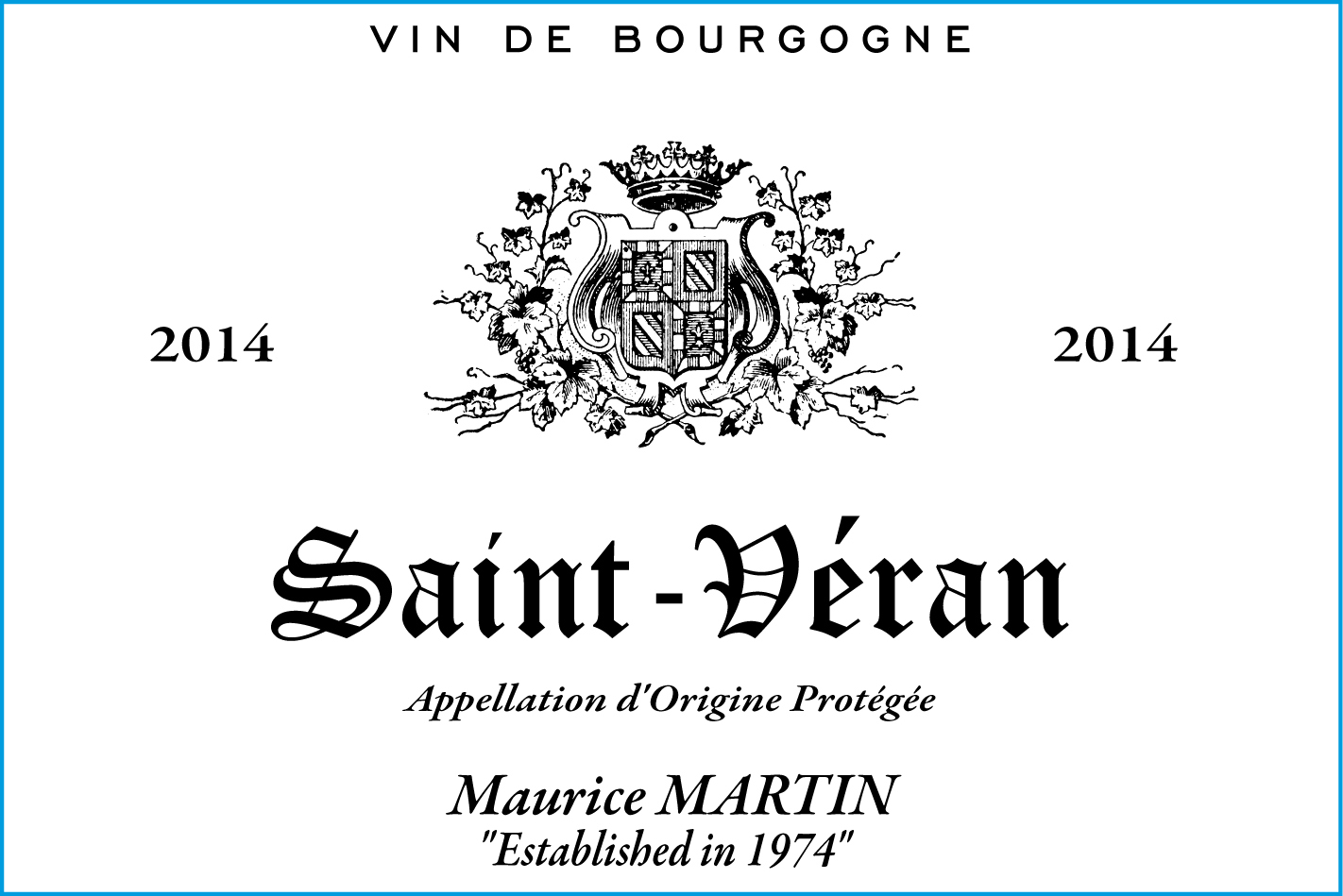
The label is an exact replica of the label used by Maurice Martin when he began selling wine in bottle instead of selling everything to the negoce (Wine merchants).
Today, Maurice Martin's philosophy is still showing through the wines. Affordable, clean, fresh, aromatic and true to the soils and weather found in the Maconnais region.
Date Founded: 1974
Maurice Martin, Etablished in 1974, is the father of Richard and Stéphane Martin, from Domaine de la Croix Senaillet.
The label is an exact replica of the label used in 1974 by Maurice Martin when he began selling wine in bottle with his own label instead of selling everything to the negoce (Wine merchants).
It was the beginning of a quality driven goal, instead of quantity driven as it was the case before when the wine merchants would buy anything and the producer wouldn't mind as his name wouldn't be at stake.

All older vintage wines have been purchased from a single collectors cellar. Pictures can be requested before shipment.

Hyde de Villaine Chardonnay Napa Valley Carneros Hyde Vineyard is made from 100 percent Chardonnay.
Star-bright vibrancy. Chiseled acidity and minerality focus the palate with flavors spanning lemon ice to dried mango and hazelnut. The purity of this wine showcases the coolness of the 2023 vintage. A captivating texture of precision and charm highlights this complexity offering.
Review:
This wine is truly excellent, showing a mineral-edged nose with pure energy and tension. Aromas of struck match, citrus blossoms, crushed stones and salted nuts. The palate is taut, with no hard edges and driving acidity that keeps you salivating for minutes. Closing in on perfection. Drink or hold.
-James Suckling 99 Points



