
" We don't sell the wine without touching the vine "
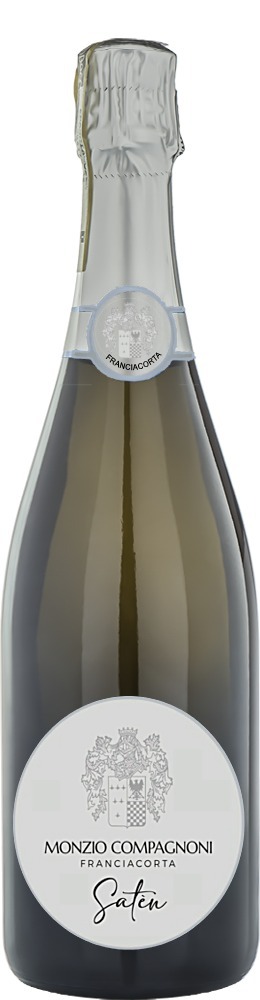
| Country: | Italy |
| Region: | Lombardia |
| Winery: | Monzio Compagnoni |
| Grape Type: | Chardonnay |
| Organic: | Yes |
| Vintage: | 2018 |
| Bottle Size: | 750 ml |
Monzio Compagnoni Franciacorta Saten Brut Millesimato
Color: very deep golden yellow, often, with very abundant froth and persistent perlage of great finesse.
Scent: it has a rich spectrum of scents, it is enveloping and almost greasy without any cloyingness; there are sensations of vanilla, biscuit, licorice, anise.
Taste: in perfect correspondence with the nose, even the taste is full, rich, generous, juicy; all well balanced by an acid base that allows the sweet sensations (of ripe fruit) to express themselves without tiring the palate
The name "Saten" means Silk.
The name "Franciacorta" comes from a phrase in the 1100-1200’s for tax exempt. The phrase is "Franzacurta”….referring to tax exempt status of some local towns in Lombardy, Italy. Franziacorta became a DOC in 1967 and was granted the DOCG status in 1995. There are 2000+ hectares (5,400 acres) total for the appellation with over 100 producers. Total production for the DOCG is around 550,000 cases.
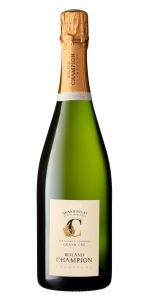
Roland Champion Champagne Blanc de Blancs Grand Cru Vintage Brut Grand Eclat is 100% Grand Cru Chardonnay from the chalky soils of Chouilly.
This Champagne is full of elegance and finesse. Very complex nose, with a bouquet of aromas dominated by honey, brioche and notes of dried fruits, hazelnuts and sweets. Perfectly matured.
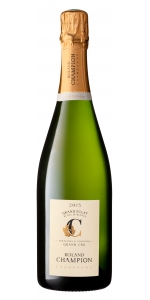
Roland Champion Champagne Blanc de Blancs Grand Cru Vintage Brut Grand Eclat is 100% Grand Cru Chardonnay from the chalky soils of Chouilly.
This Champagne is full of elegance and finesse. Very complex nose, with a bouquet of aromas dominated by honey, brioche and notes of dried fruits, hazelnuts and sweets. Perfectly matured.
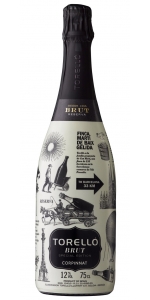
Torello Corpinnat Special Edition Brut Reserve is made from 44% Xarel.lo, 37% Macabeo, 11% Chardonnay, 8% Parellada.
The estate soils have been formed from sediments from the Garraf Massis, deposited thousands of years ago. One of the most characteristic features of the estate’s soils is the presence of accumulations of calcium carbonate. The movement of water through the soil dissolves the carbonates and takes them to a certain depth. The continuous repetition of this process has ended up producing the accumulation of these deposits. When these become massive, after thousands of years, they bind together and form a hard stratum called a petrocalcic horizon. This hard stratum limits the availability of water to the vine and the production, but is a factor that gives the grape quality
The wine offers a straw yellow color, clean, transparent, fine, and persistent bubbles with a rosary formation. In the nose fresh pear aromas stand out along with delicious notes of pastry cream, white flowers, and candied fruits. On the palate, good balance and acidity. Powerful and flavorful with white flowers and notes of brioche, almond and great length.
Special Edition is very versatile and matches with many different kinds of dishes; pasta, pork, chicken, fish, seafood, rice, cold cuts, desserts.
Lovely salmon pink color. A very delicate nose of strawberry and redcurrant fruit with floral undertones. There is a silky richness on the palate full of red berries balanced with a subtle bready texture. Very accessible. Will also develop nicely over time.
Colmant Brut Rose NV is made from 75% Pinot Noir and 25% Chardonnay
This wine spends a minimum of 24 months on the lees at a consistent temperature of 14C before degorgement.15% of the base wine has been barrel fermented.
Pinot Noir 75%, Chardonnay 25% (Franschhoek, Robertson and Elgin).
15% of the blend is made of reserve wine from the previous vintages and 15% of the base wine is barrel fermented.
This wine spends a minimum of 24 months on the lees at a consistent temperature of 14°C before degorgement.
Perfect as a summer sundowner. A delicious complement to white meat, strawberry dessert and decadent dark chocolate.
Review:
"The Brut Rosé (disgorged March 2018) is a blend of 75% Pinot Noir and 25% Chardonnay with 15% base wine and 15% reserve wine, with the Pinot Noir macerated on its skins for color, matured on the lees for 24 months. Deep salmon in color, it has a fine mousse and attractive strawberry and cherry scents on the nose - no shy and retiring rosé here. The palate is well balanced with Braeburn apples, hints of strawberry and a touch of tart cherries fanning out toward the creamy-textured, satisfying finish. A sparkling rosé that’s proud to be pink!- Neal Martin"
- Vinous (August 28th 2018), 91 pts
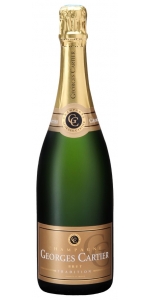
Georges Cartier Champagne Brut Tradition NV is made from 65% Pinot Meunier, 25% Pinot Noir, and 10% Chardonnay.
This champagne was made to reflect the potential of each grape growing areas of the Champagne region.
The grapes for Georges Cartier Brut Tradition have been carefully selected from the 3 emblematic areas of Champagne. Chardonnay is sourced from the Côte des Blancs, Pinot Noir from Montagne de Reims and Pinot Meunier from the Marne Valley.
Each grape variety brings its own character and specific quality to the wine: Pinot Meunier brings fruit and roundness, Pinot Noir brings character, power, structure and balance, while Chardonnay contributes to the finesse, minerality and elegance of the result wine.
The blend in 2022 will be 70% 2018 vintage and 30% of reserve wines (consisting of 2014, 2015 and 2016 vintages).
It will be RD (meaning "Recently Disgorged") to keep freshness, fruitiness, minerality and elegance.
Review:
"A blend of Pinot Noir, Pinot Meunier, and Chardonnay. Lemon drop and buttercup combine with lime sorbet. Bubbles burst with ease and the wine’s mineral tone keeps the palate cleansed."
- The Tasting Panel (May/June 20022), 93 pts
Monzio Compagnoni Franciacorta Saten Brut Millesimato
Color: very deep golden yellow, often, with very abundant froth and persistent perlage of great finesse.
Scent: it has a rich spectrum of scents, it is enveloping and almost greasy without any cloyingness; there are sensations of vanilla, biscuit, licorice, anise.
Taste: in perfect correspondence with the nose, even the taste is full, rich, generous, juicy; all well balanced by an acid base that allows the sweet sensations (of ripe fruit) to express themselves without tiring the palate
The name "Saten" means Silk.
The name "Franciacorta" comes from a phrase in the 1100-1200’s for tax exempt. The phrase is "Franzacurta”….referring to tax exempt status of some local towns in Lombardy, Italy. Franziacorta became a DOC in 1967 and was granted the DOCG status in 1995. There are 2000+ hectares (5,400 acres) total for the appellation with over 100 producers. Total production for the DOCG is around 550,000 cases.
Located in Adro among the splendid hills of Franciacorta, in a 15th century farmhouse, Monzio Compagnoni Azienda Agricola is today considered one of the most dynamic wineries operating in the Franciacorta and Bergamasco wine sector. From our vines we obtain Chardonnay, Pinot Bianco and Grigio, Merlot and Cabernet Sauvignon, Pinot Nero and Moscato di Scanzo grapes, with which we produce wines from Franciacorta and Bergamo. The winemaker Marcello Monzio Compagnoni has been carrying out this great winemaking reality for thirty years now through study, experience and passion and thanks to the modern and pragmatic mentality and the productive soul he has been able to carve out an important space in the world of wine.

All older vintage wines have been purchased from a single collectors cellar. Pictures can be requested before shipment.
Just south of the winery, Bacigalupi Vineyard straddles Westside Road in the upper reach of Russian River Valley. The 125 acre vineyard encompasses a range of terroir, from heavier valley floor soil along the Russian River to alluvial clay loam on the rolling hillsides. The fruit is sourced from a superb block of 25 year-old Wente Clone vines located on the western slope of the site. Bacigalupi was the source of the Chateau Montelena Chardonnay that, famously, beat the French wines at the "Judgement of Paris" in 1976.
Bacigalupi Chardonnay has a nose of lemon zest and vanilla bean. The palate opens with red pear and Meyer lemon, and brioche toast and honey comb notes on the finish. Like well-made Chardonnay from great vineyards around the world this wine benefits from getting some air, will age for years, and is best when served chilled around 50 degrees. This wine will evolve in the bottle for many years to come. A terrific wine from one of Sonoma County's top sites for Chardonnay.



