
" We don't sell the wine without touching the vine "
| BUY MORE! SAVE MORE! | ||||||||||||||||||||
|
| Country: | France |
| Region: | Bordeaux |
| Winery: | Ormes de Pez |
| Grape Type: | Merlot |
| Vintage: | 2020 |
| Bottle Size: | 750 ml |
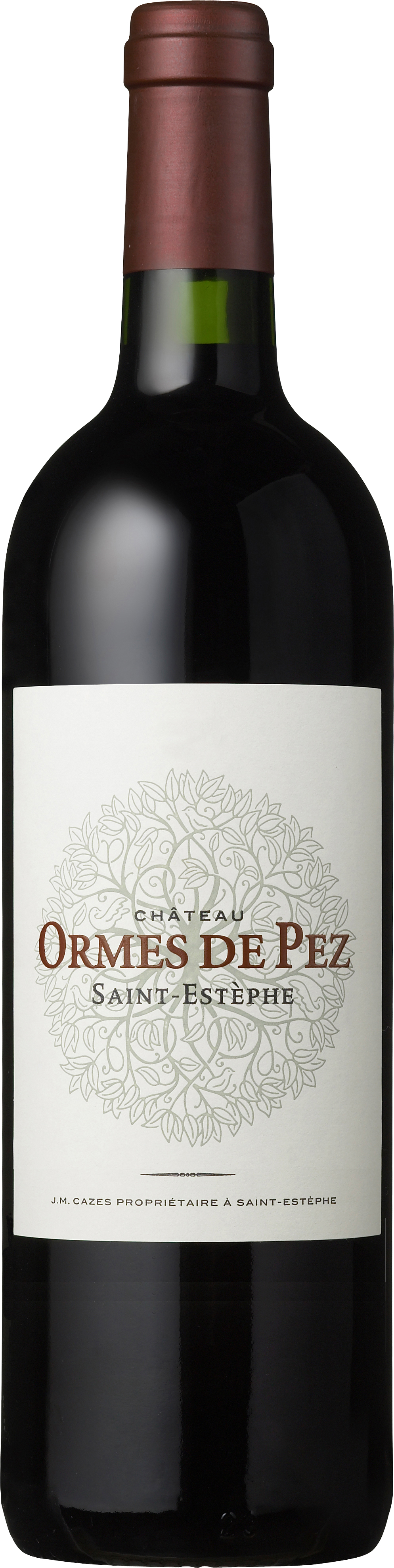
Ormes de Pez Saint Estephe is made from 54% Merlot, 38% Cabernet Sauvignon, 4% Cabernet Franc and 4% Petit Verdot.
Château Ormes de Pez 2020 displays deep garnet-purple color with notes of plum preserves and dark berries, plus hints of graphite. Nice chewiness to the texture and lovely freshness, finishing on a lingering fragrant-earth note.
Ormes de Pez has been part of the Medoc landscape since the 18th century. At the time of the French Revolution, the current property was called the Domaine de Pez (meaning ''peace'' in the local dialect). As for the elms (''ormes'') that have appeared on the bottle labels since 2003, they grew on the grounds of the domaine until this mythical variety of tree ceased to grow in Europe in the 1950's.
From the 19th century onwards, the château had numerous owners (Southard and Pieck, Berthé, Carrère, Alibert, Meiners and Allemand, Eschenauer, Johnson, Miaihle), before becoming a part of the Cazes family. In around 1880, Marie Cazes married Jean Guillou, the Ormes de Pez Cellar Master. He was sadly killed at the very beginning of the Great War and so Marie, a woman of great character, subsequently took over the business. Her brother Jean-Charles Cazes purchased Ormes de Pez in 1940. Jean-Michel Cazes later redeveloped and modernised the traditional XVIII century buildings in the early 80's.
Château Ormes de Pez lies 60 km from Bordeaux on the Médoc peninsula. It benefits from a mild ocean climate thanks to its proximity to the estuary and the Atlantic ocean. Its 40 hectares of vineyards consist of two very distinct terroirs: the Cabernets thrive on the gravelly parcels composed of quartz and rolled pebbles whereas Merlot is best-suited to the cooler, sandy-clay parcels. These parcels have good drainage properties and are representative of the Saint-Estèphe appellation. Vines are planted in accordance with the traditional Médoc planting ratio. Cabernet Sauvignon counts for 54% of plantings, complemented by 37% Merlot, 7% Cabernet Franc and 2% Petit Verdot.

Meyney Saint Estephe is made from 52% Cabernet Sauvignon, 35% Merlot and 13% Petit Verdot.
The vineyards planted on a perfectly drained siliceous gravel soil provide ideal conditions for the maturity of the grapes and result in a very deep black color wine with spicy notes and a distinguished style.
The 2020 vintage embodies what Bordeaux does best - a great classic vintage, complete, complex, rich and unctuous.
Review:
"Attractive aromas of ripe dark berries with dark spices, walnut, chocolate nibs and bark. Medium- to full-bodied with a dense, velvety texture and plush, fine-grained tannins. Very textural and creamy with a deep core of ripe dark fruit and a succulent finish. Try after 2025."
- James Suckling, 93 pts

Chateau de Saint Cosme Gigondas is made from 70% Grenache, 15% Mourvèdre, 14% Syrah, 1% Cinsaut.
The wine shows intense blackberry and fig fruit with licorice, violets, and charcoal on the finish. It is remarkably fresh and finessed given the sun and warmth of the southern Rhône. The unique micro-climate combined with 60-year-old vines and traditional winemaking make Château de Saint Cosme Gigondas the benchmark wine of the appellation.
Review:
Leading off the Gigondas, the base 2020 Gigondas has lots of black raspberry, ground pepper, and violets notes as well as a round, supple, silky style on the palate. It should be approachable on release, yet it has plenty of mid-palate depth as well as tannins, and I have no doubt it will evolve for 20 years if properly stored.
-Jeb Dunnuck 91-93 Points

Landes Cuvee Tradition Lussac Saint Emilion is made from 80% Merlot, 15% Cabernet Sauvignon and 5% Cabernet Franc
Color: deep ruby intense color.
Aroma: racy and aromatic nose with aromas of ripe red fruit.
Taste: this wine is silky, round and smooth first taste, with aromas of raspberries, and blackcurrant, powerful and complex finish.

Landes Grand Heritage Lussac Saint Emilion is made from 100 percent Merlot.
First vintage of this wine was 2010 to pay tribute to the founding father of Chateau des Landes - Paul Lassagne. He gave the family a great legacy of terroir, passion and know-how to craft this great cuvee produced from a selection of the finest grapes that are vinified and aged in 600 liter French oak foudres, just like it was done in the old days. The resulting wine is complex and aromatic offering bold aromas and flavors of dark berries, floral tones, spice, oak and vanilla. The palate is onctuous and powerful, well structured with ripe tannins. Well balanced and a complex finish.
Average age of the Vines: 60 years Yield : 50 hectoliters / hectare. Grape picking: harvest by machine. Vats: Stainless steel thermoregulated and computerized. Fermentation: 45 to 50 days with a final 35°C warm steeping. Winemaking: Malolactic fermentation in new oak barrel. Ageing: 16 months in new French Oak barrels from Allier and Limousin. Annual production: 10,000 bottles. (833 cases)

Domaine Jean Grivot Nuits-Saint-Georges Premier Cru Aux Boudots is made from 100 percent Pinot Noir.
Domaine Jean Grivot is among the great names in Burgundian wine. Étienne Grivot and his wife Marielle took over from Étienne’s father Jean Grivot in 1987. The vineyards are densely planted and farmed organically “sans certification” while the aim in the cellar is for balance and clear expression of terroir.
Jean Grivot’s 38.3 acres spread across 22 appellations with vineyards in the communes of Vosne-Romanée, Vougeot, Chambolle-Musigny, and Nuits-Saint-Georges. Besides the three grand crus, there are 8 premier crus including the much lauded Les Beaux Monts and Suchots in Vosne-Romanée. The grapes are completely de-stemmed and fermentation is spontaneous.
Nuits-Saint-Georges Aux Boudots 1er cru lies in the “Zone Vosnoise” or northern end of Nuits-Saint-Georges just below Les Damodes. It borders Vosne-Romanée Aux Malconsorts 1er just to its north. Its position slightly lower on the slope with deep soil full of pebbles results in a richer and fuller wine.
The grapes are destemmed and maceration à froid usually lasts just a day or two. The alcoholic fermentation is spontaneous and malolactic fermentation occurs in barrel. Depending on the vintage, the proportion of new oak is around 30-60% for the premier crus.
The wine shows aromas and flavors of red berries, herbs, and purple flowers. The palate is rich with ripe fruit and medium weight with bright acidity and fine tannins. Aging in 30-60% new Burgundian pièce brings notes of vanilla, toast, and baking spices.
Red Burgundy might be the world’s most flexible food wine. The wine’s high acidity, medium body, medium alcohol, and low tannins make it very food-friendly. Red Burgundy, with its earthy and sometimes gamey character, is a classic partner to roasted game birds, grilled duck breast, and dishes that feature mushrooms, black truffles, or are rich in umami.
Reviews:
‘The 2020 Nuits Saint-Georges Aux Boudots Ter Cru has the best aromatics among Grivat Nuits Saint-Georges with very well defined red berry fruit, briary and lignt sous-bois aromas. The palate is medium-badied with fine-grain tannins, slightly savory on the entry, fresh and saline on the finish. This has real verve and class, though it will benefit from time in bottle
-Vinous 93-95 Points
A wine with the substance and structure to support the generous lashings of new oak used for maturation, and the overall effect is elegant and classic in style. Aux Boudots, where Grivot has 0.85ha, is at the northern edge of Nuits, just over the border from Vosne-Romanée Malconsorts. They began to pick on the 3rd of September – Etienne specified that they are very particular that the tannins are ripe and do what they can to prolong the vegetative cycle. Still, the grapes were picked with an entirely correct pH of around 3.4.
-Decanter 94 Points

Fombrauge Saint Emilion is made from 96% Merlot and 4% Cabernet Franc.
Château Fombrauge 2020 has a dark red hue, intense fruit aromas and elegant tannins that offer a generous mouthfeel rarely seen in wine so young.
The nose reveals aromas of cherries, blackberries and raspberries, along with spicy notes.
On the palate, the wine i round, soft and silky. Its deep richness, matched with a nice freshness and a long and mellow finish, make it already a great Château Fombrauge, with a long ageing potential.
Chateau Fombrauge Saint-Emilion Grand Cru's food pairing

Gaja Ca'Marcanda 'Camarcanda' Bolgheri is made from 70% Cabernet Sauvignon & 30% Cabernet Franc .
Color : Deep garnet.Aroma : Initial aromas evoke violet, cassis, dark licorice and a spicy note of black pepper, leading to undertones of aromatic herbs, incense, dried rose petals, clove and cedar.Taste : Sleek and intense on entry with elegant herbal, light black pepper and cassis flavors on the mid palate.
Review:
After Bolgheri’s torrid and parched 2017 growing season, more moder-ate conditions in 2018 brought the vines and their wines shimmering to life. All of the wines at Ca’Marcanda fermented spontaneously in 2018, which Gaia Gaja attributes to the balance in the musts. This wine, a blend of cabernets sauvignon and franc, is taut and energetic, its flavors of crunchy plum and blackberry laced with notes of licorice, tobacco and graphite.
-Wine & Spirits 96 Points
The Ca' Marcanda estate does not make a Bolgheri Superiore, although this bottle would qualify as such. The 2018 Bolgheri Rosso Camarcanda is a blend of Cabernet Sauvignon and Cabernet Franc, and you definitely feel those full-throttle varietal aromas with big intensity and clarity. Spicy greenness comes forward as grilled rosemary and lavender essence, but the wine boasts nice depth and dimension, and enough textual richness to smooth it all out. This was a slightly cooler vintage with some sporadic rain showers throughout the summer. These conditions might explain the sharper side of those Cabernet aromas. As the wine moves over the palate, it reveals more substantial aromas of black fruit, spice and baker's chocolate. This vintage is slightly thinner than the hot 2017 expression before it and the classic 2016. However, this wine should certainly play forward positively in terms of its aging potential.
-Wine Advocate 95 Points
Dense and fluid at once, this red delivers plum, black cherry, licorice, olive, bay leaf and spice flavors. Ripe and balanced, with a lingering, spicy, tobacco-tinged aftertaste. Cabernet Sauvignon and Cabernet Franc. Best from 2023 through 2033. 1,500 cases made, 225 cases imported. — BS
-Wine Spectator 95 Points

Ruttenstock Gruner Veltliner Weinviertel Klassik is a white wine made of 100% Gruner Veltliner.
The wine offers a touch of pear, spice and dried fruit aromas on the nose, and exotic fruit characters.
Minerality emerges from the primary rock soils, followed by an elegant and lively finish.
Good food companion to many dishes; chicken, pork, fish or cold appetizers.



