
" We don't sell the wine without touching the vine "
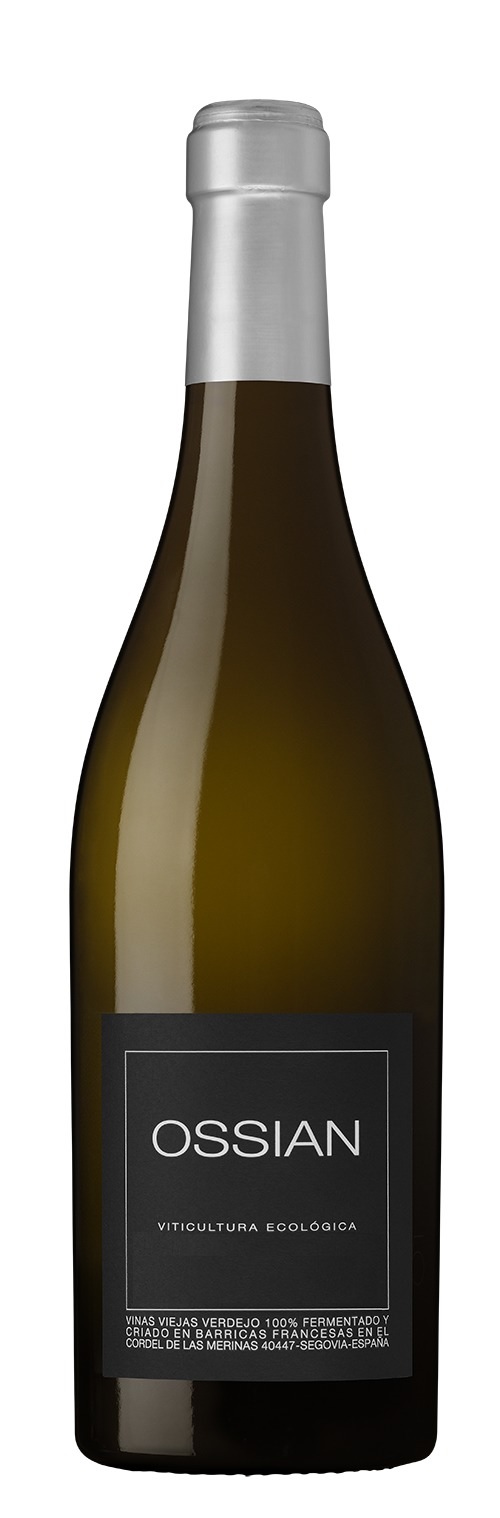
| Country: | Spain |
| Regions: | Leon Rueda |
| Winery: | Ossian Vides y Vinos |
| Grape Type: | Verdejo |
| Organic: | Yes |
| Vintage: | 2015 |
| Bottle Size: | 750 ml |

A barrel fermented, old vines Verdejo made in a style different from what we typically see in this white varietal. It has a remarkable complexity, resulting in the smoothness and depth of a high-end white. Very suitable for cellaring.
Golden yellow color with greenish reflections. Complex, toasty aromas of nuts & dried fruit. Large, creamy, spicy, balanced and voluminous.
Rice with fish, cooked seafood, grilled seafood, baked white fish.
"The eponymous 2020 Ossian was produced with Verdejo grapes from old, organically farmed vines around the village of Nieva (Segovia), a zone where phylloxera didn't reach. They consider 2020 their finest vintage to date, with a big change from 2018 and when they have achieved a much better understanding of their vineyards. It has notes of pit fruit and sweet spices, with good weight on the palate, moderate alcohol (13.5%) and ripeness and good freshness and balance. It's serious and with potential to develop in bottle. 80,000 bottles produced. - Luis GUTIERREZ"
- Robert Parker's Wine Advocate (January 31st 2023), 94 pts

Ossian Capitel Verdejo is made from 100% Verdejo.
Ossian Capital represents a particular expression of very old Verdejo vines, taking its potential far finesse, elegance and longevity. It is made in selected years with a selection of extraordinary grapes.
Color: Old golden yellow color with greenish reflections.
Aromas: Surprisingly nuanced and profound.
Flavors: Fresh, full and very light.
Review:
"The 2020 Capitel is pure Verdejo from the oldest vines from the Peña Aguda vineyard in the village of Nieva on slate soils. This is the last vineyard to be bottled and has higher alcohol (14%) than the rest of the vineyards despite now harvesting earlier. The wine has a different aromatic profile but getting closer to the style of Ossian, less opulent than in the past, with more energy, quite fruit-driven with some exotic notes reminiscent of banana skin. The whole clusters were pressed and the juice put to ferment in barrel where the wine matured with the lees and, starting this year, without bâtonnage, because they feel the wines have enough volume and stirring the lees can bring more oxidation to the wine. 2,500 bottles produced. - Luis GUTIERREZ"
- Robert Parker's Wine Advocate (January 31st 2023), 93+ pts
Ossian Capitel Verdejo is made from 100% Verdejo.
Ossian Capital represents a particular expression of very old Verdejo vines, taking its potential far finesse, elegance and longevity. It is made in selected years with a selection of extraordinary grapes.
Color: Old golden yellow color with greenish reflections.
Aromas: Surprisingly nuanced and profound.
Flavors: Fresh, full and very light.
Review:
Color: bright yellow. Aroma: ripe fruit, spicy, white fruit, citrus fruit. Flavour: balanced, fresh. Style: taut. Color: bright yellow. Aroma: powerful, creamy oak, ripe fruit, spicy. Flavour: rich, good structure, long, toasty, fine bitter notes.
-Guia Penin 96 Points

Ossian Quintaluna Verdejo is made from 100% Verdejo
Quintaluna is a young wine that is made exclusively from Verdejo in the province of Segovia. 60% is very old grape: pre-phylloxera (ungrafted). 40% is made of very young grapes on trellises, grown certified organic, with low yields. The key to success for the Verdejo grape is held in the soil. Ideal soil has a high content of sand and pebbles of different sizes. Some have higher proportions of clay and others have significant proportions of clay and limestone. As the pebbles and sand allow for good drainage, the clay holds enough moisture to allow the vines to thrive.
The color is a straw yellow with greenish reflections. On the nose, you will find aromas of white flowers, stone fruit (peach), and citrus (lemon, mandarin). It also displays tropical fruit aromas. The palate is complex. Natural acidity is evident in the freshness and length on the palate. Almond and ripe fruit flavors are found in the mid-palate with fresh grass and citrus on the finish.
It pairs wells with all kinds of appetizers, entrees and salads.
Review:
"Light, bright straw. Fresh pear, orange pith and a suggestion of pungent flowers on the powerfully scented nose, along with a building mineral nuance. Juicy and incisive in the mouth, offering Meyer lemon, pear and quince flavors accented by a spicy ginger flourish. Silky and focused on the finish, which shows powerful floral lift, minerally cut and impressive persistence. - Josh Raynolds"
- Antonio Galloni's Vinous (February 2021), 92 pts
Ossian Quintaluna Verdejo is made from 100% Verdejo
Quintaluna is a young wine that is made exclusively from Verdejo in the province of Segovia. 60% is very old grape: pre-phylloxera (ungrafted). 40% is made of very young grapes on trellises, grown certified organic, with low yields. The key to success for the Verdejo grape is held in the soil. Ideal soil has a high content of sand and pebbles of different sizes. Some have higher proportions of clay and others have significant proportions of clay and limestone. As the pebbles and sand allow for good drainage, the clay holds enough moisture to allow the vines to thrive.
The color is a straw yellow with greenish reflections. On the nose, you will find aromas of white flowers, stone fruit (peach), and citrus (lemon, mandarin). It also displays tropical fruit aromas. The palate is complex. Natural acidity is evident in the freshness and length on the palate. Almond and ripe fruit flavors are found in the mid-palate with fresh grass and citrus on the finish.
It pairs wells with all kinds of appetizers, entrees and salads.
Review:
"The 2020 Quintaluna is pure Verdejo from small plots on sandy soils in the province of Segovia, fermented in stainless steel with indigenous yeasts. They still use grapes from external suppliers but are working toward using 100% their own grapes (which they might achieve in 2023); therefore, the wine is not certified organic, because some of the vineyards from the growers are not certified. It has a balsamic nose reminiscent of bay leaf, dried yellow flowers, chamomile and pollen intermixed with pit fruit. It has a dry palate and a chalky texture, with balance and finesse, with moderate ripeness and 13.5% alcohol. 110,000 bottles. - Luis GUTIERREZ"
- Robert Parker's Wine Advocate (January 31st 2023), 92 pts

Blending Detail:
Grenache speaks loudly in the Bésoleil with notes of pomegranate, red raspberry, and strawberry leaf. The Counoise and Cinsualt bring bing cherry fruit and blueberry notes to the table, complicated by pepper and garrique. Mourvedre donates a wild meatiness to the blend, and a purple hue. Syrah rounds things out, adding texture, and flesh to the palate.
Review:
The first vintage where they’ve pushed the bottling back to give the cuvee 16-18 months in barrel, the 2015 Besoleil is a dead ringer for a high-quality Chateauneuf du Pape and offers perfumed notes of herbes de Provence, kirsch, licorice and sweet spice. It’s medium to full-bodied, textured and fruit-forward, with a hedonistic yet elegant profile that’s going to evolve gracefully.
Robert Parker 91-93 Points
An old vines Verdejo barrel fermented with a different to what we are used to in the white variety of this expression. It has a remarkable complexity resulting in smoothness and depth of a high-end white. Very suitable for cellaring.
Color: Old golden yellow color with greenish reflections.
Aromas: Complex, toasty aromas, nuts, dried fruit.
Flavors: Large, creamy, spicy, balanced and voluminous.
Manual harvest in 15 kg boxes. Inspection rigorous selection table. Certified organic farming. Full clusters, stemmed and pressed very soft, only the first run only is used. Fermentation with indigenous yeast. After fermentation the wine is aged on the lees in French oak barrels (20% new, 40% one-year-old barrel and 40% two-year-old barrels during 9 months with batonnage (stirring up the lees). Then, the wine is bottled and released only after 12 month of bottle aging.
Review:
"Rich and polished, this white offers pear, baked apple, tarragon and toasted vanilla flavors that show depth and harmony. Fresh acidity and a touch of tannins give this structure. Sophisticated, in the international style. Drink now. 2,916 cases made. –Thomas Matthews"
- Wine Spectator (August 31st 2018), 91 pts
Ossian Vides y Vinos Estate
With raw material of similar quality, Javier Zaccagnini and Ishmael Gozalo traveled to Burgundy in search of a good winemaker. There they found Pierre Millemann, which already had a strong reputation and long experience in developing large Burgundian whites. Pierre accepted the challenge and he is now in charge of the design and supervision of what this wine should be.
Under his guidance began the project with the 2005 harvest, were making two different cuvées, and fermenting the juice in Burgundian 228-liter barrels manufactured by four different coopers (all from Burgundy), with oak from three different forests, with 2 different roast. All this was intended to investigate what wood is best suited to the Verdejo grape, and endowed the wine more complexity.
The vineyards are located in the town of Nieva (Segovia). The cellar in which the project started is a small facility that is part of the old Monastery of El Parral, the twelfth century, opposite the Church, Mudejar Romanesque style, from the same era.
In short this is an old project 100% grape Verdejo 100%, 100% ungrafted, 100% organically grown, 100% fermented in oak barrels, 100% Burgundian philosophy.
The first vintage, 2005 Ossian, was bottled on October 25, 2006, yielding 12,000 bottles were put on the market in December of that year, after nine months of barrel aging and 2 months of bottle aging. Sold out in three weeks and they were awarded a 93 point score in the Penin Guide.
The project was founded on an absolutely exceptional vineyards: 9 hectares of venerable vineyards between 100 and 200 years old. This is a pre-phylloxera Verdejo since that escaped the plague because of its sandy soils.
Ossian Vides y Vinos Vineyard
The vineyards are located in the town of Nieva (Segovia province), the highest in altitude among of all the villages that are included in the D.O. Rueda, between 840 and 930 meters above sea level (150 meters in the area near the Duero River). This causes a specific climate, with higher thermal oscillations between day and night in the valley, delaying the harvest date and, finally, improving the quality of wine.
Moreover, Ossian has been certified Organic for more than seven years. The winery does not get a single chemical synthesis, or fertilizer, herbicides or fungicides of any kind. It is the oldest registered and certified organic vineyard in the D.O. Rueda.

Viejo Isaias Juana Cabernet Franc is made from 100 percent Cabernet Franc.
Cabernet Franc has an intense bright velvety red color. In the nose this wine reveals a complex expression marked by fresh berries followed by hints of floral aromas. It also displays some smoke and vanilla from the oak barrels. It is rich and balanced in the mouth with an elegant tannic structure and long fresh fruit end.
Vineyard information:
Location: Perdriel, Luján de Cuyo, on the highest area of the Mendoza river - Mendoza.
Altitude: 950m above sea level.
Soil: Stony, from Alluvial origins
Coming from our estate vineyards in Perdriel and Lujan de Cuyo.
Aged in 50% French and 50% American Oak barrels for 12 months. First and second use only.
Wine was slightly filtered before bottling.
Excellent when paired with red meats, pasta with spicy sauces, matured cheeses.
Review:
"Hints of plums and dark berries with some dried flowers, following through to a medium body with round tannins and a juicy finish. Bigger in nature. Drink or hold."
- James Suckling (March 2022), 92 pts

Brize Clos Medecin Anjou Villages Rouge is made from 60% Cabernet Franc and 40% Cabernet Sauvignon.
This is the flagship of the Estate. Clos Medecin has been produced at the estate for 90 years. All the grapes for this wine come from a very special parcel. The wine offers red fruit aromas. It is fresh, round and ample in the mouth.



