
" We don't sell the wine without touching the vine "
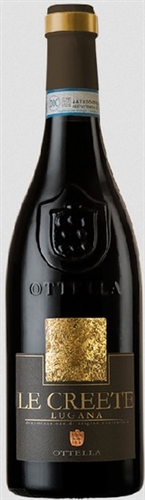

Ottella Lugana DOC Le Creete is made from 100% Turbiano (clonal type of Trebbiano di Lugana)
PRODUCTION AREA: S. Benedetto di Lugana. The grapes are harvested exclusively from our own vineyards; harvesting is strictly manual in small 17kg-crates
TRAINING METHOD: Guyot, double arc
Golden, warm, intense straw yellow. Immediate exotic notes.
It develops in a very pleasant fashion, good mineral impression Rich, succulent and well balanced for a truly
satisfactory mouthfeel. Mineral on the finish with just enough acidity to
provide lift and depth.
FOOD: Sea or lake fish to bring out its outstanding features; goes well with white meat and soup, and has quite a surprising affinity with tasty cheese
ALCOHOL BY VOLUME: 13% vol
SERVING TEMPERATURE: 10-12 degrees Celcius
Ottella Lugana DOC Le Creete is made from 100% Trebbiano di Lugana (same as Verdicchio)
The grapes for this wine come from the estate vineyards in San Benedetto di Lugana.
Golden, warm, intense straw yellow. Exotic notes of pineapple and grapefruit with delicate minerality.
Finesse yet a strong character. Rich and well balanced, firm, mineral wine with a superb pulp.
Pairs best with sea or lake fish to bring out its outstanding features; goes well with white meat and soup, and has quite a surprising affinity with full-flavored and blue cheeses.

Ottella Lugana DOC Riserva Molceo is made from 100% Trebbiano di Lugana - 25-30 years old.
The wine is produced in the area of San Benedetto di Lugana in estate vineyards that are most suitable due to the high content of white clay.
COLOR • Golden, clear, intense.
NOSE • It immediately opens with fruity notes that are enchanting, penetrating and complex. Characterized by hints of citrus fruits, flowers and fine mineral and elegant notes.
PALATE • Complex and intense blend of mineral flavors; captivating, long, lively, both in the persistence and in the strength of the flavors, mingling with unmissable citrus sensation. A delicate evolution, fine flesh, perfect longevity.
Since 2009 it has won every year the TRE BICCHIERI GAMBERO ROSSO award.
The harvest and selection of the grapes are done strictly by hand, in small 17 kg crates.
PLANTING LAYOUT AND YIELD • Double bow Guyot, yield around 8,000 kg. of grapes per hectare, equivalent to 5,040 liters of wine or 63%.
HARVEST PERIOD • Harvest late in October.
FINING AND FERMENTATION • Delicate, soft pressing of the whole bunch for most of the production, the rest with gentle destemming by oscillation. Thereafter, a strict protocol of vinification: partial malolactic fermentation, fining for 16 months on the yeast and fine lees, which mostly takes place in stainless steel tanks (80%) and the rest in wooden tonneaux and barriques.
Stimulating with marine or freshwater fish, it also goes well with savory or fatty meat (goose or pork). Enjoyable with seasoned, herbal cheeses of various types and elaborate dishes.
Review:
This riserva Lugana opens with aromas of baked nectarine with an almond crumble, followed by wafting notes of pressed wildflowers and poached lemon peel. The palate is rich, showing a lime and tropical-fruit cream note topped with sea salt, but balanced by the electric acidity on the finish. Super tasty!
-Wine Enthusiast 93 Points
Elegant and delicate in its sensorial profile, it shows notes of rose petals, linden, geraniums, hawthorn and lime. Medium-full body, radiant and essential in taste, it shows grace and personality and a truly Mediterranean aftertasting. Nice and tasty, fresh and vibrant! One of the best Lugana tastings. Drink now or grow old.
-Raffaele Vecchione - WinesCritic.com 94 Points

Ottella Lugana Bianco is a white wine made from 100% Trebbiano di Lugana (same as Verdicchio)
The grapes for this wine come from the estate vineyards in San Benedetto di Lugana - vineyards that are most suitable due to the high content of white clay.
Intense straw yellow color with green tinges. Exotic notes, candied and citrus fruits, fine and elegant minerality. Warm and deep on the nose. Expressive finesse, rich and persistent texture on the palate.
Pairs best with fish-based plates, soup, pasta or rice, white meats.
Ottella Lugana Bianco is produced in South Benedetto di Lugana. 100% Turbiano (clonal type of Trebbiano di Lugana)
The grapes are harvested exclusively from our own vineyards; harvesting is strictly manual in small 17kg-crates. Guyot, double arc training method.
A brief contact on the skin, stainless steel-controlled fermenting.
Intense straw yellow color with green tinges. Exotic notes, candied fruit and citrus, warm and very deep on the nose. Widespread expressive finesse; to the palate the texture is rich and persistant.
Pairs best with fish-based plates, soup, pasta or rice, white meat.

All older vintage wines have been purchased from a single collectors cellar. Pictures can be requested before shipment.
Ottella Lugana DOC Le Creete is made from 100% Turbiano (clonal type of Trebbiano di Lugana)
Review:
"This elegant wine opens with enticing white spring flower, freshly picked orchard fruit and herb aromas. The vibrant palate offers juicy white peach, nectarine and yellow apple flavors, framed by crisp acidity. An almond note graces the dry, refreshing finish."
- Wine Enthusiast (July 2017), 91 pts
Review:
"Flint and cedar nose with honeysuckle and ripe orchard fruit on the palate. Very drinkable and technically well made, with brisk acidity and a fine seam of minerality."
- Decanter World Wine Awards 2018, 91 pts - SILVER MEDAL
The Otella Estate
Azienda Agricola Ottella was founded in 1880 and the Montresor family has been grape growers for many generations at the Southern end of Lake Garda, near Peschiera del Garda in the D.O.C. (northwest Italy).
The winery is named after a legend that says some octuplets were born at the farm in the 16th century, and the family had immortalized the tradition naming the winery "Ottella".
The Otella Vineyard
The family owns 25 hectares (61.75 acres) of vines planted on a very typical clayey soil, and favorably influenced by the proximity of the Lake Garda. The family also owns a small parcel called "Le Creete", planted on a white chalky soil that gives the wine its exceptional character.

Weingut Prager Achleiten Riesling Smaragd is made from 100 percent Riesling.
Franz Prager, co-founder of the Vinea Wachau, had already earned a reputation for his wines when Toni Bodenstein married into the family. Bodenstein’s passion for biodiversity and old terraces, coupled with brilliant winemaking, places Prager in the highest echelon of Austrian producers.
Smaragd is a designation of ripeness for dry wines used exclusively by members of the Vinea Wachau. The wines must have a minimum alcohol of 12.5%. The grapes are hand-harvested, typically in October and November, and are sent directly to press where they spontaneously ferment in stainless-steel tanks.
Achleiten sits east of Weißenkirchen and is one of the most famous vineyards in the Wachau. The steeply-terraced vineyard existed in Roman times. Some sections have just 40 cm of topsoil over the bedrock of Gföler Gneiss, amphibolitic stone, and slate. “Destroyed soil,” as Toni Bodenstein likes to say.
Tasting Notes:
Austrian Riesling is often defined by elevated levels of dry extract thanks to a lengthy ripening period and freshness due to dramatic temperature swings between day and night. Wines from Achleiten’s highly complex soils are famously marked by a mineral note of flint or gun smoke, are intensely flavored, and reliably long-lived.
Food Pairing:
Riesling’s high acidity makes it one of the most versatile wines at the table. Riesling can be used to cut the fattiness of foods such as pork or sausages and can tame some saltiness. Conversely, it can highlight foods such as fish or vegetables in the same way a squeeze of lemon or a vinaigrette might.
Review:
The 2020 Ried Achleiten Riesling Smaragd offers a well-concentrated, fleshy and spicy stone fruit aroma with crunchy and flinty notes. It needs some time to get rid of the stewed fruit flavors, though. Full-bodied, fresh and crystalline, this is an elegant, complex and finely tannic Riesling that needs some years rather than a carafe to polymerize the tannins and gain some finesse. Tasted at the domain in June 2021.
At Prager, I could not determine that 2020 would be inferior to the 2019 vintage; on the contrary, the 2020 Smaragd wines fascinated me enormously in their clear, cool, terroir-tinged way. A 38% loss had occurred mainly because of the hail on August 22, although predominantly in the Federspiel or Riesling vineyards. There was no damage in the top vineyards such as Ried Klaus, Achleiten or Zwerithaler. "Interestingly, the vines are in agony for about two weeks after the hail. There was no more growth, no development of ripeness and sugar," reports Toni Bondenstein. The Veltliner then recovered earlier, while even picking a Riesling Federspiel in October was still a struggle. "Why Riesling reacted more intensively to the hail, I don't know myself either," says Bodenstein. Whole clusters were pressed to preserve acidity and to compensate for the lower extract, and compared to 2019, the 2020s were left on their lees longer. In June, however, the 20s in particular showed outstanding early shape.
-Wine Advocate 94 Points
Light yellow-green, silver reflections. Yellow stone fruit nuances with a mineral underlay, notes of peach and mango, a hint of tangerine zest, mineral touch. Juicy, elegant, white fruit, acidity structure rich in finesse, lemony-salty finish, sure aging potential.
-Falstaff 95 Points

Brize Les Gres Anjou Blanc is made from 100% Chenin Blanc.
This is a dry wine. Easy to drink, fresh with good acidity. The aromas are persistent with apricot and peach.
The wine is made with grapes grown in a parcel called 'Les Grès'.
Pair with cheese and seafood.



