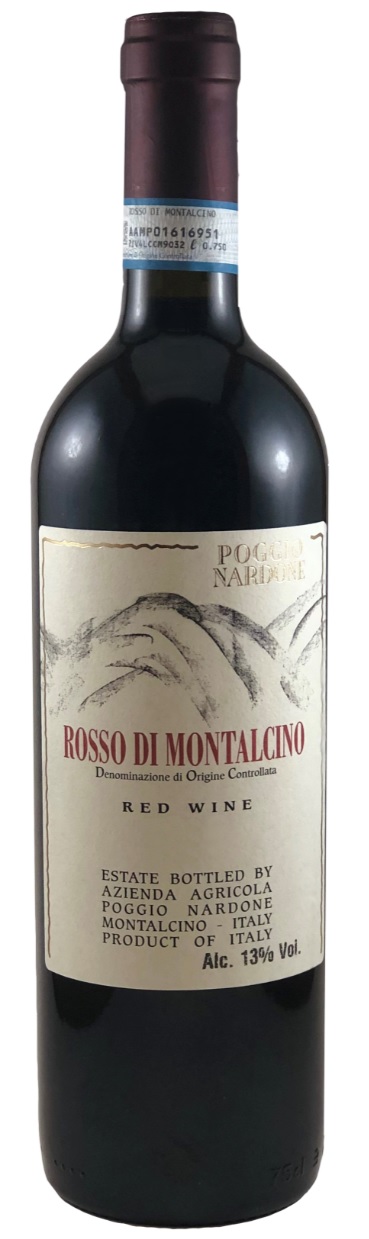
" We don't sell the wine without touching the vine "
| Country: | Italy |
| Region: | Tuscany |
| Winery: | Poggio Nardone |
| Grape Type: | Sangiovese |
| Vintage: | 2023 |
| Bottle Size: | 750 ml |

Poggio Nardone Brunello di Montalcino is made from 100 percent Sangiovese Grosso.
The rich nose displays scents of spices combined with aromas of small red ripe fruits, blackberry and blueberry.
Well structured, determined and elegant, with round and silky tannins. Very nice finish.
Alcoholic fermentation was done in tank, malolactic fermentation in oak barrels. Wine was then aged for 3 years in French oak barrels.
Review:
Powerful and classic, it alternates in the best way the floral features of magnolias, gardenias and hawthorn with fruity notes reminiscent of plums, pressed blueberries and lemon juice. Medium-full body, smooth and relaxed in the sip, it closes harmonious and balanced. How beautiful! Better from 2024.
Raffaele Vecchione - WinesCritic.com 94 Points
Poggio Nardone Brunello di Montalcino is made from 100 percent Sangiovese Grosso.
The rich nose displays scents of spices combined with aromas of small red ripe fruits, blackberry and blueberry.
Well structured, determined and elegant, with round and silky tannins. Very nice finish.
Alcoholic fermentation was done in tank, maloactic fermentation in oak barrels. Wine was then aged for 3 years in French oak barrels.
Review:
Noble and decidedly balsamic in the primary profile alternating notes of peppermint, eucalyptus, green tea leaves and guaranà. A lot of very delicate dried cherries are housed in the background giving brilliance and crunchiness. Medium bodied, well extracted mature tannins and a finale which squeezes from the centre palate onwards. Better from 2025.
- WinesCritic.com 93 Points

Collemattoni Rosso di Montalcino is 100% Sangiovese.
Color: intense ruby red.
Bouquet:violet flowers, black cherry and wild black fruits.
Taste: warm, dry and with good balance.
Coming from a parcel with 8-13 year old vines planted in sandy clay and marl soils.
Harvest is 100% destemmed with a soft pressing, fermentation in stainless steel tanks at controlled temperature of 28-30°C, pumping over for the first week of maceration followed by skin-contact maceration for 20-25 days with rack and return technique (delestage).
Malolactic fermentation completed.
Wine is slightly filtered before bottling.
Pairs with steak, pheasants and strong cheese.
Review:
-Eric Guido (Vinous) 93 Points
-The Wine Know Log 91 Points

Bright and glossy ruby red in color. On the nose it reveals aromas of small fresh berries and a trace of sour cherry, melded with hints of blackberries and black cherries, followed by a hint of vanilla. A fragrant wine with satisfying intensity. On the palate it is warm, smooth and a medium-bodied with finely-balanced tannins. Dry and sinewy yet fresh with a persistent, aromatic finish.
It naturally accompanies dishes that are typical of Tuscan cuisine with its bold, authentic flavors, such as pasta and risottos made with mushrooms or truffles, pork, grilled meats and medium-matured cheeses.
Review:
-James Suckling 91 Points

A ruby red garnet color, ripe fruit aromas, dried fruits, hints of licorice and scents of vanilla. Robust and harmonious in the mouth, a rich texture. The wine is only produced in the best vintages.
The grapes are coming from a vineyard planted at 400 meters above sea level. The soil is mainly marl and limestone.
The density of vines per hectare is 5,000 plants, which is equivalent to 2,000 vines per acre.
The pruning technique used is cordon
The grapes used are 100% Sangiovese grosso
Alcoholic fermentation was done in tank, while the Malo-Lactic fermentation was carried in oak barrels.
Wine was then aged for one year in big French oak barrels and 3 years in Slavonian oak barrels.
Review:
-James Suckling 94 Points

Codirosso Chianti is made from 90% Sangiovese, 7% Canaiolo, 3% Colorino.
Vinification: fermentation in stainless steel at controlled temperatures for 7 to 8 days with an additional 7 to 8 days on the skins. The juice is pumped over daily for 10 days at the beginning of the fermentation. The wine is then racked and goes through malolactic.
Ruby red color with purple reflections. Intense vinous bouquet with hints of violets and dark cherry fruit.The flavor is full of ripe fruit and a hint of spice. It is well balanced and dry. The finish is persistent and satisfying.
Food pairing: grilled, braised or roasted meats
Poggio Nardone Rosso di Montalcino is 100 percent Sangiovese Grosso.
Intense ruby red color with garnet tints.
Intense and delicate aromas of fresh fruits with notes of cherry.
Dry red wine with a good strength and freshness, along with a nice aromatic persistence.
The 5 hectares of specialized vineyards in Montalcino are at an altitude of 350 meters above sea level and are surrounded by woodlands of ilex, oak and arbutus which are characteristic of Montalcino’s hillside habitat. The soil is predominantly composed of marl and limestone which renders this terrain particularly rich in mineral salts.
Pairs well with pasta prepared with meat sauces, mushrooms or truffles; complex rice, main courses of pork or veal with sauces.
Review:
-Eric Guido (Vinous) 91 Points
-James Suckling 90 Points
The Poggio Nardone Estate
The estate Poggio Nardone has been founded in 1996 by Tiziano and Alessandra that, having found some manuscripts down their grandfather in which it wrote of this old place where the wine-dresser produced wine, they have tried to recreate it with their experience matured in the family estate.The estate Poggio Nardone is partially situated in the both the southwest of Montalcino as well as in the area of Montiano near the coast of the Maremma Toscana.
"A tiny estate making classically styled Brunello with consistent quality; the wines have great balance and complexity." - Anthony Dias Blue's pocket guide to wine 2006
The Poggio Nardone Vineyard
The 5 hectares of specialized vineyards in Montalcino are at an altitude of 350 meters above sea level and are surrounded by woodlands of ilex, oak and arbutus which are characteristic of Montalcino’s hillside habitat. The soil is predominantly composed of marl and limestone which renders this terrain particularly rich in mineral salts.
The 3 hectares in the Maremma are situated at an altitude of 220 meters above sea level on a plot of land formed primarily of sandstone and quartz reefs. These vineyards are west facing, and are therefore well ventilated by Mediterranean sea breezes.
Poggio Nardone’s modest size is such that the producer, with care and expertise, can thoroughly dedicate attention to every detail of the estate’s production.

Paul Hobbs ALH Cabernet Sauvignon is made from 90% Cabernet Sauvignon, 7% Merlot, 3% Cabernet Franc.
This wine presents the eye with a magenta hue and a vibrant ruby red rim. The nose offers up an inviting bouquet of ripe red cherry, damp earth, and nuances of fresh violet. The palate is elegantly structured, with harmonious layers of fine-grained tannins and refreshing acidity. As the wine unfolds it reveals a sublime blend of black raspberry, wild thyme and dark cacao, while savory herbal notes add a further intriguing dimensional note. The finish is long and graceful with a touch of graphite—a hallmark of southern Coombsville's cool climate and rocky volcanic soils.
Review:
A cool, composed wine with gorgeous flavors and silky texture, showing blueberries, dark chocolate, pencil shavings, minerals, violets and pomegranate. Full-bodied yet light on its feet, this feels lacy and airy despite lots of depth and concentration.
James Suckling 96 Points

Thorn Clarke Terra Barossa Shiraz is made from 100 percent Shiraz
Deep purple red. Aromas of ripe plums, cherries and earth with subtle notes of vanilla and cloves. The aromas follow through onto the palate with a fruit focus, subtle oak notes and soft, rounded tannins. The wine walks the line between medium and full bodied with a plush mouthfeel.
The grapes are crushed and de-stemmed into fermenters. Yeast is added immediately once in fermenter and the ferments are pumped over twice daily to maximise colour, tannin and flavour extraction. Cooling is used to ensure ferment temperatures remain in the 22-25 degree celcius range which will allow the fruit to display maximum fruit expression. Pressing then occurs approximately seven days after crushing and the wine is then put into predominately American oak to mature.