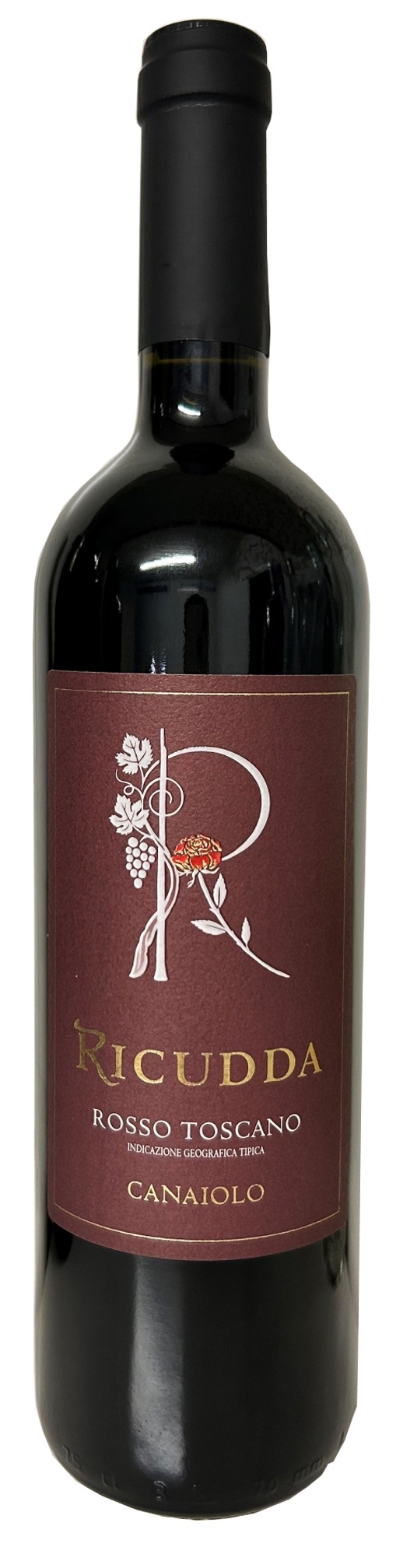
" We don't sell the wine without touching the vine "
| BUY MORE! SAVE MORE! | ||||||||||||||||||||
|
| Country: | Italy |
| Region: | Tuscany |
| Winery: | Fattoria Ricudda |
| Grape Type: | Canaiolo |
| Organic: | Yes |
| Vintage: | 2024 |
| Bottle Size: | 750 ml |
Ricudda IGT Toscana Canaiolo is made from 100% Canaiolo.
Intense ruby red with purple tints. Aromas of flowers and berries accompanied by sweet spices. Fresh and easy to drink, with intense fruity notes.
Wine is vinified in French oak barrels for 2 months. Then it is aged in concrete tanks for another 2 months.
After bottling, the wine is kept in bottle for an extra 3 months before it is release to the consumer.
The wine is produced with grapes from organic viticulture and is clarified without the use of products of animal origin.
To be combined with first and second courses based on meat, cold cuts, vegetables and fresh cheeses.
First courses with game, grilled meats, fresh and aged cheeses such as pecorino.
The Ricudda Farm is located along a secondary route of the ancient Via Francigena, which in ancient times was traveled by pilgrims who went from France to Rome and descended from the ridge of Castellina in Chianti towards the main routes of the Val D’Elsa.
It takes its name from the French Coude / Couder / Recoude, which has the meaning of “elbow, bend”.
The name of the farm can therefore be traced back to the "elbow" conformation of the farm land.
The Fattoria has been producing wine since the 15th century and is one of the oldest farms in the Chianti area. It is located in the municipality of Castellina in Chianti about halfway between Florence and Siena, at an altitude of about 360 m a.s.l. The farm and its grounds boast almost 800 years of history, from the first known acquisition a few years before 1300 by Bartolomeo di Grazia, a Florentine citizen of the time, who started production until our acquisition. The Squarcialupi family, the most powerful family in the history of Chianti, is also among the owners of the land. In 2016 the company
was acquired by the Bojola - Australi families with the aim of converting production towards a 100% organic product. 6 hectares of new vineyards were replanted, modern equipment was purchased and the old farm that houses the farm and farmhouse was renovated. The result is a production of high quality Chianti Classico with Sangiovese grapes and organic olive oil.

Ricudda IGT Toscana Canaiolo is made from 100% Sangiovese.
Intense ruby red with purple tints. Aromas of flowers and berries accompanied by sweet spices. Fresh and easy to drink, with intense fruity notes.
To be combined with first and second courses based on meat, cold cuts, vegetables and fresh cheeses.
First courses with game, grilled meats, fresh and aged cheeses such as pecorino.

Ricudda Chianti Classico Riserva 100% Sangiovese.
Deep ruby red color.
The wine shows an intense and persistent bouquet, with notes of berries and spices such as licorice and black pepper. Well-harmonized hints of oak.
In the mouth, it is well structured and balanced, complex, persistent with notes of red fruits and spices such as black pepper and licorice.
Pair with grilled red meats, steak, game of hair and feather, stewed and roasted, aged cheeses hard like pecorino.


Weinkeller Erbach Goldmuskateller Feinherb is made from 100% Goldmuskateller.
The old name for the Erbacher Honigberg was Wacholderwiesen, meaning juniper meadows. At the Wacholderwiesen there was an uprising of the peasants in the 16th century. All the ringleaders were hanged.
The Muskateller grape has the smell of elder-berries, apricots and quince. A subtle aroma of lime and coconut rounds off the experience.
RS: 27.7grams / Liter
Acidity: 6.1
Pairing: Mountain cheese, spicy Asian food, ice-cubes with lemon balm in a long drink (lemon balm grows in the vineyard Erbacher Honigberg).

Intense ruby red color with purple tints.
On the nose, the wine shows some intense notes of red fruits, especially cherry and slight hints of oak.
In the mouth, it has a good structure, great softness and it is pleasant to drink. Predominant notes of red fruits, with slight spiciness.
Pair with first courses with game, grilled meats, fresh and aged cheeses such as pecorino.

Carra Beaujolais-Villages Gamay Noir Non filtré is a new project for 2024.
We wanted a very fruity style of Beaujolais Villages using a good amount of carbonic maceration during the vinification.
The wine has a very nice ruby red color and a very pure and delicate nose of pure strawberries and cream that is very defined and seductive.
The palate is medium-bodied with crisp tannins, lively red cherry fruit and pleasing weight on the finish.
Excellent with charcuterie (garlic sausage, dry sausage, boudin noir), but also delicious with Coq au vin (Chicken cooked in a red wine sauce).
The wine will also goes well with fresh fruit and a splash of Crémant de Bourgogne for a Burgundian Sangria.

Ruffino Modus Primo Toscana IGT Italian Red Wine is the evolution of Modus, showcasing quality fruit from three Tuscan vineyards on Ruffino's Poggio Casciano Estate, each one representing the best that this centuries-old wine region terroir has to offer. This Ruffino wine opens with a bouquet of ripe cherries and orange zest, followed by layered balsamic notes and spicy hints of sweet tobacco and vanilla.
Review:
Ripe and lively in its sensory profile, it shows notes of black plums, blackberries, sage and laurel. Juniper berries describe the secondary scene. Full body, elegant and relaxed on the palate, it closes modern and captivating. Better from 2023.
-WineCritic.com 94 Points
A very savory nose of tar, leather and cigar smoke draws levity from undertones of vanilla, baking spices and dark berries. On the palate, the fruit brightens, but things stay savory overall, through a dark, bitter chocolate finish. Acid bubbles around big, chewy tannins.
-Wine Enthusiast 94 Points
Aromas of crushed stones, dark berries and blueberries follow through to a medium to full body with creamy tannins and a medium-chewy finish. Chocolate at the end. Sangiovese, cabernet sauvignon and merlot. Two or three years of bottle age will bring this around nicely. Drink after 2024.
James Suckling 94 Points
A very savory nose of tar, leather and cigar smoke draws levity from undertones of vanilla, baking spices and dark berries. On the palate, the fruit brightens, but things stay savory overall, through a dark, bitter chocolate finish. Acid bubbles around big, chewy tannins.

Continuum Red Blend 2022 is made from 45% Cabernet Sauvignon, 43% Cabernet Franc, 8% Petit Verdot, 4% Merlot.
2022 tells a story of subtle drama of the seasons. Aromatically effusive, 2022 Continuum is a seductive wine with an upright and regal core. Elegantly interwoven notes of black plum, black cherry, cacao, forest floor and tobacco leaf mingle with our sage mountain garrigue and volcanic minerality. Energetic and expressive, 2022 Continuum is a harmoniously integrated wine with structural complexity wrapped in a velvet robe.
WINEGROWING- Continuum is estate grown on our Sage Mountain Vineyard. It’s location, high on Pritchard Hill along the eastern ridge above Oakville, overlooks Napa Valley and the San Francisco Bay. The rocky, volcanic soils of the site focus the vine’s energy keeping yields low yielding fruit of depth and complexity. 38 acres of mature estate vineyard, planted in 1991 and 1996, with additional plantings in 2004, 2010, together comprise 38 distinct vineyard blocks. Cabernet Sauvignon, Cabernet Franc, Petit Verdot, and Merlot are grown from 1300 to 1600 feet in elevation, on western and southern facing aspects with slight northern and eastern slopes in places. This diversity of plantings on our volcanic soils are the essence of the complexity of Continuum.
PRODUCTION- Continuum is 100% estate grown, produced and bottled. All fruit is selectively hand-harvested at night. The fruit is then sorted before and after de-stemming, and gravity fed into French oak or concrete tanks. A threeday cold soak is followed by fermentation, receiving three to four pumpovers daily, and délestage two to three times in total during the most active period. The wine remains on skins in tank for 20 to 40 days. All lots are then drained, basket pressed, and transferred with lees for malolactic fermentation and aging. Continuum spent 22 months in barrel. 63 percent of French oak barrels were new and 35 percent were once used. A single concrete amphora was also used for aging. The wine clarified slowly and settled naturally in our cold barrel room, was racked sparingly and bottled without fining or filtration. Each vineyard lot was tasted and carefully considered many times to assemble the blend.
Review:
Perfumed aromas of subtle currants, roses, lavender and sage, following through to a medium body with super-fine tannins that caress the palate and leave it fresh and inspired.
- James Suckling 99 Points