" We don't sell the wine without touching the vine "
| BUY MORE! SAVE MORE! | ||||||||||||||||||||
|
| Country: | Italy |
| Regions: | Tuscany Chinon |
| Winery: | Fattoria Ricudda |
| Grape Type: | Sangiovese |
| Organic: | Yes |
| Vintage: | 2020 |
| Bottle Size: | 750 ml |
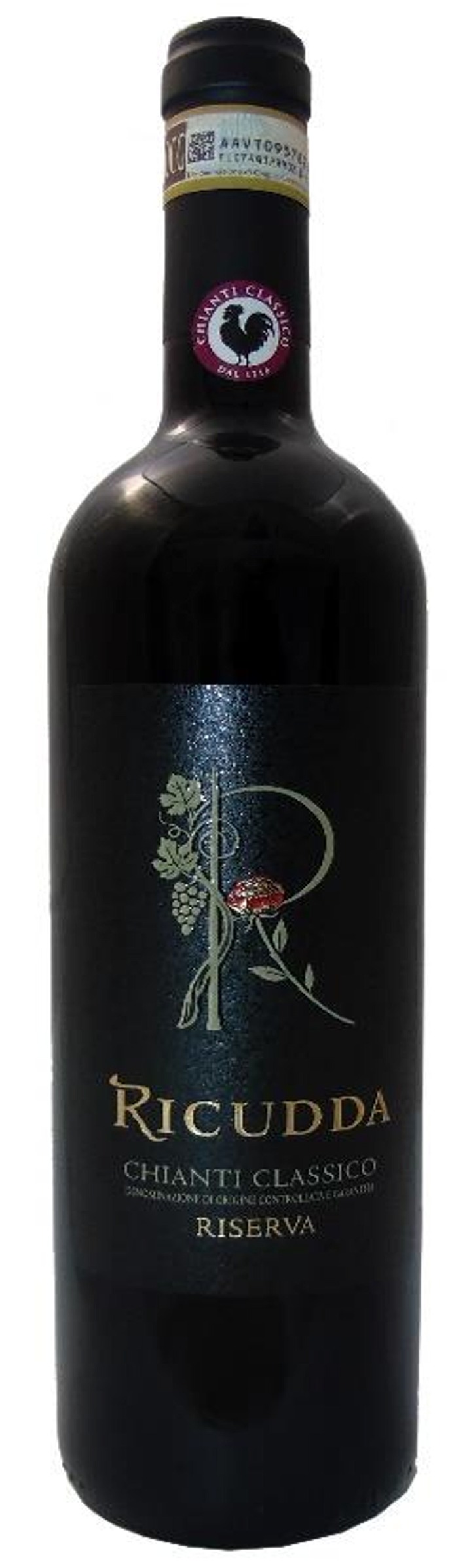
Ricudda Chianti Classico Riserva 100% Sangiovese.
Deep ruby red color.
The wine shows an intense and persistent bouquet, with notes of berries and spices such as licorice and black pepper. Well-harmonized hints of oak.
In the mouth, it is well structured and balanced, complex, persistent with notes of red fruits and spices such as black pepper and licorice.
Pair with grilled red meats, steak, game of hair and feather, stewed and roasted, aged cheeses hard like pecorino.
The Ricudda Farm is located along a secondary route of the ancient Via Francigena, which in ancient times was traveled by pilgrims who went from France to Rome and descended from the ridge of Castellina in Chianti towards the main routes of the Val D’Elsa.
It takes its name from the French Coude / Couder / Recoude, which has the meaning of “elbow, bend”.
The name of the farm can therefore be traced back to the "elbow" conformation of the farm land.
The Fattoria has been producing wine since the 15th century and is one of the oldest farms in the Chianti area. It is located in the municipality of Castellina in Chianti about halfway between Florence and Siena, at an altitude of about 360 m a.s.l. The farm and its grounds boast almost 800 years of history, from the first known acquisition a few years before 1300 by Bartolomeo di Grazia, a Florentine citizen of the time, who started production until our acquisition. The Squarcialupi family, the most powerful family in the history of Chianti, is also among the owners of the land. In 2016 the company
was acquired by the Bojola - Australi families with the aim of converting production towards a 100% organic product. 6 hectares of new vineyards were replanted, modern equipment was purchased and the old farm that houses the farm and farmhouse was renovated. The result is a production of high quality Chianti Classico with Sangiovese grapes and organic olive oil.

The grapes for this wine come from a small parcel of 6 acres in the village of Puligny-Montrachet, resulting in wines of exceptional quality. The same viticulture and vinification methods are applied for all the wines from the Domaine.
The wine offers an expressive nose of white flowers, stone fruits and buttered bread notes. The mouth is mineral and elegant, and delicate toasty nuances bring extra length in the mouth alongside a fresh acidity and a good balance.
Pair with veal Stew, Grilled Salmon, Epoisse cheese

Farnio Chianti Montalbano Riserva is made from 90% Sangiovese, 5% Canaiolo and 5% Colorino.
Brilliant ruby red with plain ruby shades, fairly clear. Blackberry and violet notes emerge on the nose with spiced and vegetal tones, leading to a leathery and pencil lead finish. Elegant, pleasant, pure and intense aromas but vigorous and round. Slightly tannic and fresh, balanced and full-bodied.
Wild boar in sauce, grilled meat, casseroles, game and mature pecorino cheese.

Salvadori Chianti Riserva DOCG 2017 is made from Sangiovese 90% , Merlot 10

Intense ruby red color with purple tints.
On the nose, the wine shows some intense notes of red fruits, especially cherry and slight hints of oak.
In the mouth, it has a good structure, great softness and it is pleasant to drink. Predominant notes of red fruits, with slight spiciness.
Pair with first courses with game, grilled meats, fresh and aged cheeses such as pecorino.

Rinaldi Panta rei Monferrato Rosso is a blend of 50% Barbera and 50% Cabernet Sauvignon.
This wine is quite tasty, smooth, silky and powerful.
It is loaded with dried red fruit notes from the appassimento of the grapes and it also has a lot of spicy aromas and flavors from the oak ageing.
Grown on limestone soils.
The average age of the vines is 30 years old.
10% of the wine is appassimento. Appassimento is an Italian term for drying harvested grapes, traditionally on bamboo racks or straw mats, for a few weeks up to several months to concentrate the sugars and flavors. This process is used in making Amarone, Recioto and Sforzato.
This drying method is not traditional in Piemonte but is popular in other part of Italy like in the Veneto region.
Thanks to this new method the wine is rounder and softer, boasts beautiful notes of red dried fruits.
Pantarei is aged 14 months in French oak ((the wood is Allier, medium toast) barrels and 6 months in bottle before release.
Delicious with wild game, grilled meat and strong cheese.

Capra Marco Doppiadi Barbera d'Asti is made from 100% Barbera.
Color: very deep bright ruby red with violet hues.
Bouquet: intense and persistent, pleasantly fruity and reminiscent of plums and black cherries.
Flavor: vinous, full, pleasantly fresh and generous.
Suitable as an aperitif with appetisers and sliced meats, it is perfect throughout a meal. it is perfect with pasta dishes featuring tagliatelle and ravioli, as well as with meaty main courses, such as stews and roasts. Interesting with medium-mature cheeses, with Toma and Pecorino.

Intense ruby red color with purple tints.
On the nose, the wine shows some intense notes of red fruits, especially cherry and slight hints of oak.
In the mouth, it has a good structure, great softness and it is pleasant to drink. Predominant notes of red fruits, with slight spiciness.
Pair with first courses with game, grilled meats, fresh and aged cheeses such as pecorino.

Tenuta di Nozzole La Forra Chianti Classico Riserva is made from 100% Sangiovese.
Located north of the village of Greve in the heart of the Chianti Classico region, the Nozzole estate covers a striking, rugged, mountainous area of about 1,000 acres at 984 feet in elevation. In order to obtain concentration and complexity in the wine, yields are kept low. The grapes are hand harvested, destemmed and crushed. Fermentation is initiated on the skins in temperature-controlled stainless steel tanks, followed by a maceration period to draw out color and tannins. The wine is racked into stainless steel tanks for malolactic fermentation before aging in oak vats and in bottle before release. The wine is bottled on the estate.
The 2020 vintage was characterized by a basically cold period between April and May and by a generally warm and dry climate until July. The initial slight delay of the vegetative cycle has been recovered since the summer. The sudden increase in temperatures, especially for the later varieties where the fruit set had not yet ended, has favored a production characterized by sparse and light bunches. The stable and sunny climate of the months of August and September allowed the grapes to complete ripening in optimal conditions.
Review:
Attractive on the nose with cherries, red berries, dried herbs and baking spices. It’s medium-bodied with fine tannins. Harmonious and poised with a refined character. Weightless and agile. Polished and succulent finish.
-Wine Enthusiast 93 Points
Farnio Chianti Montalbano Riserva is made from 90% Sangiovese, 5% Canaiolo and 5% Colorino.
Brilliant ruby red with plain ruby shades, fairly clear. Blackberry and violet notes emerge on the nose with spiced and vegetal tones, leading to a leathery and pencil lead finish. Elegant, pleasant, pure and intense aromas but vigorous and round. Slightly tannic and fresh, balanced and full-bodied.
Wild boar in sauce, grilled meat, casseroles, game and mature pecorino cheese.

Busi Chianti Rufina Riserva is made from 100% Sangiovese
Vineyards: Travignoli, a name which literally means “Tra Vignoli” (between the vineyards) is located in the middle of Frescobaldi’s Nipozzano vineyard in the heart of the Rufina zone. There is documented evidence that wine was first produced there in the 5th C BC by the Etruscans who called it “Nectar of the Gods”. The Church acquired the land and constructed the cellars in 1100.
Count Busi and his family acquired the estate in the 1800’s. Overall, 91
hectares belong to the estate. The 60 hectares of vineyards are excellently
position on the slopes with a southerly exposure at an elevation between 270 to 370 meters. Clay, marl and calcareous soil with a large percentage of rocks and stones for good drainage. Vines are an average of 10–25 years old.
Harvest: October– by hand.
Yield per hectare: 40 Quintals per hectare
Vinification: Fermentation in stainless steel at controlled temperatures for 7 to 8 days with an additional 7 to 8 days on the skins. The wine is then racked and goes through malolactic. It is then racked again and stays another 3 months in stainless steel.
Aging: 25 to 30 hectoliter barrels of Slavonian oak for 18 months and 3 months in Allier barriques. There is a period of refinement of 4 to 5 months in the bottle.
Alcohol: 13% by vol.
Color: Ruby red with garnet reflections.
Bouquet: Intense, ethereal bouquet with hints of leather, tar and ripe cherry fruit.
Taste: The flavor is full of mature fruit with nuances of leather and liquorice. The taste is complex and round and rich with character. The finish is persistent and satisfying.
Foods: Grilled, braised or roasted meats, dishes flavored with mushrooms, or rosemary. Excellent with polenta dishes.
Total Production: 3,300 cases
Enologist: Mauro Orsoni

Busi Vin Santo del Chianti Rufina Riserva is made from 100% Sangiovese.
This is a Riserva level Chianti showing prestige and elegance, being powerful and elegant at the same time.
Color: Ruby red with garnet reflections.
Aromas: Intense, ethereal bouquet with hints of leather, tar and ripe cherry fruit.
Flavors: Full of ripe fruit with nuances of leather and liquorice. The taste is complex and round and rich with character. The finish is persistent and satisfying.
Pair with grilled, braised or roasted meats, dishes flavored with mushrooms, or rosemary. Excellent with polenta dishes.

On the palate, it reveals a fresh attack followed by an ample, structured, long-lasting finish. The wine unfurls in successive stages and ends with top-quality tannins produced by whole cluster fermentation. It features aromas and flavors of smoked ham, violet, graphite, graphite, and licorice.
Review:
A refined, fine-textured and precise Cote-Rotie with aromas of cherries, wild berries, wild herbs, bark and baking spices. Medium-bodied with finely grained tannins. There is a vibrant and spicy character at the center, with a succulent, precise and lively expression toward the long finish. Try after 2026.
-James Suckling 95 Points

Henriot Brut Souverain is made from 50% Pinot Noir, 40% Chardonnay, 10% Pinot Meunier.
The Brut Souverain is the most historical cuvée in the region, as it was the first cuvée Apolline Henriot produced in 1808. Apolline aspired to put the light on her vineyards through the expression of a champagne. According to her, one year was not enough to tell the story of the terroirs, so she decided to put wines in reserve each year to incorporate them into a future blend. Therefore, she founded the House by creating a Champagne that would have blending as its fundamental principle. The House respects this philosophy today and uses every terroir in this multi-cru, multi-vintage cuvée. It was named Brut Souverain by Ernest Henriot, Apolline's grandson, when the House was appointed the official champagne supplier to the Courts of the King of Holland and of the Emperor of Austria-Hungary.
Review:
A superprecise, reductive style due to bright lime-peel aromas enhanced by chalky minerality with linden tree and yellow plums. Light-bodied, it has zesty acidity with pinprick bubbles, a tight-knit structure and a chewy yet very polished finish.
-James Suckling 95 Points