
" We don't sell the wine without touching the vine "
| BUY MORE! SAVE MORE! | ||||||||||||||||||||
|
| Country: | Italy |
| Region: | Tuscany |
| Winery: | Societa Agricola Betti |
| Grape Type: | Sangiovese |
| Organic: | Yes |
| Vintage: | 2021 |
| Bottle Size: | 750 ml |
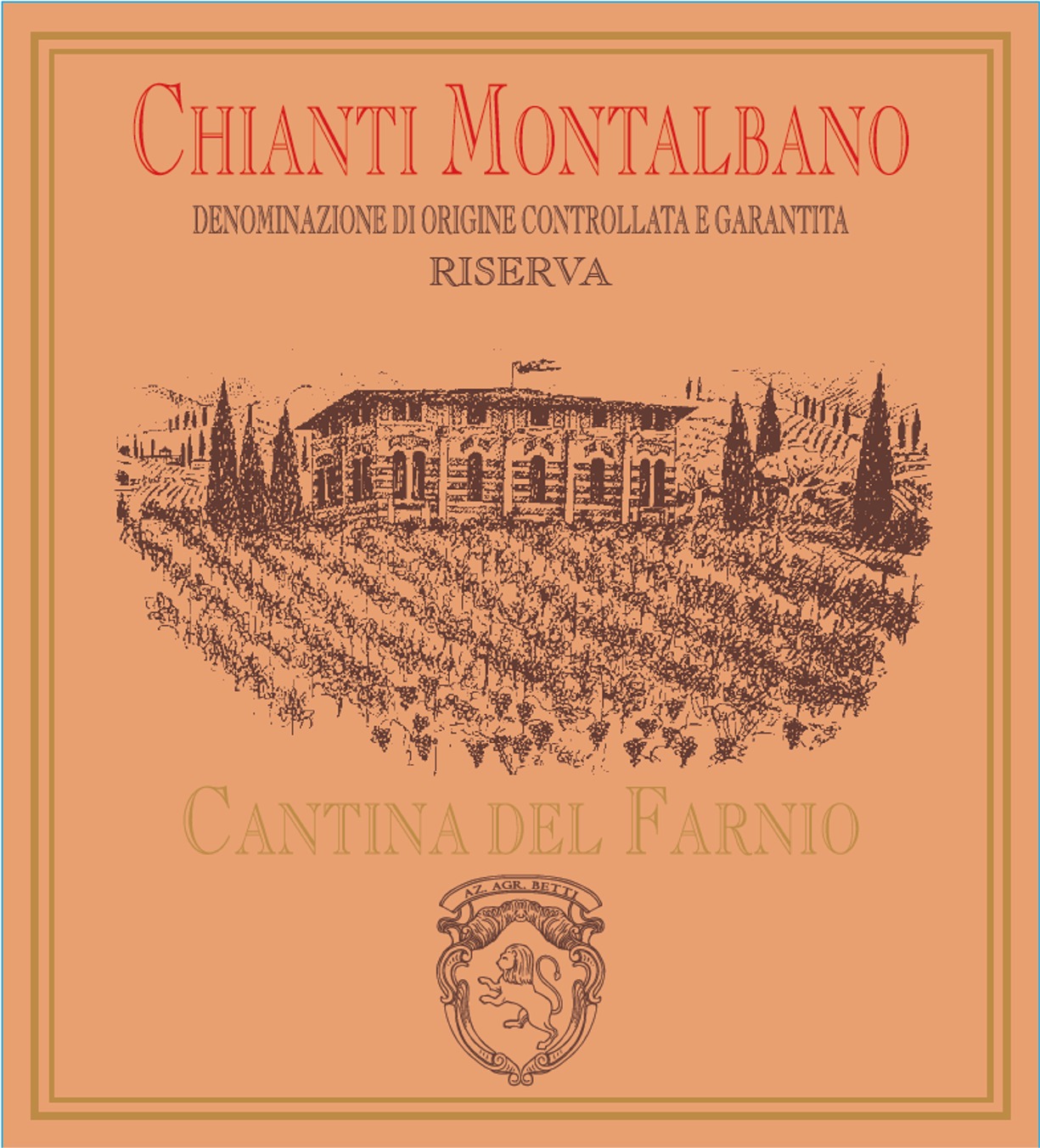
Farnio Chianti Montalbano Riserva is made from 90% Sangiovese, 5% Canaiolo and 5% Colorino.
Brilliant ruby red with plain ruby shades, fairly clear. Blackberry and violet notes emerge on the nose with spiced and vegetal tones, leading to a leathery and pencil lead finish. Elegant, pleasant, pure and intense aromas but vigorous and round. Slightly tannic and fresh, balanced and full-bodied.
Wild boar in sauce, grilled meat, casseroles, game and mature pecorino cheese.
The winery was founded in 1903 by Bartolomeo Baldi, great-great-uncle of the current owners, the brothers Guido and Gherardo Betti: the Betti family is in fact originally from Florence and in the past the cellar was the so-called country house. In 2003 Guido and Gherardo made a very important decision that would define their lives: that is, they decided to devote themselves totally to viticulture and therefore transformed what had always been the second family business into a modern winery, Guido, born in 1978, oversees the Italian Commercial and Export sectors while Gherardo, born in 1983, manages all the oenological and agronomic part
Guido and Gherardo Betti's work has always been oriented towards the highest quality, both in the vineyard and in the cellar. The basic intention is to constantly enhance the innate characteristics of the wines of the territory - finesse and liveliness in the first place - without any forcing, but simply accompanying a soil that was already born perfect. The cultivation includes partial grassing and organic fertilizers (for example the plants of favette cut and buried at the time of flowering release nitrogen into the soil) and an attitude of interventionism only when it is really needed, without any forcing. Harvesting is partly manual and partly mechanical, depending on the plots.
Guido and Gherardo therefore consider themselves as custodians of a marvelous territory, which they have the duty to defend without distorting it: in their thinking, modern technologies and everything that involves innovation is absolutely looked upon with great favor, as long as it is aimed at guaranteeing a production in which every single bottle expresses personality and genuineness.

Salvadori Chianti Riserva DOCG 2017 is made from Sangiovese 90% , Merlot 10

Ricudda Chianti Classico Riserva 100% Sangiovese.
Deep ruby red color.
The wine shows an intense and persistent bouquet, with notes of berries and spices such as licorice and black pepper. Well-harmonized hints of oak.
In the mouth, it is well structured and balanced, complex, persistent with notes of red fruits and spices such as black pepper and licorice.
Pair with grilled red meats, steak, game of hair and feather, stewed and roasted, aged cheeses hard like pecorino.
Review:
-James Suckling 91 Points

Intense ruby red color with purple tints.
On the nose, the wine shows some intense notes of red fruits, especially cherry and slight hints of oak.
In the mouth, it has a good structure, great softness and it is pleasant to drink. Predominant notes of red fruits, with slight spiciness.
Pair with first courses with game, grilled meats, fresh and aged cheeses such as pecorino.
Review:
-James Suckling 92 Points
-Wine Enthusiast 90 Points

Rinaldi Panta rei Monferrato Rosso is a blend of 50% Barbera and 50% Cabernet Sauvignon.
This wine is quite tasty, smooth, silky and powerful.
It is loaded with dried red fruit notes from the appassimento of the grapes and it also has a lot of spicy aromas and flavors from the oak ageing.
Grown on limestone soils.
The average age of the vines is 30 years old.
10% of the wine is appassimento. Appassimento is an Italian term for drying harvested grapes, traditionally on bamboo racks or straw mats, for a few weeks up to several months to concentrate the sugars and flavors. This process is used in making Amarone, Recioto and Sforzato.
This drying method is not traditional in Piemonte but is popular in other part of Italy like in the Veneto region.
Thanks to this new method the wine is rounder and softer, boasts beautiful notes of red dried fruits.
Pantarei is aged 14 months in French oak ((the wood is Allier, medium toast) barrels and 6 months in bottle before release.
Delicious with wild game, grilled meat and strong cheese.

Capra Marco Doppiadi Barbera d'Asti is made from 100% Barbera.
Color: very deep bright ruby red with violet hues.
Bouquet: intense and persistent, pleasantly fruity and reminiscent of plums and black cherries.
Flavor: vinous, full, pleasantly fresh and generous.
Suitable as an aperitif with appetisers and sliced meats, it is perfect throughout a meal. it is perfect with pasta dishes featuring tagliatelle and ravioli, as well as with meaty main courses, such as stews and roasts. Interesting with medium-mature cheeses, with Toma and Pecorino.

Fenocchio DOC Nebbiolo Langhe Bussia is made from 100 percent Nebbiolo.
The color is a deep ruby red with garnet reflections and an intense and fruity bouquet of plum and cherry. The flavor is dry with good body, well balanced tannins and harmonious with hints of licorice and rose.
Parcel is 2 hectares (5 acres) planted at 300 meters above sea level.
Pairing well with all types of food, from appetizers to cheeses with red and white meat.
Review:
-Decanter World Wine Awards 90 Points

Farnio Chianti Montalbano Riserva is made from 90% Sangiovese, 5% Canaiolo and 5% Colorino.
Brilliant ruby red with plain ruby shades, fairly clear. Blackberry and violet notes emerge on the nose with spiced and vegetal tones, leading to a leathery and pencil lead finish. Elegant, pleasant, pure and intense aromas but vigorous and round. Slightly tannic and fresh, balanced and full-bodied.
Wild boar in sauce, grilled meat, casseroles, game and mature pecorino cheese.

Busi Chianti Rufina Riserva is made from 100% Sangiovese
Vineyards: Travignoli, a name which literally means “Tra Vignoli” (between the vineyards) is located in the middle of Frescobaldi’s Nipozzano vineyard in the heart of the Rufina zone. There is documented evidence that wine was first produced there in the 5th C BC by the Etruscans who called it “Nectar of the Gods”. The Church acquired the land and constructed the cellars in 1100.
Count Busi and his family acquired the estate in the 1800’s. Overall, 91
hectares belong to the estate. The 60 hectares of vineyards are excellently
position on the slopes with a southerly exposure at an elevation between 270 to 370 meters. Clay, marl and calcareous soil with a large percentage of rocks and stones for good drainage. Vines are an average of 10–25 years old.
Harvest: October– by hand.
Yield per hectare: 40 Quintals per hectare
Vinification: Fermentation in stainless steel at controlled temperatures for 7 to 8 days with an additional 7 to 8 days on the skins. The wine is then racked and goes through malolactic. It is then racked again and stays another 3 months in stainless steel.
Aging: 25 to 30 hectoliter barrels of Slavonian oak for 18 months and 3 months in Allier barriques. There is a period of refinement of 4 to 5 months in the bottle.
Alcohol: 13% by vol.
Color: Ruby red with garnet reflections.
Bouquet: Intense, ethereal bouquet with hints of leather, tar and ripe cherry fruit.
Taste: The flavor is full of mature fruit with nuances of leather and liquorice. The taste is complex and round and rich with character. The finish is persistent and satisfying.
Foods: Grilled, braised or roasted meats, dishes flavored with mushrooms, or rosemary. Excellent with polenta dishes.
Total Production: 3,300 cases
Enologist: Mauro Orsoni

Busi Vin Santo del Chianti Rufina Riserva is made from 100% Sangiovese.
This is a Riserva level Chianti showing prestige and elegance, being powerful and elegant at the same time.
Color: Ruby red with garnet reflections.
Aromas: Intense, ethereal bouquet with hints of leather, tar and ripe cherry fruit.
Flavors: Full of ripe fruit with nuances of leather and liquorice. The taste is complex and round and rich with character. The finish is persistent and satisfying.
Pair with grilled, braised or roasted meats, dishes flavored with mushrooms, or rosemary. Excellent with polenta dishes.

Bright and glossy ruby red in color. On the nose it reveals aromas of small fresh berries and a trace of sour cherry, melded with hints of blackberries and black cherries, followed by a hint of vanilla. A fragrant wine with satisfying intensity. On the palate it is warm, smooth and a medium-bodied with finely-balanced tannins. Dry and sinewy yet fresh with a persistent, aromatic finish.
It naturally accompanies dishes that are typical of Tuscan cuisine with its bold, authentic flavors, such as pasta and risottos made with mushrooms or truffles, pork, grilled meats and medium-matured cheeses.
Review:
-James Suckling 91 Points
Ricudda Chianti Classico Riserva 100% Sangiovese.
Deep ruby red color.
The wine shows an intense and persistent bouquet, with notes of berries and spices such as licorice and black pepper. Well-harmonized hints of oak.
In the mouth, it is well structured and balanced, complex, persistent with notes of red fruits and spices such as black pepper and licorice.
Pair with grilled red meats, steak, game of hair and feather, stewed and roasted, aged cheeses hard like pecorino.
Review:
-James Suckling 93 Points
-Jeb Dunnuck 91 Points
Ricudda Chianti Classico Riserva 100% Sangiovese.
Deep ruby red color.
The wine shows an intense and persistent bouquet, with notes of berries and spices such as licorice and black pepper. Well-harmonized hints of oak.
In the mouth, it is well structured and balanced, complex, persistent with notes of red fruits and spices such as black pepper and licorice.
Pair with grilled red meats, steak, game of hair and feather, stewed and roasted, aged cheeses hard like pecorino.
Review:
-James Suckling 91 Points

Beatus began with a dream and a friendship. Our dream was to make wine in Châteauneuf du Pape, one of the first regions to inspire the desire to pursue winemaking in general, and of working with Grenache in particular.
We developed a long-standing friendship with Anne-Charlotte Melia-Bachas, Proprietor of Chateau de la Font du Loup, who approached us with the idea to craft a wine together a number of years ago.
This has all come to fruition with Beatus, a wine that we have decided to make ongoing, every year — since tasting the exciting results of the first vintage in barrel.
The vineyard parcel selected for this wine is a single plot of 80-year old Grenache at the top of La Crau in Châteauneuf du Pape, the highest location in the AOC. It sits on a north-facing slope that helps guard against the sometimes intense summer heat that can affect the surrounding areas.
This plot is called “Le Poteau” and has been generously granted to us by Anne-Charlotte as the core of this wine, with supplementation of Syrah and Mourvèdre from surrounding parcels also grown on the Chateau de la Font du Loup estate, to round out the blend.
The winemaking is directed by myself and carried out by Anne-Charlotte, Stéphane Dupuy d’Angeac and their team. It is our hope to bring you one of the finest expressions of Grenache from this special region each and every vintage.
Yields from this block are very small due to the age of the vines, therefore only up to 100 cases of Beatus will be produced each year, depending on the conditions of the vintage.
Our first release was in November of 2022.
– Winemaker Todd Alexander
Review:
Made in collaboration with Chateau de la Font Du Loup, the 2020 Beatus is an extraordinary bottling that rivals some of the top wines of this region. The nose is hugely perfumed with red rose petals, potpourri, sage and shades of red currants. The palate displays the same level of concentration as it does on the bouquet. Beautiful guava and ripe strawberry fruits parade with copious minerals and a sinfully good texture on the palate. Fresh and vibrant, this is just sensational stuff to enjoy in its heady youth.
Owen Bargreen 97 Points

Chappellet Pritchard Hill Estate Vineyard Cabernet Sauvignon is made from Cabernet Sauvignon.
Chappellet's Pritchard Hill Cabernet Sauvignon has been, since the beginning of their winemaking career, the most sought after wine of their portfolio. The wine is truly a love letter to the winegrowing potential of Pritchard Hill. The wine was inspired by Bordeaux, and like most left bank Bordeaux, the wine is a blend of predominately Cabernet Sauvignon with remaining amounts other classic Bordeaux blend varieties. The vines grow upon rocky, mountainside vineyards. After harvest and fermentation, the wine was aged for 22 months in 100% new French oak barrels.
Chappellet planted on Pritchard Hill in 1967, among the first to prove this rugged, high-elevation bench on Napa Valley's eastern ridge could grow world-class Cabernet. The volcanic, iron-rich soils sit above the fog line, where poor ground and long, even ripening yield naturally concentrated fruit and the wine's celebrated capacity to age.
Review:
The flagship release here, the 2023 Cabernet Sauvignon Pritchard Hill sports a saturated purple hue and absolutely heavenly aromatics of crème de cassis, liquid violets, graphite, crushed stone, and a Pauillac-like character that builds with time in the glass. Based on 95% Cabernet Sauvignon and 5% Petit Verdot, it's full-bodied, has a deep, concentrated mouthfeel, ultra-fine tannins, and a great, great finish. This is magical stuff that offers pleasure even today given its purity, balance, and finesse, but I'd be shocked if it didn't keep for 50 years or more. Drink 2025-2075.
Jeb Dunnuck, 100 points
Review:
-Jeb Dunnuck 100 Points
-Jane Anson (Jane Anson - Inside Bordeaux) 100 Points
-Joe Czerwinski (Robert Parker) 100 Points
-Decanter 99 Points




