
" We don't sell the wine without touching the vine "
| BUY MORE! SAVE MORE! | ||||||||||||||||||||
|
| Country: | France |
| Regions: | Rhone Chateauneuf du Pape |
| Winery: | Rotem & Mounir |
| Grape Type: | Grenache |
| Organic: | Yes |
| Vintage: | 2019 |
| Bottle Size: | 750 ml |
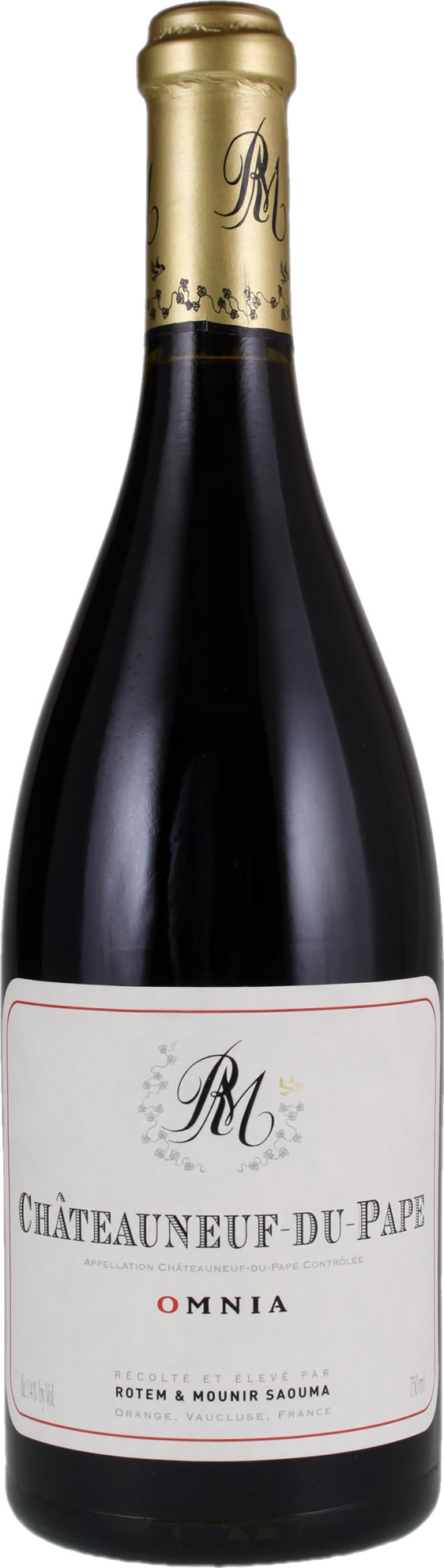
The aging is as Mounir ages his Burgundies: extremely long, never racked, no fining, no filtration. It would be easy to say that we expected the experience running one of Burgundy’s leading producers, Lucien Le Moine, would show in Mounir’s wines. But the actual results need to be tasted to be believed and understood: a wine with beguiling fruit and savory richness, yet extraordinary finesse and detail.
Mounir Saouma likes to describe Châteauneuf-du-Pape as a mosaic, with all the wild traditions and differences together making for very different interpretations. Omnia, Latin for “all,” is his attempt to encompass the entire region’s terroir and winemaking history (and perhaps future) in one glass. The fruit comes from 9 vineyard parcels across all 5 of the Châteauneuf communes, Châteauneuf-du-Pape, Courthezon, Sorgues, Bedarrides and Orange (in early vintages, when the Saoumas did not have all the vineyards they have today, they would purchase fruit; today, Rotem & Mounir Saouma is 100% Estate). The wine is then vinified and aged in foudres, cement and 500 liter barrels – a little bit of everything.
2019 was another warm and dry vintage in the southern Rhône, marked by insistent drought and repeated heat waves during the season. With little disease pressure or frost, the crop was close to normal size, but bunch and berry-size was reduced during the growing season by the lack of water. The grapes were thus concentrated and rich in sugar and acidity, although potential alcohol levels were often quite high. Vineyards at higher elevations – Châteauneuf du Pape and Gigondas in particular — handled the heat better, and the wines from those AOPs are rich yet also remarkably fresh and energetic. Despite the initial concerns about the growing season, 2019 looks to be a watershed vintage in the Southern Rhône, producing rich wines with exceptional concentration and aging potential
Inviting aromas of sliced strawberries, red cherries and rose. Full-bodied with vibrant acidity and succulent fruit. Fine, structured tannins are vertically aligned with the fruit. More dark-fruited than the nose lets on and entirely delicious. I love the subtle spice here.
-James Suckling 94 Points
Very refined, with silky and fine-grained structure carrying alluring bergamot, rooibos tea, incense, dried cherry and lightly mulled raspberry notes along. A long sanguine thread weaves through the finish. Hard to resist now with so much charm, but this will benefit from cellaring. Grenache, Syrah and Mourvèdre.
-Wine Spectator 94 Points
Burgundy meets the Rhone. An utter respect for tradition, and in some ways a total break. We’ve watched as Mounir and Rotem Saouma, of Burgundy producer Lucien Le Moine, slowly developed their estate and wines in Chateauneuf-du-Pape, and the results today are too extraordinary and distinct to ignore.
Let’s start at the beginning: 5 acres in Pignan. A sale was being conducted through the French state that presented the opportunity to buy a somewhat neglected parcel adjoining some oustanding plots (notably Rayas’ Bois de Rayas and the Pignan lieu dit). The Saoumas have long loved the area and its wines, have many friends, and saw they could potentially acquire land in a way that would not be possible in Burgundy.
The sheer vitality of these vines today is extraordinary. We know and love Mounir Saouma because of the way he transmits both unknown and acknowledged great crus of Burgundy through his elevage into masterpieces, but it turns out he may be an even more talented vineyard manager. Mounir’s philosophy is in theory straightforward. He has worked to improve drainage in his vineyards, works with organic manures, and doesn’t mind the low yields he is getting in his plots. As is the case with most things in life, simplicity appears only after deliberation and experience.
From this plot Mounir has been able to acquire additional vineyards, and today farms a total of 21 acres across 8 vineyards in all 5 villages of the appellation (Chateauneuf-du-Pape, Bedarrides, Sorgues, Courthezon and Orange). The kaleidiscope of the terroirs he works with is reflected in the cellar, as well, where a combination of barrels, foudres, cement, and eggs are used, all except the last of which can be considered “traditional” within the diversity of Chateauneuf’s viticultural history. The fruit is pressed firmly with small presses dating from the late 1970s, left in tank to macerate at relatively cool temperatures for 8 days, and then transferred to the various vessels. The wines are never punched down, never racked, and never sulfured until a light addition a month before bottling. They age for between 24-36 months, including the white, which as you might expect has an outsized focus here.
The wines are stunning: precise, intense, complex, expressive visions of Chateauneuf. They somehow speak to the past, but also to the present (and we would guess, the future), all in their own voice.

Grand Veneur Chateauneuf-du-Pape Rouge Les Origines is made from 50% Grenache, 30% Mourvedre and 20% Syrah
Matured in vats (grenache) and in oak casks (syrah and mourvèdre).
Deep and brilliant, purple-red colour. An exciting nose with aromas of black fruit (blackcurrant, cherry) spices and vanilla. This great aromatic complexity is found on the palate : the spices and ripe fruit appear with an elegant woodiness and harmonious tannins. The finish has good aromatic length and introduces a touch of liquorice and pepper.
A terrific Châteauneuf du Pape with great concentration and finesse.
Best between 2 and 20 years. Best to decant if young (less than 5 years old).
Soil type Extreme north of Châteauneuf du Pape. This plateau is made with a high quantity of red clay mixed with rocks. This area is considerated to be one of the best to produce rich and powerful red wines. By definition, LES ORIGINES will always deliver a great complexity and ageing potential. Winemaking & ageing Harvest is sorted by hand, destemmed and crushed. Fermentation temperature is controlled at 30°C. Vatting period of 18 to 20 days. Matured in vats (grenache) and in oak casks (syrah and mourvèdre).
Review:
"The 2019 Châteauneuf Du Pape Les Origines is also deep purple-hued and has a classic bouquet of crème de cassis and blackberry fruits intermixed with notions of graphite, chocolate, and spicy wood. Rich, full-bodied, and concentrated, this is beautifully done and despite its more modern elevage, it has plenty of Provençal character and charm."
- Jeb Dunnuck (October 2020), 94-96+ pts
"Warm in feel, with a gush of plum puree and blackberry paste flavors, liberally laced with black licorice and roasted alder notes. A solidly built, modern version, with a nice tug of warm earth on the back end. Best from 2022 through 2034. —J.M."
- Wine Spectator's Insider (June 9th 2021), 93 pts

Xavier Vignon Chateauneuf-du-Pape Rouge Cuvee Anonyme 2019 is made from 60% Grenache, 15% Mourvedre, 10% Syrah and the rest is "field blend" with the following grapes : grenache, vaccarese, counoise, mourvèdre, terret noir and muscardin.
One of Xavier Vignon's first almost anonymous blends only in MAGNUMS !
The grapes come from "collection vines", where many grape varieties are planted together, making it difficult to identify the exact share of each variety: grenache, vaccarese, counoise, mourvèdre, terret noir and muscardin.
Partially destemmed and vinified in a mix of demi-muids and tank, it offers a beautifully pure, vibrant bouquet of black raspberries, white and black pepper, candied orange, and violets. Complex, layered, and nuanced, this beauty is medium to full-bodied, has a seamless texture, and a great finish. It has both elegance and richness, and will keep for 15+ years.
Pairing: Duck in sauce with olives. Ravioli with porcini mushrooms, cream of parsnip and bacon crisps. Partridge leg confit with olive oil.
Review:
"The flagship from Xavier is the 2019 Châteauneuf Du Pape Cuvee Anonyme, and in 2019 it’s 60% Grenache, 15% Mourvèdre, 10% Syrah, and the balance a mix of permitted varieties. Partially destemmed and brought up in a mix of demi-muids and tank, it offers a beautifully pure, vibrant bouquet of black raspberries, white and black pepper, candied orange, and violets. Complex, layered, and nuanced, this beauty is medium to full-bodied, has a seamless texture, and a great finish. It has both elegance and richness, and will keep for 15+ years."
- Jeb Dunnuck (October 2020), 95-97 pt

Mordoree Chateauneuf-du-Pape La Reine des Bois is made from Grenache 75 %, Mourvèdre 10%, Syrah 10 % , Counoise 3% & Vaccarese 2%.
This premium cuvee - whose name means "Queen of the Woods" - is from 65-year-old vines, planted on Villafranchian-era terrasses. Yield is 30 hl/ha.
Deep ruby red; opaque. Aromas of red fruits change to wooden touches of leather, black truffles and coffee. Fat, concentrated and full flavored with a very long liquoriced and fruity finish.
Pairs with red meats, sauce dishes, game animals (woodcock, wild boar) and semi mature cheeses.
Review:
"The 2019 Châteauneuf Du Pape Cuvée De La Reine des Bois is a deeper, more masculine wine with gorgeous cassis and blackberry fruits as well as graphite, licorice, crushed stone, violets, and lavender nuances. Rich, full-bodied, and incredibly concentrated, it has a brilliant sense of freshness and purity as well as length on the finish. It's going to require 4-5 years of bottle age, but this straight-up thrilling Châteauneuf du Pape will have 20-25 years of prime drinking."
- Jeb Dunnuck (November 2021), 98+ pts

Cabrieres Chateauneuf du Pape Rouge L'Esprit is made from 50% Grenache, 15% Syrah, 15% Mourvèdre, 10% Cinsault and 10% remaining: Muscardin, Counoise, Picpoul, Terret noir, Vaccarèse, Clairette, Bourboulenc, Roussanne, Picardan.
The vineyard is situated on the high tablelands, which are characteristic of the northern area of Châteauneuf-du-Pape. The terrain consists mainly of alpine diluvium and chalky Miocenian soil, with large flint pebbles covering the surface. These pebbles conserve the heat of the day during the night, thus avoiding too much evaporation.
85-year-old vines. Aged 12 months in French oak. Intense ruby color, with a dominant nose of black fruits (blackcurrant and blackberry) evolving into smoke and grilled notes. Robust tannins on the palate with a long finish.
Pair with choice red meat, prime rib and game, or try with strong cheeses and chocolate dessert.

Chateau La Nerthe Chateauneuf-du-Pape Rouge is made from Grenache 39%, Mourvédre 33%, Syrah 25%, Cinsault 2%, Others 1%.
Château La Nerthe is one of the oldest estates in Châteauneuf-du-Pape and dates from 1560. Château La Nerthe has 227 acres of vineyards that surround the château and top the renowned La Crau plateau. The terroir is typical of the region. Vineyards run along a slope and grow in sandy-clay soils. The ground is covered by a layer of ‘galets’ – large, round, well-worn stones that were carried down from the Alps by glaciers during the last ice age. All the 13 permitted primary varietals are planted here. Grenache dominates 62% of the vineyards and the average vine age is over 40 years old. The grapes are hand harvested and sorted on tables. The grapes are then put into vats for almost 4 weeks with regular pump overs and punch downs. The must is tasted every day during fermentation to ensure the best extraction of the berry compounds. At the end, the wines are racked into oak vats for malolactic fermentation. The cuvée is then aged in large French oak casks and barrels for 12 months before blending. Bottling takes place 6 months later.
The dark, deep, inky color of the wine shows immediately, stemming from the concentration of the vintage. Nose of blackcurrants, black tea and dried flowers stands out. The mouth is rich, fruity and velvety with an incredibly layered tannic structure. The wine is balanced and pure with strong intense and incredibly long aging potential.
Review:
A focused expression, this wine delivers pure red and black fruits unfolding against a delicate rose-petal backdrop. Silky yet chewy tannins gradually reveal layers of red cherry, pomegranate, spice, violets, and a hint of clove. Its elegance is underscored by fine tannins, suggesting a wine that, while quiet now, holds the promise of revealing its full beauty with time in the bottle. Cellaring through 2028+ before revisiting should prove to be rewarding.
-Wine Enthusiast 93 Points

Crabitey Graves Rouge is made from 47% Cabernet Sauvignon, 47% Merlot and 6% Petit Verdot.
Château Crabitey Graves Rouge presents a dark cherry color with nice ruby glints. The nose is fresh, revealing a wide range of red fruits flavors, along with a mellow and elegant oak presence. The mouth is powerful and round, supported by smooth and subtle tannins. The wine reveals a good length on the palate, with fruity and slightly oaky notes.
Pairs well is grilled lamb, beef stroganoff and hard cheeses.
Review:
"The 2019 Crabitey is impressive, just as it was en primeur. Bright redtoned fruit, white chocolate, flowers, gravel and mint give the 2019 quite a bit of freshness and energy that builds over time. This mid-weight, wonderfully expressive Graves is a winner.- Antonio Galloni"
- Antonio Galloni's Vinous (January 2022) 91 pts

Nickel & Nickel Truchard Vineyard Chardonnay is made from 100 percent Chardonnay.
The 2023 Nickel & Nickel Truchard Chardonnay opens with enticing aromatics of tropical fruit, tangerine, and a hint of honeysuckle. On the palate, it presents a bright and vibrant profile, with a natural lift from its fresh fruit flavors and lively acidity. The tropical and citrus notes are complemented by a subtle brioche character, while the oak imparts a pleasant roundness, bringing balance and weight to the wine.
Review:
The freshness and pure fruit flavors of this generous wine ring clear as a bell. Crisp green apples, Bosc pears and subtle oak spices like vanilla bean and toasted almonds fill the palate. While medium-bodied, it feels full and generous and has a lingering finish. Drink now or hold.
-James Suckling 94 Points
Winemaker Joe Harden ages his Truchard Vineyard Chardonnay for 10 months in 30% new French oak, with minimal stirring and no malolactic fermentation, allowing for a slightly more pronounced oak presence. Truchard, one of Carneros' most esteemed sites, is characterised by rolling hills with ideal sun exposure and cooling breezes. Harden sources fruit from eight distinct blocks across the vineyard’s expansive 109 hectares, with harvests spanning roughly a month. Among the selections is Clone 809, a Muscat clone that adds floral aromatics and a touch of baking spice. The Truchard Chardonnay exhibits a silky texture on the palate, layered with citrus peel and tropical hints of apricot and peach. A rich spine of acidity is further heightened by vivid mineral tension, creating a wine that is both racy and rich. Elegantly balanced, it’s a delightful sipper with impressive depth and vibrancy.
-Decanter 94 Points

Obsidian Vineyard Syrah is bathed in terroir. The vines experience severe stress, pushing the roots ever deeper through rock in search of water, producing miniature clusters of intense power. Given the wine’s natural propensity for tannin, we take extreme care in the cellar to chisel/whittle its rough edges and leave room for richness to flatter its distinctive scaffold. The mid-palate supports flavors of roasted coffee beans, sarsaparilla, and dark chocolate. The finish marches on long after most wines have tired.
Our estate vineyard — the six-acre Obsidian Vineyard in the Knights Valley AVA — has an incredibly complex soil structure. It takes its name from a layer of volcanic obsidian rock that was discovered when we drilled for water.
Chocolate ganache, black currants, fig, graphite, and an expansive mouthfeel.
Review:
"Joe Donelan believes his Obsidian Vineyard is one of the world’s greatest sites for Syrah. I’ve visited the site twice, and can say candidly it certainly sits among the most striking vineyards I've ever laid eyes on within the U.S. It sits like a rock on a promontory—two switchbacks to reach the top—and the stones under the top soil, quite literally, never stop emerging from the ground. The place has an ancient, almost sacred, temple-like feel. It is consistently swept by afternoon breezes. The vineyard was replanted in 2017 after fires ravaged it. Winemaker David Milner laid out the site at denser spacing than before, at 2,000 vines per acre to keep yields per vine low while still achieving sensible tonnage, averaging around three tonnes per acre. Viognier was planted for co-fermentations, alongside some Cabernet Sauvignon, for a single vineyard bottling of that grape. ‘God put on his viticultural hat when he designed this site,’ says Milner. The vineyard is planted with ENTA 174, 877, and Alban 1 clones, along with Donelan Heritage selections certified virus-free. The wine, the 2023 vintage release (the first from the new vines), was aged for 21 months in 36% new oak and co-fermented with 1.8% Viognier, using 32% whole clusters. And it is positively gorgeous: composed of nine different blocks, each fermented separately, then assembled through sequential blending, with no racking until bottling. From just five-year-old vines, this wine is utterly extraordinary—something oddly achievable from young vines on rare occasion. I tasted this wine from the same bottle over three days. While the high-toned espresso-bean and cedar accents are present at first pull of the cork, they mellow out a day later, and the fruit profile is so vibrant. This is the sign of an excellent wine. I first tasted wines from the Donelan’s Obsidian Vineyard years ago at Tasting Panel Magazine in the late, great Anthony Dias Blue’s office. Cushing Donelan showed the wines, and to this day, I recall the first moment I put my nose into a glass of Obsidian Syrah. In early January of 2026, as I nosed this brand new release of Obsidian Syrah, I was transported straight back to that tasting twelve years ago. What’s remarkable is that the aromatics are unmistakably the same, yet from these new, more densely planted vines, the aromas are more refined—precision-farmed wines from young vines delivering a level of detail and poise that feels beyond their years. So what’s in the glass? Pure red, black, and blue fruit nuances layered with tobacco, white truffle character, violet pastille, and an intoxicating perfume. White pepper notes emerge on the medium- to full-bodied palate, framed by velvety tannins. Iron-like and crushed slate minerality underpins dazzling black cherry and blackberry fruit, brown spices, and blood orange richness. There’s a velvety, iron-fist quality here that exudes polish, complexity, and undeniable quality. You want to drink it now—and you absolutely can—but it will also reward time in the cellar. Either way, you’ll be utterly wowed. And when you realise the price is under £100, the achievement becomes even more staggering. As these vines mature, what will become of them in subsequent vintages? I suspect that as the vines mature, they'll go in and out of phases, but so long as Mother Nature cooperates, I expect this wine to continue to dazzle each vintage. - Jonathan CRISTALDI"
Decanter (January 5th 2026), 100 points
This is the first vintage of the Obsidian Syrah after wildfires torched the vineyard in 2017, leading to significant redevelopment. Throughout all those years, the Donelans have exhibited remarkable patience and a clear sense of purpose. This is their reward: a truly magnificent, towering wine of the highest level.
Knights Valley is one of the most magical grape-growing districts in the United States, but it is not very well known because only a few estate wineries are located there.
The 2023 Syria Obsidian Estate is one of the most profound, moving wines I have tasted in Sonoma County. Blackberry, gravel, incense, chocolate, lavender, and dried herbs race out of the glass. Delicate yet powerful, the 2023 is spectacular. It is also very fairly priced in today’s market.
Vinous 100 Points



