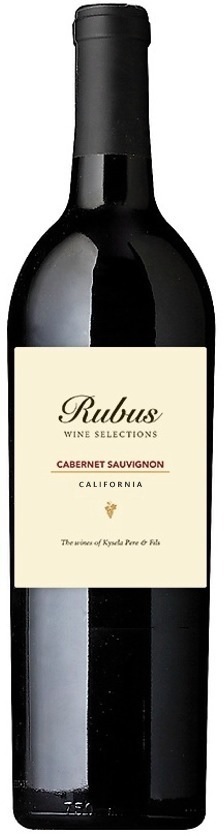
" We don't sell the wine without touching the vine "
| Country: | United States |
| Region: | California |
| Winery: | Rubus |
| Grape Type: | Cabernet Sauvignon |
| Vintage: | 2018 |
| Bottle Size: | 750 ml |

Rubus Cabernet Sauvignon Napa Valley is made from 100 percent Napa Valley Cabernet
Its long finish displays full mature flavors of blackberry, currant and chocolate with just a hint of toasty oak and black cherry. The tannins are refined and polished, allowing the fruit to be the focus.

This California Cabernet Sauvignon has rich flavors with a hint of black currant and cherry. The tannins are soft, leading to a smooth finish with a hint of oaked vanilla and a touch of eucalyptus/mint freshness.
100% California AVA Cabernet Sauvignon.
Average age of the vines: 15 years.
Picked at premium ripeness. Fermented in static tanks with pump-overs three times per day.
Aged five months French oak Barrels.
Alcohol: 13.5%
RS 0.5 g/l
TA 5.7 g/l
Serve this deep purple hued beauty with a variety of hearty dishes ranging from Osso Bucco to grilled red meats and cheeses.

Alejandro Bulgheroni Lithology Beckstoffer Las Piedras Cabernet Sauvignon is made from 100 percent Cabernet Sauvignon.
From a St. Helena vineyard planted by early Napa settler Edward Bale more than 150 years ago, and later serving as the estate vineyard for the area’s first winery built by Henry Pellet in 1860, the Las Piedras site always gives us our prettiest wine. When placed next to Dr. Crane and To-Kalon wines, the Las Piedras show a certain elegance, with a very graceful entry and finely detailed complexity. We produce it with at least 75% new French oak, so there is a floral, spicy, and vanilla accent to the intense red and black fruits, cassis, and black cherry liqueur. What distinguishes this bottling is the beautifully fine tannins, delicate texture, and stunning purity. (Less than 100 cases made.)
Fermentation 70% Oak, 24% Concrete, 6% Puncheon
Review:
-Jeb Dunnuck 98 Points

Avennia Red Willow Cabernet Sauvignon is made from 100% Cabernet Sauvignon.
The Red Willow Cabernet is a true blockbuster.
Coming from one specific block of 30 year old vines at this iconic vineyard, then strictly barrel selected, this is the essence of powerful, old vine Washington Cabernet. After all of our efforts promoting the idea of the Bordeaux blend, it would take a pretty compelling argument to suspend that idea and make a 100% varietal Cabernet. In 2016 Red Willow provided us with just that. Each time we tasted it in the barrel, the belief grew that this was something special. Something we can't make every year. In the end we were won over, and decided to make a limited amount of this wine. But don't be fooled, as this too is a blend and a selection. Each year as we are tasting the grapes as harvest approaches, we notice that the vines near the bottom of this long, steep west-facing slope, are a little different. The vines at the bottom are in a little richer soil, and get a little more water, so we pick them separately, sometimes even a week or ten days apart, and keep them separate in barrel.
This wine is all from the top of the vineyard, with its lower yield and poorer soils giving more concentration and interest. Then further, nearly every combination of new and used French oak barrels were trialed to find the best blend. It's not enough just to use the four best barrels, but to trial each combination to see how they complement each other. For a wine with this much mass, 100% new French oak was used for the first time at Avennia. It is a wine that needs a little cellaring to start, but should last a very long time.
Review:
-Jeb Dunnuck 96 Points

I feel this wine expresses the greatness of California and its hidden pockets where Cabernet can excel. The cold Pacific Ocean running the entire length of the state presents maritime influences – and with each small distance eastward the climate warms. Stony soils, south facing slopes and moderately warm conditions are the keys to producing dark, rich and good tasting Cabernet.
A small release from Caymus Vineyards, this wine is a California-appellation Cabernet Sauvignon – supple, dark and rich, bearing the signature hallmarks of Caymus. It is sourced from sites throughout the state which feature climatic conditions, soils and topography that are ideally suited to Cabernet. This project stems from excitement over California's diverse vineyard land, often in lesser-known areas, with the potential to produce exceptional Cabernet.

Hoopla Cabernet Sauvignon AVA California is made from 83% Cabernet Sauvignon, 8% Petite Sirah, 4% Merlot, 3% Petit Verdot, 2% Malbec .
Our California Cabernet is a nod to Dante. Dedicating this wine, from the king of grapes, to our original boss just made sense to us. Like any king worth his salt, Dante was sure of his alpha status in the pack. Spencer didn’t even have to pat the passenger seat before he’d jump up and claim ‘shotgun!’ Lindsay was a good sport about sitting in the back. Like Dante, this Cabernet was born and raised here with true California pedigree. It is a luscious, juicy, fruit-centric wine, with a whimsical and punchy mouthfeel, layered with flavors of baking spices and clove. A pleasure to drink easily, anytime, with food or without!
This generous Cabernet Sauvignon has a deep, inky purple color and is very ripe with blackberry and blueberry fruit. The palate is very concentrated with deep plum and pomegranate flavors which include some panaforte spices. Though the wine is very concentrated, it is balanced with acidity and its oak profile while ample is integrated. Overall the wine finishes ripe with black cherry, cassis and spices, very supple and silky and long on the finish.
This wine pairs very well with a gourmet burger, eggplant Moussaka or a wild boar Ragu with Fettuccine and foraged mushrooms with shaved Reggiano Parmesan.
This California Cabernet Sauvignon has rich flavors with a hint of black currant and cherry. The tannins are soft, leading to a smooth finish with a hint of oaked vanilla and a touch of eucalyptus/mint freshness.
100% California AVA Cabernet Sauvignon.
Average age of the vines: 15 years.
Picked at premium ripeness. Fermented in static tanks with pump-overs three times per day.
Aged five months French oak Barrels.
Alcohol: 13.5%
RS 0.5 g/l
TA 5.7 g/l
Serve this deep purple hued beauty with a variety of hearty dishes ranging from Osso Bucco to grilled red meats and cheeses.
The Rubus Concept
Rubus wines are a private label created and used by Kysela Pere et Fils, LTD in order to buy, bottle and market wine found at incredible quality/price ratio. All Rubus wines are selected by Fran Kysela MS.
It was first used for a superb batch of 1,200 cases of Amador county Zinfandel back in 1997. The wine sold in a few days and the Rubus brand was not used since then.
During a trip in California in 2009, when Fran Kysela tasted some incredible wines (available in bottle but without label), he decided to help resurrect the brand creating an outstanding Cabernet Sauvignon from Stag's Leaps district in Napa Valley (California) , followed by an excellent Chardonnay from Russian River Valley (California)
We then developed the Rubus Zinfandel from Lodi (California).
In 2011, we added a Shiraz/Viognier blend from the Barossa in Australia.
For 2012, the newest addition to the Rubus line is a Chardonnay from Colchagua Valley in Chile.
Rubus is now its own brand representing quality for the consumer and an incredible price along the way.
Rubus Meaning
The name RUBUS means "raspberry" in Latin and it is the name given to the genus of flowering plants in the rose family. For instance, here are some famous fruit from the Rubus family with their latin names:
Rubus fruticosus agg. – Blackberry
Rubus idaeus – European Red Raspberry
Rubus occidentalis – Black Raspberry
Rubus pensilvanicus – Pennsylvania Blackberry
Rubus strigosus – American Red Raspberry

SALE!
Hugl Zweigelt Secco Rose is made from 100% Zweigelt
Despite its relative youth, Zweigelt is actually an Austrian classic. This variety was created in 1922, when Dr. Fritz Zweigelt crossed two grapes - St Laurent and Blaufränkisch. Originally, it was intended for the new variety to be called Rotburger, referring to the place where it was born, Klosterneuburg. But this name never took hold, and instead, Zweigelt was named after the man who was the key in its development.
Today, Zweigelt is the most widely planted red variety in Austria, growing in nearly 9% of this country's vineyards. It is a robust grape, highly resistant to dryness, frost and various diseases.
Lively, fruity bouquet of strawberry, cherry and floral aromas. Refreshing and beautifully balanced, this is a great wine to enjoy as an aperitif. This is a Secco for the whole day and the whole night
The wine is made of 100% Zweigelt grapes of 15-35 years old (25 years old in avarage).
The soil is mainly loam and loess.
It is made using the Charmat method and the wine is aged for 3 months on the lees in stainless steel tanks.
The wine is slightly filtered before bottling.
Drink by itself as an aperitif, it is also a great picnic or brunch wine and will be a good pick to celebrate any occasion.

Siegel San Elias Cabernet Sauvignon is made from 100 percent Cabernet Sauvignon.
Fresh and delicate cassis tones, a great structure. Draw the cork half an hour before serving and serve at room temperature.
Smooth and fruity on the palate, the wine goes well with pasta, salads.

Tamarack Chardonnay is made from 100% Chardonnay.
Bright aromas of ruby red grapefruit, mango and stone fruit are found in the bouquet while on the palate, the bright acidity of this wine showcases flavors of guava, crisp Granny Smith apples and Asian pears. Combing the best of both cooperage techniques, the combination of aging in stainless steel highlights the fruit while the aging in neutral French oak provides an added complexity to the wine.
Aged 60% in neutral premier French oak and 3% in new premier French Oak 37% stainless steel.Dropped by gravity straight to the press, the juice is pumped directly to barrel or tank and chilled, inoculated with Chardonnay 3079 yeast, primary fermentation started and finished, secondary fermentation started but completed to preferred taste, typically around 50% completion. All fermentation is done in a 58 degree Fahrenheit barrel room.
Walla Walla Valley Appellation: Alderbanks Vineyard
Columbia Valley Appellation: Bacchus and Gamache Brothers Vineyards
Yakima Valley Appellation: Olsen Brothers and French Creek Vineyards

Rubus Brut Rose is made from 60% Tempranillo, 40% Bobal.
The Rubus Project was created by Fran Kysela as a way to source & sell incredible wines at value prices. All wines in this international project are hand-selected by Fran Kysela. Rubus wines are fruit driven, true-to-type values that over deliver - a true representation of quality for the consumer at an excellent price.
Stunning salmon-pink hues. The nose is intense and fine, dominated by notes of red berries. On the palate, the combination of fine bubbles and delicate aromas produces a delightfully light and silky rosé.
Machine harvest. The base wine is fermented at a low temperature. The second fermentation takes place at 14°C for 2 weeks, followed by dosing.

Zombie Zin Zinfandel is made from 95% Zinfandel and 5% Syrah
Be careful if you go out at night. The Zombie Zin is designed to be consumed in hiding with the only friends you have left... post apocalypse.
The Zombie Zin is sporting a new label design with a torn look, that suggests a window into another world. The colors are more vibrant earth-tones and the capsule is a deep red.
The Zombie Zinfandel is very dark in color, almost a black-purple. The aromas are of ripe, dense black fruits and a hint of dried herbs. The flavors are complex and rich, sporting succulent blackberries, powdered cinnamon, cola and cherry jam. Just a hint of black pepper in the long finish.
The grapes for the Zombie are sourced throughout California, mostly from the dry, hot sandy soils of the Delta region and the Central Valley. The final blend benefitted from some inky Syrah grapes that came from the Central Coast. The wine was fermented in Stainless Steel and aged for about a half a year in American oak.
Pairs well with bloody BBQ meats, sinister soups with eye of newt, bubbly caldron of fleshy stew.

Praia Aveleda Vinho Verde NV is made from 40% Loureiro, 20% Trajadura, 20% Arinto, 20% Azal.
Praia, which means "beach" in Portuguese, is a smooth and fresh wine with delicate and lovely fruity flavors. Slightly spritzy, it is well balanced and very refreshing.
The region is typical for its unique wines that are fresh and light, combined with a very well balanced acidity. These characteristics result from the region's unique soil and climate, with a strong Atlantic influence that you will identify when you taste it.
The wine is ideal as an aperitif or throughout a meal, especially with fish, seafood, white meat and salads. Due to it freshness, it is particularly pleasant in a relaxed and informal ambiance.

Fenocchio DOC Barbera d'Alba Superiore Bussia is made from 100 percent Barbera.
The color is a deep ruby red with garnet reflections. It has a rather intense bouquet, with scents typical of the vine and a full bodied and dry flavor, with a distinct and pleasing acidity. It becomes mature with aging, acquiring a full and balanced flavor.
Parcel is 2.5 hectares (6.2 acres) planted at 300 meters above sea level.
It pairs well with red and white meats, tagliatelle pasta and cheeses.

Grand Veneur Chateauneuf du Pape Blanc Le Miocene is made from 60% Clairette, 40% Roussanne
Pale yellow colour with hints of green, aromas of white flowers (may blossom, honeysuckle).
The palate is pleasantly balanced between liveliness and roundness, which brings out characteristics of dried apricot, honey and elderberry. A Châteauneuf du Pape white displaying a great finesse.
Best between 1 and 8 years.
Soil type Coming from the single vineyard named “La Fontaine”, the plot is facing north.It is made of clay-sand and limestone. Thanks to the northern orientation, it is always very well aired. This sector allow the Roussane and Clairette to mature in great conditions without losing freshness, which we believe is key point. Winemaking & ageing Whole-bunch pressing. Vinification in stainless-steel tanks. Fermentation temperature controlled at 15°C.
Review:
-Nicolas Greinacher (Vinous) 92 Points