
" We don't sell the wine without touching the vine "
| BUY MORE! SAVE MORE! | ||||||||||||||||||||
|
| Country: | Italy |
| Region: | Tuscany |
| Winery: | Ruffino |
| Grape Type: | Cabernet Franc |
| Organic: | Yes |
| Vintage: | 2017 |
| Bottle Size: | 750 ml |
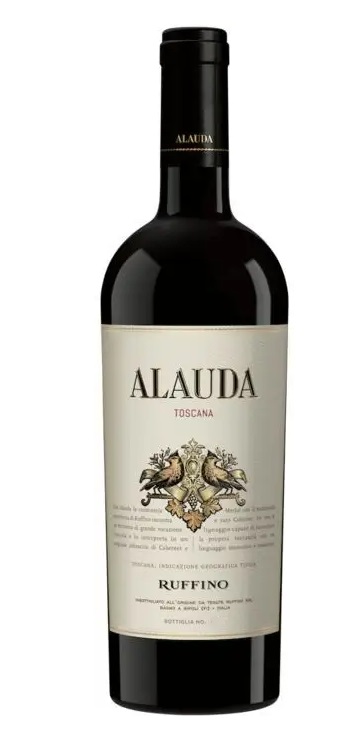
Ruffino Alauda Toscana IGT is made from 40% Cabernet Franc, 35% Merlot, 25% Colorino.
An elegant, full-bodied wine, Alauda is a harmonious sum of its parts. Rich with varietal flavors of plum and cherry from the Merlot and layered with ripe berry flavors from the Cabernet Franc, and unique balsamic and dark chocolate notes from the Colorino. The extended oak aging process integrates the blend while providing tertiary flavors of sweet spice and soft, elegant tannins for a lingering finish. This wine will age gracefully for decades.
In 1927, Ruffino returned some of the honor bestowed upon its wines by releasing its first vintage of Riserva Ducale—named after the Duke of Aosta as an acknowledgement of his esteemed patronage. The reputation of Ruffino wines continued to spread, and Ruffino soon began to export its wines to the United States and other countries. In fact, the first Chianti imported to the U.S. was Ruffino.
Ruffino’s status was firmly establised both nationally and internationally when its Chanti won a Gold Medal at the 1881 Milan Wine Exhibition, a prise at the 1884 Nice Exhibition, and another Gold Medal at the 1885 Antwerp Exhibition. Intrigued by the winery‘s reputation, in 1890, the Duke of Aosta braved a long journey to taste the Ruffino wines he had heard so much about. He was so impressed by the wines that he appointed Ruffino as the official supplier to the Italian royal family.
After the Second World War, Ruffino purchased the first of its Tuscan estates, the Villa di Montemasso in the Chianti Classico region. Ruffino continued to invest in new vineyards and became one of the first major wineries with vineyard estates in Italy‘s three most renowned wine-producing regions - Chianti Classico, Brunello di Montalcino and Vino Nobile di Montepulciano.
Ruffino has established itself as a leader in Chianti, renowned for consistency and quality, and Ruffino Chianti has become a global ambassador of Tuscan wines around the world. Not surprisingly, when Chianti first became recognized as a DOCG wine in 1984, Ruffino Chianti DOCG was awarded the first warranty strip.

Ruffino Alauda Toscana IGT is made from 40% Cabernet Franc, 35% Merlot, 25% Colorino.
An elegant, full-bodied wine, Alauda is a harmonious sum of its parts. Rich with varietal flavors of plum and cherry from the Merlot and layered with ripe berry flavors from the Cabernet Franc, and unique balsamic and dark chocolate notes from the Colorino. The extended oak aging process integrates the blend while providing tertiary flavors of sweet spice and soft, elegant tannins for a lingering finish. This wine will age gracefully for decades.
Review:
“Lush and polished, boasting plum, blackberry, chocolate and oak spice flavors. Solidly built, with excellent harmony, a smooth texture and long, toasty finish.”
Wine Spectator 92 points

Ruffino Modus Primo Toscana IGT Italian Red Wine is the evolution of Modus, showcasing quality fruit from three Tuscan vineyards on Ruffino's Poggio Casciano Estate, each one representing the best that this centuries-old wine region terroir has to offer. This Ruffino wine opens with a bouquet of ripe cherries and orange zest, followed by layered balsamic notes and spicy hints of sweet tobacco and vanilla.
Review:
Ripe and lively in its sensory profile, it shows notes of black plums, blackberries, sage and laurel. Juniper berries describe the secondary scene. Full body, elegant and relaxed on the palate, it closes modern and captivating. Better from 2023.
-WineCritic.com 94 Points
A very savory nose of tar, leather and cigar smoke draws levity from undertones of vanilla, baking spices and dark berries. On the palate, the fruit brightens, but things stay savory overall, through a dark, bitter chocolate finish. Acid bubbles around big, chewy tannins.
-Wine Enthusiast 94 Points
Aromas of crushed stones, dark berries and blueberries follow through to a medium to full body with creamy tannins and a medium-chewy finish. Chocolate at the end. Sangiovese, cabernet sauvignon and merlot. Two or three years of bottle age will bring this around nicely. Drink after 2024.
James Suckling 94 Points
A very savory nose of tar, leather and cigar smoke draws levity from undertones of vanilla, baking spices and dark berries. On the palate, the fruit brightens, but things stay savory overall, through a dark, bitter chocolate finish. Acid bubbles around big, chewy tannins.

Tenuta di Arceno Valadorna is made from 60% Merlot, 32% Cabernet Franc, 4% Cabernet Sauvignon, 4% Petit Verdot .
The first impression of the nose is earthy with notes of cypress, vanilla bean, and spice. There are deep fruit flavors of black cherries, plums and blueberries followed by pleasant hints of chocolate and dried rose petals. On the palate, the tannins are chewy and accompanied by lively acidity; contributing to a long finish dominated by flavors of dried figs and licorice. The 2016 Valadorna is a time bomb of joy that will stand the test of time and age well in the cellar if patience permits.
This Merlot-led blend is sourced primarily from the Valadorna and Capraia blocks, which produce the estate’s most complex and mineral-based expressions of this variety. The blocks are located within the cooler part of the estate, naturally irrigated by the stream that undulates through it, and feature sandy brown soils and lower yields than typical. These blocks are often the last Merlot blocks to ripen on the estate.
Review:
Solid and radiant in the glass it shows notes of pink grapefruit, flowering geraniums, pressed blueberries, plums and rosemary. There is more in the background in the brightness of the lemon, lime and bergamot notes. Full body, well-polymerized tannins that are decidedly vibrant and tense at the moment and an impressive long finish that will relax over time. Better from 2024.
-Raffaele Vecchione - WinesCritic.com 96 Points

Capezzana Ghiaie Della Furbia Toscana IGT is made from Cabernet Sauvignon 40%, Syrah 35%, Merlot 25%.
In 1979 Ugo Conti Bonacossi created Ghiaie della Furba from vineyards planted among the pebble (Ghiaie) rich soils of the Furba stream. Originally planted with clippings from the famed Chateau Lafite estate in Bordeaux, the wine was made from Cabernet Sauvignon, Cabernet Franc and Merlot until the blend was changed in 1998 with the addition of Syrah. The inclusion of Cabernet Franc was slowly discontinued and today the blend includes Cabernet Sauvignon, Merlot and Syrah and is made only in the best vintages
Review:
This wine starts with pine needles and crunchy red fruit on the nose, with wet slate, cedar and tobacco leaf slowly emerging. The palate turns richer, with cherries, blackberries, dark chocolate, a little tar, coffee and sambuca. Tannins are very firm and the acid vibrant through a long finish.
-Wine Enthusiast 93 Points

Castellare di Castellina 'I Sodi di San Niccolo' Toscana IGT is a blend of Sangioveto (85%-90%) and Malvasia nera (15-10%)
Castellare’s top wine, ranked in the Wine Spectator Top 100 on multiple occasions and recognised with the prestigious Gambero Rosso’s Tre Bicchieri and Bidenda’s Cinque Grappoli ratings. The company takes great pride in demonstrating the greatness of the Sangioveto variety, paired with Malvasia Nera, achieving a worldwide position of sixth place.
Pairs well with cold cuts and meat rich in flavour, cheeses with a strong and aromatic taste, in particular, Pecorino Toscano and Parmigiano.
The masterpiece of Castellare, I Sodi di San Niccolo, has twice placed in the top 100 of Wine Spectator, and has been awarded “Three Glasses” by Il Gambero Rosso.
I Sodi di San Niccolo is produced solely with native varieties: 85-90% of Sangioveto and 10-15% of Malvasia Nera, I Sodi comes from the two best crus of the farm.
The word "I Sodi" was used by the Tuscan farmers to describe those grounds which had to be processed by hand, being too hard (in fact firm) or too steep to allow for the employment of the horses, unlike the "fields" that make the grounds more easily cultivable.
Reviews:
Clear ruby with a fine garnet sheen. Impressive nose, very finely drawn, aromas of juicy cherries, blood orange and dried thyme, some liquorice in the background. Polished and precise from the attack to the finish, finely-meshed, very well-integrated tannins, flows beautifully, finely worked out fruit, long finish.
-Falstaff 97 Points
Complex and deeply embedded aromas of ripe blackberries, spices and aromatic bark. Full-bodied and very firm for now, with impressive concentration of fruit and tannin. Very long, balanced finish. Great to taste now, but this is one for the cellar. Patience will be rewarded. Sangiovese and malvasia nera. This has always been a top Tuscan red. Best from 2027.
- James Suckling 96 Points
Super fragranced nose, patchouli, pot pourri, Turkish Delight, rose with caramelised red berries and a touch of smoke and incense - all quiet forward and expressive. The nose alone you could smell for hours such is its complexity and beguiling nature. Powerful and concentrated on the palate, this is broad and muscular, sinewy with depth and determination. Tannins are well integrated, really giving the support to the fruit and acidity, driving the flavours forward despite the clear weight and hold. Fragranced red berries continue on the palate with a touch of stone, graphite and matchstick. Rich and big on the mid palate, becoming more focussed towards the finish. Cleary well made with lots going on. Acidity is great, it's cool, clean, sleek and packed full of flavour. Almost too much, this is a big wine, so needs time, but has lots of appeal and mouthwatering freshness throughout. Released on the 9th March. Director and winemaker Alessandro Cellai.
- Decanter 96 Points

Castellare di Castellina 'I Sodi di San Niccolo' Toscana IGT is a blend of Sangioveto (85%-90%) and Malvasia nera (15-10%)
Intense ruby red in color and with a great olfactory concentration, thanks to the presence of a ripe red fruit that leads to notes of jam, but also spices, vanilla and licorice. In the mouth the wine is characterized by a dense and elegant texture, also supported by the important acidity of the Sangiovese, the tannins are absolutely sweet and the finish is long and of great persistence.
Excellent with cured meats and savory meats, with succulent dishes and mature cheeses. Much appreciated when paired with Tuscan Pecorino and Parmigiano.
The masterpiece of Castellare, I Sodi di San Niccolo, has twice placed in the top 100 of Wine Spectator, and has been awarded “Three Glasses” by Il Gambero Rosso.
I Sodi di San Niccolo is produced solely with native varieties: 85-90% of Sangioveto and 10-15% of Malvasia Nera, I Sodi comes from the two best crus of the farm.
The word "I Sodi" was used by the Tuscan farmers to describe those grounds which had to be processed by hand, being too hard (in fact firm) or too steep to allow for the employment of the horses, unlike the "fields" that make the grounds more easily cultivable.
Reviews:
Packed with ripe, juicy cherry, blackberry, pomegranate and floral aromas and flavors, this red is supple and beautifully integrated. Earth, iron and tobacco accents add detail as this winds down on the lazy, resonant aftertaste, showing terrific energy. Sangioveto and Malvasia Nera. Best from 2026 through 2043.
-Wine Spectator 97 Points
#35 Wine Spectator Top 100 of 2024
Vinous 97+ Points

Redigaffi has an intense color that arouses enthusiasm and satisfy the sight, it highlights great complexity characterized by the fruity attack in the mouth leaving then “room” to tobacco and liquorice notes. Good concentration given by the pre-harvesting activity, three passages and perfect maturation reached by our grapes.
Outstanding complexity. Floral notes typical of our “Macchia Mediterranea” are intense and persistent. The elegance of tannins is enhanced by the great structure and balance. Considerable extraction and good acidity.
Review:
Wow. The aromas are really something else with red fruits, black olives, spices like cardamon and nutmeg, as well as hints of tar and meat. It’s full-bodied yet in check and focus with fine, fine tannins that roll over the palate and create beautiful motion. Chewy yet silky and endless. A great young merlot and one of the best for a number of years.
- James Suckling 99 Points

Weller-Lehnert Piesporter Michelsberg Riesling is made from 100 percent Riesling.



