
" We don't sell the wine without touching the vine "
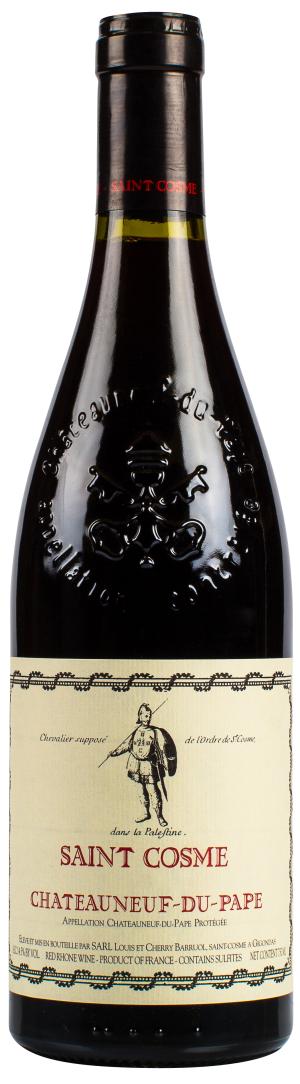
| Country: | France |
| Regions: | Rhone Chateauneuf du Pape |
| Winery: | Saint Cosme |
| Grape Type: | Grenache |
| Organic: | Yes |
| Vintage: | 2022 |
| Bottle Size: | 750 ml |

At Saint Cosme, their white wine traditions are as important and time-honored as the reds. The Clairette grape variety has found the ideal place to express itself in the cool, limestone valley of Saint Cosme. Produced by massal selection from the Le Poste vinevard, the Clairette for Hominis Fides thrives in Miocene limestone sand. Its aromas of fennel and grapefruit usher in its finely textured palate, imparting it with substantial agability.

Chateau de Saint Cosme Gigondas is made from 70% Grenache, 15% Mourvèdre, 14% Syrah, 1% Cinsaut.
The wine shows intense blackberry and fig fruit with licorice, violets, and charcoal on the finish. It is remarkably fresh and finessed given the sun and warmth of the southern Rhône. The unique micro-climate combined with 60-year-old vines and traditional winemaking make Château de Saint Cosme Gigondas the benchmark wine of the appellation.
Review:
Leading off the Gigondas, the base 2020 Gigondas has lots of black raspberry, ground pepper, and violets notes as well as a round, supple, silky style on the palate. It should be approachable on release, yet it has plenty of mid-palate depth as well as tannins, and I have no doubt it will evolve for 20 years if properly stored.
-Jeb Dunnuck 91-93 Points

Hominis Fides is typically the most elegant of Château de Saint Cosme’s three single-vineyard Gigondas. “Grenache grown in the sandy soil produces marvelously textured wines as well as extremely refined tannins; a very special and stylish wine,” says Louis Barruol. The wine features aromas and flavors of pepper, truffle, graphite, and smoke.
Grenache is the pale-colored, red-fruited, and potpourri-scented red grape variety of the southern Rhône and can be paired with both rustic and sophisticated dishes. Full-bodied Grenache-based wines are ideal with stews, braises, and grilled meats, while lighter versions can work well with dark fish and tomato-based dishes such as ratatouille.
Review:
Deep, vivid ruby-red. Intensely perfumed, mineral-tinged scents of medicinal cherry, redcurrant and cassis are complemented by suggestions of star anise, white pepper and pungent flowers. It offers densely packed bitter cherry, red berry liqueur, lavender and licorice flavors that open up very slowly with air. Extremely primary but highly promising, with a long, spice- and mineral-tinged finish shaped by youthfully firming tannins. Made with 100% whole clusters; raised in barriques, one-third of them new.
-Vinous 95-97 Points

Chateau de Saint Cosme Gigondas Le Claux is made from 95% Grenache, 5% Syrah.
Château de Saint Cosme is the leading estate of Gigondas and produces the benchmark wines of the appellation. The property has been in the hands of the Barruol family since 1490. Louis Barruol took over from his father in 1992 making a dramatic shift to quality and converting to biodynamics in 2010.
Château de Saint Cosme Gigondas Le Claux is the estate’s oldest vineyard and sits near the entrance to the winery. “It was first planted in 1870 following phylloxera. My uncles thought it wasn’t producing enough fruit and planned to uproot it in 1914,” says Louis Barruol, but “World War I interrupted that plan.”
The 1.8-hectare Le Claux—meaning “Clos” in old French—is a field blend of predominately Grenache. Louis Barruol believes 10% of the vineyard is from the original 1870 planting. Vines are replaced by massal selection and the average vine age is 60-years. The wine is made with whole cluster fermentation from indigenous yeasts, is aged in 20% new 228-liter barrels, and bottled without fining or filtration.
Tasting Notes
Brilliant violet color. Displays pungent, mineral- and spice-accented cherry, black raspberry, potpourri and licorice aromas, along with hints of savory herbs, vanillo and incense. Chewy and tightly focused on the palate, offering bitter cherry, dark berry and Moroccan spice flavors that unfurl slowly through the back half. It closes with firm tension, chewy tannins and excellent tenacity, leaving resonating cherry and floral notes behind. All barriques, a third of them new.
-Vinous 95-97 Points

Le Poste’s cool microclimate and limestone soil make it one of Saint Cosme’s most structured, aromatic, and mineral intense wines of the estate. This wine always walks a knife's edge of power and finesse thanks to its deep fruit and precise structure. The wine features aromas and flavors of iodine, violet, pepper, and ash.
Grenache is the pale-colored, red-fruited, and potpourri-scented red grape variety of the southern Rhône and can be paired with both rustic and sophisticated dishes. Full-bodied Grenache-based wines are ideal with stews, braises, and grilled meats, while lighter versions can work well with dark fish and tomato-based dishes such as ratatouille.
Review:
Deep magenta. Expansive, spice- and mineral-tinged black raspberry, kirsch and boysenberry aromas are complicated by suggestions of incense, lavender and smoky minerals. Alluringly sweet and focused in the mouth, offering densely packed red and blue fruit preserve, floral pastille and exotic spice flavors that smoothly balance weight and finesse. This wine shows superb finishing clarity and mineral lift on the penetrating and impressively long finish, which features polished tannins and resonating fruit, floral and mineral notes.
-Vinous 95-97 Points

On the palate, it reveals a fresh attack followed by an ample, structured, long-lasting finish. The wine unfurls in successive stages and ends with top-quality tannins produced by whole cluster fermentation. It features aromas and flavors of smoked ham, violet, graphite, graphite, and licorice.
Review:
A refined, fine-textured and precise Cote-Rotie with aromas of cherries, wild berries, wild herbs, bark and baking spices. Medium-bodied with finely grained tannins. There is a vibrant and spicy character at the center, with a succulent, precise and lively expression toward the long finish. Try after 2026.
-James Suckling 95 Points
Saint Cosme Chateauneuf-Du-Pape Rouge is made from 50% Grenache, 30% Mourvèdre, 15% Syrah, 5% Cinsault.
Saint Cosme Châteauneuf-du-Pape comes from three climats, the most famous of which is the plateau of La Crau with its distinctive galets over clay, bringing power and structure to the blend. The climats of Valori and Christia are on sandy soils, giving the wine its perfume and freshness. The wine is a blend of Grenache Mourvèdre, Syrah, and Cinsaut, made with whole cluster fermentation from indigenous yeasts, is aged for 24 months in old 228-liter barrels, and bottled without fining or filtration.
Château de Saint Cosme is the leading estate of Gigondas and produces the appellation’s benchmark wines. Wine has been produced on the site of Saint Cosme since Roman times, evident by the ancient Gallo-Roman vats carved into the limestone below the château. The property has been in the hands of Louis Barruol’s family since 1490. Henri and Claude Barruol took over in 1957 and gradually moved Saint Cosme away from the bulk wine business. Henri was one of the first in the region to work organically beginning in the 1970s. Louis Barruol took over from his father in 1992, making a dramatic shift to quality, adding a négociant arm to the business in 1997, and converting to biodynamics in 2010.
The estate is in the heart of Gigondas where 15 hectares of vineyard grow in the shade of the Dentelles de Montmirail. The limestone that distinguishes Gigondas from other southern Rhône appellations is visible on the jagged cliffs of the Dentelles. In addition to Gigondas and the old-vine selection Gigondas Valbelle, three single-vineyard Gigondas are produced: Hominis Fides, Le Claux, and Le Poste. Louis Barruol owns an additional 10 hectares of vineyard in Violès outside of Gigondas to produce Les Deux Albions Blanc IGP. Côtes-du-Rhône Les Deux Albions Rouge and Le Poste Côtes-du-Rhône Blanc round out the estate offerings and are labeled as “Château de Saint Cosme.” Little James’ Basket Press, Châteauneuf-du-Pape, and northern Rhône appellations are from contracted growers and are labeled “Saint Cosme.”
Louis Barruol’s style combines the region’s typical ripeness with freshness, an elusive quality in the warm climate of the southern Rhône. One of the keys to freshness is the use of stems for their red wines. The stems absorb alcohol during fermentation and help retain acidity and tannin. Red wines are made by spontaneous fermentation. Louis prefers cement tanks or mostly used 228-liter Burgundian pièce for élevage with just a few traditional demi-muid for his whites. The négociant wines are transported to Gigondas in casks to avoid racking and unnecessary exposure to oxygen. Reds are bottled unfined and unfiltered. “I want to make wines which express their terroir with purity and personality. I want balanced wines with a great ability to age,” says Louis Barruol.


The 2022 Jayson Chardonnay achieves a beautiful equilibrium of richness, buoyancy, and intricacy. Aromas of sweet Meyer lemon, crushedalmond, and grilled pineapple lead to a concentrated palate of bright lemon curd and orange blossom honey underscored by fresh pear andtoasted nuttiness with a hint of baking spice. The texture is classic Pahlmeyer, plush and detailed, while the presence of bright Carneros fruitbrings energy and litheness. Flavors are lifted and extended on a spine of bright acidity, the lingering finish striking an ideal balance betweenopulence and mouthwatering freshness.
Review:
This generous, buttery and spicy wine is sourced from several parts of Napa Valley and brings gorgeous richness to the nose, palate and finish. Elements of brown butter, marzipan, toasted almonds and poached pears flood the flavors, with vanilla bean and a touch of sweet coconut. Barrel fermented in 36% new French oak, it’s full-bodied and nicely viscous in texture.
James Suckling 93 Points



