
" We don't sell the wine without touching the vine "
| Country: | France |
| Winery: | Charles Thomas |
| Grape Type: | Grenache |
| Vintage: | 2019 |
| Bottle Size: | 750 ml |

Importer Sale
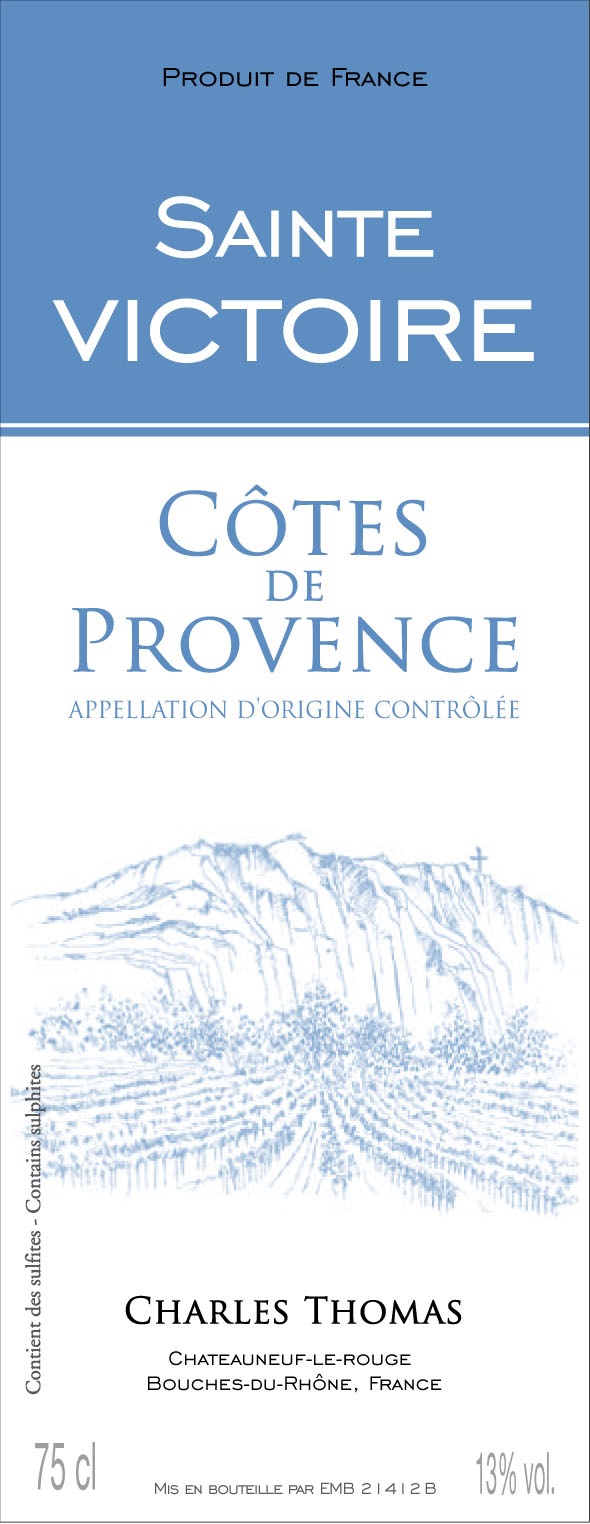
Sainte Victoire Cotes de Provence Rose is made with 50% Grenache, 30% Syrah, 20% Cinsault
Bright, crisp, fruity rosé from Provence.
Sainte Victoire became its own AOC within the AOC Cotes de Provence in 2005. It is more demanding in term of yields, vinification and quality than the general AOC Cotes de Provence. Green harvest and in the cellar, using a sorting table in order to keep only the best grapes for the macerations.
A natural match to enjoy with salad, chicken, grilled salmon, just simply with an hamburger or on his own, colder, during a warmer summer day.

Domaine La Maionnette Rose Cotes de Provence is made from 60% Syrah, 20% Cinsault and 20% Grenache.
The plots of Domaine de la Maïonnette benefit from a clay-limestone soil and are located on a plateau surrounded by hundred-year-old oaks. Bordered by the Provencal scrubland, the vineyard enjoys a dry climate typical of the region.
An emblematic cuvée of the estate, this Cotes de Provence rosé reveals concentrated aromas of citrus fruits and white flowers, and a beautiful structure. The fresh palate brings out sweet candy notes, gooseberry and litchi, and delivers bright acidity and ample length on the finish.

This wine reveals a complex and elegant bouquet that combines ripe fruit, leather and a fine woodiness. Round and warm on the attack, the palate is supported by solid tannins and a pleasant freshness in this harmonious and well textured wine.
The Merlot bring fruity notes and minerality from the clay-limestone terroir, enhanced by the incredibly expressive and spicy Cabernet Franc.
Review:
"A terrific effort from this large and immaculately maintained property on the clay-limestone slopes of the Côtes de Castillon, the 2019 d'Aiguilhe exhibits aromas of cherries and cassis mingled with notions of burning embers, licorice and warm spices. Medium to full-bodied, layered and concentrated, with lively acids, powdery tannins and a mineral finish, it's intelligently matured in tank and large-format oak as well as small barriques. - William Kelley"
- Robert Parker's Wine Advocate (April 2022), 92 pts
"The 2019 d'Aiguilhe has a really lovely bouquet of ample black cherry, mulberry and light floral scents, very pure and delineated. The palate is medium-bodied with cedar-infused red fruit. While not as exuberant as the aromatics, this is nicely detailed and quite poised on the finish. No, I still cannot pronounce its name, but this Castillon Côtes de Bordeaux is well worth seeking out. - Neal Martin"
- Antonio Galloni's Vinous (February 2022), 92 pts

G.D. Vajra Bricco Delle Viole Barolo is made from 100 percent Nebbiolo.
The Barolo Bricco delle Viole shows the signature verticality of its vineyard. The wine is beautifully layered and - while restrained as it’s always the case in the youth of Bricco delle Viole - it also shows a complexity of layers with purple flowers, sweet spices and mineral tones. The palate is noble, with a refined acid spine and profound tannins that promise a long aging potential.
Among the historical vineyards of Barolo, Bricco delle Viole is the highest and the closest to the Alps. It rises from 400 to 480 meters above sea level, on the Western ridge of the village. Its name, “Hill of Violets”, originates from the flowers that blossom early here due to the perfect south exposure. Up above the fogs, Bricco delle Viole enjoys the earliest sunrise and the last sunset every day. Thanks to its vines dating back to 1949 and -now- 1931, a dramatic diuturnal temperature range and this pure light, Bricco delle Viole generates a sophisticated and profound Barolo DOCG of bright aromatics, chiseled tannins and subtle minerality. 2018 is a vintage that shows many nuances of Bricco delle Viole: beyond the signature verticality of this site, the wine offers high tones laced with mineral nuances and plenty of energy and youth.
Review:
A juicy Barolo, with vibrant acidity and a fluid profile that exudes cherry, raspberry, mown hay, mineral and eucalyptus aromas and flavors. Tight yet long, with excellent potential.
#26 Wine Spectator Top 100 of 2023
The last wine poured at my tasting at the winery is the G.D. Vajra 2019 Barolo Bricco delle Viole. With its high vantage point in the hills west of Barolo, Bricco delle Viole is a world apart in terms of soils (with Sant'Agata marl and fossils) and even harvest times. Slow and careful ripening like the kind that characterizes fruit in 2019 renders a very delicate and ethereal expression with floral tones, wild mint and licorice. This organic wine is solid in build and structure. Indeed, Isidoro Vaira remarks that Nebbiolo tannins have changed since the 1970s and 1980s.
-Wine Advocate 97+ Points
Jeweled in appearance, the 2019 Barolo Bricco Delle Viole may be the best wine I have tried yet from Vajra. Its gorgeous and alluring perfume of fresh roses is followed by a Burgundian, elegant red with incredible length and no harsh edges, fine and present tannins, and beautiful, graceful concentration. It is drinking well now, and I will be trying to get my hands on as much of this as possible. Drink 2025-2045.
-Jeb Dunnuck 97 Points

Delas Freres Cote Rotie La Landonne Rouge is made from 100 percent Syrah.
This very ancient region dates back to the Roman Era and is located on the right bank of the Rhône. It is said that during the Middle Ages, “The Seigneur de Maugiron” gave a hillside to each of his two daughters - one was brunette and the other fair - thus, were born the names of “Côte Brune” and “Côte Blonde.” Wines from the Côte Blonde tend to be more delicate and lighter in character than the fuller wines of the Côte Brune. Together, they make a wine of style and substance. This cuvée is a vineyard plot selection. The grapes come exclusively from a plot within the named slope of “La Landonne.”
This cuvée‘s first vintage was 1997. The wine is only made in the very best years. Its highly limited production never exceeds 2,500 bottles per year.
The steep, terraced hillsides along the river produce wines that are among the "biggest" reds of France. The Delas Côte-Rôtie is primarily Syrah with an addition of up to 10 to 20% of Viognier grapes in the crop. The soils of the northern part of the Côte Brune vineyard consists of extremely steep, terraced slopes of ferruginous mica schists which are covered with schist sand (arzel). The Côte Blonde has a varied geology with gneiss and granite predominating at the most southern side of the appellation. The area has dry, hot summers with regular rainfalls during other seasons. The grapes for the “La Landonne” cuvée are picked by hand at maximum maturity. Fermentation takes place in traditional open-topped concrete tanks, following three days of pre-fermentation cold maceration. Before fermentation, the maceration process continues under controlled temperatures of 82°F to 86°F. Daily cap pushing down and pumping over are carried out for about 10 days with total vatting time of up to 20 days. The wine is aged for 14 to 16 months in new or one year old oak casks. The barrels are topped up regularly.
Food Pairing: This wine pairs wonderfully with fine meats, roasted beef, water games, truffles and spicy stews. The bottle should be opened 1 to 3 hours before drinking. This wine needs at least 3 years cellaring before it can open up its complexity. In such case it is strongly recommended to decant before serving.
Tasting Notes: The wine‘s deep color is underscored by plummy hues. A complex nose shows deep, fruity aromas with hints of licorice and roasted coffee. Endowed with a dense and silky tannic structure, this is a full, fleshy wine that provides an ample and generous palate. Its lasting finish speaks of considerable ageing potential.
Reviews:
This is dark and still a bit reticent, with a cast iron cloak around the core of dark currant, plum and blackberry paste flavors, showing lots of sweet bay leaf, anise and singed apple wood notes in the background. There's serious grip through the finish. For the cellar.
-Wine Spectator 96 Points
Very open, spicy and fresh on the nose, you could almost open this now. Struck flint notes assist in teasing out notes of leaf tea, tobacco, rosemary and rose. Very full-bodied, generous but powerful on the palate, tense and mineral. Mouthcoating ripe, sweet tannin and robust amounts of sweet baking spices, along with more tobacco and black fruit on the palate. Has depth, length, power and impressive balance despite the high alcohol. Drink from now into 2022, or from 2031 to 2040. Lieu-dit La Landonne, from the Brune side (mica schist bedrock). Matured in new and one-year-old barrels for 14 months.
-Decanter 96 Points
The 2019 Côte Rôtie La Landonne comes from one of the greatest sites for Syrah in the world, the La Landonne lieu-dit located close to the center of the appellation, on the Côte Brune side. It reveals a deeper purple hue (it's slightly more opaque than the Seigneur de Maugiron) and offers a brilliant nose of ripe cassis, black raspberries, scorched earth, smoked herbs, and seared meat. Full-bodied and powerful on the palate, this is a deep, spicy, concentrated Côte Rôtie with a plush, layered mouthfeel, sweet tannins, beautiful balance, and a great, great finish. This puppy brings the fruit, opulence, and texture of the vintage yet still has a classic Côte Rôtie character.
-Jeb Dunnuck 96 Points
Fresh aromatic layers of mint sit atop crushed red cherries and wild strawberries, with light clove and thyme on the nose. The palate is rich and enticing with black cherries, plums, rhubarb, pomegranate seeds, black olives and freshly picked rosemary leaves. Tremendous texture, structure, and refreshing acidity carry this wine to a robust finish of orange zest and black tea leaves. Maisons Marques & Domaines USA.
- Wine Enthusiast 96 Points
This very ancient region dates back to the Roman Era and is located on the right bank of the Rhône. It is said that during the Middle Ages, “The Seigneur de Maugiron” gave a hillside to each of his two daughters - one was brunette and the other fair - thus, were born the names of “Côte Brune” and “Côte Blonde.” Wines from the Côte Blonde tend to be more delicate and lighter in character than the fuller wines of the Côte Brune. Together, they make a wine of style and substance. This cuvée is a vineyard plot selection. The grapes come exclusively from a plot within the named slope of “La Landonne.”
This cuvée‘s first vintage was 1997. The wine is only made in the very best years. Its highly limited production never exceeds 2,500 bottles per year.
The steep, terraced hillsides along the river produce wines that are among the "biggest" reds of France. The Delas Côte-Rôtie is primarily Syrah with an addition of up to 10 to 20% of Viognier grapes in the crop. The soils of the northern part of the Côte Brune vineyard consists of extremely steep, terraced slopes of ferruginous mica schists which are covered with schist sand (arzel). The Côte Blonde has a varied geology with gneiss and granite predominating at the most southern side of the appellation. The area has dry, hot summers with regular rainfalls during other seasons. The grapes for the “La Landonne” cuvée are picked by hand at maximum maturity. Fermentation takes place in traditional open-topped concrete tanks, following three days of pre-fermentation cold maceration. Before fermentation, the maceration process continues under controlled temperatures of 82°F to 86°F. Daily cap pushing down and pumping over are carried out for about 10 days with total vatting time of up to 20 days. The wine is aged for 14 to 16 months in new or one year old oak casks. The barrels are topped up regularly.
Tasting Notes
The wine‘s deep color is underscored by plummy hues. A complex nose shows deep, fruity aromas with hints of licorice and roasted coffee. Endowed with a dense and silky tannic structure, this is a full, fleshy wine that provides an ample and generous palate. Its lasting finish speaks of considerable ageing potential.
Food Pairing
This wine pairs wonderfully with fine meats, roasted beef, water games, truffles and spicy stews. The bottle should be opened 1 to 3 hours before drinking. This wine needs at least 3 years cellaring before it can open up its complexity. In such case it is strongly recommended to decant before serving.

Bellevue Cotes de Castillon Cuvee Vieilles Vignes is made from 65% Merlot, 35% Cabernet Franc. Aged in mostly new oak barrels (90% French oak and 10% American oak), and some Château Haut Brion 2nd Barrels.
The wine offers a rich and intense bouquet of blackcurrant, blackberry and strawberry. It is smooth and full in the mouth with a velvety texture. Acidity combined with firm but well-integrated tannins are a fine supporting cast to the black fruit flavors at the end.
Importer Sale
Sainte Victoire Cotes de Provence Rose is made with 50% Grenache, 30% Syrah, 20% Cinsault
Bright, crisp, fruity rosé from Provence.
Sainte Victoire became its own AOC within the AOC Cotes de Provence in 2005. It is more demanding in term of yields, vinification and quality than the general AOC Cotes de Provence. Green harvest and in the cellar, using a sorting table in order to keep only the best grapes for the macerations.
A natural match to enjoy with salad, chicken, grilled salmon, just simply with an hamburger or on his own, colder, during a warmer summer day.
The Charles Thomas Estate
This Estate is located in the GARD department near Pont Saint Esprit (10 miles North-West of Orange).
The Charles Thomas Vineyard
56 Ha grown organically since March 2009 (in conversion).
Part of the vineyard is plowed with horses.
4 varietals are produced: 29 Hectares (72 acres) of Syrah, 22 Hectares (54.5 acres) of Grenache, 3 Hectares (7.5 acres) of Mourvedre and 2 Hectares (5 acres) of Carignan.
Mechanical harvest.
Yields: 48 hectoliters per Hectares.
Average age of the vines : 30 years old.
The vineyard is situated in an archeological site that has revealed many artifacts dating back from the 4th Century.

Bright dark color, balanced acidity and sweetness. Taste of cinnamon, vanilla, liquorice and clay. Pleasant finish with bitter herbs.
In 1904 Cherubino Valsangiacomo produced the first vermouth bottle, afther 100 years, the fifth generation of the Valsangiacomo familly STILL making it with the ancestral formula devised by Benedetto Valsangiacomo.
Red Vermouth, flavored fortified white wine base, together with aromatic mediterranean herbs such as fennel, chamomille and tyme, sweeted with sugar, and grape must caramel.
Ideal as an aperitif, on the rocks with an orange slice. Also very good with cured and pickled products.

Boussey Volnay Premier Cru Les Taillepieds is made from 100 percent Pinot Noir.
The grapes for this Volnay Premier Cru Les Taillepieds are coming from the vineyard located in the middle of the coteau, halfway up the hill, with a very nice South sun exposure, allowing to reach an optimal ripeness every year.
The wine displays a nice ruby and garnet color. It boasts aromas of red and black fruit, fig, and violet.
It always has a lot of finesse and elegance, but also a great length to the finish, with juicy and round tannins.
Pair with frog legs with parsley and garlic, omelette, duck and cheese.
Slightly filtered before bottling.The wine is then aged in French Oak barrels for 12 months. (25% new barrels).
The Volnay Premier Cru Les Taillepieds is vinified in temperature controlled stainless steel tanks.
Surface area : 0.2 hectare (0.49 acres)

Thorn Clarke William Randell Cabernet is made from 100 percent Cabernet
The William Randell range of wines were created in honor of the family ancestor - the esteemed pioneer William Richard Randell (1824 - 1911). The wines are sourced solely from grapes grown on the family estate vineyards. Wines in this range are only made in exceptional vintages.
The deep red color with purple hues of this wine draw you in. The nose is brimming with notes of fresh blackcurrant intertwined with complexing savory spice. The palate has an integrated French oak influence with notes of toasty cedar accompanied by further notes of briary fruits. A wine with great depth and drive.



