" We don't sell the wine without touching the vine "
| BUY MORE! SAVE MORE! | ||||||||||||||||
|
| Country: | France |
| Region: | Rhone |
| Winery: | Segries (Chateau) |
| Grape Type: | Grenache |
| Organic: | Yes |
| Vintage: | 2024 |
| Bottle Size: | 750 ml |
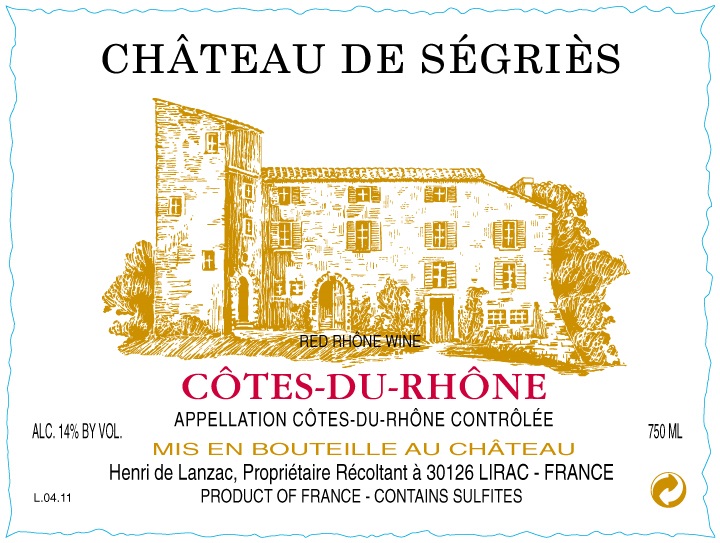
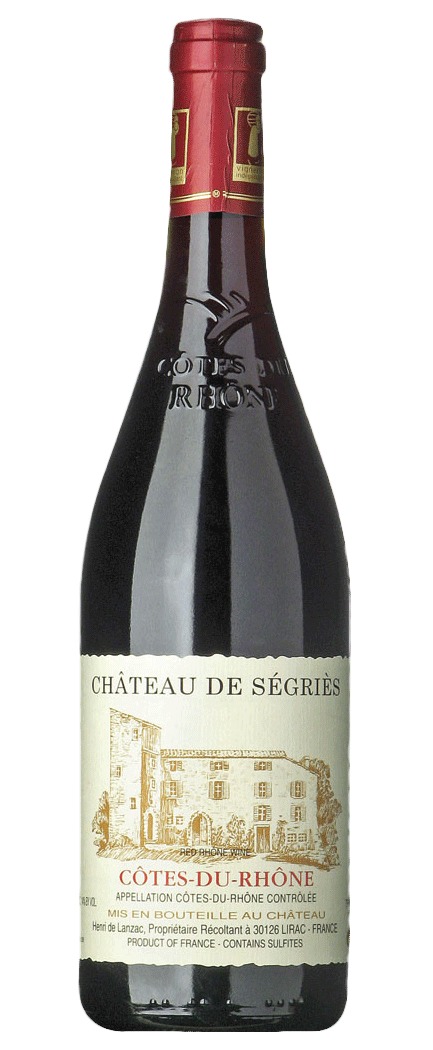
Segries Cotes du Rhone Rouge is made from 50% Grenache, 30% Syrah, 10% Cinsault, 10% Carignan
The Chateau de Segries Estate
In 1994, Henri de Lanzac, cousin of Christophe Delorme from Domaine de la Mordoree, purchased the Domaine and began to improve the quality of the wine. "Segries" in provencal means "water spring". This family owned and operated winery is located in Lirac and produces some of the best values in my portfolio. They produce the following A.O.C. wines:
* Tavel Rose
* Cotes du Rhone Rouge
* Lirac Rouge
* Lirac Blanc
"An old Lirac estate with recent signs of revival under the new owners; the reds are medium weight, good to drink inside six years; charming Tavel." - Anthony Dias Blue's pocket guide to wine 2006
"A super value treasure trove in the southern Rhone, Segries is a large estate of 109 acres brought back to life over the last decade by Henri de Lanzac. The wines continue to go from strength to strength."- Wine Advocate (#178, Aug. 2008)
"Over the last fifteen years, this property has been transformed into one of the better value producers in the Cotes du Rhone. The old, oxidized, vegetal offerings have been replaced with classic examples of Provencal wines that are fresh and fruity with ripe tannins." - Wine Advocate (#190, Aug. 2010)
"The new releases from proprietor Henri de Lanzac are all impressive." - Wine Advocate (#195, June 2011)
"This has been a reliable producer of terrific values in the Cotes du Rhone (and for their Tavel rose) for a number of years, and they have once again done an admirable job." - Wine Advocate (#201, June 2012)
The Chateau de Segries Vineyard
The Domaine Chateau de Segries owns 44.5 hectares of vineyard land (108.91 acres), all in old vines, 30 hectares in one piece alone:
- 7 ha (17.30 acres) in Tavel, on limestone, pebble stone, sand and clay based soils.
- 30 ha (74.10 acres) in Lirac, on clay and limestone based soils.
- 4 ha (9.88 acres) in Cotes du Rhone.
- 3.5 other ha (8.65 acres) in Cotes du Rhone for the "Clos de l'Hermitage"
Many of the vines date back to 1925, and were planted by the former owner Count de

Segries Cotes du Rhone Rouge is made from 50% Grenache, 30% Syrah, 10% Cinsault, 10% Carignan
The wine is ripe, rich and round, with black raspberry, white pepper and spice flavors. True Cotes du Rhone in a Bistro style.

Segries Clos Jean Alesi Cotes du Rhone Rouge is made from 1/3 each of Grenache, Syrah and Mourvèdre.
This wine was originally called Segries Lanzac Clos Hermitage Cotes du Rhone Rouge
This 3.5 hectare vineyard, located in the famous “Quartier de la Chartreuse de Villeneuve-les-Avignon”, has been owned by the Formula 1 race car driver Jean Alesi since 1995. It is managed by Château de Ségriès.
This wine is a blend of 33% Grenache, 33% Syrah, and 33% Mourvedre sourced from 40-year-old vines. It was fermented in concrete vats then aged for nine months in 5% new oak barrels. The wine is a very grapey color in the glass. There is a light nose of tightly packed black fruit, dried herbs, pepper, and licorice. In the mouth there are tight-grained blue fruit, fine, powerful tannins, and a little strawberry flavor breaking loose. With air the wine reveals pencil and pepper flavors along with the structure for aging.
Yield: 40 hl/ha
Age of the vines: 40 years.
Vinification: 21 days skin maceration in temperature controlled concrete vats
Ageing: 9 months oak aging -5% new French oak from Seguin Moreau cooper and 95% of 1 year old barrels.
Delicious with roast meat, grilled vegetables, strong cheese and chocolate desserts.

Maison du Midi Cotes-du-Rhone Rouge Vielles Vignes is 80% Grenache, 10% Syrah and 10% Mourvedre.
This ruby red colored wine with purple glints develops red fruits aromas and spicy overtones. In the mouth, this wine is smooth and its supple structure emphasizes aromas. Fruitforward and easy drinking wine showing light spices and silky tannins. A perfect everyday wine.
This delicious juicy wine can be enjoyed now with steak frites, any Mediterranean dishes, pizzas, grilled chicken and cheese.

Chateau Cabrieres Cotes du Rhone Rouge Vieilles Vignes is made from 50% Grenache and 50% Syrah.
Château Cabrières’ Côtes du Rhône vineyard is located south of Orange, on the edge of Châteauneuf-du-Pape. The area of the vineyard is 1.53 hectares. The soil is comprised of clay-limestone mixed with pebbles.
Bright cherry red color with an expressive red fruit nose (strawberry and raspberry). Soft tannins in mouth, with freshness and spices. This CDR tastes like a baby Châteauneuf-du-Pape!
Pairs with charcuterie, pizza, pasta and mild cheeses.

La Reserve du Prince Cotes du Rhone Rouge Vieilles Vignes is 80% Grenache, 10% Syrah and 10% Mourvedre.
This ruby red coloured wine with purple glints develops red fruits aromas and spicy overtones. In the mouth, this wine is smooth and its supple structure emphasizes aromas. Fruitforward and easy drinking wine showing light spices and silky tannins. A perfect everyday wine.
This delicious juicy wine can be enjoyed now with steak frites, any Mediterranean dishes, pizzas, grilled chicken and cheese.

Alain Jaume Cotes Du Rhone Rouge Haut de Brun is made from 60% Grenache, 30% Syrah, 10% Cinsault
The colour is purple-tinged garnet.The aromatic range of the nose goes from fresh berries (wild raspberry, blackcurrant, blackberry) to spices.The palate is big and full-flavoured, with silky-smooth tannins and aromas of the fruit already mentioned. The finish introduces touches of liquorice and pepper. A Côtes du Rhône with great complexity for an every day drinking.
A classic Rhône to drink between 1 and 4 years. Best poured at 17°C.
Traditional wine making and ageing is performed in vats only. Bottling after 10-12 months.
Ideal throughout the meal, but particularly with poultry and other white meats, as well as mild cheeses.

Hickinbotham Peake Cabernet Shiraz is made from 60 percent Cabernet and 40 percent Shiraz.
Named after the late Mr. Edward John Peake who established the first vineyard and orchard at Clarendon circa 1850. Blending Cabernet Sauvignon and Shiraz is a famous part of Australian winemaking history and whilst the individual components of this wine are mighty, the sum of The Peake’s parts is magnificent. The Cabernet shines aromatically with notes of blackberry pie and dark chocolate, while the Shiraz fills the mid-palate with black plum and toasty oak. Fine tannins and balanced acidity contribute to an incredibly long finish. The Peake continues to honor the legacy of this iconic Australian blend.
Review:
Hickinbotham's 2017 The Peake Cabernet Shiraz is a 60-40 blend of the varieties, aged in a healthy proportion of new French oak. As a barrel selection, it stands above the other wines in the lineup, being more complex and complete than either the Brooks Road Shiraz or the Trueman Cabernet. Cassis leads the way, rounded out by ripe cherries and joined by shadings of cedar and vanilla. It's full-bodied and concentrated in the mouth, rich, supple and almost creamy in texture and boasts a long, silky finish. While nearly drinkable already, it should easily age for a decade or more.
-Wine Advocate 96 Points

Castellare di Castellina 'I Sodi di San Niccolo' Toscana IGT is a blend of Sangioveto (85%-90%) and Malvasia nera (15-10%)
Intense ruby red in color and with a great olfactory concentration, thanks to the presence of a ripe red fruit that leads to notes of jam, but also spices, vanilla and licorice. In the mouth the wine is characterized by a dense and elegant texture, also supported by the important acidity of the Sangiovese, the tannins are absolutely sweet and the finish is long and of great persistence.
Excellent with cured meats and savory meats, with succulent dishes and mature cheeses. Much appreciated when paired with Tuscan Pecorino and Parmigiano.
The masterpiece of Castellare, I Sodi di San Niccolo, has twice placed in the top 100 of Wine Spectator, and has been awarded “Three Glasses” by Il Gambero Rosso.
I Sodi di San Niccolo is produced solely with native varieties: 85-90% of Sangioveto and 10-15% of Malvasia Nera, I Sodi comes from the two best crus of the farm.
The word "I Sodi" was used by the Tuscan farmers to describe those grounds which had to be processed by hand, being too hard (in fact firm) or too steep to allow for the employment of the horses, unlike the "fields" that make the grounds more easily cultivable.
Reviews:
Packed with ripe, juicy cherry, blackberry, pomegranate and floral aromas and flavors, this red is supple and beautifully integrated. Earth, iron and tobacco accents add detail as this winds down on the lazy, resonant aftertaste, showing terrific energy. Sangioveto and Malvasia Nera. Best from 2026 through 2043.
-Wine Spectator 97 Points
#35 Wine Spectator Top 100 of 2024
Vinous 97+ Points