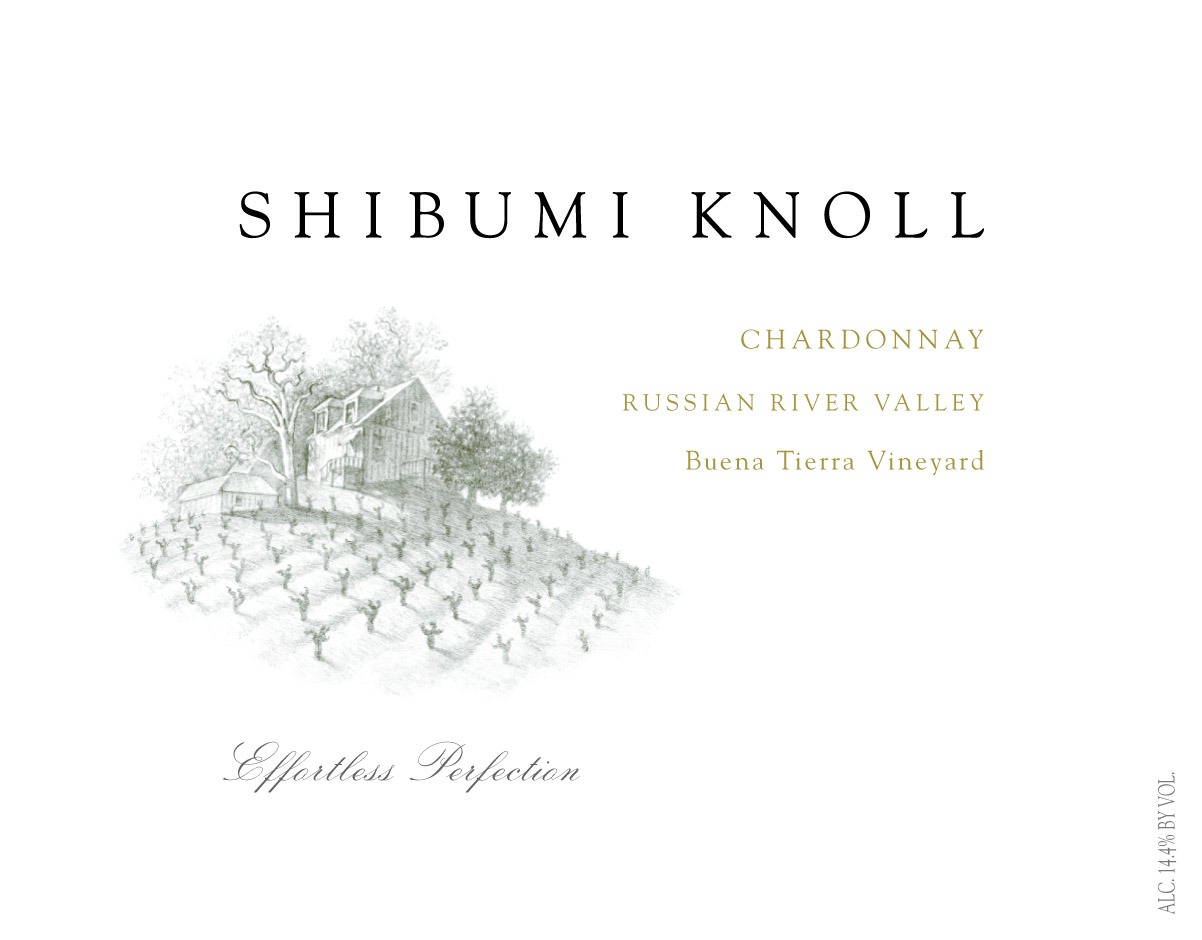
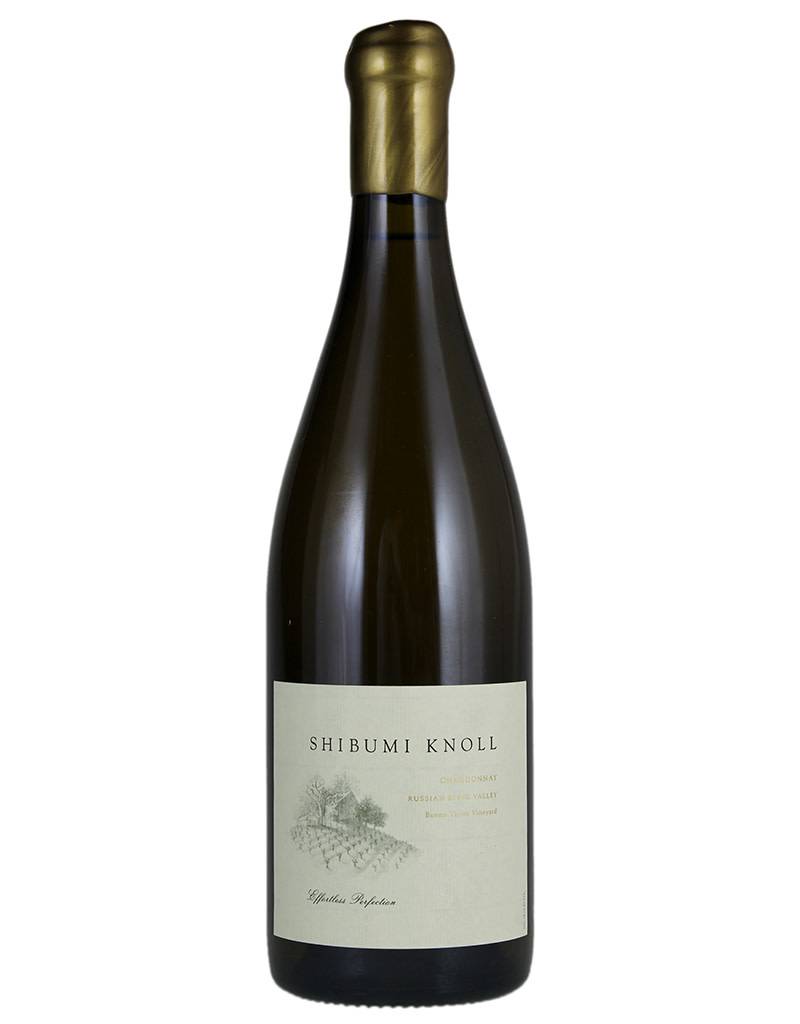
" We don't sell the wine without touching the vine "
| Country: | United States |
| Regions: | California California (Napa) |
| Winery: | Shibumi Knoll |
| Grape Type: | Chardonnay |
| Organic: | Yes |
| Vintage: | 2017 |
| Bottle Size: | 750 ml |

Shibumi Knoll Chardonnay Corazon del Rio is made from 100% Chardonnay aged 14 months in 20% new French oak.
Review:
“The 2021 Chardonnay Corazon Del Rio Vineyard is another brilliant Chardonnay (these are all made by Thomas Rivers Brown) from the Russian River Valley. Bright citrus, honeyed flowers, and subtle toasty oak notes define the aromatics, and it's medium-bodied, has a fresh, focused mouthfeel, terrific balance, and a great finish. I'd be thrilled with bottles in the cellar.”
-Jeb Dunnuck, 95 points
100% Chardonnay aged 14 months in 30% new French oak.
Review:
“Stone fruits, buttered citrus, white flowers, and a subtle hint of green almonds all emerge from the 2021 Chardonnay Buena Tierra Vineyard, a medium to full-bodied, ripe, yet elegant Chardonnay. I love its overall balance, and it brings an impressive mix of richness and elegance.”
Jeb Dunnuck, 96 points
The 2020 Cabernet is a shining example of how delicious, elegant and beautiful our Cabernet can be. The aromas of ripe plum, black cherry and stone fruits entice the nose. The wine is beautifully structured with a soft, velvety feel on the palate. The soft, subtle tannins make it seem that you are drinking a more mature wine. The hint of spice integrated with dark stone fruits segue into a long, lingering and enticing mouthfeel. This vintage is not one to miss, it’s approachable now and destined to be off the charts in years to come
Review:
Lastly, the 2020 Cabernet Sauvignon Shibumi Knoll Vineyard is all varietal and spent 22 months in 75% new barrels. It's another beautifully balanced and impeccably made wine from this team that has tons to love, and in this case, it certainly represents a relative value as well. Cassis, darker chocolate, scorched earth, and graphite are just some of its aromatics, and it's concentrated and has full-bodied richness, fine tannins, and the pure, layered, impressive style of the vintage front and center.
-Jeb Dunnuck 94 Points
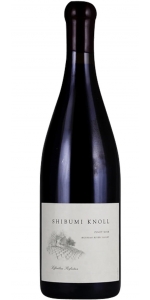
Shibumi Knoll Pinot Noir Sonoma Coast is made from 100 percent Pinot Noir, 20 percent in new French Oak.
Review:
“Moving to the reds, the 2021 Pinot Noir Sonoma Coast comes from the Riddle Vineyard in Sonoma and spent 10 months in 20% new French oak. Black raspberries, sappy herbs, spring flowers, and some black tea notes all give way to a medium-bodied, elegant, vibrant Sonoma Pinot Noir with supple, fine-grained tannins and a great finish. It will age, but it's too good to resist today.”
Jeb Dunnuck, 96 points
Fullerton Five Faces Chardonnay is made from 100 percent Chardonnay.
Five FACES is an acronym for the Fullerton family – Filip, Alex, Caroline, Eric, and Susanne. The wines blend fruit from multiple vineyards in Willamette Valley, mainly in the north of the valley with one to the west in the Van Duzer Corridor. A full representation of the Willamee Valley’s soil types is on display with one volcanic vineyard, two loess (windblown) vineyards, and two sedimentary vineyards. The vineyards range in elevation from 550-700 feet.
Honeydew melon, japanese pear, apricot, honeysuckle, apple-blossom, nutmeg, brioche, and lemon curd. Melon is echoed on the palate with notes of lemon, tangerine, toasted almonds, and fennel. Lovely and integrated acidity balances the palate weight from 17 months on the lees.
17 months in 10% new French Oak
Paris with creamy dishes and cheeses. Chicken and Turkey.
Kershaw Chardonnay Deconstructed Groenland Shale CY548 is made from 100 percent Chardonnay.
The inspiration for this Chardonnay stems from my belief that the Elgin region has both a signature grape as well as particular terroirs within its demarcated boundary that reflect regional credentials. This Chardonnay was selected from a sub-region of Elgin from a specific vineyard and an individual clone (CY548).
Tasting Notes:
Sourced from the foothills of the Groenland Mountain in Northern Elgin this clone has been taken from Corton Charlemagne cuttings. It produces wines that have aromatics oscillating between lemon blossom, white flowers, petrichor and struck stone. Full in body they exude concentration with white stone fruit yet reinforced with an austere texture and robustness that makes for excellent aging potential. The Bokkeveld Shales adds structure and concentration to the flavor.
Vineyards:
Sourced from the foothills of the Groenland Mountain in Northern Elgin this clone has been taken from Corton Charlemagne cuttings.
Winemaking:
Grapes were hand-picked in the early autumnal mornings, placed into small lug baskets and tipped directly into a press before being gently whole-bunch pressed up to a maximum of 0.6 bar or until a low juice recovery of 580 liters per ton was obtained. The juice gravity-flowed directly to barrel (no pumps were used at all) without settling. The unclarified juice had no enzymes or yeast added to it and therefore underwent spontaneous fermentation until dry, with malolactic discouraged. The wine rested in barrel for 4 months prior to judicious sulfuring and a further 7 months’ maturation in barrel before racking and bottling.
Barrel: Selection: A small number of artisanal coopers are selected from mostly Burgundy, with only French oak was chosen. Up to 40% of the oak is new with the remainder split into 2nd and 3rd fill barrels of predominantly 228 litres.
Look at pairing this with textured fish, straightforward chicken dishes, pan-fried or grilled pork dishes, soft-rind cheeses, cream or creamy dishes be it with pasta or the aforementioned fish, chicken or pork, to allow the complexity of the wine to shine through. If using mustard, preferably use Dijon mustard as it uses verjus (soured grape juice) and not vinegar. Also look to delicate herbs (tarragon, dill, basil, parsley) rather than hard stalked herbs (rosemary, thyme, oregano, etc). Avoid smoked meats or fish as well as highly spiced dishes as this can overwhelm the wine and clash with the oak. I would try oysters; Lobster grilled or boiled but not thermidor as it is too rich; turbot, dover sole, sea bass, yellowtail with a shellfish sauce; fish pie; roasted free-range chicken with tarragon; roast loin of pork with garlic and ginger; truffle risotto; pasta in a clam sauce; slice of brie de meaux.
Review:
"Perfume of flowers, minerals and citrus zest. The palate is dense and focused, almost chewy with an opulent mandarin mid palate and long, savory finish. Matured in 50% new oak that is seamlessly integrated with the wine."
- International Wine Review (Richard Kershaw Lifts Elgin To New Heights, February 2019), 94 pts
RUSSIAN RIVER, BUENA TIERRA VINEYARD
On the nose, you smell honeycomb and apricot with a slight hint of warm spices. The color is bright, clear and golden with legs that gently slide down the sides. The taste is a treat of Meyer lemon and vanilla with a touch of Crème Brulee. Its fresh, smooth and delicate. The complex flavors of the old vines make this wine an old soul. The finish lingers just long enough.
Don was a serious collector (and consumer) of fine wines for over thirty years. In January of 2003 we brought a small knoll 3.5 miles north of Saint Helena in the heart of the Napa Valley. Included in this two acre parcel was a rocky .75 acre Cabernet vineyard planted in 1996, a very modest vineyard cottage (originally a stone barn built in 1921), a guesthouse and a winery. After an internal remodel of the cottage, many gallons of paint and extensive landscaping, the knoll became our home.
Many years ago we read the book Shibumi, which became one of our favorites: adventure, intrigue, romance, the book has it all. The book introduced us to the concept of Shibumi, a Japanese word describing a physical and emotional state which most nearly translates to “the pursuit of perfection though simplicity” or “Effortless Perfection”. Life on our little knoll in a simple cottage surrounded by vineyards, canopied by majestic oaks and blessed with bucolic 360-degree views, is truly one of perfection through simplicity. Hence when we decided to make wine under our own label, “Shibumi Knoll Vineyards” seemed perfect.
We feel blessed to live in the beautiful Napa Valley and thank you for loving our wines.
It is said by Burgundian vinters that the grape is simply a vehicle that allows the vineyard to express itself. Shibumi Knoll is located in the center of the Napa Valley .3 miles off Highway 29 and a quarter mile from the Napa River. It is on the alluvial fan of Mill Creek and is composed of 80% rock. Thus the wine shows the grace of Napa Valley Cabernet yet has the structure we see in wines from stony hillside vineyards. We harvest the grapes when they are ripe but not overly so. Therefore our Cabernet shows many qualities of a great red Bordeaux. Because of these qualities it is a favorite at The French Laundry.
Our first vintage of Shibumi Cabernet was the 2003. The grapes were processed at Benessere Winery located about a half mile north of Shibumi Knoll. There, while watching the grapes being processed, Don met another vintner, Eugena Keegan, who was bringing in Pinot Noir and Chardonnay grapes from Sonoma County. Eugena asked Don if he’d like to barrel taste her wines. The last wine he tasted, a chardonnay from Buena Tierra Vineyards, he felt was stunning. Eugena was moving to Oregon so he approached the owner of Buena Tierra Vineyards, located on the Russian River in Sonoma county about buying the grapes. The owner explained that because the vines were 35 years old and grape production was down, he was going to replant the 2.4-acre block. Don offered to pay full production price for whatever grapes were harvested, an agreement which has continued for 12 years.
The Shibumi Knoll Buena Tierra Chardonnay has proven to be among the best in the country. The 2005 vintage received a 97 from The Wine Spectator, tied for the highest score given California Chardonnay in the first decade of this century.
This ancient block of vines has produced some incredible Chardonnay vintage after vintage.
In the summer of 2012 Don was walking the Buena Tierra Vineyard with Thomas Brown when Thomas pointed to a small block of Swan clone Pinot Noir and said “I could make some great Pinot Noir from these grapes.” 2012 was our first vintage from this block. Our Pinot Noir is a favorite of many among the wines we produce.
Kershaw Chardonnay Deconstructed Groenland Shale CY548 is made from 100 percent Chardonnay.
The inspiration for this Chardonnay stems from my belief that the Elgin region has both a signature grape as well as particular terroirs within its demarcated boundary that reflect regional credentials. This Chardonnay was selected from a sub-region of Elgin from a specific vineyard and an individual clone (CY548).
Tasting Notes:
Sourced from the foothills of the Groenland Mountain in Northern Elgin this clone has been taken from Corton Charlemagne cuttings. It produces wines that have aromatics oscillating between lemon blossom, white flowers, petrichor and struck stone. Full in body they exude concentration with white stone fruit yet reinforced with an austere texture and robustness that makes for excellent aging potential. The Bokkeveld Shales adds structure and concentration to the flavor.
Vineyards:
Sourced from the foothills of the Groenland Mountain in Northern Elgin this clone has been taken from Corton Charlemagne cuttings.
Winemaking:
Grapes were hand-picked in the early autumnal mornings, placed into small lug baskets and tipped directly into a press before being gently whole-bunch pressed up to a maximum of 0.6 bar or until a low juice recovery of 580 liters per ton was obtained. The juice gravity-flowed directly to barrel (no pumps were used at all) without settling. The unclarified juice had no enzymes or yeast added to it and therefore underwent spontaneous fermentation until dry, with malolactic discouraged. The wine rested in barrel for 4 months prior to judicious sulfuring and a further 7 months’ maturation in barrel before racking and bottling.
Barrel: Selection: A small number of artisanal coopers are selected from mostly Burgundy, with only French oak was chosen. Up to 40% of the oak is new with the remainder split into 2nd and 3rd fill barrels of predominantly 228 litres.
Look at pairing this with textured fish, straightforward chicken dishes, pan-fried or grilled pork dishes, soft-rind cheeses, cream or creamy dishes be it with pasta or the aforementioned fish, chicken or pork, to allow the complexity of the wine to shine through. If using mustard, preferably use Dijon mustard as it uses verjus (soured grape juice) and not vinegar. Also look to delicate herbs (tarragon, dill, basil, parsley) rather than hard stalked herbs (rosemary, thyme, oregano, etc). Avoid smoked meats or fish as well as highly spiced dishes as this can overwhelm the wine and clash with the oak. I would try oysters; Lobster grilled or boiled but not thermidor as it is too rich; turbot, dover sole, sea bass, yellowtail with a shellfish sauce; fish pie; roasted free-range chicken with tarragon; roast loin of pork with garlic and ginger; truffle risotto; pasta in a clam sauce; slice of brie de meaux.
Review:
"Perfume of flowers, minerals and citrus zest. The palate is dense and focused, almost chewy with an opulent mandarin mid palate and long, savory finish. Matured in 50% new oak that is seamlessly integrated with the wine."
- International Wine Review (Richard Kershaw Lifts Elgin To New Heights, February 2019), 94 pts
Roederer Estate L'Ermitage Brut is made from 52% Chardonnay, 48% Pinot Noir.
The 2019 features aromas of quince paste and light pastry crust. The entry is bright and textured midpalate. A mouthwatering finish is highlighted by pear skin and an even, creamy texture.
Review:
If sunshine could be bottled it would be this. Aromas of fresh succulent stone fruit, a hint of yeast, citrus blossoms and notes of quince on the nose. The mousse is creamy and light with baked red apples, blood orange zest, white grapefruit, sticky caramel and layered salinity with a mouthwatering finish. It will bring a smile to your lips.
-Wine Enthusiast Cellar Selection 100 Points
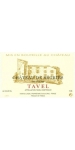
Segries Tavel Rose is made from 50% Grenache, 30% Cinsault, 15% Clairette, 5% Syrah.
The age of the vines is 30 years. Traditional vinification at low temperature, "vin de saignée" with a maceration during one night in cement vat.
This is large for a Rose...structured and focused, with the color of dark ruby. The nose is loaded up with fresh fruit. Strawberry, blackcurrant, and raspberry beam from the glass. On the palate, the mouth-feel is ripe and succulent. It has strength, but maintains its fresh and crisp expression. The finish is filled with Asian spice and slight hints of smoke. Drink this juice now or over the next year or two.