" We don't sell the wine without touching the vine "
| Country: | Chile |
| Region: | Colchagua Valley |
| Winery: | Siegel |
| Grape Type: | Syrah |
| Vintage: | 1234 |
| Bottle Size: | 750 ml |

Sale price good on website only and wine must be shipped to your home.
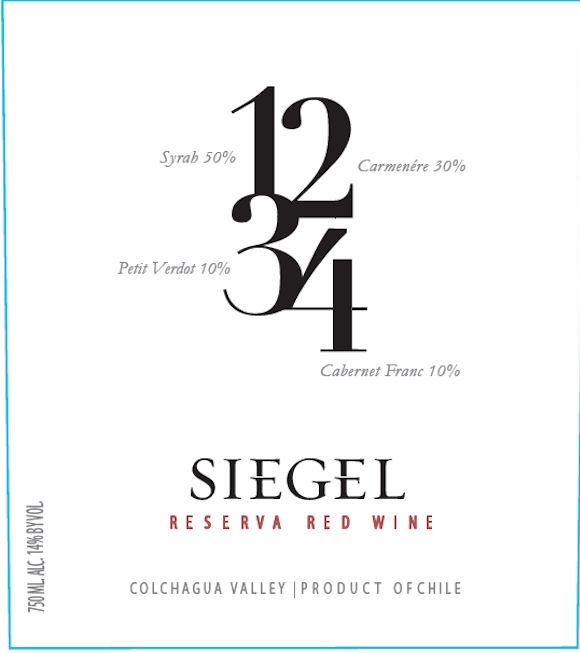
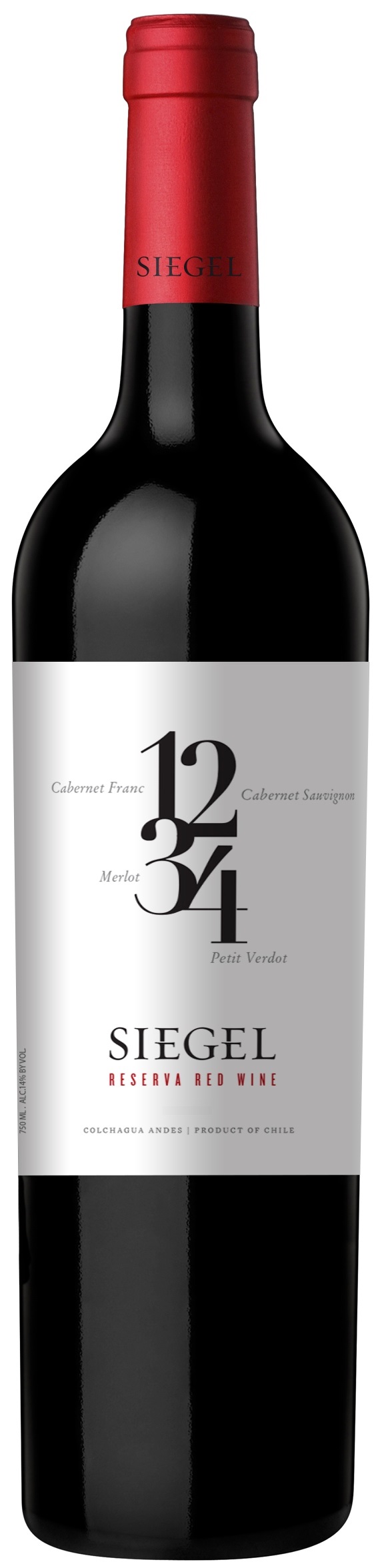
Siegel Reserve Red Blend 1234 is made from 50% Syrah, 30% Carmenère, 10% Cabernet Franc and 10% Petit Verdot.
Deep ruby color. Intense aromas of black fruits, white pepper, spices and a hint of clove. The blend of four varieties gives a complex, deep wine with juicy tannins, good volume and very balanced.
Pre-fermenting cold maceration for five days, alcoholic fermentation at 26-28 C to obtain color and structure. Post fermentation maceration of two to three weeks according wine tasting and then the wine is separated from the skins. The wine ends its malolactic fermentation in tank. Harvest: by hand (30 day harvest window)
Paella, Confit de Canard (duck confit) and pastas.

Siegel Ketran Red Blend is made from 35% Syrah, 30% Petit Verdot, 25% Carmenere, 10% Cabernet Franc
Ketran is coming from the Mapuche Language and it means "plowed earth". In fact, Earth was plowed by fire from the volcanic acitivity. Ketran is a tribute to the volcanic soils that gave birth to the fantastic terroir of Los Lingues, located at the foothills of the “Cordillera de los Andes".
The wine is clean and bright in color.
The wine displays a very aromatic and elegant nose of ripe black fruit, prune and dried fig.
The mouthfeel is smooth and the length to the finish is quite exceptionnal, with sweet and fleshy tannins, balanced by a perfectly integrated acidity which gives the wine some freshness and emphasizes the presence of fruit and its ability to age.
Coming from the volcanic soils of Los Lingues, at the foothills of the Andes mountain.
The wine went through ML fermentation, it was then aged 24 months in French Oak barrels.
The wine has been slightly filtered before bottling.
Review:
"2014 is the second release of Siegel's top red wine, made from a four-way cuvée of Syrah, Petit Verdot, Carmenère and Cabernet Franc. Plush, spicy and smoothly oaked, with some tannic backbone and a glossy finish. Needs time. 2021-30"
- Tim Atkin MW (Chile 2019 Special Report), 94 pts
Ketran is Siegel’s most ambitious wine. Debuting with the 2013 vintage, it’s a selection of the best barrel lots from Los Lingues in the Andean zone of Colchagua. The blend works very well, especially if you let the wine breathe for a few hours beforehand. The oak steps aside, and the aromas of fruit and herbs take over in a red with firm, sharp tannic structure that leaves room for the acidity—not very prominent in a warm year, but still present—to achieve balance. This blend is for the cellar.
-Patricio Tapia - Descorchados 94 Points

Siegel Reserve Cabernet Sauvignon Cabernet Uber Cuvee is made from 85% Cabernet Sauvignon, 15% Syrah.
Dark red color, perfumed nose with hints of vanilla. This fruity, cherry flavored wine exhibits round rich flavors that over deliver.
8 weeks of Oak aging, medium toasted barrels, 100% French Oak.
Best with grilled meats and stews.

Siegel Special Reserve Cabernet Sauvignon is made from 100 percent Cabernet Sauvignon.
Viña Siegel is a family operated winery with a well-established tradition and long history. For generations we have been dedicated to the art of crafting wines with strong identities.
Our Special Reserve wines represent the union of tradition and innovation in two generations. The grapes are sourced through careful selection of our best vineyards. Their ripe and round tannins clearly express the terroir of Colchagua. Siegel Special Reserve Cabernet Sauvignon has been aged for 12 months in french oak barrels, lending it structure and complexity. The wine is deep ruby red and presents aromas of Cassis, red fruits, black pepper, black cherries, tabacco, cinnamon and chocolate. On the palate it is highly concentrated with juicy notes of red fruits and spices.
Serve with red meat, braised stews, grilles pork and flavorful cheeses.
Pre-fermentative cold maceration for 5 days, with alcoholic fermentation occurring at 27-29°C to better extract polyphenols from the wine. Post-fermentative maceration for 2 to 3 weeks. Then part of the wine is decanted into barrels for 10-12 months. The rest of the wine finishes its malolactic fermentation in stainless-steel tanks. Once the wine has been blended it is smoothly clarified.

Siegel Special Reserve Chardonnay is made from 100 percent Chardonnay.
This Chardonnay has a pale yellow color. On the nose is is complex with citrus and tropical fruit aromas balanced with notes from the oak aging. On the palate it has good acidity with a long finish.
VINIFICATION: Alcoholic fermentation occurs at 16-17 degrees C. When the alcoholic finishes part of the wine is kept on a pump-over program.
FINNING AND FILTRATION: Once the wine has been blended it is clarified and then undergoes cold stablisation and is later filtered through clay.
AGING: Aged in French oak barrels for 6 months.
Pairs well with fish like Tilapia, salmon and white meats.

is made from 74% Malbec, 13% Cabernet Franc, 12% Petit Verdot, 1% Merlot
Vineyard Notes
Siegel Reserve Red Blend 1234 is made from 50% Syrah, 30% Carmenère, 10% Cabernet Franc and 10% Petit Verdot.
Deep ruby color. Intense aromas of black fruits, white pepper, spices and a hint of clove. The blend of four varieties gives a complex, deep wine with juicy tannins, good volume and very balanced.
Pre-fermenting cold maceration for five days, alcoholic fermentation at 26-28 C to obtain color and structure. Post fermentation maceration of two to three weeks according wine tasting and then the wine is separated from the skins. The wine ends its malolactic fermentation in tank. Harvest: by hand (30 day harvest window)
Paella, Confit de Canard (duck confit) and pastas.
The Vina Siegel Crucero Estate
Alberto Siegel was born in Santiago in 1946, the third generation in Chile of an Austrian family. His grandfather was an Austrian architect that built some very important and traditional buildings in downtown Santiago, at the beginning of the 20th century, including the Chilean Federal Reserve.
His father, Don Germán, was a viticulturist that spent most of his career in charge of Viña San Pedro’s vineyards near the town of Molina, 140 miles south of Santiago. There Alberto grew up, literally in the middle of the vines. It was not a surprise when he decided to study Agronomy and specialize in winemaking at the Universidad Católica in Santiago.
After finishing high school, he spent a year working in wineries in Germany, and upon his return in 1971, he joined the German company Bayer. His job was to sell fertilizers to farm owners in the Colchagua area, 100 miles south of Santiago. Through this job he got to know almost every land owner, most of which were grape growers and wine producers.
A few years later and as a natural consequence, he started to act as a wine and grape broker, selling the production of small owners to the big Chilean wineries. He established Sociedad La Laguna, and he soon became the most important Chilean broker in this field, a position that he holds today by far. There is hardly any Chilean person or company involved in the wine business that has not dealt with Alberto Siegel at least once.
In parallel, and together with his father, Alberto founded Viña Siegel in 1980. They started planting vineyards in Colchagua and building the Winery in Santa Cruz. When Don Germán died in 1998, Alberto became the owner, together with his family. In the beginning, Viña Siegel only sold bulk wines to the biggest Chilean wineries, like Concha y Toro, San Pedro and Santa Rita. In 1997, Alberto decided to enter the bottled wines business and made the necessary investments to go ahead with this project.
Today, the winery has a capacity of over 3 million gallons and the company owns over 1,850 acres of vineyards in Colchagua. Their wine cellar has state of the art technology, such as vertical pneumatic presses, vacuum filters, and stainless steel tanks with total temperature control, for both cooling and heating. Viña Siegel Winery is still a family operation, with Alberto Siegel as chairman and chief winemaker. The winery has two consultants in enological matters.
The Vina Siegel Crucero Vineyard
The varieties of grapes grown are Cabernet Sauvignon, Merlot, Carménère, Syrah, Chardonnay and Sauvignon Blanc, with other new varieties being added as markets demand. Viña Siegel is currently working with terroir consultant Pedro Parra to design a new site in Los Lingues, which will be planted with several new varietals, including Carignan, Grenache, and Mourvedre. The winery produces a range of varietal wines, along with reserve wines that highlight the quality of the grapevines born in this valley. The Colchagua Valley is truly a synthesis of the country’s way of life and wine has been produced here since time out of mind. This area, which has deservedly been raised to the category of estate bottling in wine making, has maintained its prestige due to the great quality of its wines. One of its noted symbols is its high quality Cabernet Sauvignons, and its red wines in general. Its variety of soils and climatic variations, some warmer, some cooler, have given the region innumerable attributes for grapevine cultivation.

The origin of Lot C-91 began in the fall of 1969 when Joe Heitz created this one-off cuvée, which was very normal in those days, as a more premium version of his already iconic Napa Valley Cabernet Sauvignon bottling. Joe envisioned Lot C-91 as a greater step up in quality from the Napa Valley Cabernet Sauvignon, with a higher quality of fruit sourcing, coming exclusively from the sought-after single vineyards of Heitz Cellar.
Lot C-91 is the culmination of 50 years of tireless effort, trial and error, and the continual desire to make a unique expression of the heralded vineyards of Heitz Cellar.
Review:
Wow. Such a racy and exciting nose! This is quite agile and nimble, full of red and blue berries in the forefront, then complemented by spiced orange, earl grey, red plums, potpourri, savory plums and chocolate. Tense and elegant on the palate, which is all about succulent red berries, nuance and texture. Nothing redundant here. A great Napa cabernet sauvignon that has real definition. A beauty by all accounts!
-James Suckling 96 Points
In 1969, Heitz produced a one-off cuvée called Lot C-91. It was thought of as an elevated version of the Napa Valley Cabernet – a 'best of the best' blend from sites throughout Napa. After a bottle of the '69 turned up and turned heads at a Heitz wine dinner, the winemaking team decided to produce a modern iteration. It's comprised of vineyards in four AVAs: Rutherford (34%), Oakville (34%), Howell Mountain (17%) and St Helena (15%). The dazzling nose instantly shows off the component from Martha's Vineyard and on the palate it walks the line between succulent, powerful, herbal and floral, showing none of the heat of the 2017 vintage. As of June 2020, this was still a barrel sample, while many Napa 2017s are already on the market.
-Decanter 96 Points

Roland Champion Champagne Blanc de Blancs Grand Cru Vintage Brut Grand Eclat is 100% Grand Cru Chardonnay from the chalky soils of Chouilly.
This Champagne is full of elegance and finesse. Very complex nose, with a bouquet of aromas dominated by honey, brioche and notes of dried fruits, hazelnuts and sweets. Perfectly matured.