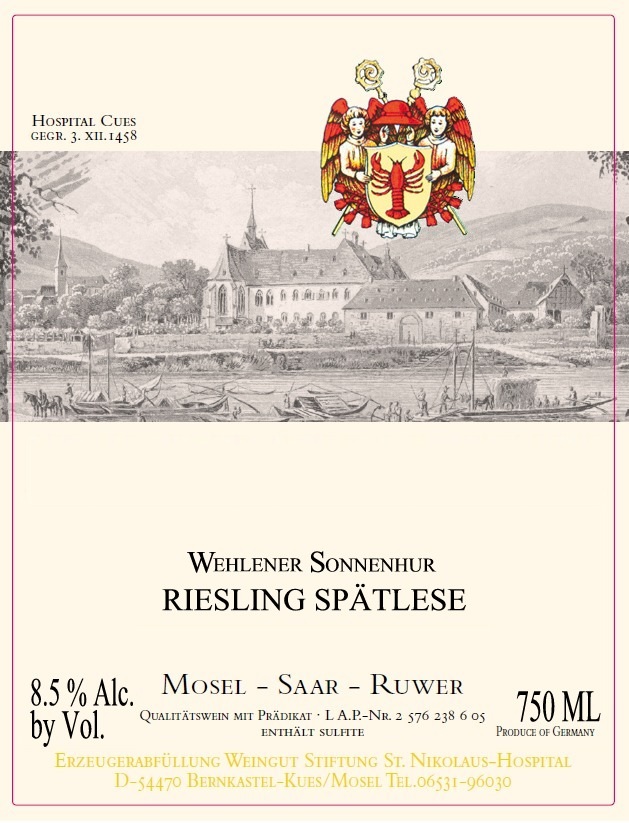
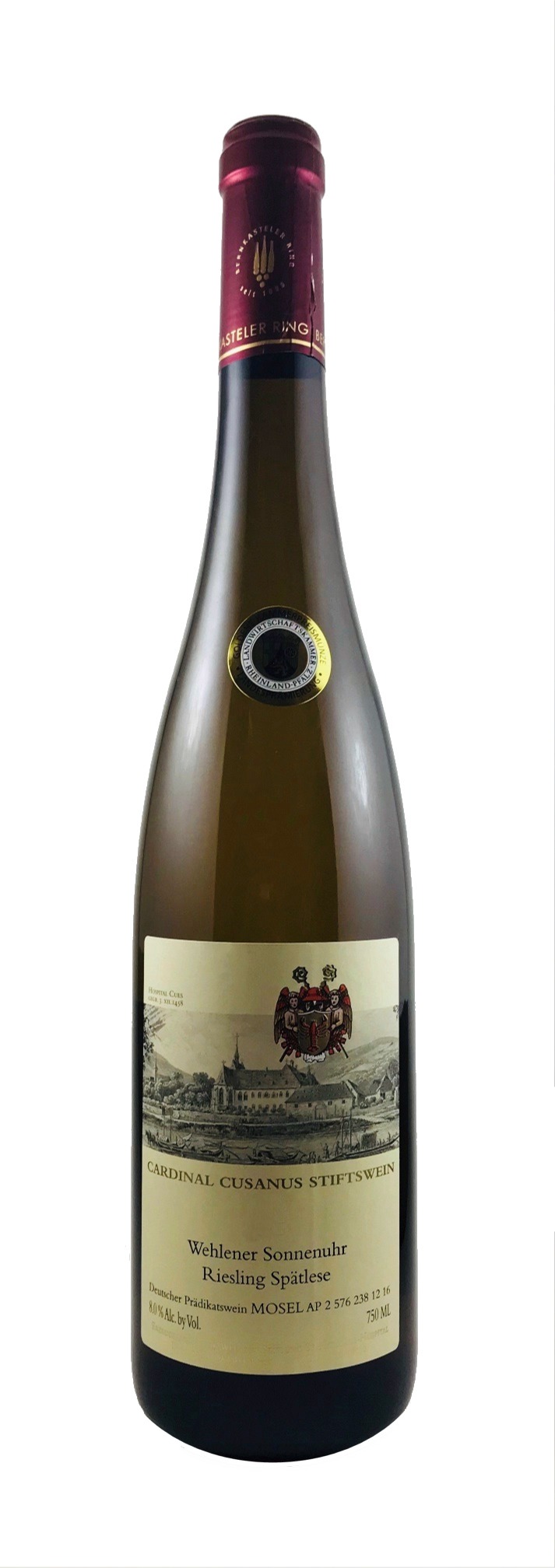
" We don't sell the wine without touching the vine "
| Country: | Germany |
| Region: | Mosel |
| Winery: | St. Nikolaus-Hospital |
| Grape Type: | Riesling |
| Vintage: | 2018 |
| Bottle Size: | 750 ml |
St. Nikolaus Brauneberger Juffer-Sonnenuhr Riesling Spatlese is made from 100 percent Riesling.
"Sonnenuhr" means sundial. The vineyard is facing the small town of Brauneberg formerly Dusemond. It's a steep slate slope on the Mosel, with a south-southeast exposure.
Full-bodied Riesling with typical Devonian slate qualities. Luscious fruit; nice minerality, length and acidity.

St. Nikolaus Graacher Himmelreich Riesling Kabinett is a delicious wine with good alcohol, acidity and sweetness.
RS: 55 grams/liter
Acidity: 7.8 grams/liter
ABV: 7.5%
Goes well with Asian cuisine with some spiciness.
Dr. Loosen Wehlener Sonnenuhr Alte Reben Riesling Grosses Gewachs is made from 100 percent Riesling.
This is one of the greatest vineyards in the Middle Mosel. This precipitously steep, rocky vineyard consistently yields some of the most elegant and sophisticated white wines in the world. Citrus and white peach flavors predominate when the wines are young, turning to a pure expression of the mineral soil as they age.
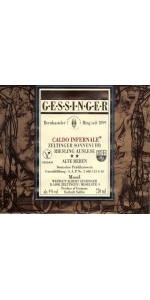
Gessinger Zeltinger Sonnenuhr Riesling Auslese Alte Reben Caldo Infernale made from 100 percent Riesling.
The Zeltinger Sonnenuhr Riesling Auslese Caldo Infernale was produced from over 100-year-old ungrafted vines in the Gewann “im Kalk,” the original part of the vineyard. This is a typical Devonian slate Riesling with fruity elegance and great durability.
Although riper elements of yellow peach, coconut, Victoria pineapple, and almond cream directly capture the attention, the nose maintains a fresh character with minty and zesty notes. The wine shows ripe and sweet elements on the palate, and has quite some creamy and juicy elements such as canned yellow peach and pineapple. The finish brings the right amount of zest to lift up the aromatics and adds focus and tension, while there is an almost Eiswein-type of acidity in the aftertaste. This is a gorgeous Auslese.
Gessinger Zeltinger Sonnenuhr Riesling Auslese Alte Reben Caldo Infernale made from 100 percent Riesling.
The Zeltinger Sonnenuhr Riesling Auslese Caldo Infernale was produced from over 100-year-old ungrafted vines in the Gewann “im Kalk,” the original part of the vineyard. This is a typical Devonian slate Riesling with fruity elegance and great durability.
Although riper elements of yellow peach, coconut, Victoria pineapple, and almond cream directly capture the attention, the nose maintains a fresh character with minty and zesty notes. The wine shows ripe and sweet elements on the palate, and has quite some creamy and juicy elements such as canned yellow peach and pineapple. The finish brings the right amount of zest to lift up the aromatics and adds focus and tension, while there is an almost Eiswein-type of acidity in the aftertaste. This is a gorgeous Auslese.
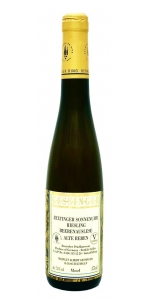
Gessinger Zeltinger Sonnenuhr Riesling Beerenauslese is made from 100 percent Riesling.
This deep yellow-colored wine offers a quite aromatic nose made of mirabelle, ripe apple, almond cream, date, ether oil, and earthy spices. It proves nicely complex and delicately oily on the otherwise focused and delicately racy palate, and leaves a subtly unctuous and still quite sweet feel of honeyed dried fruits, starfruit, kumquat, and almond cream in the precise and persistent finish. Some fresher elements of citrusy fruits and grapefruit already lighten up the aftertaste and hint at the greatness to come. This beautiful dessert wine is still really in its infancy but will develop into quite a beauty at maturity, once the candy floss driven sweetness will have receded into the background.
The Riesling Beerenauslese remains on the lees for several months to add a creamy texture to the mineral notes and to enhance the mouth-feel and drinkability.Zeltinger Sonnenuhr Riesling Beerenauslese Alte Reben was made from botrytized fruit hand-picked at a whopping 150° Oechsle from old ungrafted vines, spontaneously fermented and vegan. Fermentation with preferably wild yeasts gives this wine a unique and authentic taste, reflecting the extreme vineyard sites of the Mosel Valley. A cool temperature allows a slow fermentation which can continue for as long as the wine and the vintage requires.
Perfect match to sweet-and-sour dishes as well as spicy food.
St. Nikolaus Wehlener Sonnenuhr Riesling Auslese is made from 100 percent Riesling.
"Sonnenuhr" means sundial. The vineyard is facing the small town of Wehlen, located in the middle of a long steep curved slate slope on the Mosel, with a south-southwest exposure.
The wine exhibits a fresh fruity bouquet of peach and apricots with honey and spicy notes. Strong, sweet and long flavors. Elegant, full bodied and luscious wine with good minerality and acidity on the palate.
The vineyard consists of 0.7 hectares (1.7 acres) and the soil type is light Devonian slate.
The Sun exposition is south-southwest with an inclination of 50 %.
The yield was 50 hl/hectare.
No Oak. Fermentation took 2 months and the wine was left on the lees for 3 months before bottling.
Review:
- Wine Enthusiast (January 2020), 92 pts
St Nikolaus-Hospital Cusanusstift is the oldest estate in the Middle Mosel region, founded in 1458 by philosopher Nikolaus von Kues, the best known ancestor of the town of Bernkastel-Kues. He became Bishop and Cardinal then founded the St Nikolaus Hospital, a social service institution that has been functioning since 1465. Over the years, this award-winning producer has received numerous medals for his wines, and is a member of the "Bernkasteler Ring". The equipment at the winery is state of the art and the winemakers are among the finest ones in Germany. The estate also operates the Vinothek, one of Europe's most beautiful tasting facilities which gathers 140 of Germany's top producers and represents a major tourist destination.
The vineyard is located along the Mosel River and measures 15 hectares (37.05 acres) total, including the following sites: Wehlener Sonnenuhr, Graacher Himmelreich, Graacher Domprobst, Bernkastler Badstube, Bernkastler Graben, Brauneberger Juffer and Braunberger Juffer-Sonnenuhr. The 40 year-old vines are planted on steep, slate soil.
Mascot is a small-production label founded by Will Harlan in Napa Valley. The wines under this label are made from the younger vines of Harlan Estate, BOND, and Promontory, but The Mascot bottles share an exclusive preview at the development of their estates. Founded as an initial experiment to see what the young vines were capable of producing, the wines were initially only shared with close friends and family. By 2008, Will officially released the first vintage to the public since production had increased significantly. They create just one wine made from Cabernet Sauvignon, and the bottle is aged for five years before release. Assembled into a single, youthful expression, this wine shares a glimpse into the evolution and pedigree of its parent estates.
Tasting Notes:
A mild winter with scant rainfall introduced the 2020 growing season. Conditions remained pleasantly even-keeled throughout the spring, except for some light precipitation in March. It is worth noting that decades of research and steady viticultural progress have enabled our vines to begin achieving tannin and textural ripeness earlier in the season, and this fact—along with the drought conditions experienced in preceding years—led to one of the earliest picking windows in our history. This development proved crucial to the 2020 vintage, when we were fortunate to have fully completed our harvest before the Glass Fire began in late September. A vibrant purity manifests within this vintage’s generosity, which advances without excess of weight or volume. Aromas of gentle red fruit give way, eventually, to a savory darkness and finely wrought core. An effortless, structural tension transforms into a silky softness on the palate that envelopes The Mascot’s inner depth and dimension. The 2020 vintage resonates rather than roars: its intricate threads of tannin, acidity, and nuance interweave to form a complete expression that shimmers with sensory detail.
Fragrant aromas of yellow peach and ripe melon are found on the nose, interspersed with bright citrus notes. These continue on the palate with notes of creamy vanilla and buttery nuances on the long finish. Rombauer's signature bright acidity is evident throughout each sip, balancing the softness of the midpalate.
Pairings for this wine include crab cakes, barley risotto, and strawberry shortcake.