
" We don't sell the wine without touching the vine "
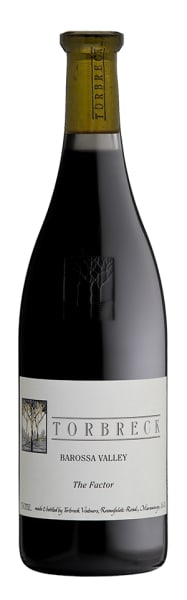
| Country: | Australia |
| Region: | Barossa Valley |
| Winery: | Torbreck |
| Grape Type: | Shiraz |
| Organic: | Yes |
| Vintage: | 2019 |
| Bottle Size: | 750 ml |

The Factor is predominantly from the Gomersal and Marananga sub-regions of the Barossa, providing dense texture and richness to the palate with subtle notes of olive tapenade, saddle leather and minerals. Ripe aromas of plum and wild blackberries, olive, pepper and spice are all supported by a dark core of espresso roast, ripe blackberries and saltbush. Brooding and densely packed, this lavish wine has ample generosity to cellar for many years, where it will slowly unravel.
Review:
Offers a dense, powerful mix of violet, bittersweet chocolate and sandalwood-infused morello cherries in syrup. Blueberry, blackberry and date-nut bread flavors are plump on a frame of polished and toothsome tannins. Clove and Saigon cinnamon notes linger, with a powerful crescendo on the finish. Shiraz.
Wine Spectator 96 Points
Robert Parker's Wine Advocate 96+ Points

Every now and then, in life and in wine, we are presented with unique opportunities to express ourselves and create something truly remarkable.
When rare opportunities arise, we need to capture, nurture and develop them so that their potential is fulfilled. So when Torbreck was given the opportunity to work with one of the most famous vineyards in the Barossa Valley, it became almost inevitable that the resulting wine would be truly remarkable.
In 2003, Torbreck growers and fourth generation descendants of the Seppelt family, Malcolm and Joylene Seppelt, asked our winemakers to create for them a small batch of Shiraz from their old Gnadenfrei vineyard in the sub-region of Marananga.
Planted in 1958, the five acre vineyard is traditionally dry grown and comes from an original Barossa clonal source. South facing, on the eastern side of a ridge separating the Seppeltsfield and Marananga appellations, these aged vines have been meticulously hand tended, traditionally farmed and pruned by a grower with a lifetime’s experience on Western Barossa soils of very dark, heavy clay loam over red friable clay. The resulting low yields of small, concentrated Shiraz berries make the vineyard the envy of all winemakers in the Barossa.
We looked longingly at the wine when it was returned to the Seppelts, knowing that it was the best we had ever made. In 2005 we convinced the Seppelts to sell Torbreck the fruit and The Laird was born. In 2013 Torbreck purchased the Gnadenfrei vineyard, securing The Laird’s reputation as one of the world’s great single vineyard Shiraz wines.
Torbreck is the name of a forest near Inverness, Scotland and you’ll find more than a passing nod to the Celts in our wine naming conventions. The Laird of the Estate in Scotland is the Lord of the Manor and master of all he surveys.
Review:
I poured the 2017 The Laird, set it aside and got about doing other jobs for 45 minutes or so, to give it some room to breathe. And it does breathe. It has its own pulse and beat and life, and it flexes and moves in the mouth. This is incredibly enveloping, with aromas reminiscent of campfire coals, charred eucalyptus, lamb fat, roasted beetroot, black tea and a prowling sort of countenance. In the mouth, the wine is bonded and cohesive and seamless, there are no gaps between anything, no space between fruit, oak and tannin; it all comes as one. While this is a singular wine, it is so big and concentrated that it needs no accompaniment other than some fresh air and a good mate. It's denser than osmium and is impenetrable at this stage.

Yalumba The Signature Cabernet Sauvignon Shiraz is made from 52% Cabernet Sauvignon, 48% Shiraz .
Encompassing everything the Hill-Smith family stands for and the perfect representation of Yalumba’s history and ethos, The Signature is a sentimental favorite. A classic Australian blend of Cabernet Sauvignon and Shiraz, the first vintage release of The Signature was in 1962. Since then, this outstanding wine has acknowledged more than 57 Signatories; people who have enhanced the traditions and culture of Yalumba.
Seductive and alluring florals, cool mints, red pomegranate with fine blackberry fruits and dark cherry aromas. The palate is delightfully generous with dark red cherry fruit that merges into ironstone tannins. A medium to full bodied wine with a long, flowing tannin profile.
Review:
A full-weighted, archetypal Aussie blend. Cabernet and shiraz, both from the Barossa. The top wines of Yalumba have undergone considerable refinement in recent years. The tannins, better managed; the fruit, more restrained; the oak, judicious. Here, an example. Fresh and lithe. Scents of anise, bay leaf and kirsch, with a nourishing core of beef bouillon. An expansive sweetness grows in trajectory, with a douse of menthol at the finish. Drinkable now, but best from 2025.
-James Suckling 94 Points

The Grade Cabernet Sauvignon Serpent's Back Napa Valley is made from 100 percent Cabernet Sauvignon.
Review:
The 2019 Cabernet Sauvignon Serpent's Back shows a more aromatic, high-toned side of this site. Bright red/purplish berry fruit, pomegranate, cinnamon and sweet floral accents are all laced together. The Serpent's Back is the most refined of these three Cabernets, but it has plenty of Calistoga punch.
-- Antonio Galloni 95 Points
The Grade Cabernet Sauvignon Serpent's Back Napa Valley is made from 100 percent Cabernet Sauvignon.
Review:
The 2019 Cabernet Sauvignon Serpent's Back shows a more aromatic, high-toned side of this site. Bright red/purplish berry fruit, pomegranate, cinnamon and sweet floral accents are all laced together. The Serpent's Back is the most refined of these three Cabernets, but it has plenty of Calistoga punch.
-- Antonio Galloni 95 Points

The Grade Cellar Kingly Project Cabernet Sauvignon is made from Napa Valley Cabernet Sauvignon.
"This is a noble expression of Cabernet Sauvignon" in full regalia, with decadent aromas and a mouthfeel viscous and sleek. "This vintage of the Kingly Project Cabernet Sauvignon enters the scene" -- Thomas Rivers Brown
Review:
The 2019 Cabernet Sauvignon Kingly Project is fabulous. A wine of vertical power and thrust, the 2019 soars out of the glass, showing magnificent intensity from start to finish. Black cherry, scorched earth, licorice, plum and chocolate give this substantial Cabernet tons of complexity. I would cellar the 2019 for at least a few years to allow the tannins to soften. -
- Antonio Galloni 97 Points
The Factor is predominantly from the Gomersal and Marananga sub-regions of the Barossa, providing dense texture and richness to the palate with subtle notes of olive tapenade, saddle leather and minerals. Ripe aromas of plum and wild blackberries, olive, pepper and spice are all supported by a dark core of espresso roast, ripe blackberries and saltbush. Brooding and densely packed, this lavish wine has ample generosity to cellar for many years, where it will slowly unravel.
Review:
This is quintessential Barossa. The red dirt in the ground rises up in the glass and transports me right back there: middle summer, hot, spicy air blowing across the tops of old vines. It's evocative. This 2019 The Factor is Port-y, concentrated and savory as all hell, with charred barrels, lamb fat, black pepper, salted licorice, pomegranate molasses and aniseed. This is about as big as I can cope with and still enjoy it; it takes density and intensity to a whole new level—no surprise for the vintage, the region and the producer. A perfect storm of thunderous strength. Like staring into the abyss . . . a little bit scary, but transfixing nonetheless.
-Wine Advocate 96 Points
Torbreck is on a quest to become one of the world’s great wine marques.
A critical part of this journey is remaining unwaveringly true to our core vision and not being diverted by trends and fashions.
SINCE 1994 TORBRECK HAS BEEN COMMITTED TO CREATING EXCEPTIONAL RHONE STYLE RED AND WHITE WINES REFLECTING THE VERY BEST VINEYARDS IN AUSTRALIA’S FAMOUS BAROSSA.
Provenance is everything to us. We believe the Barossa is the most exciting place to make wine in the world, with its gentle Mediterranean climate and 175 years of Silesian and English commitment to winemaking and grape-growing.
There is a European sense of tradition here that means vines planted in the 1840s – many of them Rhone varieties such as Shiraz, Grenache, Mourvédre – still thrive and bear fruit of unique concentration and flavour.
Torbreck pays tribute to these vineyards with minimal intervention, creating wines of richness, structure and length that age gracefully.
The multi-generational growers, whose descendants arrived here nearly two centuries ago, are the backbone of Torbreck’s winemaking aspirations. Without their knowledge of the seasons and the soil, we would not have such a precious resource of fruit to work with.
Torbreck has also been fortunate to have the opportunity to invest in the protection of some of the Barossa’s most precious vineyards, after accepting fruit from them over many years. The historic Hillside Vineyard at Lyndoch, The Laird Vineyard in the sub-region of Marananga and the Greenock Keller Vineyard owned by the Schultz family, are all now under the custodianship of Torbreck.
In 2008 this long-term commitment to the Barossa was cemented when we completed our winery and bottling line, enabling us to achieve maximum quality control through 100% estate vinification, maturation and packaging.
Our latest development was the 2017 expansion of our original settler’s cottage cellar door to become an international guest centre, where we are proud to welcome our many friends and collectors from the USA, Asia, Europe and Australia.
Torbreck has achieved a lot in less than three decades, but the journey is a long way from complete. In fact we remind ourselves every day that the best Barossa grapes are yet to be picked and the finest Torbreck wines are yet to be made.
We invite you to join us on this road to perfection.
-Pete Kight, Proprietor

Force Majeure Epinette is made from 79% Merlot, 8% Cabernet Sauvignon, 8% Cabernet Franc, and 5% Petit Verdot .
Epinette is Force Majeure's Right-bank Bordeaux-inspired blend, and was named after an avenue in Libourne (France) that leads to Pomerol and Saint-Émilion, the home of Merlot and Cabernet Franc. Epinette is also the name of a musical instrument akin to a piano, as well as a word for pine tree, which is a fitting nod to their home in Washington state.
The wine itself is a blend of primarily Merlot and Cabernet Franc, with smaller amounts of Cabernet Sauvignon and Petit Verdot, proportions of which change depending on the vintage. The Merlot and Cabernet Franc are grown in lower areas of the vineyard with deep, well-drained soils, much less rocky than the soils of our Rhone varietals.
Review:
The 2018 Epinette is the Merlot-dominated release from this team, and it's 79% Merlot, 8% Cabernet Sauvignon, 8% Cabernet Franc, and 5% Petit Verdot, all from the estate vineyard on Red Mountain. Lots of smoky black cherry and darker currant fruits as well as notes of chocolate, graphite, lead pencil, and chalky minerality emerge from the glass, and this full-bodied beauty is beautifully textured, with a stacked mid-palate, velvety tannins, and a blockbuster finish. It's up with the finest Merlots in the New World and will drink brilliantly for at least a decade, if not longer.
Previously known as Grand Reve, Force Majeure has skyrocketed to the top of the pyramid in Washington State, in no small part due to their talented winemaker, Todd Alexander, who moved from Bryant Family in Napa to Washington State to focus on this estate. While the focus is on their Red Mountain Vineyard, they make a bevy of world-class wines from throughout the Columbia Valley. Anyone doubting the quality coming from Washington State these days owes it to themselves to try these wines.
-Jeb Dunnuck 97 Points

Jean Reverdy Sancerre Blanc is 100% Sauvignon Blanc
Single vineyard. Vinification: cold fermentation in stainless steel tank, no oak, no malolactic fermentation.
Sweet, fruity and clean. White flowers (acacia, jasmine) and citrus fruits aromas. Perfectly balanced.
A delicious wine, perfect with fish dishes, especially salmon, and a local goat cheese Crottin de Chavignol.



