
" We don't sell the wine without touching the vine "
| Country: | France |
| Region: | Champagne |
| Winery: | Champagne Trouillard |
| Grape Type: | Chardonnay |
| Vintage: | 2006 |
| Bottle Size: | 750 ml |
The House of Trouillard has incredible holdings on the Côtes de Blancs. The vineyard's rating average 94-95, just one of the reasons the Blanc de Blancs has such incredible raciness and elegance. It is a Cuvée of eleven different Crus in the Reims Mountain, the Côtes de Blancs and the Sézannaise region and is the specialty of the house.
Trouillard Blanc de Blancs Brut NV is made of 100% Chardonnay with a green-gold color, characteristic of Chardonnay, and with fine persistent bubbles. This wine has an aroma that jumps out of the glass and is very inviting. On the nose there are seductive scents of warm almond croissant and honey, lightened by some floral notes. Crisp and refreshing in the mouth and lively with a very refined fruitiness and a touch of smokiness typical of wines from the Côtes des Blancs. The elegance and subtlety of the Chardonnay are to be especially appreciated as an aperitif, and nicely accompanies shellfish and fish.
It has become the favorite of those who know Champagne Trouillard.
Reviews:
"A blend of grapes from the Aube and the Marne Valley, this ripe wine shows the structure of Pinot Noir. The fruit's richness balances the low dosage to give an almost bone-dry wine that is full, fruity and that could age further in bottle. - ROGER VOSS"
- Wine Enthusiast (December 2019), 91 pts
"Aromatic, offering ripe fruit and yeast notes, this is backed by firm acidity, with a lively bead and flavors of Golden Delicious apple, white peach, ginger and whole-grain toast. Drink now through 2018. 2,500 cases made. –AN"
Wine Spectator (Web Only 2013), 90 pts
- Chardonnay du Monde 2012, SILVER MEDAL
This all Chardonnay Champagne is sourced from eleven different crus. It offers a fragrant bouquet of orchard fruit with hints of toasted grain and lemon zest. On the palate, there’s good textural richness and attractive apple and pear complemented by a smoky mineral note. But what we like most about this Blanc de Blancs is its outstanding sense of freshness. 100% Chardonnay aged 2+ years on the lees; 7-8 g/L RS" - - I-WineReview (Champagne: Diversity and Change, January 2020), 91 pts
Trouillard Elexium Rose Brut NV rosé cuvée is made with 100% Pinot Noir grapes and aged for 3 years on the lees. The color is a seductive salmon pink with fine bubbles. The Pinot Noir gives this fruity wine its rich bouquet of raspberries and fresh-baked bread. On the palate it is rich yet balanced with lashings of red-berry fruitiness and an ephemeral creaminess. An enormously popular and versatile rosé, this wine is perfect with roast game birds or fowl, smoked salmon and creamy cheeses.
ELEXIUM stands for:
*EL for ELegence
*EX for EXcellence
*IUM- for Optimum and Summum
Review:
"This lovely Champagne displays a light copper salmon color and aromas of brioche, toasted nuts and herbs. It displays a creamy mousse and a soft creamy mouth feel with hints of strawberry jam and scones."
i-winereview.com (The World of Rose Report, June 2018), 90 pt
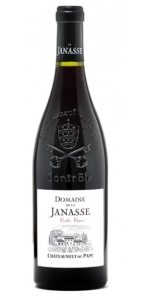
Domaine de la Janasse Chateauneuf-du-Pape Cuvee Vieilles Vignes is made from 65% Grenache, 20% Mourvèdre, 10% Syrah, 5% divers.
In contrast to Chaupin, which is made from old-vine Grenache on sandy soils, the cuvée Vieilles Vignes is from old vines of Grenache, Mourvedre, Syrah along with smaller percentages of other permitted varieties that are grown in these old vineyards. The wine is sourced from 4 terroirs: pebbly clay, sand, gravelly red clay and sandy limestone. Vieilles Vignes is always the most powerful and concentrated Châteauneuf-du-Pape cuvée made at Domaine de la Janasse.
Review:
The 2020 Châteauneuf Du Pape Vieilles Vignes also saw some stems (the estate started keeping some stems with the 2016 vintage) and was 75% destemmed, with the blend being 70% Grenache, 20% Mourvèdre, and the rest Syrah, Cinsault, and Terret Noir. As usual, it’s a more powerful, black-fruited wine comparted to the Cuvée Chaupin and has lots of crème de cassis, liquid violet, crushed stone, woodsmoke, and peppery herbs. It displays the vintage’s purity and freshness yet brings the concentration as well as the structure. I’ll be shocked if it’s not in the handful of top wines in the vintage.
-Jeb Dunnuck 96-98 Points
Domaine de la Janasse Chateauneuf-du-Pape Cuvee Vieilles Vignes is made from 65% Grenache, 20% Mourvèdre, 10% Syrah, 5% divers.
In contrast to Chaupin, which is made from old-vine Grenache on sandy soils, the cuvée Vieilles Vignes is from old vines of Grenache, Mourvedre, Syrah along with smaller percentages of other permitted varieties that are grown in these old vineyards. The wine is sourced from 4 terroirs: pebbly clay, sand, gravelly red clay and sandy limestone. Vieilles Vignes is always the most powerful and concentrated Châteauneuf-du-Pape cuvée made at Domaine de la Janasse.
Review:
The advantages of old vines are perhaps most evident in the more difficult vintages (whether hot and dry or cool and rainy). The 2021 Chateauneuf du Pape Vieilles Vignes is a strong effort, delivering supple, velvety waves of ripe black cherries and black raspberries. Medium to full-bodied, it's rich and concentrated without seeming at all heavy or unbalanced, finishing long and juicy. It's approximately 75% Grenache, 15% Mourvèdre, 5% Syrah and 5% other varieties, keeping in mind that up to 15% of the old Grenache vines are actually Clairette Rose.
-Wine Advocate 96 Points
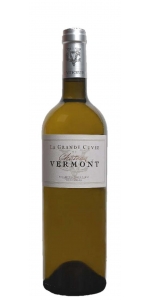
La Grande Cuvee du Chateau Vermont Blanc is made from 70% Sauvignon Blanc and 20% Semillon and 10% Sauvignon Gris.
Traditional blend of "Grand Vin Blanc de Bordeaux", a beautiful wine vinified and matured in barrels. Fine wine, elegant and well-balanced; dominated by Sauvignon (fruitiness), with vanilla notes coming from the oak aging. This wine has beautiful structure and very long-lasting aromas and flavors, providing great aging potential.
Perfect with dish of fish in sauce, scallops, langoustine, and cheeses.
Review:
Some passion fruit, green apple and green mango on the nose, following through to a pure but creamy palate with chalky acidity and elegant citrus and stone-fruit flavors. Drink now."
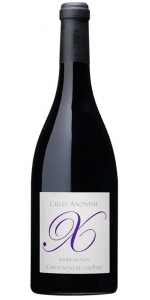
Xavier Vignon Chateauneuf-du-Pape Rouge Cuvee Anonyme 2019 is made from 60% Grenache, 15% Mourvedre, 10% Syrah and the rest is "field blend" with the following grapes : grenache, vaccarese, counoise, mourvèdre, terret noir and muscardin.
One of Xavier Vignon's first almost anonymous blends only in MAGNUMS !
The grapes come from "collection vines", where many grape varieties are planted together, making it difficult to identify the exact share of each variety: grenache, vaccarese, counoise, mourvèdre, terret noir and muscardin.
Partially destemmed and vinified in a mix of demi-muids and tank, it offers a beautifully pure, vibrant bouquet of black raspberries, white and black pepper, candied orange, and violets. Complex, layered, and nuanced, this beauty is medium to full-bodied, has a seamless texture, and a great finish. It has both elegance and richness, and will keep for 15+ years.
Pairing: Duck in sauce with olives. Ravioli with porcini mushrooms, cream of parsnip and bacon crisps. Partridge leg confit with olive oil.
Review:
"The flagship from Xavier is the 2019 Châteauneuf Du Pape Cuvee Anonyme, and in 2019 it’s 60% Grenache, 15% Mourvèdre, 10% Syrah, and the balance a mix of permitted varieties. Partially destemmed and brought up in a mix of demi-muids and tank, it offers a beautifully pure, vibrant bouquet of black raspberries, white and black pepper, candied orange, and violets. Complex, layered, and nuanced, this beauty is medium to full-bodied, has a seamless texture, and a great finish. It has both elegance and richness, and will keep for 15+ years."
- Jeb Dunnuck (October 2020), 95-97 pt
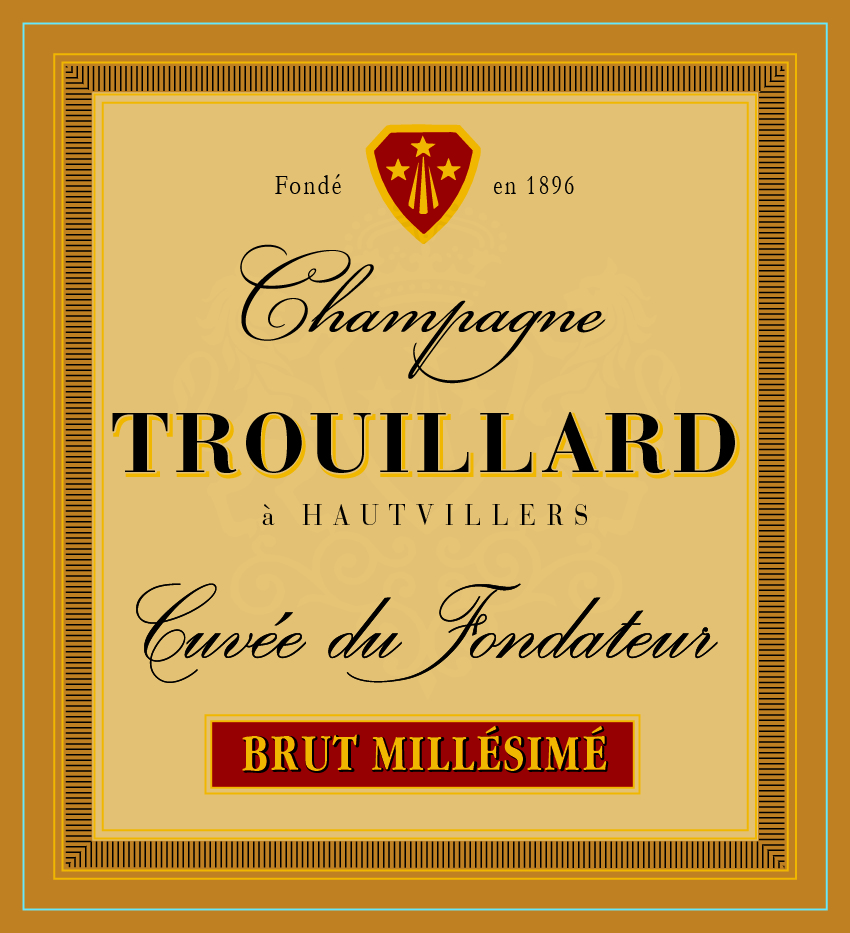
Trouillard Cuvee du Fondateur 2006 is made of 100% Chardonnay grapes coming from the Côte des Blancs vineyards. A very limited bottling.
Trouillard Cuvee du Fondateur 2006 sparkling gold color is vivid and bright. The aromas are floral and honeyed with a wisp of vanilla. The palate is elegantly full with ripe white peach flavors and toasty overtones but balanced with a lively freshness, and delicacy on the long finish.
A beautiful tribute to the top champagne produced at the Maison Trouillard and a decadent partner to foie gras!
The Estate
The Trouillard family has been part of the Champagne business in Epernay since the 19th century with Lucien Trouillard, the founder, showing an interest in Champagne at an early age. He produced his first bottles in 1896. When he passed away in 1966, his two sons took over the operation, followed by his grandsons Luc and Bertrand. In 1979, the House of Trouillard became one of the most important houses in the champagne business. The brothers split the activity in 1990 to focus on their own Champagne labels. However, Bertrand Trouillard shares a small cuverie with his cousins, enabling them to share the costs of production. Bertrand stresses the importance of tradition in the wine making process, but also uses modern methods of production when the quality is not undermined. Only the "jus de raisin" or first pressing is used. The wine is matured in their extensive underground caves cut from the naturally soft chalk where the temperature remains a constant 50°F. Bertrand emphasizes the fact that the French quality laws in Champagne have been raised and the wines must spend a minimum of 15 months of bottle ageing as opposed to 12 months previously. In fact, their Extra Selection Brut spends at least two years on its lees before bottling. They produce 20,000 cases per year (quite small for Champagne) and they export 55% of the production. The house style is similar to a Blanc de Blancs: more emphasis is on the lighter fruit, thus the refreshing, crisp, yet creamy flavors.
At Champagne Trouillard, time is their ally, and patience their secret. Bertrand Trouillard carries on the family traditions while adding his own stringency and tireless quest for perfection.
The Vineyards
They farm 15 hectares (37 acres), divided into 15 parcels of vines, averaging a 94-95 rating. The vineyards are located in the Montagne de Reims in Marne department, Riceys in the Aube, and the Côtes des Blancs on the best facing slopes for maximum sunshine. Vine roots dig deep into the famous chalky limestone soils of the region, which once was under water and hence is full of sea shell fossils. The viticulture method of culture raisonnée is used, meaning pesticides and herbicides are only used when absolutely necessary.

All older vintage wines have been purchased from a single collectors cellar. Pictures can be requested before shipment.
Obsidian Vineyard Syrah is bathed in terroir. The vines experience severe stress, pushing the roots ever deeper through rock in search of water, producing miniature clusters of intense power. Given the wine’s natural propensity for tannin, we take extreme care in the cellar to chisel/whittle its rough edges and leave room for richness to flatter its distinctive scaffold. The mid-palate supports flavors of roasted coffee beans, sarsaparilla, and dark chocolate. The finish marches on long after most wines have tired.
Our estate vineyard — the six-acre Obsidian Vineyard in the Knights Valley AVA — has an incredibly complex soil structure. It takes its name from a layer of volcanic obsidian rock that was discovered when we drilled for water.
Chocolate ganache, black currants, fig, graphite, and an expansive mouthfeel.
Review:
"Joe Donelan believes his Obsidian Vineyard is one of the world’s greatest sites for Syrah. I’ve visited the site twice, and can say candidly it certainly sits among the most striking vineyards I've ever laid eyes on within the U.S. It sits like a rock on a promontory—two switchbacks to reach the top—and the stones under the top soil, quite literally, never stop emerging from the ground. The place has an ancient, almost sacred, temple-like feel. It is consistently swept by afternoon breezes. The vineyard was replanted in 2017 after fires ravaged it. Winemaker David Milner laid out the site at denser spacing than before, at 2,000 vines per acre to keep yields per vine low while still achieving sensible tonnage, averaging around three tonnes per acre. Viognier was planted for co-fermentations, alongside some Cabernet Sauvignon, for a single vineyard bottling of that grape. ‘God put on his viticultural hat when he designed this site,’ says Milner. The vineyard is planted with ENTA 174, 877, and Alban 1 clones, along with Donelan Heritage selections certified virus-free. The wine, the 2023 vintage release (the first from the new vines), was aged for 21 months in 36% new oak and co-fermented with 1.8% Viognier, using 32% whole clusters. And it is positively gorgeous: composed of nine different blocks, each fermented separately, then assembled through sequential blending, with no racking until bottling. From just five-year-old vines, this wine is utterly extraordinary—something oddly achievable from young vines on rare occasion. I tasted this wine from the same bottle over three days. While the high-toned espresso-bean and cedar accents are present at first pull of the cork, they mellow out a day later, and the fruit profile is so vibrant. This is the sign of an excellent wine. I first tasted wines from the Donelan’s Obsidian Vineyard years ago at Tasting Panel Magazine in the late, great Anthony Dias Blue’s office. Cushing Donelan showed the wines, and to this day, I recall the first moment I put my nose into a glass of Obsidian Syrah. In early January of 2026, as I nosed this brand new release of Obsidian Syrah, I was transported straight back to that tasting twelve years ago. What’s remarkable is that the aromatics are unmistakably the same, yet from these new, more densely planted vines, the aromas are more refined—precision-farmed wines from young vines delivering a level of detail and poise that feels beyond their years. So what’s in the glass? Pure red, black, and blue fruit nuances layered with tobacco, white truffle character, violet pastille, and an intoxicating perfume. White pepper notes emerge on the medium- to full-bodied palate, framed by velvety tannins. Iron-like and crushed slate minerality underpins dazzling black cherry and blackberry fruit, brown spices, and blood orange richness. There’s a velvety, iron-fist quality here that exudes polish, complexity, and undeniable quality. You want to drink it now—and you absolutely can—but it will also reward time in the cellar. Either way, you’ll be utterly wowed. And when you realise the price is under £100, the achievement becomes even more staggering. As these vines mature, what will become of them in subsequent vintages? I suspect that as the vines mature, they'll go in and out of phases, but so long as Mother Nature cooperates, I expect this wine to continue to dazzle each vintage. - Jonathan CRISTALDI"
Decanter (January 5th 2026), 100 points
This is the first vintage of the Obsidian Syrah after wildfires torched the vineyard in 2017, leading to significant redevelopment. Throughout all those years, the Donelans have exhibited remarkable patience and a clear sense of purpose. This is their reward: a truly magnificent, towering wine of the highest level.
Knights Valley is one of the most magical grape-growing districts in the United States, but it is not very well known because only a few estate wineries are located there.
The 2023 Syria Obsidian Estate is one of the most profound, moving wines I have tasted in Sonoma County. Blackberry, gravel, incense, chocolate, lavender, and dried herbs race out of the glass. Delicate yet powerful, the 2023 is spectacular. It is also very fairly priced in today’s market.
Vinous 100 Points



